Best Dog Food for Greyhounds: Portions, Body Condition, and Daily Routine
Published on October 20, 2026
Compare four JustFoodForDogs choices for Greyhounds and build a feeding record that connects previous intake, measured portions, body condition, muscle condition, and life at home.
This article is sponsored by JustFoodForDogs.
The best dog food for greyhounds provides complete nutrition for the right life stage, in a measured amount that fits the individual dog’s current needs. A retired racing Greyhound’s previous feeding history is valuable, but it does not establish a permanent calorie allowance for life at home.
Start with what the dog already eats, assess body condition and muscle condition, and turn the chosen recipe’s calorie information into a practical daily ration. These four JustFoodForDogs options offer different ways to build that routine.
What kind of food is best for a Greyhound?
The best Greyhound food is a complete and balanced recipe suited to the dog’s life stage, health, and present routine. A pet Greyhound does not automatically need racing food, a raw diet, or a fixed number of cups simply because another Greyhound does well on that plan.
When comparing Greyhound food brands, look at the exact recipe. Products from the same company can have different calorie densities and life-stage statements. Useful Greyhound food recommendations should explain both why a recipe fits and how its amount will be measured.
Key Takeaways
- Choose complete and balanced food for the appropriate life stage
- Record the previous diet before making changes
- Assess body condition and muscle condition separately
- Convert the individual calorie allowance into measured portions
Begin with these checks:
- Nutritional adequacy: Does the label cover growth, adult maintenance, or another relevant life stage?
- Energy density: How many calories does the food provide per gram or other measured unit?
- Current condition: What weight and body-composition goals have been established for this dog?
- Actual intake: How much food is eaten, including rewards and extras?
- Household fit: Can you store, prepare, and serve the planned amount consistently?
Vetstreet’s guide to understanding dog food labels explains why the ingredient list does not answer every nutritional question. The adequacy statement and calorie information help turn a promising choice into a usable feeding plan.
This guide concerns full-sized Greyhounds, including retired racing dogs. Our Greyhound breed profile provides broader background. The individual dog’s history and condition still matter more than a general description of the breed.
Four JFFD choices for a Greyhound’s daily routine
These options differ in growth eligibility, calorie density, and storage format. Their practical roles below follow current manufacturer information. None is a universal winner for every Greyhound.
| Recipe | Life-stage fit | Calories per gram | Practical reason to consider it |
|---|---|---|---|
| Chicken & Rice | All life stages, including growth | 1.530 | A grain-inclusive fresh option for a puppy or adult plan |
| Fish & Sweet Potato | All life stages, including growth | 0.922 | A fish-based option with a larger gram portion for the same calories |
| Beef & Russet Potato | Adult maintenance | 1.559 | A complete fresh beef recipe for an adult |
| JustFresh Home-Cooked Chicken | Adult maintenance | 1.254 | Unopened shelf storage that can simplify supply planning |
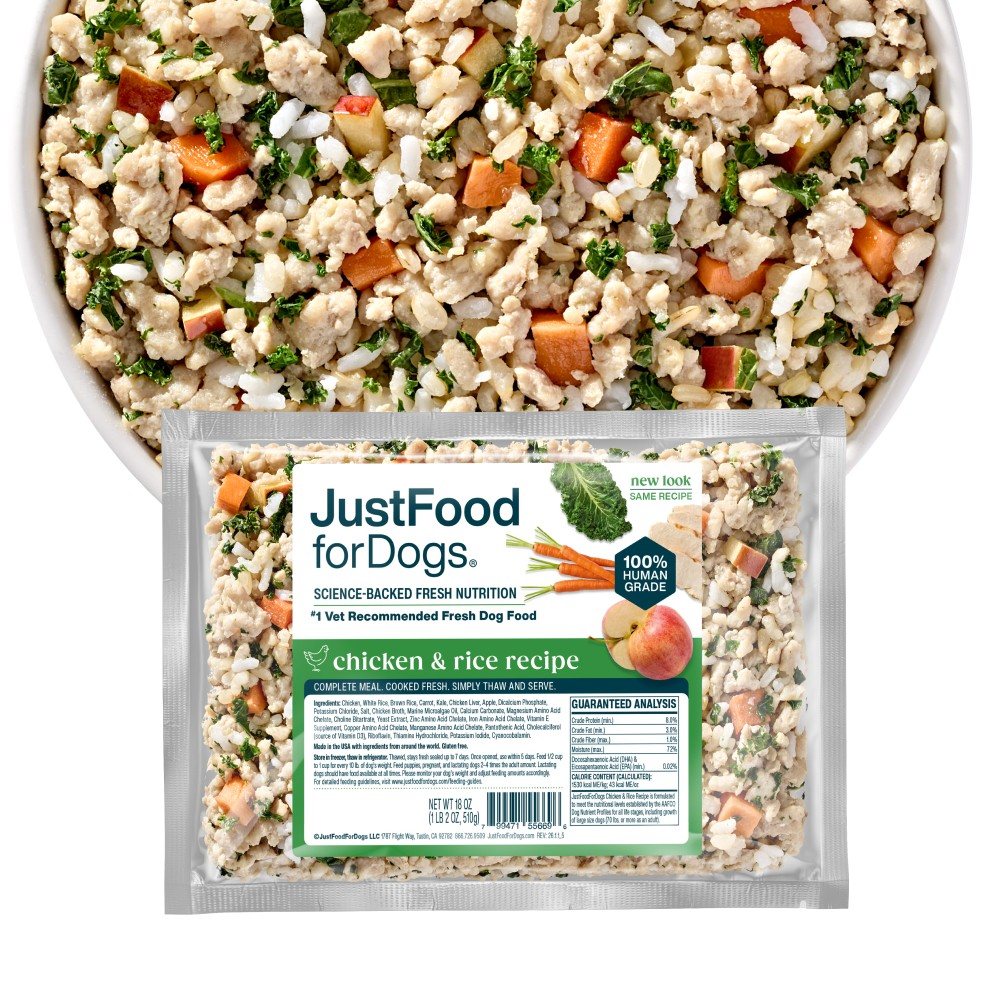
JustFoodForDogs Chicken & Rice
Chicken & Rice is a fresh-frozen candidate for a household considering a grain-inclusive recipe appropriate for a puppy or adult. Its current formulation includes chicken and both white and brown rice.
The manufacturer’s current information lists 1,530 kcal/kg, equivalent to 1.530 calories per gram. Its all-life-stages statement includes growth of large-size dogs expected to reach 70 pounds or more as adults.
- Useful fit: A growth-appropriate fresh recipe that can also suit an adult feeding plan.
- Portion point: Calculate the daily grams from the calories assigned to this recipe.
- Routine point: Plan thawing and refrigerator space around the amount actually used.
Growth eligibility does not mean an adult should receive a puppy feeding amount. Nor does a recipe remaining suitable mean the serving should remain unchanged as activity or condition changes.
The product is a complete formulated food. A homemade bowl containing chicken and rice does not reproduce its nutrient balance simply by using the same headline ingredients.
JustFoodForDogs Fish & Sweet Potato
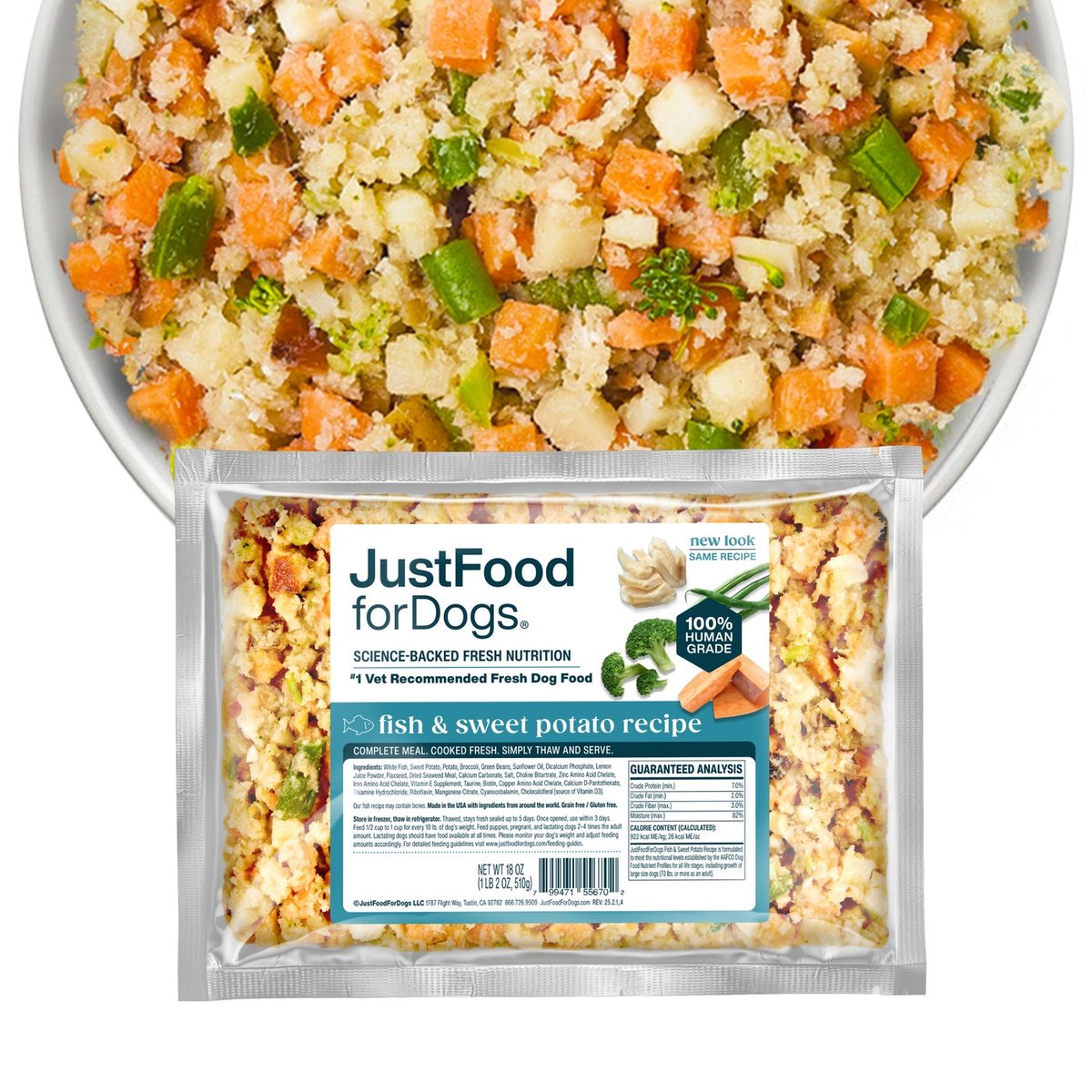
Fish & Sweet Potato provides another growth-appropriate option. The current fish blend contains cod, pollock, and haddock, rather than cod alone.
Its listed calorie density is 922 kcal/kg, or 0.922 calories per gram. That is lower than the other three choices here. A dog receiving a set calorie allocation would therefore eat more grams of this recipe.
- Useful fit: A suitable fish-based recipe for a puppy or adult.
- Portion point: Recalculate the gram amount instead of carrying over another food’s serving.
- Routine point: Consider the total food quantity and the shorter fish-specific storage window.
The larger serving by weight can affect meal preparation and package use. It is not evidence that the food is nutritionally weaker, and lower calorie density alone does not make it a weight-loss diet.
Likewise, a fish ingredient does not make this regular recipe a treatment for a diagnosed food allergy. Use the actual formulation and the individual dog’s needs to make that decision.
JustFoodForDogs Beef & Russet Potato
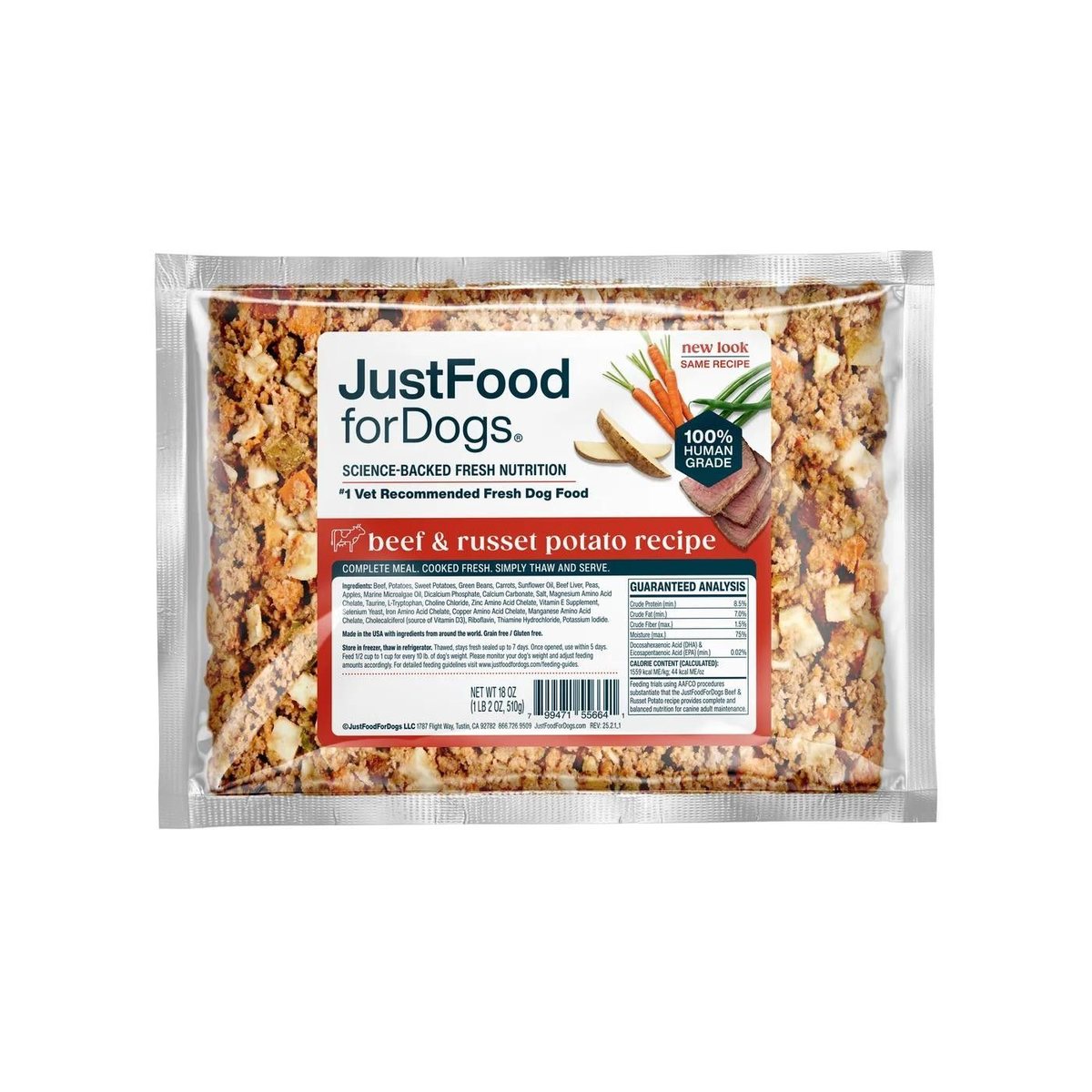
Beef & Russet Potato is a complete adult-maintenance recipe. It is not intended as the full diet for a growing Greyhound puppy.
The manufacturer lists 1,559 kcal/kg, or 1.559 calories per gram. Its adult-maintenance adequacy is substantiated through feeding trials using AAFCO procedures.
- Useful fit: An adult whose feeding requirements suit this complete beef recipe.
- Portion point: Measure its serving even when it appears similar to another fresh meal.
- Routine point: Keep the full recipe name on instructions shared with other caregivers.
This is the highest calorie density among these four specific options, but that narrow comparison does not establish it as a racing or athletic-performance food. A retired Greyhound’s current requirements remain the deciding factor.
If the dog already eats an appropriate food successfully, changing to a beef recipe is a choice to plan and measure. It is not a necessary step in adapting to retirement.
JustFoodForDogs JustFresh Home-Cooked Chicken
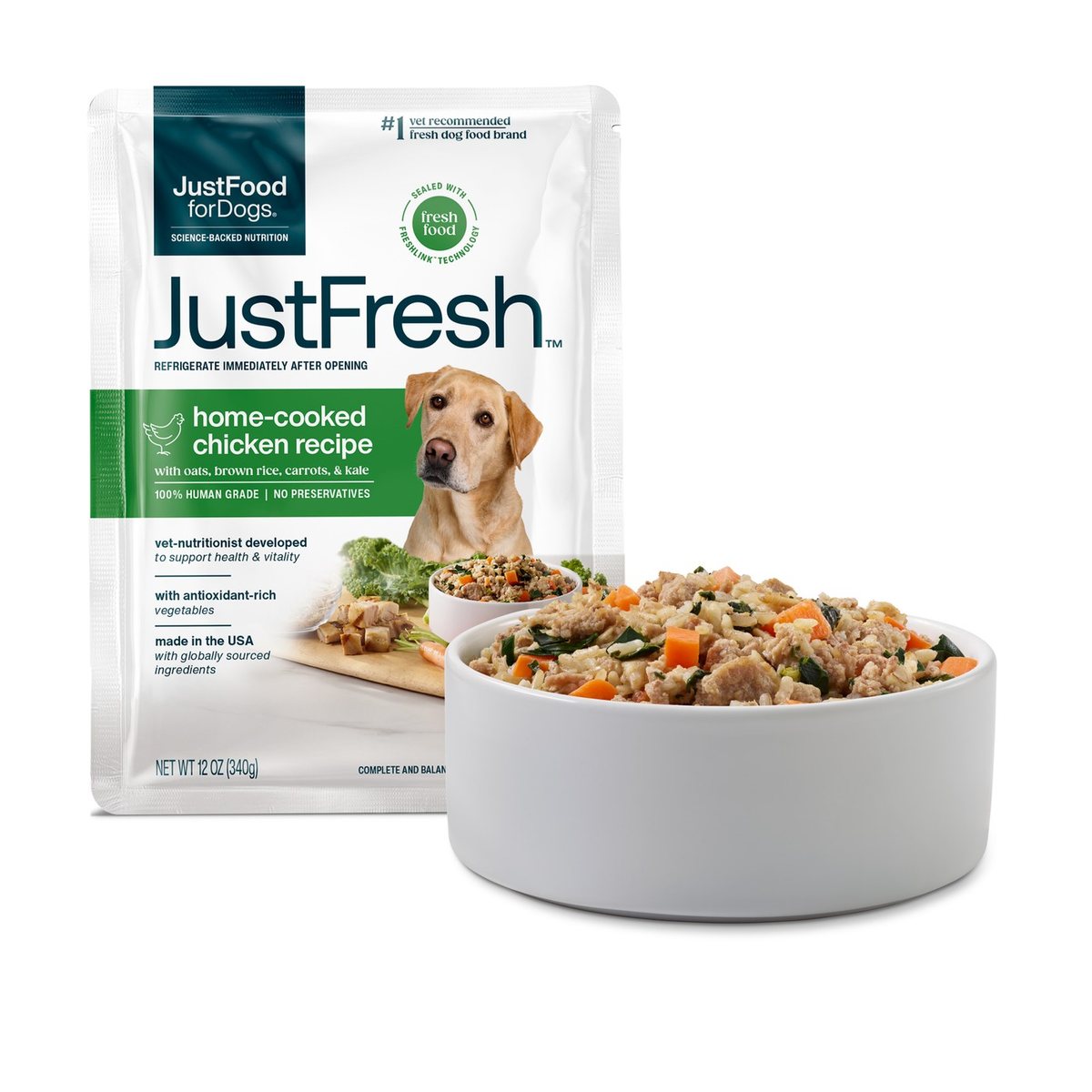
JustFresh Home-Cooked Chicken offers unopened shelf-storage convenience for adult-maintenance feeding. Its current formulation contains oats and brown rice.
The current recipe information lists 1,254 kcal/kg, or 1.254 calories per gram. This product is distinct from fresh-frozen Chicken & Rice and is not a complete puppy diet.
- Useful fit: An adult routine that benefits from keeping unopened food in the pantry.
- Portion point: Use JustFresh’s own calorie density when calculating food weight.
- Routine point: Include refrigeration and timely use after opening in the plan.
Shelf storage can simplify keeping an appropriate supply available, particularly when freezer space is limited. It does not remove the need to measure food or manage opened packages.
For background on the brand, see Vetstreet’s JustFoodForDogs review. Use the exact current product label for today’s portions and life-stage decisions.
Start with the feeding history of a retired racing Greyhound
A useful retired Greyhound feeding guide begins with continuity. Obtain the current diet and serving instructions before introducing a new food, especially when the dog is arriving from a rescue or foster home.
The best food for an ex-racing Greyhound may already be the complete food it is eating successfully. A change can be appropriate, but choosing the replacement is easier when you know the starting point.
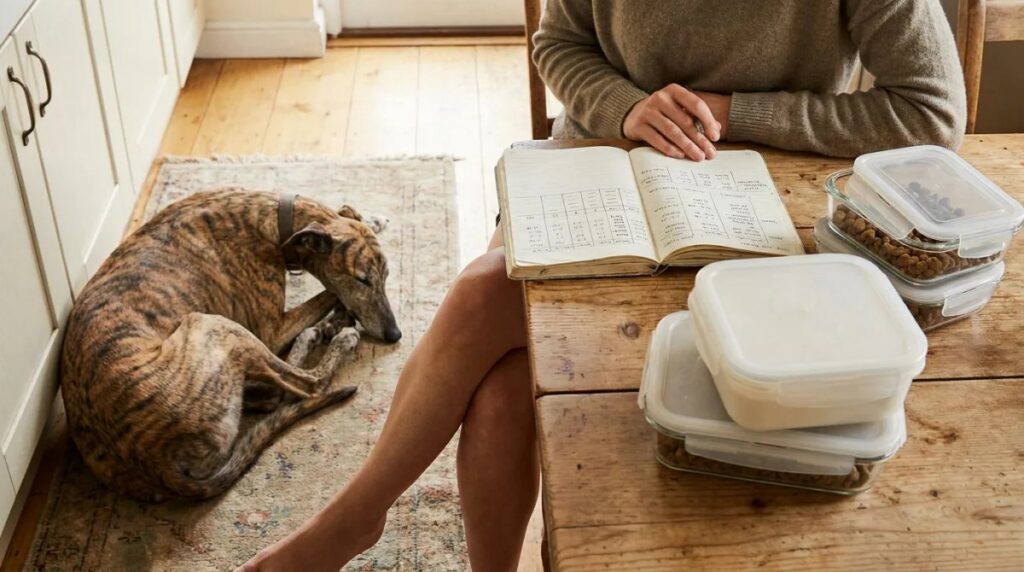
Ask the previous caregiver for:
- The exact food names and recipes.
- The amounts offered and usually eaten.
- The measurement method used.
- The daily meal schedule.
- Treats, chews, and other calorie-containing extras.
- Recent weight records and relevant veterinary observations.
- Any existing transition or medical feeding instructions.
Racing history is not today’s calorie requirement. A dog may already have spent time in foster care with a pet routine, or its activity may be changing substantially at adoption. Establish what the dog has been doing recently rather than assuming its last recorded ration belonged to active racing.
Create an adoption-baseline feeding card
Use a single card or shared note to connect the old routine to the new one. It should record facts, distinguish estimates, and make the first veterinary feeding discussion concrete.
| Field | What to record | Why it matters |
|---|---|---|
| Date and source | Who supplied the information and when | Distinguishes current instructions from older history |
| Previous complete food | Full product name and recipe | Similar names can have different calorie densities |
| Previous amount | Grams, ounces by weight, or the actual volume measure | Makes the starting ration reproducible |
| Actual intake | Usually finished, partly left, or variable | Offered food is not always consumed food |
| Extras | Treats, chews, food for medication, and table food | Reveals calories outside the main bowl |
| Current weight | Measurement date and scale, when known | Establishes a reference point |
| Body condition | Veterinary assessment or clearly labeled observations | Helps evaluate body fat |
| Muscle condition | Veterinary assessment or concerns to discuss | Keeps muscle assessment separate |
| Current activity | The recent real routine | Avoids relying on an old racing description |
| New recipe | Full name, adequacy statement, and calories per gram | Supports accurate recalculation |
| Current plan | Daily grams and meal division | Gives each caregiver the same instructions |
| Review point | When and why the plan will be reassessed | Prevents an initial estimate from becoming permanent |
A blank field is more useful than an invented answer. If the previous amount is unknown, label it unknown and establish a starting plan with the adoption organization and veterinarian. Do not convert “a scoop twice daily” into a precise calorie figure without knowing the scoop and food.
Preserve the starting point
Record the previous food and actual amount before making a change. A reliable baseline helps distinguish a recipe change from a change in total calories.
Translate informal instructions carefully
Handover instructions often use familiar household language. “One bowl,” “a heaped cup,” or “a little meat” may have worked for one caregiver without being reproducible in a different kitchen.
Ask for a demonstration or a measured equivalent where possible. If the old food is still available, weigh the actual serving that the caregiver means. Keep the calorie information from its label with the record.
- Identify whether “ounces” means food weight or a volume measure.
- Note whether a cup is level, heaped, or a specific supplied scoop.
- Record additions separately from the complete food.
- Distinguish the amount per meal from the total per day.
- Confirm whether instructions already include treats.
This step can prevent an accidental change before the new food is even introduced. A more generous scoop or an extra meal may alter intake while everyone believes the old routine has been preserved.
Use the history without treating it as a target
A previous weight is part of the dog’s history, not automatically the ideal weight to maintain forever. The same applies to a previous calorie intake.
Ask the veterinarian to interpret the record alongside an examination. That allows the household to establish a suitable current goal without assuming every retired racer should gain weight or that every change in muscle definition is desirable.
Keep the discussion focused on the individual:
- Is the dog’s present body condition appropriate?
- Is muscle condition being maintained?
- Is the measured intake consistent with the intended goal?
- Has activity changed enough to warrant reassessment?
- Are appetite or health changes affecting the plan?
For a Greyhound without racing history, the same method applies. Replace the racing handover with the most recent household, shelter, or veterinary feeding information.
Assess body condition and muscle condition separately
A Greyhound’s lean outline does not remove the need for individual assessment. Body condition and muscle condition are separate, and a scale reading cannot fully describe either one.
Body condition evaluates body fat. Muscle condition evaluates muscle. The WSAVA nutrition resources provide separate assessment tools because those observations answer different questions.
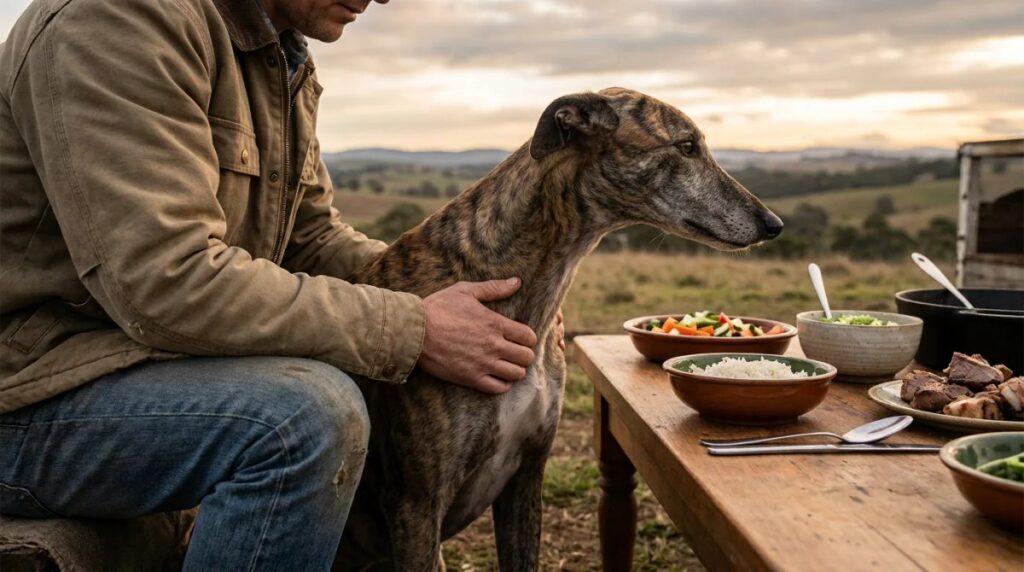
Keep these measures distinct in the feeding record:
- Weight: The dog’s total measured mass and how it changes.
- Body condition: The amount and distribution of body fat.
- Muscle condition: Whether muscle is being maintained.
- Actual intake: Food consumed, including extras.
- Activity and health: Context that helps explain the observations.
An athletic-looking dog can still need a nutritional assessment. A dog whose weight stays similar can also experience changes in body composition. Avoid using either a photograph or the word “lean” as permission to ignore an unexplained trend.
Learn a repeatable physical assessment
Have your veterinarian show you how to assess your Greyhound. The WSAVA canine body-condition chart considers features such as rib coverage, the waist, and abdominal tuck. Applying it thoughtfully is more useful than following a fixed rule about how many ribs should show.
For home observations, use a consistent method and record changes without assigning a diagnosis. A note such as “ribs feel more prominent than last month” is useful to bring to the veterinarian. Declaring a target weight from a picture of another Greyhound is much less reliable.
Make comparisons under similar conditions:
- Use the same scale when practical.
- Record the date of each weight.
- Note recent changes in intake or activity.
- Learn the same hands-on assessment technique across caregivers.
- Bring persistent or unexpected changes to the veterinarian.
There is no universal healthy weight that applies to every Greyhound. Individual size, sex, frame, condition, and health all affect interpretation. A breed weight range cannot substitute for evaluating a particular dog.
Understand what should prompt a review
An agreed portion plan should have a review point. That review can be brought forward if the dog is leaving meals, losing weight unexpectedly, or showing a meaningful change in muscle or general health.
Useful triggers include:
- A sustained change in appetite.
- Unexplained weight gain or loss.
- A change in rib coverage or other body-condition observations.
- Suspected muscle loss.
- Persistent digestive changes.
- A substantial and sustained change in activity.
A feeding record makes those conversations more specific. It lets the veterinarian distinguish a change in the dog’s response from a change in what the household is actually serving.
Do not respond to every lean-looking feature with extra food. Conversely, do not dismiss progressive weight loss because Greyhounds are naturally lean. Both approaches can obscure what the individual dog needs.
Reassess senior Greyhound food through current needs
Senior Greyhound food should be chosen around the older dog’s actual condition and health. An age label does not establish that every dog needs fewer calories, a different protein level, or a new recipe immediately.
An older dog may remain on the same appropriate complete food, with a different amount. Another may need a more substantial change because of an identified medical or nutritional issue.
At a senior feeding review, bring:
- The exact recipes and current amounts.
- Recent weight records.
- Appetite and leftover observations.
- All treats and other extras.
- Changes in activity or comfort eating.
- Any concerns about muscle condition.
Keep unexpected weight loss separate from planned calorie control. If an older Greyhound is eating less or losing muscle, simply celebrating a lower scale number misses the reason for the assessment.
Calculate Greyhound food portions from the recipe’s calories
The useful Greyhound food amount is the amount that provides the individual’s planned calories from the foods actually served. There is no single cup limit that works across different recipes.
Begin with an appropriate starting calorie allowance. WSAVA’s healthy-adult calorie guide is a starting reference for adults in ideal condition. It is not a universal retirement ration or a prescription for weight gain, weight loss, or illness.
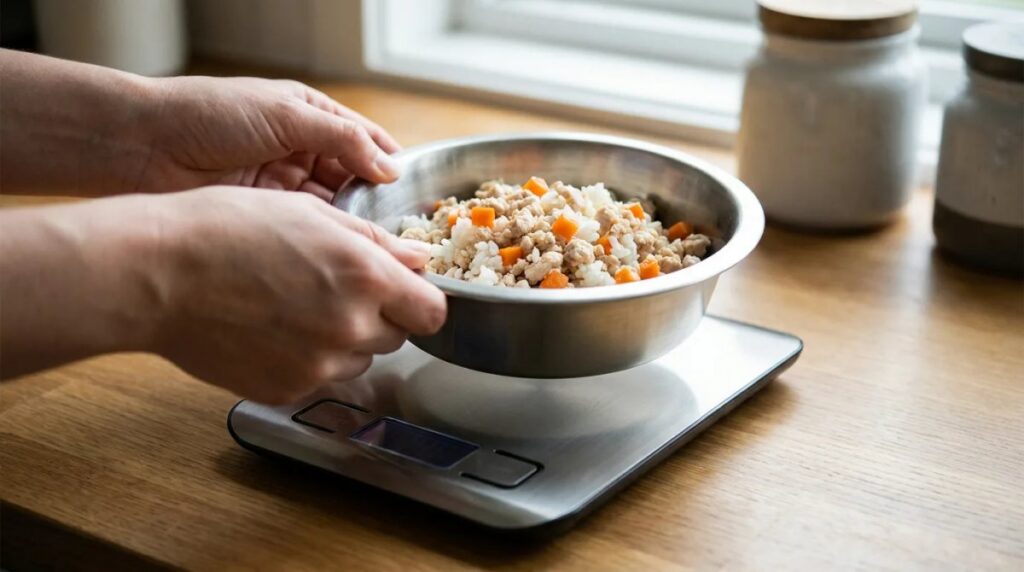
Then calculate:
Daily grams = calories assigned to the recipe ÷ calories per gram.
When the label gives kcal/kg, divide by 1,000 to get calories per gram. For Chicken & Rice, 1,530 kcal/kg becomes 1.530 kcal/g.
Compare equal calories, not equal scoops
The following example assigns 1,000 calories to one complete recipe. This is a calculation illustration, not a daily recommendation for a Greyhound.
| Recipe | Illustrative calculation | Approximate grams for 1,000 calories |
|---|---|---|
| Chicken & Rice | 1,000 ÷ 1.530 | 654 g |
| Fish & Sweet Potato | 1,000 ÷ 0.922 | 1,085 g |
| Beef & Russet Potato | 1,000 ÷ 1.559 | 641 g |
| JustFresh Home-Cooked Chicken | 1,000 ÷ 1.254 | 797 g |
These are alternative ways to provide the same illustrative calorie allocation. They are not portions to combine.
The difference shows why a new food should not inherit an old food’s weight or bowl level automatically. A package that looks similar may contain a recipe with substantially different calories per gram.
Recalculate when the recipe changes
Equal weights of two foods can supply different calories. Keep the dog’s planned calorie allocation clear, then calculate the appropriate grams of each recipe.
Include everything eaten during the day
The amount of Greyhound food per day includes more than meals. Training rewards, chews, and food used to give medication can contribute meaningful calories.
For general feeding, keep noncomplete extras together within 10% of daily calories, with stricter individual instructions taking priority. AAHA identifies higher contributions from noncomplete foods as a nutritional risk.
Build the day’s ration in this order:
- Establish the total calorie allowance.
- Reserve the planned calories for noncomplete extras.
- Subtract those calories from the total.
- Assign the remaining calories to complete food.
- Convert each food’s allocation into grams.
- Divide the food among meals and any complete-food rewards.
- Record what is left uneaten.
The 10% figure is a ceiling, not a requirement to add treats. It also applies to the combined day, rather than separately to each treat type or caregiver.
A whole-day example with mixed complete foods
Imagine a hypothetical adult whose established allowance is 1,100 calories per day. The plan reserves 50 calories for noncomplete extras, leaving 1,050 calories for complete foods.
Suppose 650 complete-food calories are assigned to Chicken & Rice and 400 to a suitable complete dry food.
- Total daily allowance: 1,100 calories.
- Noncomplete extras: 50 calories.
- Chicken & Rice: 650 calories.
- Complete dry food: 400 calories.
- Check: 50 + 650 + 400 = 1,100 calories.
For Chicken & Rice, divide 650 by 1.530 to get approximately 425 grams. If the hypothetical dry food provides 4 calories per gram, 400 calories equals 100 grams.
The dry-food density is an illustrative value. Substitute the actual figure on the product you use. Do not apply it to an unidentified kibble.
This plan replaces part of the fresh-food allocation with dry-food calories. It does not add dry food to an already complete 1,100-calorie ration. Both substantial complete-food components also need to be appropriate for the dog’s life stage and health.
Measure food in a repeatable way
A kitchen scale can make the calculation usable across caregivers. Place the empty bowl on the scale, tare it, and add the planned food weight.
If a meal contains two foods, measure each separately. That makes it easier to identify what changed if one recipe is substituted or the dog leaves part of a mixture.
Use these habits consistently:
- Keep the scale set to grams when the plan is written in grams.
- Exclude the bowl’s weight.
- Record each recipe by its full name.
- Keep the current calorie density beside the portion instructions.
- Note whether the written amount is per meal or per day.
- Replace outdated feeding notes after an adjustment.
Precision should serve the routine. A sensible gram amount repeated reliably is more useful than a complicated calculation that different caregivers interpret differently.
Compare food costs using the same allowance
The amount needed per day also helps you compare costs without relying on package size alone. A heavier package is not necessarily more days of food, because recipes can supply different calories per gram.
Use current purchase information and the established ration: cost per day = package price × daily grams ÷ net package grams.
This formula is most useful when you will use the full package according to its storage instructions. If opened food is regularly discarded, the actual cost per fed day will be higher.
Check the inputs before comparing costs
- The price of the exact package selected.
- Its net food weight.
- The planned daily amount from that recipe.
- Whether the price applies to a single unit or multipack.
- Any shipping or recurring-order terms relevant to the purchase.
No current price is assumed here. The purpose is to compare the foods using your dog’s plan rather than declaring one format cheaper from an unrelated package price.
How many meals a day should a greyhound have?
For an adult Greyhound, dividing the daily ration into at least two meals is a practical starting routine, unless individual veterinary instructions specify otherwise. The important distinction is dividing one daily allowance, not multiplying it.
Cornell’s GDV guidance supports two or more meals rather than a single large feeding. Meal frequency is one consideration in a broader individual plan; it does not eliminate the risk of bloat.
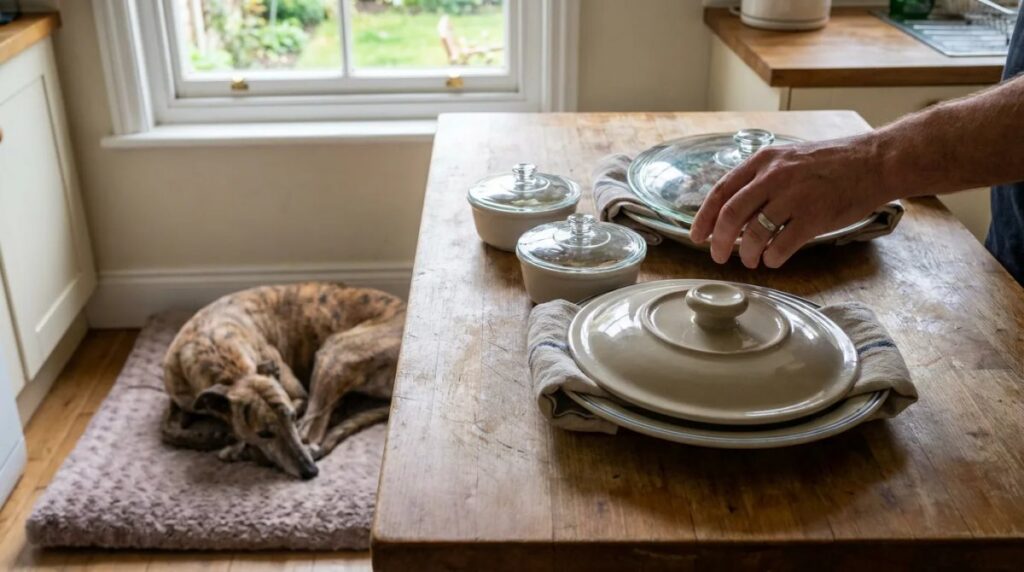
A predictable meal schedule helps the household know:
- Which portion belongs to each meal.
- Whether food has already been served.
- How much remains for later.
- Whether appetite differs between meals.
- What another caregiver should do.
Meals do not have to be identical if the individual’s plan uses a different split. The total should remain clear, and any meal-time instructions connected to medication or health needs should be followed.
Keep the meal schedule visible
A shared record prevents accidental double-feeding. An empty bowl does not prove the dog missed a meal; someone may have already fed the dog and washed it.
Write the meal amounts alongside a place to mark completion. If one person handles breakfast and another handles dinner, both should be able to see the day’s rewards and other additions.
A simple entry can record:
- Time served.
- Exact food amount.
- Feeder’s initials.
- Food left.
- Additional treats or other food.
If the dog routinely leaves one meal, record that pattern before changing the entire day. It may help identify a schedule problem, an overestimated portion, or another issue that needs assessment.
Plan activity around the individual routine
Discuss meal timing around vigorous exercise with your veterinarian, especially when the activity pattern changes. A fixed waiting interval should not be presented as a guarantee that a Greyhound cannot develop bloat.
Keep the distinction between an ordinary meal and an emergency clear. Nonproductive retching, abdominal swelling, marked restlessness, or collapse can indicate GDV and require immediate veterinary attention. Do not wait for the next meal or try to manage those signs by changing food.
For ordinary feeding, the practical goal is consistency. A sustainable schedule makes it easier to notice when the dog behaves differently from its usual pattern.
Make a food change without losing track of intake
A food change should preserve a clear picture of what the dog is eating. Obtain any transition instructions from the adoption organization and follow appropriate manufacturer or veterinary guidance.
If the dog needs an urgent medically directed diet change, those instructions take priority. Otherwise, a measured transition helps separate a change in recipe from an unintended change in total calories.
Start with the baseline card:
- Confirm the current complete food and amount.
- Identify the new recipe and its life-stage eligibility.
- Calculate the calories provided by each measured amount.
- Decide how the foods will be introduced and meals divided.
- Keep other foods consistent while observing the change.
- Record actual intake and tolerance.
Avoid changing the main food, treat supply, meal schedule, and several supplements simultaneously. When multiple things change together, it becomes harder to describe what the dog responded to.
Use calorie proportions during a transition
A proportion such as “half old food, half new food” can mean several things. Half by weight is not necessarily half by calories, and equal-looking portions may provide different amounts of energy.
If the transition plan divides calories between two complete foods, calculate the weight of each part separately. This helps keep the intended daily allowance stable while the recipes change.
For example, suppose a hypothetical transition stage assigns 500 calories to the old food and 500 to Chicken & Rice:
- Chicken & Rice portion: 500 ÷ 1.530 = approximately 327 grams.
- Old-food portion: 500 divided by that food’s actual calories per gram.
- Combined complete-food allocation: 1,000 calories.
This example explains the calculation only. It does not prescribe a transition schedule, duration, or calorie allowance.
If one food is left behind in a mixed bowl, the consumed ratio differs from the planned ratio. Record that observation rather than assuming the dog ate the calculated combination.
Track response without naming a cause too quickly
Keep observations specific. “Left about a quarter of breakfast” is more useful than “does not like fresh food.” “Loose stool began after the new treats were introduced” is more useful than declaring an ingredient allergy without evidence.
Record:
- Food amounts offered and left.
- Treats and other additions.
- Stool changes.
- Vomiting or other signs of illness.
- The timing of each recipe change.
- Whether activity and behavior remain usual.
Persistent reduced intake or digestive symptoms deserve veterinary advice. Repeated recipe switching should not replace assessment of a dog that is unwell.
A regular JFFD recipe is a complete-food option, not a treatment for every digestive problem or suspected food reaction. A diagnosed condition may require a different plan.
Keep observations factual
Record what changed, when it changed, and what the dog ate. A clear history is more useful than assigning a food intolerance after one unfamiliar meal.
Match the new food to storage capacity
A daily ration calculation also tells you how much food needs to be prepared. For a larger dog, several meals may represent a substantial amount of refrigerated food.
Work out both supply and opened-package use:
- Daily grams multiplied by feeding days gives the amount to have available.
- Package grams divided by daily grams gives estimated package-days.
- The manufacturer’s instructions determine the actual storage limit.
- Each recipe needs its own calculation when mixed feeding.
According to JustFoodForDogs’ current FAQ, opened refrigerated non-fish fresh-frozen meals should be used within five days, fish meals within three days, and JustFresh within three days. Its refrigerator-thawing estimates are up to 24 hours for 18-ounce packs and up to 48 hours for 72-ounce packs.
Respect sealed-thawed limits and the specific package instructions as well. Opening a container does not erase the time the food has already spent thawed.
The FDA’s storage guidance recommends a refrigerator at 40°F or below and prompt refrigeration or disposal of unused moist food. Keep bowls and utensils clean.
Make the next handover easier
Once the food change is established, update the baseline card rather than leaving two conflicting sets of instructions. A sitter or family member should be able to find the current plan immediately.
Include:
- The current full recipe name.
- Daily grams and meal amounts.
- The reserved reward allowance.
- Storage and opening information.
- Any individual medical feeding instructions.
- The contact to use if appetite or health changes.
Keep the earlier entries as history, with dates. That preserves the information needed to understand future changes without making the everyday serving instructions confusing.
The best routine is one the dog can follow comfortably and the household can repeat accurately. A suitable recipe, reliable portions, and a clear record provide the foundation for that routine.
Greyhound feeding questions
There is no universal height that every Greyhound food bowl should reach, and a food stand should not be chosen as a bloat-prevention measure. Cornell’s GDV guidance identifies raised food bowls as a possible risk factor. If your Greyhound has a medical or mobility issue affecting feeding position, ask the veterinarian for individual instructions. Otherwise, use a stable, clean bowl that the dog can access comfortably and observe how the dog eats. A taller stand is not automatically better because the dog has long legs. When comparing Greyhound food bowls, practical stability and easy cleaning matter more than a promise that one height prevents illness. Do not use a bowl-height rule as a substitute for veterinary advice about an identified problem.
Greyhounds need the same protections from dog-toxic foods as other dogs. The FDA’s potentially dangerous foods guidance covers important hazards, and suspected exposure warrants prompt contact with a veterinarian or pet poison service. These safety boundaries are different from unsupported breed-wide bans on ordinary complete-food ingredients. A dog with a diagnosed food reaction or prescribed diet needs its own specific restrictions.
A small piece of plain peeled banana can be an optional treat for a dog that tolerates it and whose individual diet permits it. UC Davis includes banana in its dog-treat guidance. Count it with all other noncomplete extras rather than adding a separate fruit allowance. A complete diet does not require banana, and a large dog does not automatically need a large portion.
No. Have the individual dog assessed using hands-on body condition, weight trend, muscle condition, and health history. Do not use a fixed visible-rib count or another dog’s photograph as the feeding target. At the same time, progressive weight loss or a meaningful change in condition should not be dismissed as normal Greyhound leanness.
The dog’s current activity, condition, and nutritional needs determine suitability. A previous racing label does not establish today’s requirement. Bring the current food and portion record to the veterinary assessment, then decide whether to continue the recipe, change the amount, or choose another appropriate complete food.