Digestive Enzymes for Dogs: What They Do and When They May Help
Published on November 02, 2026
Sponsored by Animal Biome. This article contains affiliate links. We may earn a commission if you purchase through them. Vetstreet receives compensation from Animal Biome.
Digestive enzymes for dogs help break food into smaller components that the body can absorb. Dogs normally make their own digestive enzymes, so the first decision is what kind of help a dog actually needs: everyday digestive support, support for the gut microbiome, or treatment for a diagnosed pancreatic condition.
Those paths use different products. Animal Biome Daily Digest Blend is a meal-associated supplement for everyday support. Pancreatic enzyme replacement serves a separate medical purpose. Understanding that distinction makes it easier to read labels, discuss symptoms with your veterinarian, and choose a routine with a clear reason behind it.
All featured products are chosen at the discretion of the author. However, Vetstreet may make a small affiliate commission if you click through and make a purchase.
How Digestive Enzymes for Dogs Work
Digestive enzymes are proteins that help break down nutrients. The pancreas produces important enzymes and releases them into the intestine as part of normal digestion. There, they work on food so smaller nutrient components can be absorbed.
Three names explain much of what you will see on a digestive-enzyme label:
- Protease breaks down protein. Protein in a meal needs to be broken into smaller components during digestion.
- Lipase breaks down fat. Its role is different from that of an enzyme acting on protein or starch.
- Amylase breaks down starch. It helps process this type of carbohydrate.
An enzyme’s job is specific. A longer list of enzymes is not automatically evidence that a product suits a particular dog better. The important questions are which ingredients are present, what the product is designed to do, and whether that purpose matches the dog’s needs.
For example, Animal Biome Daily Digest Blend contains a blend that includes protease ingredients, amylase, lipase, and other enzymes. It also contains prebiotic FOS and S. boulardii yeast, so reading the complete ingredient list gives a fuller picture than the words “digestive enzymes” alone.
Normal pancreatic function remains an important part of the decision. A dog does not automatically have an enzyme shortage because it eats cooked food, is getting older, or occasionally passes a soft stool. Digestive symptoms can have several causes, and those circumstances do not establish a diagnosis.
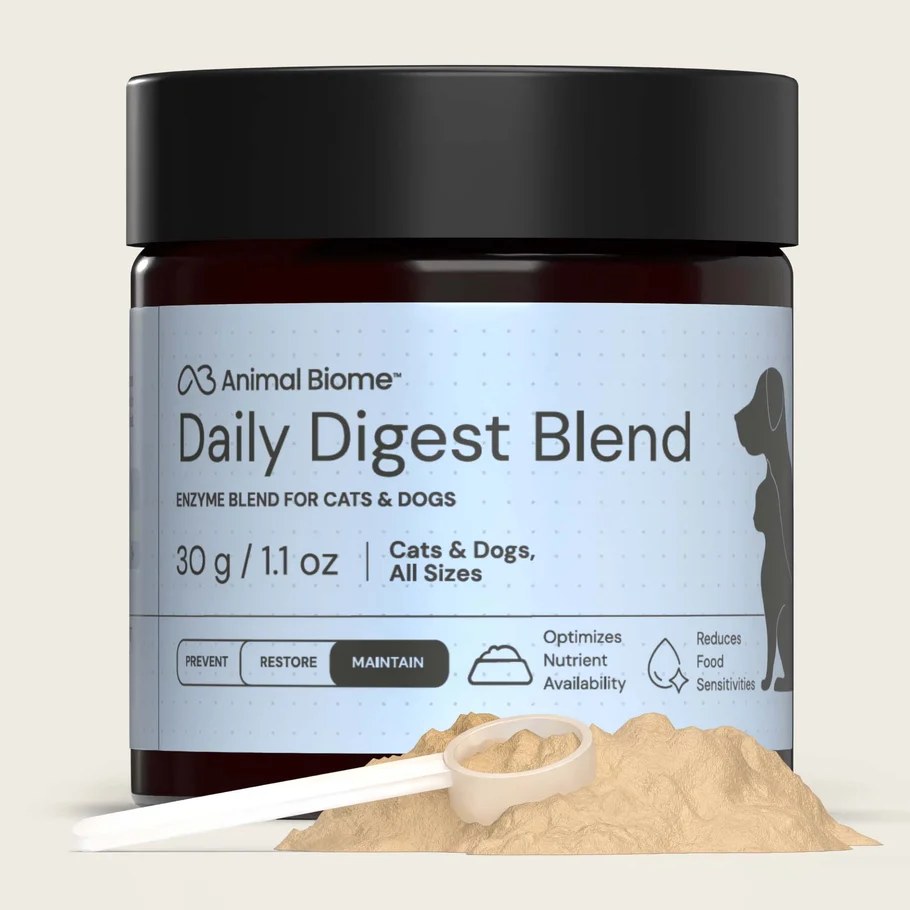
Animal Biome Daily Digest Blend
Meal-associated enzyme and prebiotic support, distinct from prescribed pancreatic replacement.
Tufts veterinary nutrition guidance explains that healthy animals generally produce the enzymes needed for digestion. It also discusses a healthy-dog study in which adding plant- or animal-sourced enzymes did not improve measured nutrient digestibility. That finding supports choosing a supplement for an identified purpose instead of assuming every dog needs extra enzymes.
If you are considering everyday support, describe the intended benefit in observable terms. “We want to review whether this meal routine is appropriate for this dog” is a clearer starting point than assuming a powder will solve any digestive problem. The veterinarian can help decide whether a supplement trial is reasonable or whether another step should come first.
When Enzyme Support and Pancreatic Treatment Differ
Everyday digestive support and pancreatic enzyme replacement are different decisions. A supplement intended to accompany normal meals is not interchangeable with treatment for exocrine pancreatic insufficiency, commonly called EPI. In EPI, the pancreas does not produce enough digestive enzymes, so treatment needs to address that deficiency.
Pancreatitis means inflammation of the pancreas. It is not another name for EPI. Although pancreatic disease can affect digestive function, a diagnosis of pancreatitis does not by itself tell you which enzyme product, if any, is appropriate.

Match the product to the digestive-care goal
| Care goal | What guides the choice |
|---|---|
| Everyday digestive support | Product directions and the individual dog’s feeding plan |
| Microbiome support | The intended roles of probiotics and prebiotics |
| Pancreatic enzyme replacement | A veterinary diagnosis and a treatment plan for enzyme deficiency |
This separation is useful when you read about digestive enzymes for dogs with pancreatitis, acid reflux, IBD, or diarrhea. These descriptions name different health concerns. They do not identify one universal “best” enzyme supplement. The right response depends on what is causing the signs and what treatment is already in place.
A bacterial microbiome profile answers another kind of question. Animal Biome’s Gut Microbiome Test for Dogs analyzes the types and proportions of bacteria in a stool sample. It can inform a discussion about microbiome support, but it does not diagnose EPI or measure whether the pancreas is producing enough digestive enzymes.

Animal Biome Gut Microbiome Test for Dogs
Bacterial microbiome profiling for an informed ongoing support discussion; not a parasite diagnostic test.
The distinction matters because several tests may involve a dog with abnormal stools while investigating different things. A microbiome test is not a parasite test, a food-allergy test, or a pancreatic-function test. The name of the symptom does not make these tests substitutes for one another.
When pancreatic enzyme replacement is needed, veterinarians select an appropriate preparation and direct its use with food. Some products contain pancreatin, a mixture of pancreatic enzymes. Whether a preparation is described as veterinary, prescription, or available for purchase elsewhere does not make it equivalent to an everyday supplement; its composition and treatment role still matter.
Animal Biome explicitly states that Daily Digest Blend is not intended for pets with EPI or other pancreatic disorders. If your dog has an existing pancreatic diagnosis, keep its treatment plan intact and ask the veterinarian managing it before introducing another digestive product.
How Veterinarians Check for an Enzyme Deficiency
You cannot confirm an enzyme deficiency from the appearance of a bowel movement or a response to an over-the-counter powder. Veterinary assessment combines the history, examination, body condition, and appropriate laboratory testing. Tufts notes that EPI can be confirmed with a blood test.
That assessment also helps distinguish reduced digestion from other reasons a dog may not maintain weight or pass normal stools. Depending on the history, the veterinarian may investigate intestinal disease, parasites, nutritional issues, or other conditions. Choosing tests according to the clinical question is more useful than ordering several unrelated tests and hoping one explains everything.
Prepare for the appointment with information that makes the pattern easier to interpret:
- A current weight and previous weights, if available.
- The food’s exact name, usual daily amount, and recent changes.
- All medications, supplements, and treats.
- When the problem began and whether it is continuous or intermittent.
- Any previous pancreatic diagnosis or gastrointestinal test results.
Bring the enzyme container if you already started a product. The label helps the veterinarian interpret what the dog has actually received, including ingredients that may not be obvious from the product’s name.
Digestive Enzymes, Probiotics, and Prebiotics Have Different Jobs
Digestive enzymes act on food. Probiotics provide live microorganisms. Prebiotics provide substances that beneficial gut microbes can use. These categories can appear together in one product, but combining them does not make their functions identical.
That is why “probiotics versus digestive enzymes” is not a contest with one winner. A dog’s pancreatic function, diet, symptoms, and intended care goal determine which category is relevant. The best combination is the one with an appropriate purpose and understandable directions, rather than the one with the most ingredient categories on its packaging.
Use three questions to interpret a combination formula:
- Which ingredients are enzymes? Look for names such as protease, amylase, and lipase.
- Which ingredients are probiotics? Identify the organism rather than assuming every microbe is a bacterium.
- Which ingredients are prebiotics? Note sources such as FOS so they can be considered alongside the dog’s food and other supplements.
Vetstreet’s guide to how probiotics for dogs work explains the microbial side of this distinction. Its broader dog gut health guide also places supplements in the context of feeding and overall care.
Animal Biome S. boulardii + FOS Powder offers a useful example of a different formulation: its probiotic ingredient is a yeast, and its FOS is a prebiotic. It is not a pancreatic enzyme product. S. boulardii + FOS may therefore fit a different support goal from a meal-associated enzyme blend.
Check for Overlapping Ingredients
Dog food can also contain probiotic or prebiotic ingredients, and some products combine probiotics with digestive enzymes. Check the food label as well as the supplement label before adding more. Two products marketed for different purposes may still contribute the same prebiotic ingredient.
For example, Daily Digest Blend and S. boulardii + FOS both contain FOS and yeast, in different formulations and amounts. Their names alone do not reveal that overlap. A veterinarian can help decide whether one product addresses the goal or whether a combination is appropriate.
A combination formula can make a suitable routine convenient, but convenience should not obscure the plan. You should still be able to explain what each part is for, how much is given, and which observations will be used at follow-up.
How to Choose a Digestive Enzyme Supplement
A good digestive-enzyme supplement is one that matches the intended use and can be administered reliably. Start with those criteria before comparing reviews, serving counts, or claims about natural ingredients. A top-rated product used for the wrong purpose is not a better fit than a clearly labeled product chosen for a specific need.
Read beyond the front of the package. The ingredient panel, directions, storage instructions, and manufacturer’s guidance explain how the product is meant to work in a feeding routine. Keep a copy of that information with the dog’s records so you can compare future purchases accurately.
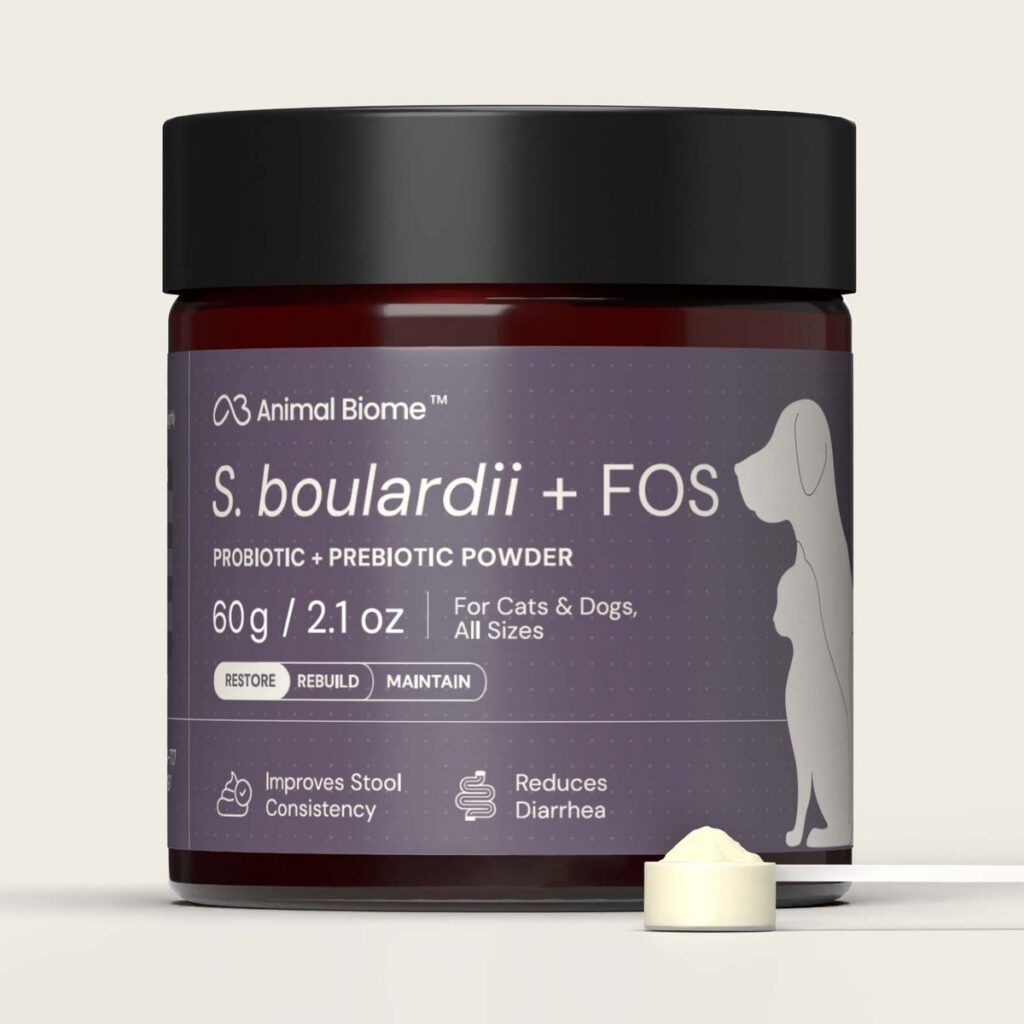
Animal Biome S. boulardii + FOS Powder for Cats and Dogs
A yeast probiotic plus prebiotic fiber for digestive support.

A useful selection checklist includes:
- Intended purpose: Everyday support, microbiome support, or veterinary pancreatic treatment.
- Species and life-stage guidance: A product labeled for cats and dogs still needs dog-specific directions.
- Ingredients and amounts: Include the non-enzyme components in the comparison.
- Format: Powder, capsule, or another form the dog can receive consistently.
- Instructions: Look for a clear daily amount, meal guidance, and storage information.
- Suitability: Review known conditions, current medications, and previous ingredient reactions.
Powder can be convenient for a dog that readily eats food with an addition. A capsule may be practical for a different routine. Neither format is automatically more effective. Consider whether the dog will consume the full amount, whether meals are shared, and whether everyone who feeds the dog can follow the same directions.
Natural, plant-based, vegetarian, animal-based, and organic describe different aspects of a product. They do not establish that all such products have the same enzyme activity or clinical purpose. Papain and bromelain, for example, are plant-derived enzyme ingredients. Animal-derived pancreatic preparations have a different role when used to replace deficient enzymes under veterinary direction. The word “organic” is similarly incomplete as a selection criterion. One ingredient may be described as organic without that description applying to the whole formulation. Check what the claim actually refers to and continue to assess the entire product.
When Microbiome Support Is the Goal
Some dogs need a microbiome-focused approach rather than another enzyme formula. Animal Biome Gut Restore for Dogs contains screened canine fecal-derived microbes in delayed-release capsules. It is intended to introduce a community of dog-specific microbes and differs from a conventional single-strain probiotic.
That option should be discussed in the context of the dog’s needs. It is not a source of pancreatic enzyme replacement, and its capsules have product-specific instructions, including being given whole. Knowing those distinctions helps an owner compare authentic roles without treating every digestive-support product as interchangeable.
- Homemade or DIY digestive enzymes are not a reliable substitute for a formulated supplement. Foods can contain enzymes, but the amount and activity in a household serving do not provide a standardized canine treatment. Adding fruit, raw ingredients, or a homemade mixture also changes the diet in ways that may be unrelated to the intended goal.
- Avoid using a human enzyme product simply because its ingredient names look familiar. Human directions, accompanying ingredients, and serving sizes may not suit a dog. If you already own one, show its complete label to your veterinarian rather than estimating a canine amount.
- For a senior dog with stomach issues, start with the symptoms and health history, not age alone. New problems in an older dog deserve assessment; they should not automatically be attributed to a need for extra enzymes. The same principle applies to products promoted as “all natural” or as the best digestive enzymes for sensitive stomachs.
Reviews can help identify practical questions, such as whether owners found a powder easy to mix. They cannot establish the diagnosis of the reviewer’s dog or predict your dog’s response. Look for evidence that addresses the actual purpose, and distinguish a manufacturer’s intended-use statement from a controlled clinical result.
When deciding where to buy, choose a source that supplies the complete current label and manufacturer information. Compare the same formulation and size, check that storage instructions are available, and keep the lot information. A familiar product name on an abbreviated retailer listing may omit details needed for an informed decision.

Animal Biome Gut Restore for Dogs
Species-specific microbial restoration for an appropriate veterinary-guided plan.
Compare container sizes by the planned daily amount, not just the weight printed on the jar. The current Daily Digest Blend label lists approximately 43 scoops in the 30-gram size and 86 in the 60-gram size. How long either lasts depends on the dog’s applicable daily directions and the amount actually used. A useful purchasing calculation has three steps:
- Find the approximate number of supplied scoops in the container.
- Divide that number by the total scoops used each day under the agreed plan.
- Compare the result with the intended review period and the product’s storage instructions.
For example, a container described as 43 scoops would represent about 43 days at one scoop per day or about 21 days at two scoops per day. Those are arithmetic examples, not instructions to select either amount for your dog. Confirm the dog’s actual directions first.
This comparison is especially helpful when two dogs share a product but have different daily amounts. Add their planned use when estimating how long the container will last, while keeping each dog’s serving record separate. Buying a larger container does not justify increasing an amount or extending a trial beyond its agreed review. Keep the decision about quantity separate from the decision about whether the routine is useful.
Safety also belongs in product selection. Digestive-enzyme products can cause side effects, including digestive upset, and some preparations can irritate the mouth or upper digestive tract. The relevant question is not whether every product is safe for every dog, but whether this formulation is suitable and what to do if new signs develop.
Where Daily Digest Blend Fits Into an Everyday Routine
Daily Digest Blend is Animal Biome’s meal-associated option for everyday digestive support. Its current label lists a 600-milligram ProBiome Enzyme Blend per scoop, along with S. boulardii, slippery elm, and bamboo extract. The blend also includes FOS.
The detailed formula helps explain why a whole-product view matters. Per scoop, the official page lists 432.21 milligrams of NutraFlora FOS within the blend and 75 million CFU of S. boulardii separately. Those numbers describe the formulation; they should not be used to infer that it is interchangeable with a different FOS or yeast product.
Its administration directions are tied to food:
- Use the scoop supplied with the product.
- Select the dog’s total daily amount from the current weight-based directions.
- Add the powder to food at meals as directed.
- Begin by offering it with a small portion of a food the dog already enjoys.
- Clarify how the daily total should be divided if the dog eats several meals.
The distinction between “daily” and “per meal” is important. If a label gives a daily total and also says to use the product with each meal, that does not mean repeating the entire daily total at every feeding. Ask the manufacturer or your veterinarian if the division is unclear. The official Daily Digest Blend directions advise giving it with food rather than mixing it into drinking water. That keeps the enzymes associated with the meal they are intended to act on and makes it easier to observe how much the dog consumes.
Keep the first introduction simple. A familiar meal, a measured addition, and a record of what was eaten make the response easier to interpret than simultaneously changing food, treats, and supplements. If several dogs share a feeding space, provide individual bowls and supervise the meal.
Before combining Daily Digest Blend with another product, check for overlapping ingredients. Animal Biome notes that the combined prebiotic fiber in Daily Digest Blend and S. boulardii + FOS can cause digestive upset in some pets. A clear plan for the complete routine is more helpful than assuming two digestive products must provide twice the benefit.
How to Monitor Whether the Plan Is Helping
To judge whether a digestive enzyme is working for your dog, compare the agreed goal with repeated observations of stool consistency, appetite, meal intake, and body weight. A sustained change toward the veterinary team’s target is more useful than one better bowel movement; improvement alone does not prove that the enzyme caused it. Choose the observations before starting so you have a baseline, then keep a brief daily record and review it at the agreed follow-up.
Track:
- Body weight: Use comparable measurements and the interval your veterinarian recommends.
- Stool consistency and frequency: Describe the pattern rather than judging one isolated bowel movement.
- Appetite and intake: Record how much food was eaten, including the supplemented portion.
- Other signs: Note vomiting, discomfort, or changes in usual activity.
- Actual use: Include the amount given, missed servings, and other changes in the routine.

Key Takeaways
- Record body weight, appetite, and the amount of supplemented food actually eaten.
- Compare stool consistency across several observations rather than one bowel movement.
- Set a reassessment date and contact the veterinary team sooner if the dog worsens.
Improvement does not necessarily prove the supplement caused it. Food changes, prescribed treatment, and the natural course of a short digestive upset can all affect the same observations. Bring the full timeline to follow-up so decisions are based on the whole picture. For related stool questions, see Petful’s guide to mucus in dog poop and WebVet’s guides to dog diarrhea after boarding and dog diarrhea at night.
Do not wait for a scheduled review if the dog develops concerning signs. Cornell’s Riney Canine Health Center advises veterinary attention for diarrhea accompanied by problems such as vomiting, poor appetite, lethargy, or black or tarry stool, and for diarrhea that does not resolve promptly.
Vomiting and diarrhea can also lead to fluid loss. Vetstreet’s guide to recognizing dehydration explains signs worth discussing with the veterinary team. A supplement trial should never delay assessment of a dog that is becoming unwell.
Questions About Digestive Enzymes for Dogs
A recommendation should begin with a reason for supplementation. Dogs with normal pancreatic function generally produce their own digestive enzymes, so an enzyme product is not automatically necessary for every healthy dog. Everyday support may be considered for a defined purpose, while diagnosed enzyme deficiency requires veterinary treatment. Ask what the product is expected to contribute and what observation would justify continuing it. That gives the choice a practical basis instead of treating supplementation as a requirement simply because the dog eats cooked food or is older.
Some dogs may develop new digestive signs or irritation after starting an enzyme product. The response can depend on the specific ingredients, amount, and other products being used. If vomiting, diarrhea, food refusal, or signs of mouth discomfort appear, contact your veterinarian and provide the label and timeline. Do not assume that worsening stools mean the amount needs to be increased. Severe or rapidly worsening signs need prompt assessment, while milder changes still deserve review before the routine is expanded.
In dogs, weight loss despite appetite and persistent abnormal stools are reasons to investigate digestion and nutrient absorption, including the possibility of EPI. They are not proof that an enzyme supplement is needed. Other diseases can produce similar changes, and some dogs show a less obvious pattern. Record weight, food intake, and bowel movements and arrange veterinary assessment. Choosing a powder based only on symptoms can miss the distinction between an enzyme deficiency and another condition that needs a different treatment.
A dog with an existing pancreatic diagnosis should not have its prescribed regimen replaced or supplemented without guidance from the treating veterinarian. Dogs with unexplained weight loss, active illness, previous ingredient reactions, or a complicated treatment plan also need an individual review first. Bring the current medications and supplements list along with the proposed product label. The goal is to select an appropriate formulation and avoid conflicting or overlapping use, rather than assume that a digestive supplement is suitable solely because it is sold without a prescription.
Enzymes are given with meals because their role is associated with food digestion. That is different from the time needed to observe a meaningful change in appetite, stool pattern, or body weight. There is no single reliable number of days for every dog or product. Use the agreed reassessment date and the outcome selected at the start of the plan. If the dog worsens, contact the veterinary team sooner. If nothing changes, review the purpose and actual use rather than automatically increasing the amount or adding another supplement.