How Many Calories Should My Dog Eat? A Daily Chart by Weight and Activity
Published on October 29, 2026

Find a starting calorie range for your adult dog, follow a worked calculation, and convert food-label calories into measured portions while accounting for treats and body condition.
Sponsored by JustFoodForDogs. This guide uses published veterinary guidance and current recipe labels. No hands-on feeding test was performed.
The answer to “how many calories should my dog eat” starts with body weight, but it does not end there. Activity, reproductive status, life stage and body condition all influence the daily amount. A useful estimate must also account for treats and the calorie density of the food you serve.
The chart below gives healthy-adult starting ranges. The worked example then turns a calorie allowance into grams of food. Use both to establish a consistent routine, and adjust that routine using your dog’s weight trend and body condition rather than treating a calculated number as permanent.
How many calories should my dog eat each day?
For a healthy adult dog, daily needs are commonly estimated by calculating resting energy requirement, or RER, and applying a factor appropriate to the dog. The AAHA nutrition guidelines use this formula:
RER = 70 × body weight in kilograms^0.75
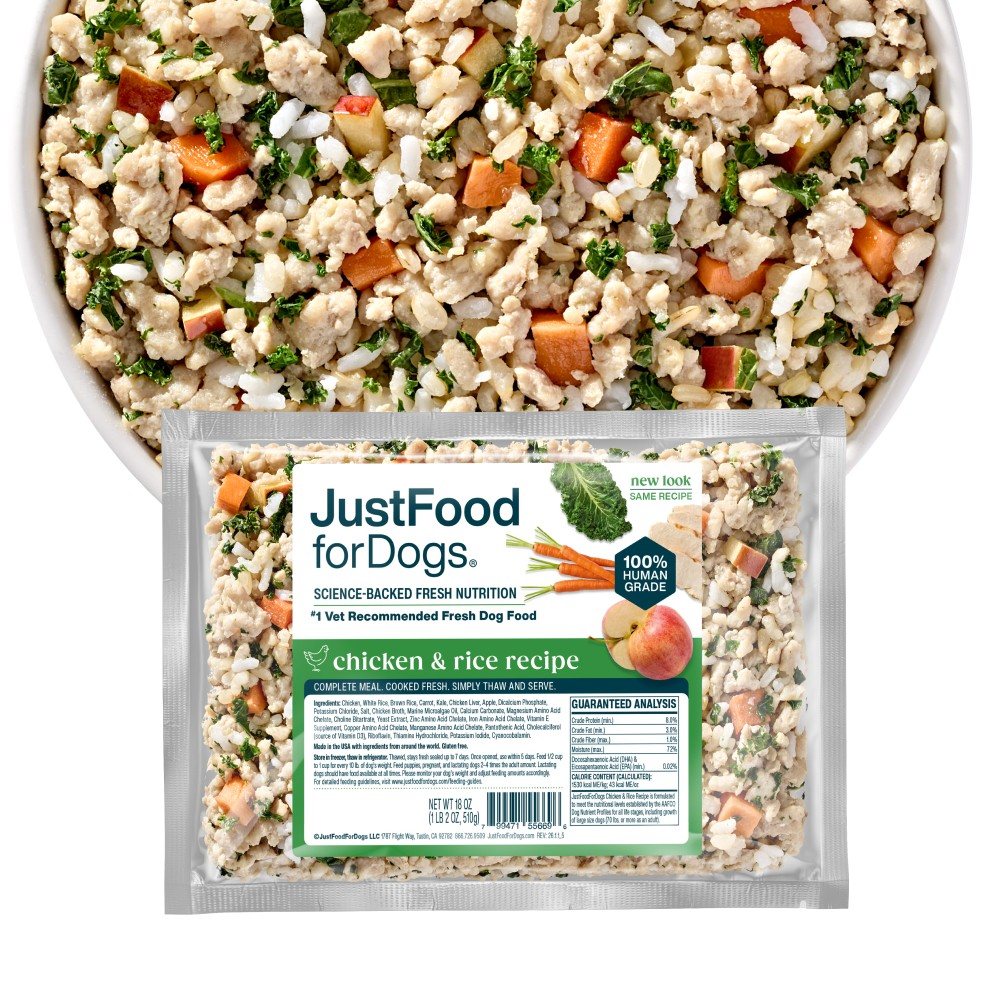
JustFoodForDogs Chicken & Rice
Check the current Chicken & Rice recipe, portions and ordering options.
RER estimates resting needs. It is not automatically the full daily food allowance. Maintenance energy includes the demands of ordinary life, and the multiplier helps account for differences between dogs. Convert pounds to kilograms by dividing by approximately 2.2046 before using the formula.
Key Takeaways
- Treat the calculated calories as a starting estimate, then monitor body condition.
- Count meals and extras within one daily calorie total.
- Convert food calories into grams per day using the exact recipe label.
For example, JustFoodForDogs Chicken & Rice currently provides 1,530 kcal/kg. That label value lets you translate an appropriate calorie allowance into a measurable portion instead of guessing from bowl size.

A dog’s calories per day do not rise by a fixed amount for every additional kilogram. The formula uses weight to the power of 0.75, which is why simply multiplying every dog’s weight by one universal calories-per-kilogram figure can mislead.
Daily calorie chart by weight and activity
These adult calorie estimates use three ranges from AAHA: 1.0–1.2 times RER for inactive adults, 1.4–1.6 for neutered adults and 1.6–1.8 for intact adults. Values are rounded to the nearest whole calorie after calculating each range.
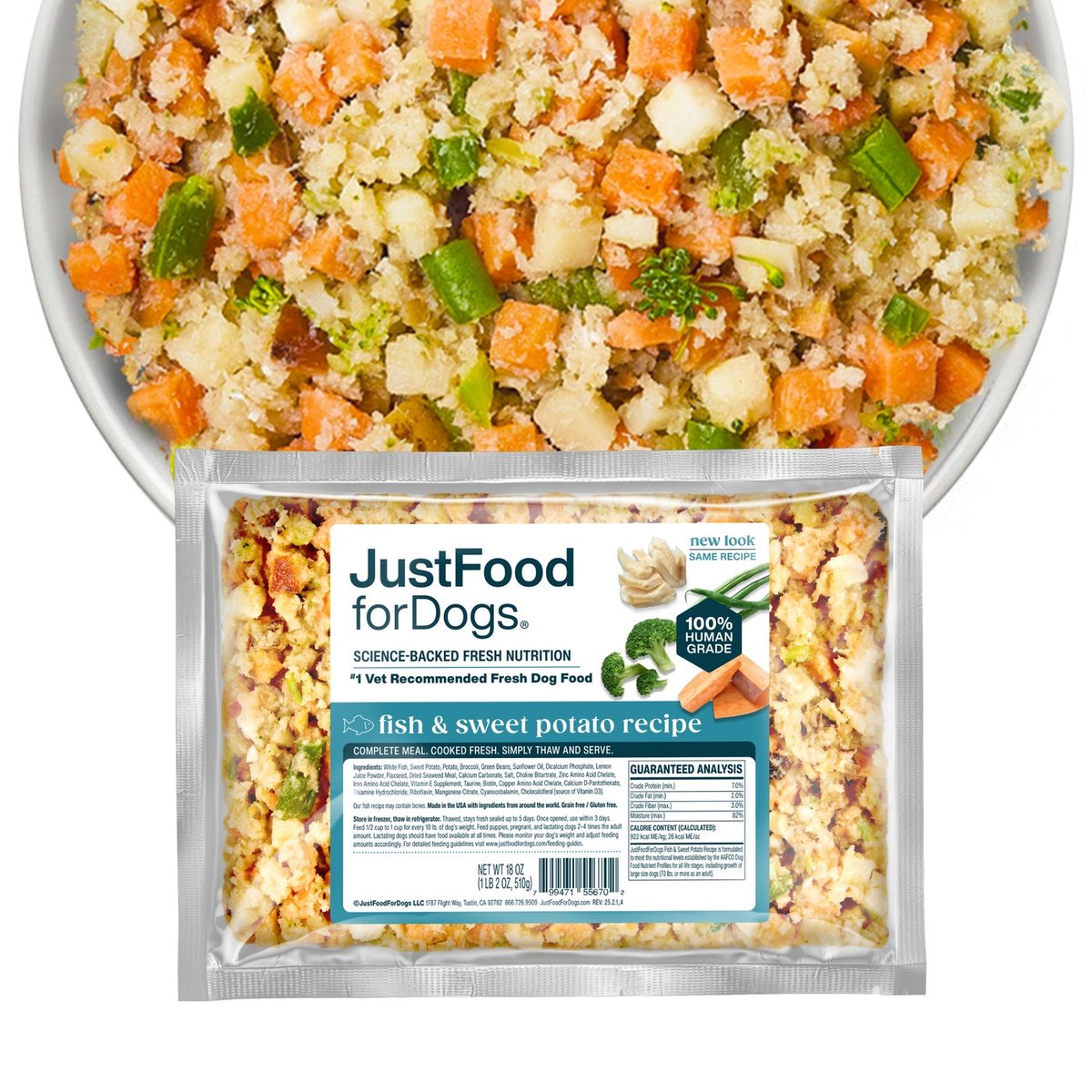
JustFoodForDogs Fish & Sweet Potato
Check the current Fish & Sweet Potato recipe, portions and ordering options.
The categories can overlap. A neutered dog may also be inactive. “Intact” describes reproductive status, not a high-activity level, and the right factor should reflect the whole dog. Do not add the columns together or select the largest value because your dog enjoys walks.
Adult calorie estimates by weight, with explicit adult factors and limitations. All values are kcal/day starting estimates for healthy adults.
| Adult weight | Inactive adult: 1.0–1.2 × RER | Neutered adult: 1.4–1.6 × RER | Intact adult: 1.6–1.8 × RER |
|---|---|---|---|
| 5 lb / 2.27 kg | 129–155 | 181–207 | 207–233 |
| 10 lb / 4.54 kg | 218–261 | 305–348 | 348–392 |
| 20 lb / 9.07 kg | 366–439 | 512–585 | 585–659 |
| 40 lb / 18.14 kg | 615–738 | 862–985 | 985–1,108 |
| 60 lb / 27.22 kg | 834–1,001 | 1,168–1,335 | 1,335–1,501 |
| 80 lb / 36.29 kg | 1,035–1,242 | 1,449–1,656 | 1,656–1,863 |
The same calorie target can require different food weights. JFFD Fish & Sweet Potato provides 922 kcal/kg, so 600 calories corresponds to approximately 651 grams. Chicken & Rice supplies the same calories in approximately 392 grams. Compare food energy, not equal spoonfuls.
Use activity as context when reviewing the estimate. A change from regular long walks to short outings can change needs even if body weight initially stays the same. Working and endurance dogs require a different assessment; the intact-adult column is not a substitute for a sports-nutrition plan.
Calculate calories, then convert them into food portions
A dog calorie calculator is useful only when its inputs and assumptions are clear. You can perform the calculation manually with a scientific calculator. Record the weight, selected factor and food label so you can reproduce the result or change one input later.
The following example uses a hypothetical healthy 10-kilogram neutered adult, a factor of 1.6 and a maximum of 10% of calories reserved for extras. It illustrates the arithmetic, not a feeding prescription for every dog weighing 10 kilograms.
Manual calculation with inputs, formulas and worked results: resting energy requirement, daily calorie target, food calories and grams per day.
| Step | Calculation | Worked result |
|---|---|---|
| Resting energy requirement | 70 × 10^0.75 | About 394 kcal/day |
| Daily calorie target | Unrounded RER × 1.6 | About 630 kcal/day |
| Maximum extras allowance | Unrounded daily target × 0.10 | About 63 kcal/day |
| Complete-food calories | Unrounded daily target × 0.90 | About 567 kcal/day |
| Chicken & Rice grams per day | Unrounded food calories ÷ 1,530 × 1,000 | About 370 g/day |
The general portion formula is food calories ÷ kcal/kg × 1,000 = grams per day. Use the food’s allocated calories, not the total target before accounting for treats. Keeping the intermediate calculation unrounded avoids small errors accumulating between steps.
To find how many calories are in your dog food, look for the calorie-content statement on the exact package. Check the unit carefully:
- kcal/kg means calories per kilogram of food.
- kcal/cup applies to the stated cup measure for that particular food.
- kcal/package applies to the named package size, not every pack in the range.
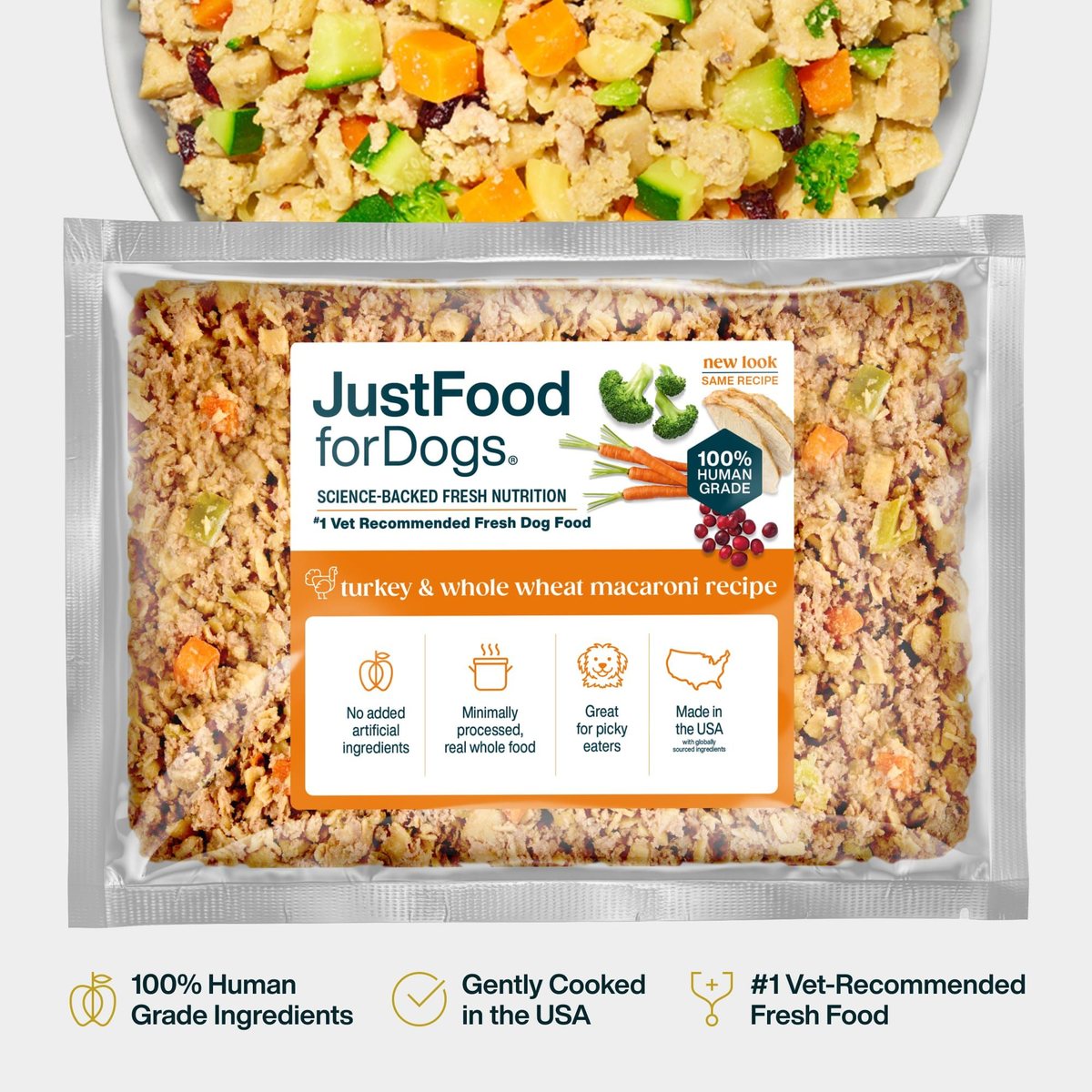
JFFD Turkey & Whole Wheat Macaroni is an adult-maintenance example at 1,741 kcal/kg. A 600-calorie food allowance would equal approximately 345 grams. This is why switching recipes requires recalculating the portion even when your dog’s daily calorie target stays unchanged.
JustFoodForDogs Turkey & Whole Wheat Macaroni
Check the current Turkey & Whole Wheat Macaroni recipe, portions and ordering options.
A dog RER calculator supplies only the first step. A complete dog food calorie calculation must also choose the appropriate factor and translate the result into the food actually served. After weighing the daily amount, divide it among meals and keep the measurement method consistent.
If two people feed the same dog, record the daily amount somewhere both can see it. A correctly calculated breakfast and an independently calculated full-day dinner can otherwise become an accidental extra meal.
Count treats, chews and toppers
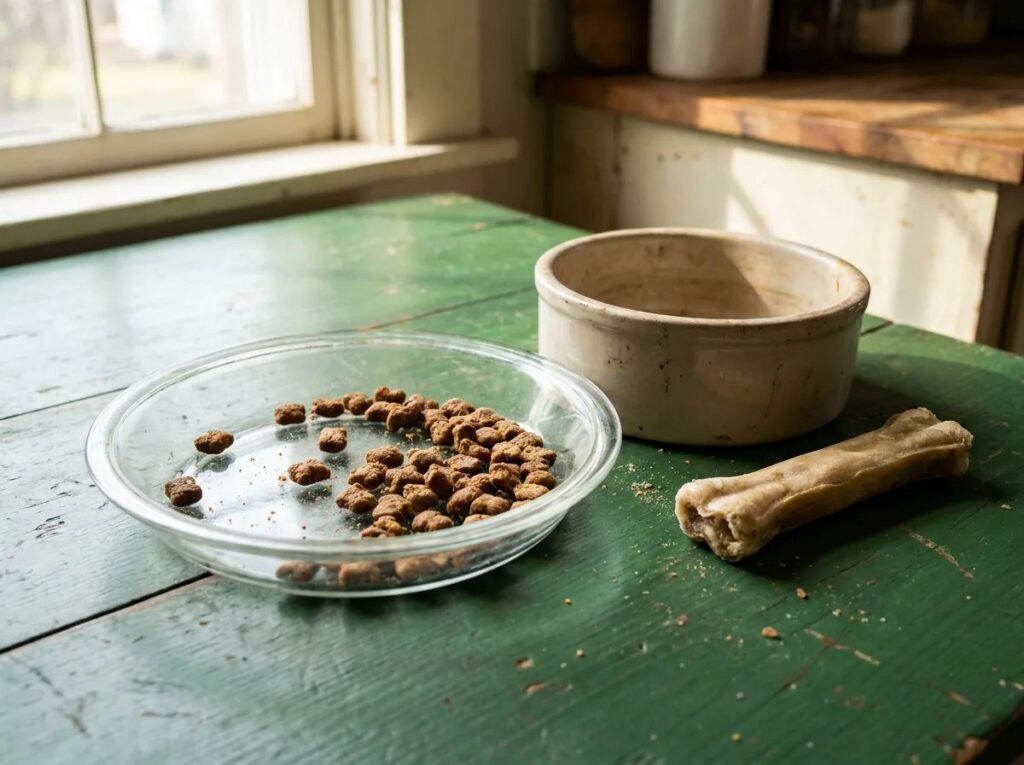
Small extras can be easy to overlook when meals are carefully measured. Count what the dog actually consumes across the whole day, including food used for training or to give medication. A chew’s purpose does not remove its calories.
Make a daily inventory:
- Meals and any additional complete food.
- Training rewards, biscuits and dental chews.
- Table food, supplemental toppers and other edible extras.
For a hypothetical 600-calorie daily target, a 10% extras ceiling is 60 calories. The remaining 540 calories would come from complete food. That ceiling is not a requirement to give treats; if you use fewer extras, allocate the daily intake accordingly.
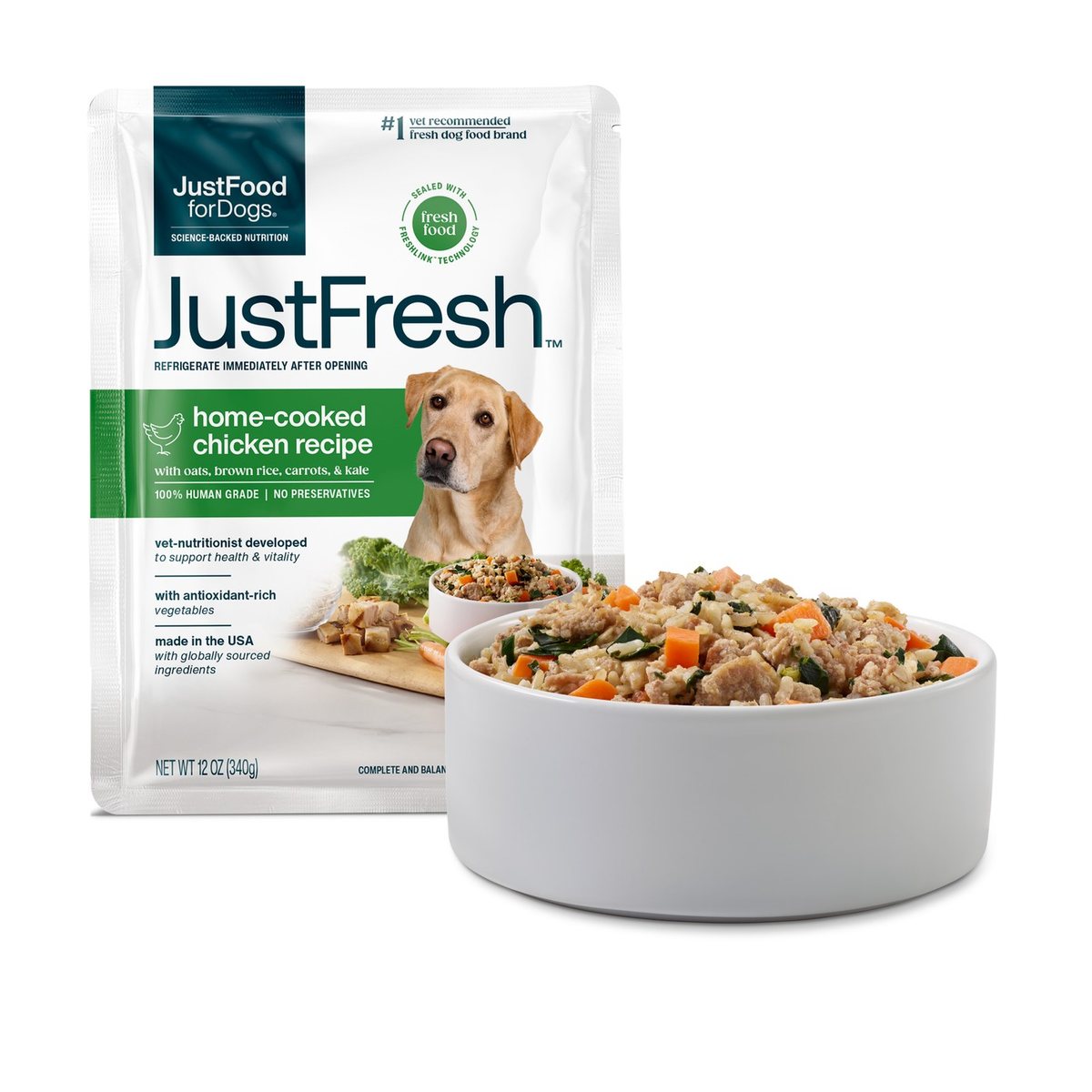
JFFD JustFresh Chicken is a complete adult-maintenance meal at 1,254 kcal/kg. If it replaces part of another complete food, calculate both foods’ calorie shares. Adding it on top of an unchanged full portion increases the total.
A complete meal and a supplemental topper have different roles. JustFresh Boost toppers are intended for supplemental or intermittent feeding. They should not replace a large share of a complete diet merely because the resulting bowl contains the desired number of calories. Energy intake and nutritional adequacy must both remain appropriate.
JustFoodForDogs JustFresh Home-Cooked Chicken
Check the current JustFresh Home-Cooked Chicken recipe, portions and ordering options.
When the adult chart does not apply
The chart is designed for healthy adults at an appropriate body condition. It does not establish a target for puppies, pregnancy, lactation, illness, intensive work or intentional weight loss. Those situations change either energy requirements, nutritional needs or both.
Use a separate feeding plan when:
- Your dog is growing, pregnant or nursing.
- A medical condition affects food intake or nutrient requirements.
- Your dog needs to lose or gain weight.
- Training or work creates unusually high energy demands.
For weight loss, the important question is not simply how many calories a dog of its current weight needs for maintenance. Target weight, body condition, medical history and the food’s nutrient concentration affect the plan. Our guide to canine obesity and helping your dog lose weight explains the broader process.
Puppies need growth-appropriate food as well as sufficient calories. An adult-maintenance label does not become suitable for growth because the portion is increased. Read what you need to know about feeding your puppy for that separate life-stage decision.
Adjust portions using weight and body condition
The most useful follow-up is a record of what you feed and how your dog responds over time. Tufts’ feeding guidance emphasizes that estimated requirements are starting points and actual weight and body condition help guide adjustments.
Track three things together:
- Intake: Measured meals, treats and leftovers rather than food offered alone.
- Weight trend: Comparable measurements over time rather than one isolated reading.
- Body and muscle condition: Changes in fat coverage or muscle that the scale alone may miss.
A stable scale reading does not necessarily mean the plan needs no attention. Muscle and body fat can change in different directions. Your veterinary team can help assess both, especially if your dog is older or activity has changed.
Before changing the portion, check for an explainable difference: extra treats, a new recipe, a different measuring cup or another household member feeding. Correct those inconsistencies first. If weight changes unexpectedly despite a consistent routine, seek advice rather than repeatedly reducing or increasing meals without understanding why.
Related reading: Petful explains how much fat counts as low in dog food, and WebVet shows how much fresh dog food costs for a small dog.
Frequently Asked Questions
It is not the default complete-food-to-treat ratio used here. AAHA recommends at least 90 percent of calories from complete and balanced food, with no more than 10 percent from treats and other extra calories. A different split needs a nutritionally appropriate plan; the percentages alone do not make an unbalanced mixture complete.
For a healthy adult already at an appropriate body condition, current weight can inform a maintenance estimate. If your dog is overweight or underweight, do not substitute a guessed ideal weight and assume the result is a safe plan. Establish the target and monitoring approach with your veterinary team.
A calculator provides a starting estimate, while individual requirements vary. First check the recipe’s calorie density and any uncounted extras. Then use the weight trend and body condition to evaluate intake. A stable, healthy dog may need less than the estimate without the calculation being a precise measure of its metabolism.
Yes. Include them in the daily calorie total, even when their purpose is dental care or training. If several people give training treats, set aside the day’s allowance in one container. That makes the remaining amount visible and helps prevent everyone from assuming someone else’s rewards were already counted.
Yes. In food labeling, one kilocalorie, written kcal, is the unit commonly called a calorie. Grams measure food weight, not energy. Two recipes can weigh the same and provide different calories, so use each food’s kcal/kg or another clearly stated label unit when converting the allowance.
No. Puppy age and growth change the calculation and the required diet. AAHA lists different growth factors for puppies under four months and those four months or older, but these still need individual adjustment. Use a puppy feeding plan and confirm that the exact recipe’s adequacy statement covers the required growth stage.