PetLabCo.® Joint Care Chew Advanced Review
Published on September 09, 2026
Sponsored disclosure: This article was created in partnership with PetLabCo.®. Vetstreet may earn a commission if you purchase through links in this article. Vetstreet reviewed the current product label, manufacturer information, and independent veterinary evidence. The product was not obtained or used for a hands-on test, so this review does not make first-hand claims about taste, texture, palatability, tolerance, or results in an individual dog.
Written by Athena Gaffud, DVM
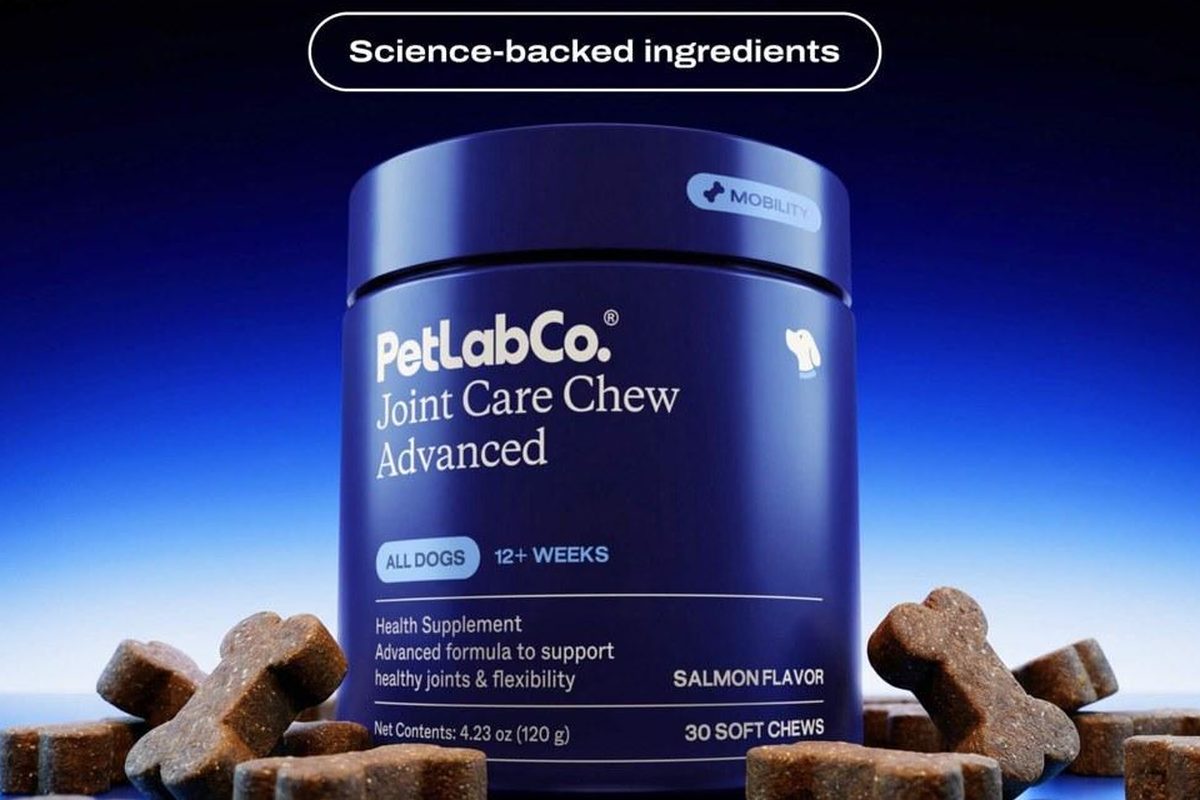
This PetLabCo.® Joint Care Chew Advanced review examines the current salmon-flavored soft chew, including label quantities, weight-based directions, ingredient evidence, safety considerations, and its place in a broader mobility plan.
The current Joint Care Chew Advanced product information describes an upgraded formula with glucosamine, methylsulfonylmethane (MSM), green-lipped mussel, chondroitin sulfate, Boswellia, and omega-3 fatty acids from anchovy oil. That is important because some older reviews of PetLabCo.® joint chews discuss a previous ingredient list. This review is limited to the formula and directions displayed by PetLabCo.® on August 25, 2026.
PetLabCo.® Joint Care Chew Advanced: Key Takeaways
- What it is: A daily salmon-flavored soft chew formulated to support joint mobility, flexibility, cartilage, and comfort during normal movement.
- Who it is made for: The manufacturer says it is suitable for dogs 12 weeks and older, with a daily serving based on body weight.
- What stands out: The label combines six active ingredient groups in one soft chew. Per two soft chews, the labeled daily serving for a 25 to 49.9 lb dog, it supplies 800 milligrams of glucosamine, 500 milligrams of MSM, 400 milligrams of green-lipped mussel, 300 milligrams of chondroitin sulfate, 40 milligrams of Boswellia, and 110 milligrams of total omega-3 fatty acids. Smaller and larger dogs receive proportionally less or more according to the weight-based serving table.
- What the evidence says: Omega-3 fatty acids have the strongest broader canine joint evidence among the listed supplement categories. Evidence for green-lipped mussel is promising but preparation-specific. Evidence for glucosamine and chondroitin is mixed to weak for osteoarthritis pain, while canine outcome evidence for MSM and Boswellia remains limited.
- What this review cannot establish: We did not conduct a hands-on test, and we did not identify a published clinical trial of this exact finished formula. Ingredient research cannot prove that one branded combination will produce the same outcome.
- Bottom line: The soft chew offers a convenient, multi-ingredient option for owners seeking daily joint support. It should complement, not replace, veterinary evaluation, weight management, appropriate exercise, rehabilitation, or prescribed care when a dog has pain or reduced mobility.
How We Evaluated This Dog Joint Supplement
This is an expert-analysis review, not a product trial. Our assessment used four decision factors:
- Formula transparency: We compared the current active and inactive ingredient lists with the stated serving directions.
- Evidence quality: We reviewed veterinary guidelines, a systematic review, and canine studies for the major ingredient categories.
- Practical use: We considered serving frequency, weight bands, allergens, storage, tub sizes, and current pricing.
- Clinical fit: We assessed whether the product is positioned responsibly as supportive care rather than as a treatment for arthritis or another disease.
This method evaluates what is verifiable without implying that we observed a dog taking the soft chew. A study of a therapeutic diet, purified fish oil, or a particular green-lipped mussel preparation does not automatically validate every supplement that includes that ingredient.
Vetstreet previously published a broad, hands-on review of several PetLab products. That article documented one owner’s experience with an earlier Joint Care Chew. This review instead examines the current Advanced formula as a single product. We do not transfer the earlier observations to the updated formula.
Our sister site Petful has also reviewed other products in the PetLabCo.® line, including Probiotic Chews, ProBright® Advanced, ProBright® Advanced One, and DF-14 Daily Foundation.
Product Snapshot
| Feature | Current product information |
|---|---|
| Product | PetLabCo.® Joint Care Chew Advanced |
| Product type | Daily canine joint-support supplement |
| Form and flavor | Salmon-flavored soft chew |
| Intended age | Dogs 12 weeks and older, according to the manufacturer |
| Serving | 1 to 4 chews daily, based on weight |
| Active ingredients | Glucosamine HCl, MSM, green-lipped mussel, chondroitin sulfate, Boswellia, total omega-3 fatty acids from anchovy oil, EPA, and DHA |
| Notable animal-derived ingredients | Shellfish-derived glucosamine, green-lipped mussel, anchovy oil, and salmon hydrolysate |
| Inactive ingredients | Apple cider vinegar, coconut glycerin, hickory smoke flavor, rosemary extract, salmon hydrolysate, sunflower lecithin, sunflower oil, and sweet potato |
| Available counts | 30, 60, and 90 soft chews, as listed by the manufacturer |
| Manufacturing | Made in the USA with domestic and globally sourced ingredients |
| Quality statement | PetLabCo.® says the company is NASC-certified and uses third-party testing for purity, potency, and label accuracy |
| Storage | Keep in a cool, dry place away from direct sunlight and reseal the tub after use |
| Review basis | Expert analysis; product not obtained or tested hands-on |
Current Price and Guarantee
On August 25, 2026, the PetLabCo.® page displayed a regular one-tub price of $38.69 and a one-tub subscription price of $30.95. Prices, discounts, tub selections, and subscription terms can change, so shoppers should confirm the total and delivery schedule before ordering.
PetLabCo.® lists a conditional 60-day guarantee for qualifying first-time US direct purchasers. Its separate general return policy covers eligible unopened items within 30 days. Check the full terms.
Current Formula and Daily Directions
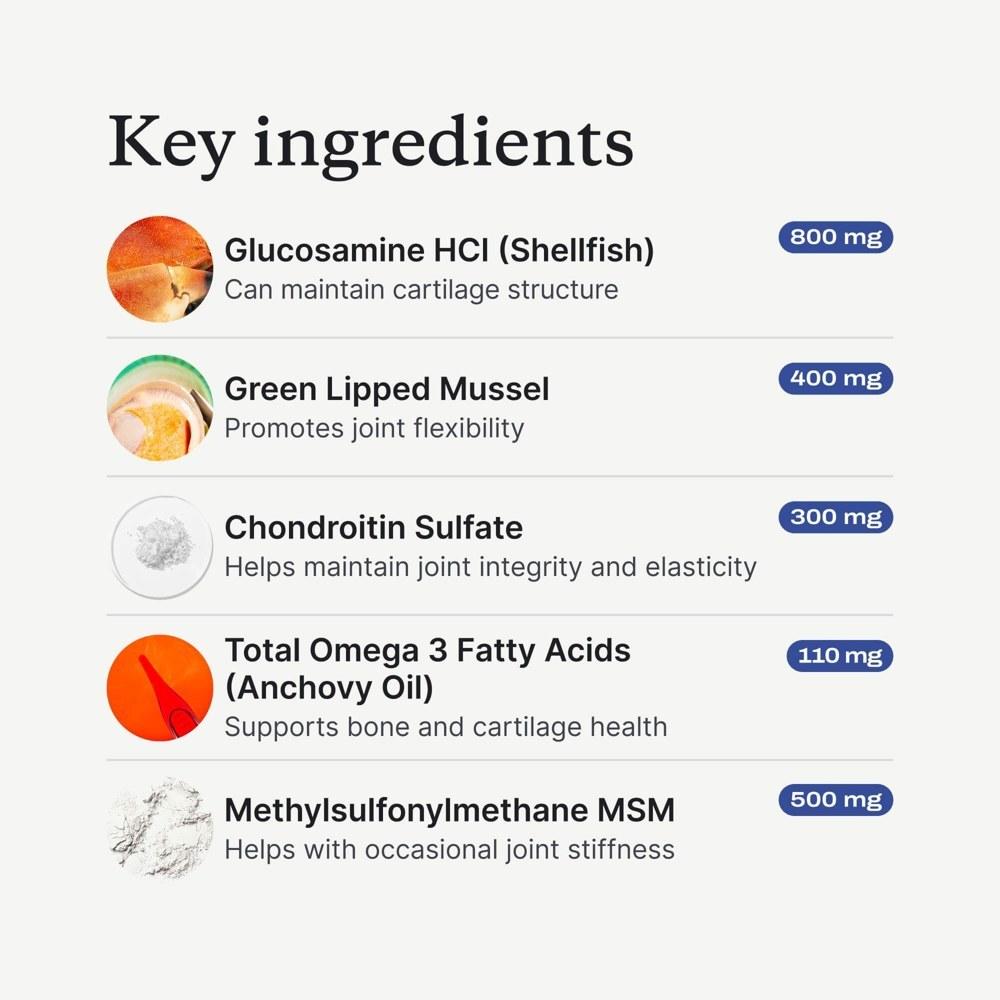
The supplement facts panel reports the following amounts per two soft chews, an 8-gram serving:
| Active ingredient | Amount per 2 chews | Evidence-focused role in this review |
|---|---|---|
| Glucosamine, from shellfish | 800 mg | Common cartilage and joint-support ingredient; clinical pain evidence is inconsistent |
| MSM | 500 mg | Sulfur-containing compound used in connective-tissue supplements; strong canine outcome evidence is limited |
| Green-lipped mussel, Perna canaliculus | 400 mg | Marine ingredient with omega-3s and other compounds; some canine studies support specific preparations |
| Chondroitin sulfate | 300 mg | Commonly paired with glucosamine; evidence does not support a promise of arthritis pain relief |
| Boswellia | 40 mg | Botanical used for joint-comfort support; canine evidence is preliminary and preparation-specific |
| Total omega-3 fatty acids, from anchovy oil | 110 mg | The ingredient category with the strongest broader evidence for canine osteoarthritis support |
| EPA | 70 mg | Long-chain omega-3 fatty acid studied in canine mobility and osteoarthritis nutrition |
| DHA | 40 mg | Long-chain omega-3 fatty acid often paired with EPA |
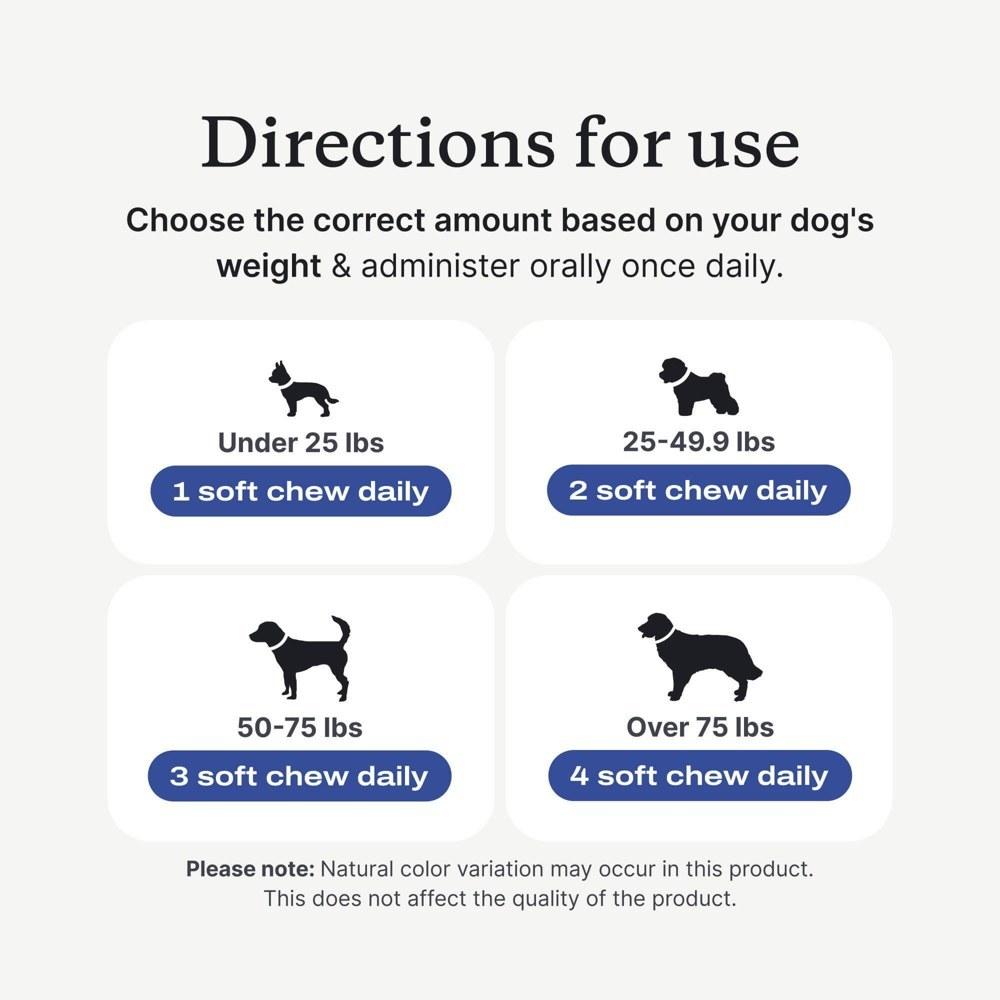
PetLabCo.® gives these daily directions:
| Dog’s weight | Daily serving | Daily amount relative to the 2-chew label serving |
|---|---|---|
| Under 25 pounds | 1 chew | One-half of each listed 2-chew amount |
| 25 to 49.9 pounds | 2 chews | The listed 2-chew amount |
| 50 to 75 pounds | 3 chews | One and one-half times each listed amount |
| Over 75 pounds | 4 chews | Twice each listed amount |
Follow the current tub directions rather than copying a serving schedule from an older review or package image. Do not increase the serving in an attempt to produce faster results. If a dog receives another joint product, fish oil, or a therapeutic diet, a veterinarian can help identify overlapping ingredients and judge the total intake.
What the Label Claims These Ingredients Support
These are the manufacturer’s stated ingredient roles, not independent clinical findings. The evidence assessment below explains what the research can establish.
- Glucosamine HCl is included to help maintain the synovial fluid that lubricates joints and to support cartilage health
- Green-lipped mussel is included to support joint health, mobility, and a normal inflammatory response
- Omega-3 fatty acids (EPA/DHA) are included to support strong muscles, healthy hips and joints, and a normal inflammatory response tied to flexibility
- Chondroitin sulfate is included to work alongside glucosamine to help support joint fluid and cartilage levels
- Boswellia is included for support with occasional joint stiffness and mobility
- MSM (OptiMSM®) is included as a connective-tissue component to support joint function and range of motion
How Strong Is the Ingredient Evidence?
For this review, “stronger” means an ingredient category has comparatively better canine clinical support. “Limited” means the evidence may involve small studies, another preparation, or outcomes that cannot be applied directly to this chew. For a broader look at how these ingredient categories are studied, see Petful’s guide to whether joint supplements are helpful or hype.
Omega-3 Fatty Acids: The Strongest Broader Evidence in the Formula
The 2022 American Animal Hospital Association pain-management guidelines state that evidence was low for all nutraceuticals evaluated for osteoarthritis clinical signs except omega-3 fatty acids in dogs. The Merck Veterinary Manual also notes improved gait and mobility with EPA supplementation and EPA-rich diets in dogs with osteoarthritis.
That makes the anchovy-oil EPA and DHA the most evidence-supported ingredient category in this formula. It does not establish a therapeutic omega-3 dose for every dog. Research quantities are assessed in the context of body weight, diet, and total daily EPA and DHA. The label’s 110 milligrams per two chews should not be described as equivalent to a therapeutic diet or separately dosed fish oil.
Green-Lipped Mussel: Promising, but Preparation Matters
Green-lipped mussel contains marine lipids and other compounds used in joint-support products. A double-blind study of 31 dogs found improvement in a total arthritis score after six weeks when a specific green-lipped mussel powder was added to a complete diet.
The study did not test the current PetLabCo.® soft chew. Extraction methods, concentrations, companion ingredients, and serving levels can differ. Green-lipped mussel has some canine research support, but this product has not been proven to relieve arthritis symptoms.
Glucosamine and Chondroitin: Familiar Ingredients With Mixed Results
Glucosamine and chondroitin are familiar joint-supplement ingredients associated with cartilage, but familiarity is not strong clinical proof.
A 2022 systematic review found a marked lack of analgesic efficacy for glucosamine-chondroitin nutraceuticals in canine and feline osteoarthritis. Merck similarly states that the available evidence does not support them for osteoarthritis pain management. Individual findings vary, but the overall evidence is inconsistent.
For this reason, the appropriate wording is that glucosamine and chondroitin are included to support joint structure and function. The article should not claim that they rebuild damaged cartilage, reverse arthritis, or replace proven pain control.
Boswellia: Preliminary Canine Support
Boswellia is a plant resin used in joint supplements. Small canine studies have reported encouraging findings for a standardized preparation or multi-ingredient formulas, but they do not prove that the 40 milligrams in this chew will produce a particular result.
We would grade the evidence as limited and preparation-specific. The product may be described as including Boswellia for joint-comfort support, while claims about treating inflammation, lameness, or pain should be avoided.
MSM: Plausible Support, Limited Direct Canine Outcome Data
MSM is a sulfur-containing compound commonly included in joint formulas. Its role in normal connective-tissue biology does not by itself establish a clinical mobility benefit. We did not identify strong, product-relevant canine outcome evidence for the 500-milligram amount in this chew.
Its presence broadens the formula, but MSM should be presented as a supportive ingredient with limited direct canine evidence, not as a proven treatment.
What We Like
- Transparent current quantities: PetLabCo.® publishes the active amounts per two soft chews, which makes the formula easier to evaluate than a proprietary blend with no quantities.
- Several joint-support approaches in one format: The chew combines omega-3 fatty acids, a marine ingredient, familiar cartilage-support compounds, MSM, and Boswellia.
- Clear weight-based directions: The four weight bands are straightforward, provided owners use the current label.
- Daily format may support consistency: Some owners find a soft chew easier to fit into a routine than capsules, liquids, or powders. This is not a claim about this product’s palatability.
- Quality information is available: The company states that it is NASC-certified, manufactures in the USA, and conducts independent testing.
Limitations to Consider
- No hands-on findings: We cannot say how a particular dog accepted, tolerated, or responded to the soft chew.
- No finished-product clinical trial identified: Research on individual ingredients cannot demonstrate the effectiveness of this exact combination.
- Evidence strength varies substantially: Omega-3s have comparatively stronger support, while glucosamine-chondroitin results are inconsistent and evidence for Boswellia and MSM is limited.
- Animal-derived ingredients create allergy considerations: The formula includes shellfish, green-lipped mussel, anchovy oil, and salmon hydrolysate.
- Cost rises with body weight: Larger dogs need three or four chews daily, so a tub may not last as long as it does for a small dog.
Who May Consider PetLabCo.® Joint Care Chew Advanced?
The product may appeal to owners who want a chew-based joint supplement for dogs with a published ingredient panel and several commonly used joint ingredients in one product.
An owner of an active adult or senior dog may discuss it with a veterinarian as one part of a broader mobility plan. PetLabCo.® also positions it for dogs over 12 weeks, but “proactive support” is not a promise to prevent joint disease. Genetics, body condition, injury history, conformation, activity, and nutrition all matter.
Pet parents who are new to the category may also find PetLabCo.®’s dog joint-supplement education guide useful for understanding the manufacturer’s intended role for daily support. It should be read alongside independent veterinary guidance.
Who Should Talk With a Veterinarian Before Use?
Every dog can benefit from individualized advice, but veterinary input is especially important when:
- A dog is limping, struggling to rise, avoiding stairs, crying out, losing muscle, or showing a sudden mobility change. These signs need diagnosis, not a supplement-only response.
- The dog has osteoarthritis, an orthopedic injury, hip or elbow dysplasia, a neurologic condition, or recent surgery.
- The dog takes an NSAID, pain medication, anticoagulant, or other chronic medication.
- Another supplement or therapeutic food already provides glucosamine, chondroitin, fish oil, green-lipped mussel, MSM, or Boswellia.
- The dog has a known or suspected fish or shellfish sensitivity.
- The dog has a sensitive gastrointestinal tract or previously reacted to a supplement.
- The dog is pregnant, nursing, or intended for breeding. The current product page says safe use in pregnant animals or animals intended for breeding has not been proven.
- The dog is younger than 12 weeks.
The label advises stopping administration and consulting a veterinarian if the dog’s condition worsens or does not improve. In an accidental overdose, contact a veterinarian or animal poison-control resource promptly rather than waiting for signs.
How It Compares With Other Joint-Support Approaches
Joint Care Chew Advanced is best compared by format and goal, not declared a universal winner. Dogs of the same age or breed can have different needs.
| Option | Potential role | Important distinction |
|---|---|---|
| PetLabCo.® Joint Care Chew Advanced | Convenient multi-ingredient daily support | Combines ingredients, but the exact formula lacks published finished-product efficacy evidence |
| Concentrated veterinary fish oil or EPA/DHA supplement | Targeted omega-3 intake | Dose should account for body weight, diet, health conditions, and total EPA/DHA |
| Therapeutic joint diet | Nutrition, calorie control, and selected joint-support nutrients in one plan | Requires a full-diet decision and may offer studied nutrient profiles |
| Single-ingredient supplement | More controlled trial of one ingredient | Easier to identify tolerance, but may require multiple products to pursue several goals |
| Prescription osteoarthritis care | Diagnosis and active pain or disease management | A supplement does not replace medication, rehabilitation, injections, or surgery when indicated |
Owners focused on omega-3 evidence can ask whether the EPA and DHA amounts fit their dog’s total nutrition plan. Owners prioritizing convenience may prefer the all-in-one chew. Dogs with active pain or functional loss need a veterinary plan first.
How to Judge Whether It Fits Your Dog
Before starting, record two or three meaningful activities, such as rising after rest, pace on a familiar walk, or using a usual step. These are more useful than saying the dog seems “younger.”
Give only the current label serving and keep the routine reasonably stable. Changing food, exercise, medication, and several supplements together makes results hard to interpret. Ask the veterinarian how long to evaluate the product. Consistent use over several weeks may be needed, but do not wait through worsening pain or mobility.
At the agreed review point, consider three questions:
- Is there a repeatable improvement in the chosen activities?
- Has the dog tolerated the product without a concerning change in appetite, stool, skin, or behavior?
- Does the cost and daily chew count remain practical for long-term use?
This does not turn an observation into a clinical trial, but it gives the veterinarian more useful information than a vague memory. If the product is not a fit, another supplement, diet, rehabilitation plan, or medical treatment may be more appropriate.
Frequently Asked Questions
The formula contains ingredients used in dog joint supplements. Omega-3 fatty acids have the strongest broader evidence among them, while green-lipped mussel evidence is preparation-specific and research on the other components is mixed or limited. We did not identify a clinical trial of the exact finished product, so no outcome can be promised.
No. Joint Care Chew Advanced is a supplement intended to support normal joint function and mobility. It is not intended to diagnose, treat, cure, or prevent arthritis or another disease. A dog with pain, lameness, or reduced function should receive veterinary evaluation, and owners should not reduce or stop prescribed medication without veterinary direction.
The manufacturer says support may become noticeable after consistent use over several weeks, but results vary. Ask the dog’s veterinarian for a reasonable evaluation window and seek help sooner if the dog worsens.
PetLabCo.® states that the soft chew is suitable from 12 weeks of age. Ask a veterinarian about rapidly growing large breeds, puppies with orthopedic concerns, or those eating a specialized growth diet.
The product is labeled for daily use according to the weight-based directions. Give the current label amount and do not add extra soft chews to accelerate results. Owners using other joint supplements, fish oil, or therapeutic diets should review total ingredient intake with a veterinarian.
“Natural” ingredients are not automatically appropriate with every medication or condition. Share the complete ingredient panel and serving with the dog’s veterinarian, especially when another product contains overlapping joint ingredients.
The current formula contains shellfish-derived glucosamine, green-lipped mussel, anchovy oil, and salmon hydrolysate. Owners of dogs with known or suspected fish or shellfish sensitivities should consult their veterinarian before use and choose a product with an appropriate ingredient profile.
PetLabCo.® has sold earlier joint-chew formulations, and older pages may mention ingredients such as turmeric extract or calcium fructoborate. The current Joint Care Chew Advanced page reviewed here lists glucosamine, MSM, green-lipped mussel, chondroitin sulfate, Boswellia, and anchovy-oil omega-3s. Use the label on the product being purchased and ask the company or a veterinarian if packaging information does not match.
Our Verdict
PetLabCo.® Joint Care Chew Advanced presents a transparent, convenient multi-ingredient formula for daily joint support. Its clearest strengths are the published active quantities, straightforward weight bands, and inclusion of EPA and DHA alongside green-lipped mussel and other commonly used joint ingredients. The company also provides manufacturing, testing, and return information that helps owners make a more informed purchase.
The evidence needs an equally transparent explanation. Omega-3 fatty acids have comparatively strong support in canine joint care, but the amount in this chew must be interpreted within the dog’s total diet. Green-lipped mussel has promising preparation-specific evidence. Glucosamine and chondroitin have inconsistent evidence for osteoarthritis pain, and product-relevant evidence for MSM and Boswellia is limited. No ingredient study proves the effectiveness of the finished chew.
For owners who value an all-in-one soft-chew format and have discussed their dog’s needs with a veterinarian, Joint Care Chew Advanced may be a practical addition to a consistent mobility routine. It is not a substitute for diagnosis, weight optimization, controlled exercise, rehabilitation, or prescribed treatment. The most useful decision is therefore not whether this is a miracle chew, but whether its ingredients, serving, allergens, cost, and supportive role fit the individual dog’s broader care plan.
Sources
- PetLabCo.® Joint Care Chew Advanced product page, current formula, directions, cautions, price, and product positioning; accessed August 25, 2026.
- 2022 AAHA Pain Management Guidelines: Nonpharmacologic Modalities, evidence context for omega-3 fatty acids, weight optimization, exercise, and rehabilitation.
- Merck Veterinary Manual: Osteoarthritis in Dogs and Cats, veterinary overview of multimodal management and nutraceutical evidence.
- Barbeau-Grégoire et al., 2022 systematic review and meta-analysis, evidence assessment for omega-3 and glucosamine-chondroitin nutraceuticals.
- Bui and Bierer, 2003, controlled study of green-lipped mussel in a complete canine diet.
- Reichling et al., 2004, preliminary study of a standardized Boswellia preparation in dogs with joint and spinal disease.
- Roush et al., 2010, randomized controlled trial of an omega-3-enriched food in dogs with osteoarthritis.
PetLabCo.® products are not intended to diagnose, treat, cure, or prevent any disease. This article is for informational purposes and does not replace veterinary advice. Consult your veterinarian before starting a supplement, especially if your dog has a medical condition or takes medication.