Digestive Enzymes for Cats: Uses and How They Differ From Probiotics
Published on November 02, 2026
Sponsored by Animal Biome. This article contains affiliate links. We may earn a commission if you purchase through them. Vetstreet receives compensation from Animal Biome.
Digestive enzymes for cats break down food, while probiotics provide live microorganisms that serve a different digestive-support role. Cats normally make their own enzymes. Before choosing a supplement, identify whether the goal is everyday meal support, microbiome support, or treatment for a diagnosed problem with pancreatic function.
Animal Biome Daily Digest Blend is designed for everyday use with meals. It combines enzymes with other digestive-support components, making it a useful example of why the full label matters. Here is how to distinguish those ingredients, assess product fit, and introduce a routine you can evaluate with your veterinarian.
All featured products are chosen at the discretion of the author. However, Vetstreet may make a small affiliate commission if you click through and make a purchase.
What Digestive Enzymes Do for Cats
Digestive enzymes help turn food into smaller components that can be absorbed. Different enzymes act on different nutrients, and much of this work occurs after food has moved beyond the mouth and stomach. The feline pancreas supplies important enzymes to the small intestine as part of normal digestion.
The main enzyme names to recognize are:
- Protease: Acts on protein.
- Lipase: Acts on fat.
- Amylase: Acts on starch.
These are normal parts of a cat’s digestive system, not ingredients that every cat must receive from a supplement. A complete meal provides nutrients for the cat to process; the cat’s own digestive organs provide much of the machinery for processing them.
If you are wondering where digestive enzymes are located, distinguish where an enzyme is produced from where it works. Pancreatic enzymes are produced in the pancreas and act in the intestine. Cats do have measurable amylase activity in their saliva, although an early study found very low levels. Research measuring feline salivary amylase confirms its presence; this does not establish a need for an enzyme supplement or reveal whether the pancreas produces enough enzymes.
Tufts veterinary nutrition guidance explains that dogs and cats with normal pancreatic function generally produce the enzymes they need. It does not support assuming that cooked food creates a universal need for replacement enzymes. Likewise, a cat’s age or one soft stool does not establish an enzyme deficiency.
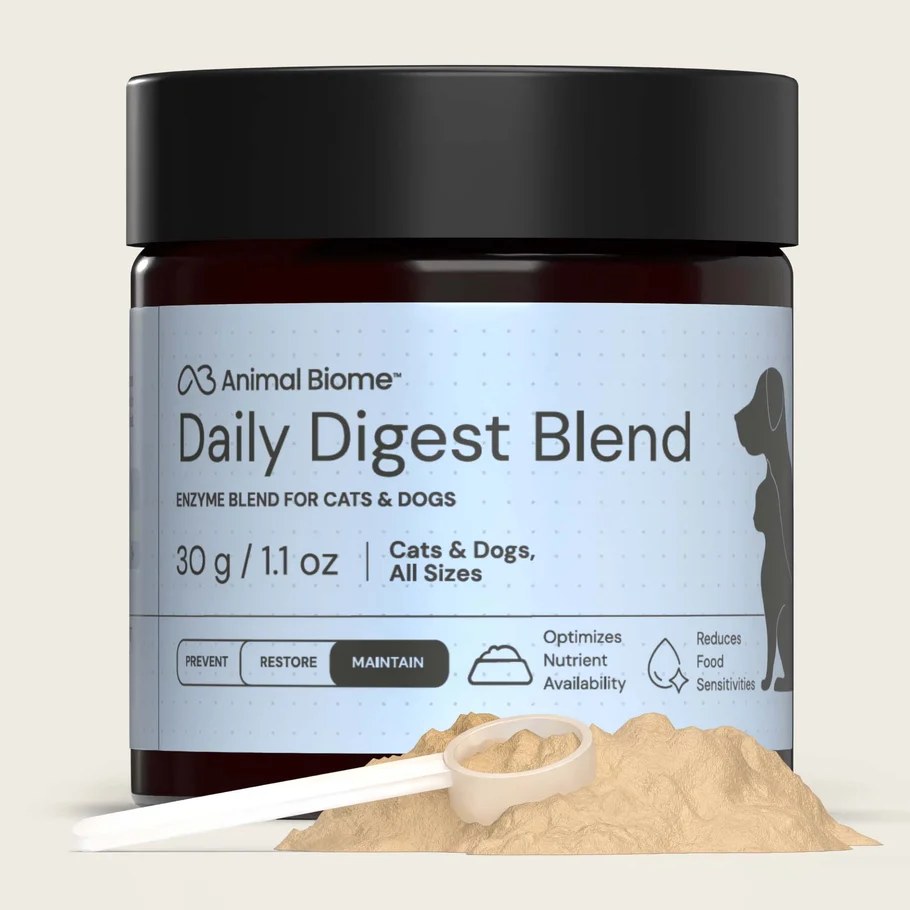
Animal Biome Daily Digest Blend
Meal-associated enzyme and prebiotic support, distinct from prescribed pancreatic replacement.
Where Everyday Enzyme Support Fits
For owners considering a meal-associated supplement, Animal Biome Daily Digest Blend contains an enzyme blend intended for everyday digestive support. Its role should be understood in the context of the cat’s existing food and health rather than treated as proof that the cat is unable to digest meals normally.
A useful question is, “What are we trying to accomplish by adding this?” Possible answers may involve a planned supportive routine or a specific veterinary recommendation. “Every cat needs enzymes” is not a sound substitute for that discussion.
Keep the proposed outcome practical. If the concern is meal tolerance, record intake and digestive signs. If the concern is weight loss, investigate the cause rather than simply adding a powder. The same label can look appealing in both situations, but the underlying decisions are different.
Digestive Enzymes and Probiotics: What Is the Difference?
A digestive enzyme breaks down food. A probiotic contains live microorganisms. A prebiotic feeds beneficial microbes. These three roles explain why products in the same section of a store may have very different ingredient lists.
Neither enzymes nor probiotics are automatically the better choice. The relevant category depends on the goal. A cat needing veterinary pancreatic enzyme replacement has a different requirement from a cat whose care plan includes support for its gut microbial community.

Three ingredient roles in digestive support
| Ingredient category | What it contributes |
|---|---|
| Digestive enzyme | Breaks down food into smaller components during digestion |
| Probiotic | Provides live microorganisms with a defined supportive role |
| Prebiotic | Feeds beneficial microbes in the gut |
A combination formula can contain more than one of these categories. Daily Digest Blend, for example, contains enzyme ingredients, FOS, and S. boulardii. The FOS is a prebiotic ingredient; the S. boulardii is a yeast probiotic. Their presence does not turn them into enzymes.
Animal Biome’s separate S. boulardii + FOS Powder illustrates the difference. It pairs the named yeast strain CNCM I-3799 with FOS and has its own directions. It is a different formulation from Daily Digest Blend, with a different amount of yeast and a different prebiotic quantity per scoop.
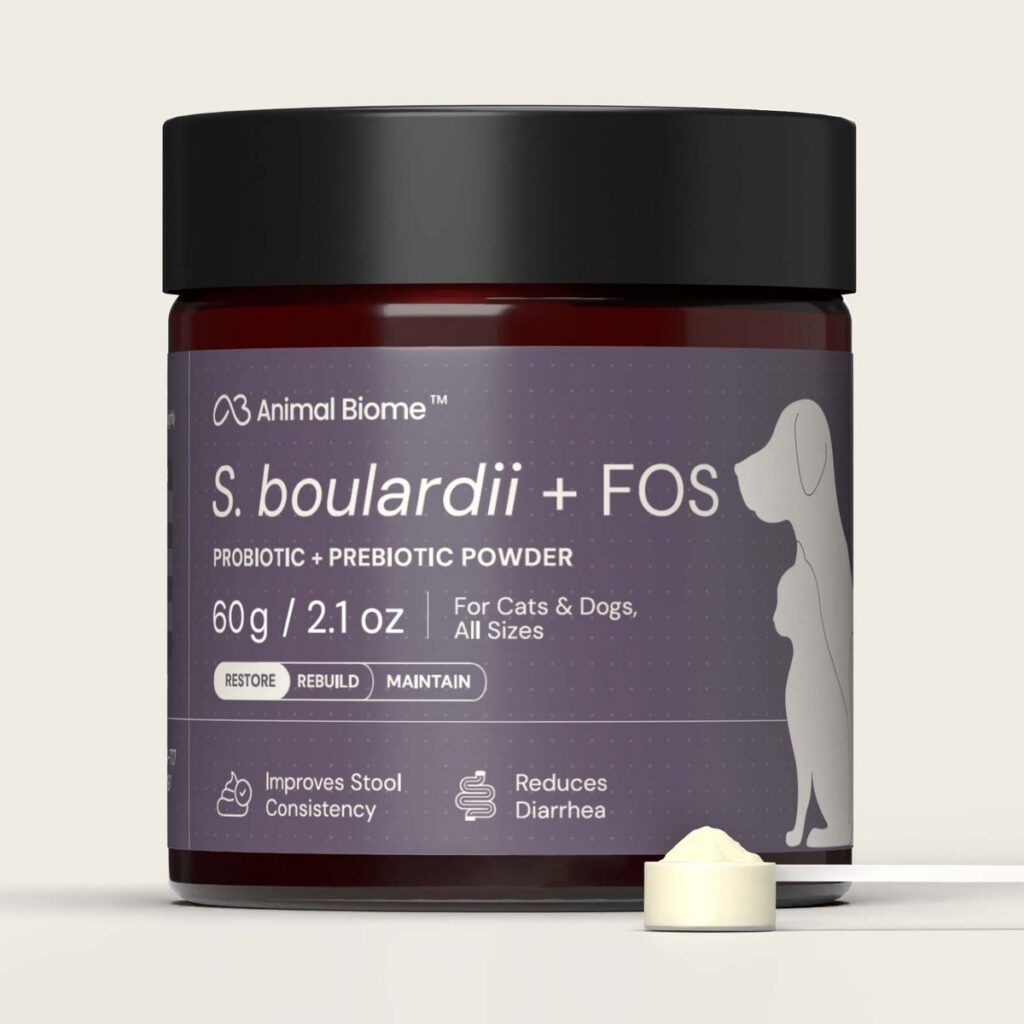
Animal Biome S. boulardii + FOS Powder for Cats and Dogs
A yeast probiotic plus prebiotic fiber for product-specific digestive support.
Compare these details before deciding that two products are equivalent:
- The organism name and strain, where listed.
- The prebiotic ingredient and its stated amount.
- The enzyme names and the product’s intended role.
- The serving unit, such as a scoop or capsule.
- Whether the amount is a daily total or a per-meal instruction.
This approach is more useful than comparing only the number of ingredients. A shorter formula may serve a focused purpose, while a combination product may suit a particular feeding plan. The choice should be intentional rather than based on the assumption that more categories are always better.
For a broader look at microbial supplements, Vetstreet’s guide to probiotics for cats with diarrhea discusses selection considerations. It also helps place probiotic use alongside the need to understand persistent symptoms.
Food and supplements should be considered together. A cat’s regular diet may already contain a prebiotic ingredient, and a second digestive-support product may contribute more of it. Identifying that overlap is part of choosing a manageable routine, especially for a cat that has reacted to dietary changes before.
When a Cat May Need Pancreatic Enzymes
Some cats develop exocrine pancreatic insufficiency, or EPI, in which pancreatic enzyme production is inadequate. Those cats may require pancreatic enzyme replacement under veterinary direction. That treatment addresses a diagnosed deficiency and should not be confused with everyday supplementation.
Pancreatitis is inflammation of the pancreas. It is a different condition, although pancreatic diseases can be related. Cornell’s Feline Health Center explains the pancreas’s digestive role and the problems associated with inflammation. A pancreatitis diagnosis alone does not establish that an ordinary enzyme supplement is the appropriate treatment.
Match support to the diagnosis
Pancreatic enzyme replacement treats a diagnosed enzyme deficiency. Everyday digestive support has a different purpose. Daily Digest Blend is not intended to replace the veterinary treatment of EPI or another pancreatic condition.
This is an important distinction when searching for the best digestive enzymes for cats with pancreatitis. The condition determines the clinical questions, while the specific product determines what it can reasonably contribute. A familiar ingredient name is not enough to make a product appropriate.
Animal Biome’s official Daily Digest Blend guidance explicitly states that the product is not intended for pets diagnosed with EPI or other pancreatic disorders. If your cat already receives pancreatic treatment, ask the treating veterinarian before adding, replacing, or changing any part of that regimen.
Signs That Should Prompt a Veterinary Assessment
Signs that warrant checking whether a cat needs digestive enzymes include unexplained weight loss, poor growth, persistent abnormal stools, or a substantial change in appetite. These observations can occur with several conditions and cannot confirm an enzyme deficiency or EPI by themselves. Some cats do not show the dramatic appetite and stool pattern owners may associate with enzyme deficiency. Veterinary assessment and appropriate pancreatic testing determine whether enzyme replacement is needed.
A clinical study of cats with EPI emphasizes considering the condition in cats with weight loss or poor growth after more common causes have been evaluated. The MSD Veterinary Manual describes feline trypsin-like immunoreactivity, or fTLI, as a blood test used in diagnosing pancreatic enzyme insufficiency.
Prepare information that helps the veterinarian choose the appropriate next step:
- The cat’s current and previous weights.
- Its exact food and the amount actually eaten.
- The timing and frequency of vomiting or abnormal stools.
- All medications and supplements.
- Any previous pancreatic or intestinal diagnosis.
A response to a supplement is not a substitute for this assessment. If the cat improves while several things are changing, the reason may still be uncertain. If it continues to lose weight, a more substantial evaluation is needed even when its stool appears temporarily better.
Choosing Everyday Digestive Support for Your Cat
To help a cat with digestion, start with a complete and balanced feline diet that suits its health needs. Depending on the care goal, your veterinarian may recommend a prescribed food, a feline probiotic or prebiotic, or an everyday meal-associated supplement such as Daily Digest Blend. Pancreatic enzyme replacement is a separate treatment for diagnosed deficiency. Begin with the feeding and care plan already in place: a cat eating a prescribed diet, taking medications, or showing persistent symptoms needs support that fits those details, with a clear reason for use and instructions everyone in the household can follow.
Bring the full label to the discussion. Digestive-enzyme supplements can differ in ingredients, intended use, texture, and serving size. Products labeled for cats and dogs still require cat-specific directions. A shared container does not mean the same amount should be given to both species.
A useful comparison includes:
- Purpose: What is the product intended to support?
- Formulation: Which enzyme, probiotic, and prebiotic ingredients are present?
- Administration: Is it given with food, as a whole capsule, or another way?
- Amount: Is the direction clear for the cat’s weight and feeding schedule?
- Tolerance: Has this cat reacted to any similar ingredient before?
- Follow-up: What would count as a useful response?
For ongoing questions about bacterial composition, Animal Biome’s Gut Microbiome Test for Cats provides a stool-based bacterial profile. Its role is to describe the microbiome and support an informed discussion. It does not diagnose an enzyme deficiency, food allergy, Giardia, or intestinal worms.
That distinction can prevent an unhelpful detour. If the clinical question is whether the pancreas produces enough enzymes, the veterinarian needs a test that addresses pancreatic function. If the question concerns the composition of the bacterial community, a microbiome profile supplies different information.
Format is another practical choice. A powder can be easy to incorporate into a familiar meal, but only if the cat eats the portion containing it. A liquid digestive-enzyme product is not automatically more suitable because it sounds easier to administer. Concentration, ingredients, and directions matter more than whether a formula pours or scoops. Consider the way your cat actually eats. A cat that finishes two individual meals is easier to monitor than one that grazes from a shared bowl. Before buying, decide how you will know whether the intended amount was consumed and how you will separate one cat’s supplemented meal from another cat’s food.
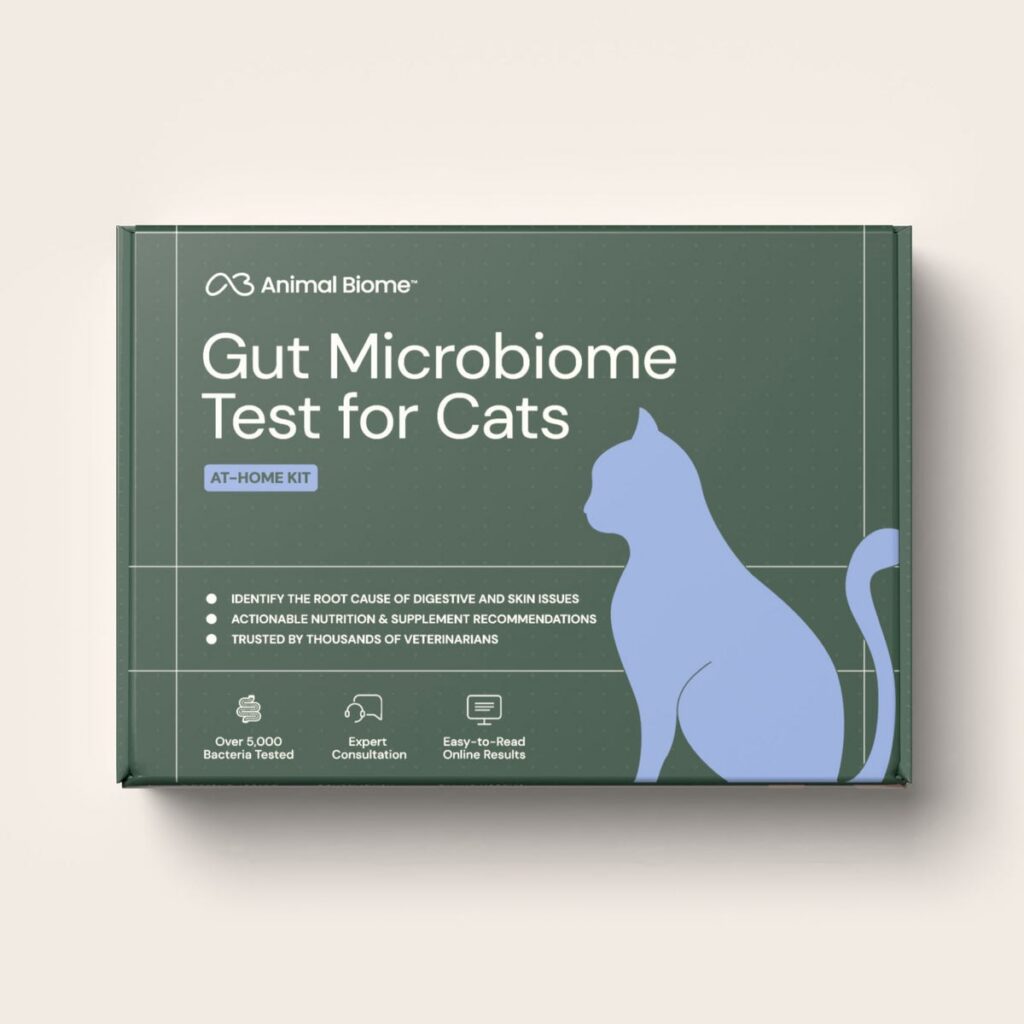
Animal Biome Gut Microbiome Test for Cats
Bacterial microbiome profiling for an informed ongoing support discussion; not a parasite diagnostic test.
Choose by Intended Purpose and Formulation
The best brand of digestive enzymes is not a universal ranking. A suitable choice has a clear purpose, transparent ingredients, usable feline directions, and a format that works for the individual cat. The most attractive claim on the front of a package cannot replace those details.
For Daily Digest Blend, the official ingredient list provides more information than the broad enzyme label. Read its components in three parts:
- Enzyme blend: Each scoop contains a 600-milligram ProBiome Enzyme Blend, which includes NutraFlora FOS, a protease blend, endopeptidase, amylase, xylanase, cellulase, papain, bromelain, lipase, and hemicellulase.
- Separately listed ingredients: S. boulardii, slippery elm, and bamboo extract appear outside that blend.
- Ingredient roles: FOS contributes a prebiotic role, while the yeast contributes a probiotic role. This is a combination product. Multiple categories are useful information when comparing it with the cat’s current supplements, not a reason to add every product in those categories.
Another distinct option is Animal Biome Gut Restore for Cats. It contains screened fecal-derived microbes from healthy cat donors in delayed-release capsules. Its purpose is microbiome restoration, and it is not a conventional single-strain probiotic or an enzyme-replacement preparation.
Gut Restore’s instructions also illustrate why format details matter: its capsules are intended to be given whole rather than opened or crushed. A caregiver who needs a powder should not assume that every capsule can be emptied onto food. Ask about the specific product before changing its delivery method.
Natural, vegetarian, plant-based, and organic claims deserve the same careful reading. They describe ingredient sources or selected features, not a guarantee that a product matches the cat’s needs. A plant-derived enzyme ingredient can be part of a formulated supplement, but its origin does not tell you the appropriate amount for your cat. Use the full formula to guide that comparison:
- Check which ingredients are actually identified as plant-derived or organic.
- Distinguish the capsule material from the contents inside it.
- Review all components when the cat has a known sensitivity.
- Look for the manufacturer’s current instructions instead of relying on a shortened retailer description.
- Keep the original package and lot information available.
The same care applies to safety. Digestive enzymes can cause side effects, and the risk depends partly on the preparation and the individual cat. A product intended for everyday support should still be reviewed when the cat has a medical condition or takes several medications.
Do not use a human product or a homemade mixture as an assumed substitute. A human serving may contain unsuitable accompanying ingredients or provide no usable feline directions. The appropriate comparison is between defined formulations and purposes, not between products that happen to share an enzyme name.
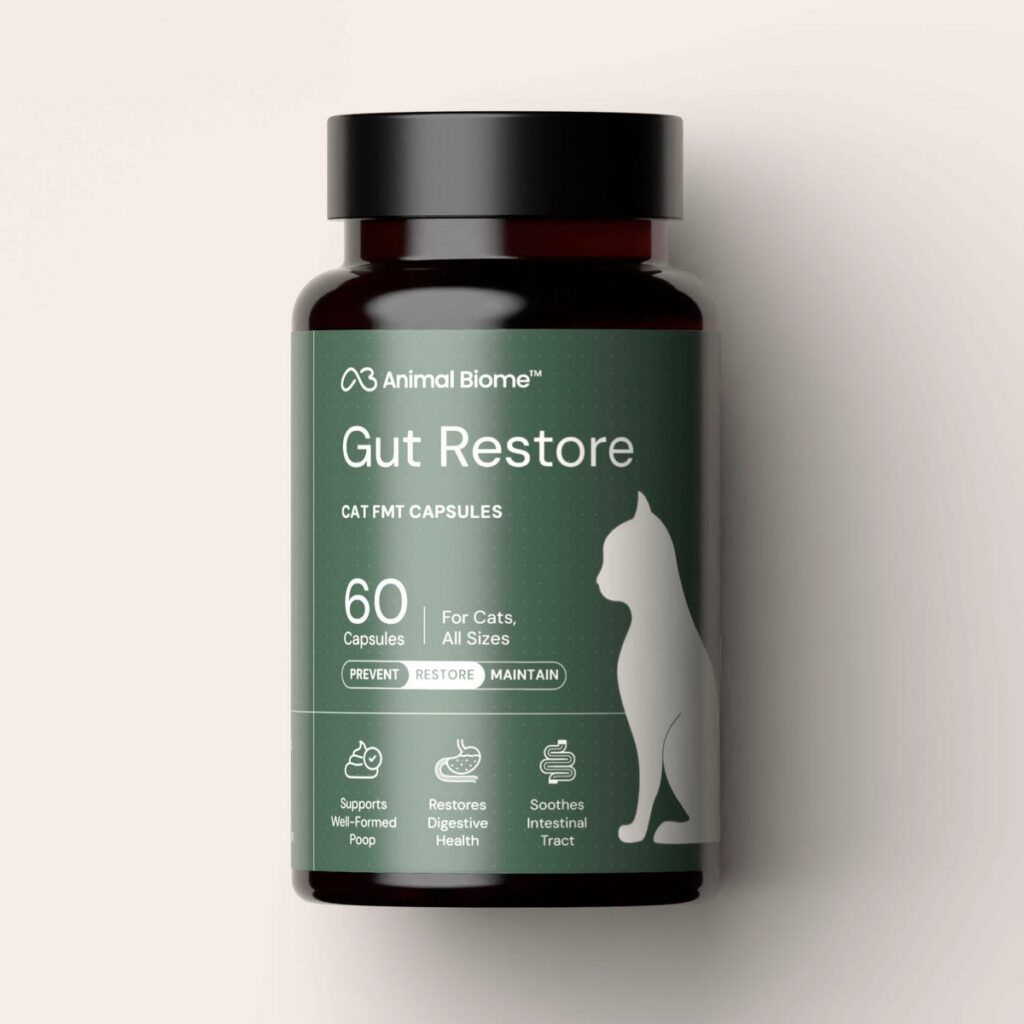
Animal Biome Gut Restore for Cats
Species-specific microbial restoration for an appropriate veterinary-guided plan.
The units on a combination-product label also deserve attention. Milligrams describe ingredient mass, while CFU describes a quantity of viable microorganisms. Enzyme activity can be listed in other units that relate to the specific enzyme. These numbers answer different questions and should not be added together into a single “strength” score. For a clearer comparison:
- Keep each number attached to its named ingredient and unit.
- Check whether it describes one scoop, one capsule, or the full daily serving.
- Compare the supplied serving tool with the directions on that same container.
- Ask the manufacturer about an unclear unit instead of converting it by guesswork.
Daily Digest Blend’s label, for example, gives a weight for the ProBiome blend and a separate CFU count for S. boulardii. The detailed blend information also identifies FOS. That means the blend’s total weight should not be interpreted as the amount of one particular enzyme.
Photograph the directions when starting a new container. If a future package changes its serving information, check whether the routine needs clarification rather than automatically carrying forward the previous scoop count. When a cat’s weight falls at an ambiguous printed boundary, ask which direction applies. A small clarification at this point keeps the feeding plan understandable and repeatable.
How to Introduce Daily Digest Blend With Meals
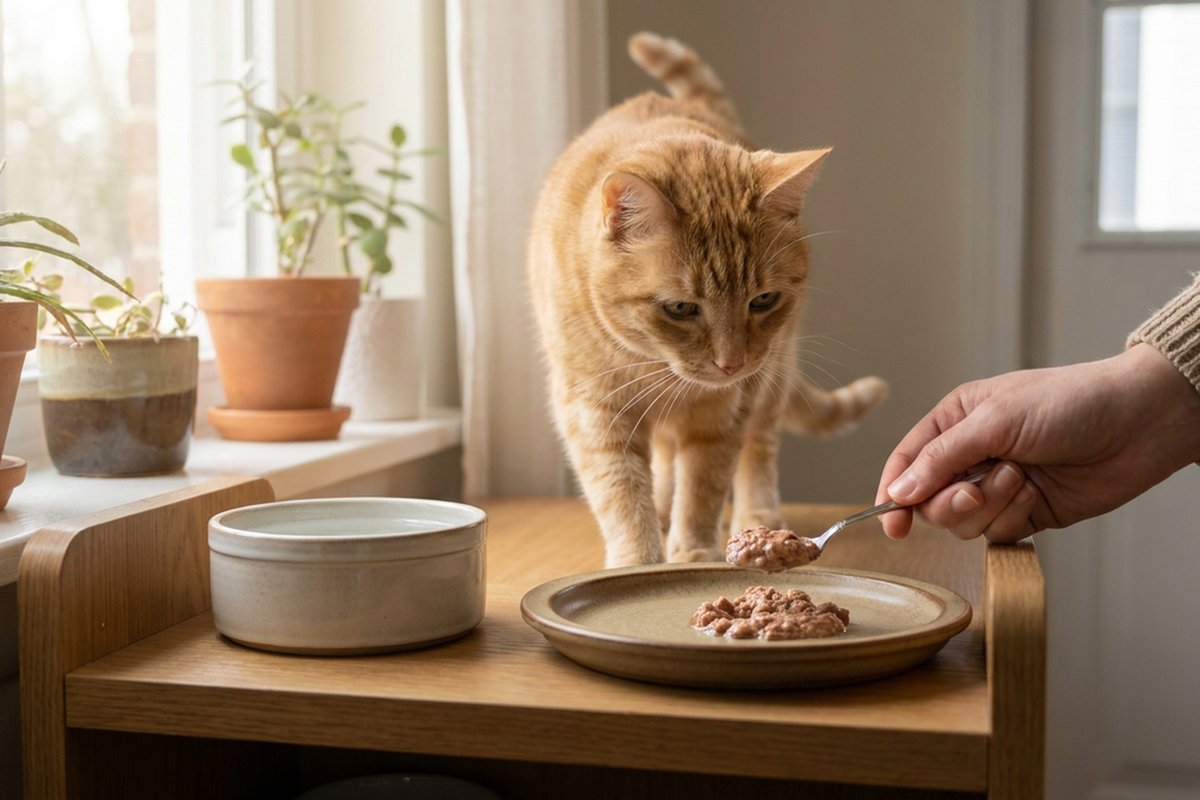
Animal Biome directs owners to give Daily Digest Blend with food. Its enzymes are intended to act together with the meal, so administration is part of the feeding routine rather than a separate drink or occasional treat.
Start with the directions on the current container and the plan agreed with your veterinarian. The label provides a daily amount by cat weight and instructs owners to add powder at meals. Clarify how to divide the daily total if the cat eats several times; do not assume that the full daily amount should be repeated at every feeding.
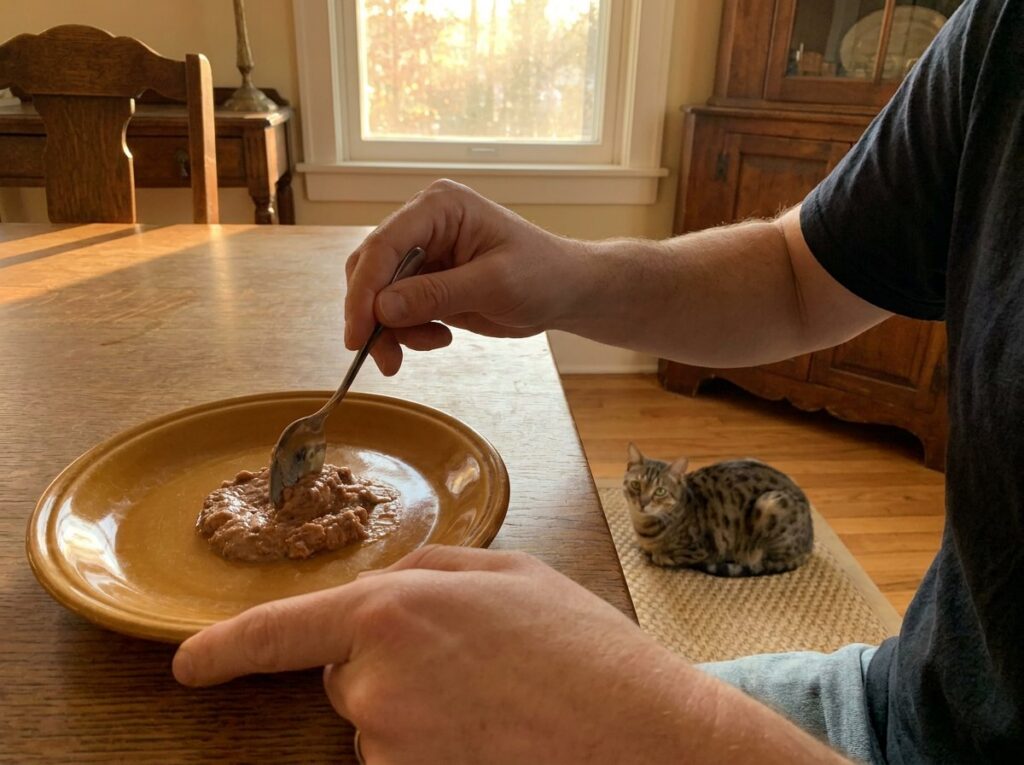
A practical introduction follows a simple sequence:
- Measure with the product’s supplied scoop.
- Add the planned amount to a small portion of a food the cat already enjoys.
- Watch whether that portion is eaten.
- Offer the remainder of the usual meal.
- Record any refusal, unfinished food, or new digestive signs.
A small first portion helps separate two questions: whether the cat accepts the addition and whether it eats its normal meal. If the entire daily food supply is supplemented at once and the cat refuses it, both questions become harder to answer.
Keep access to food central to the plan. Do not try to make a cat accept a supplement by withholding its ordinary meals. A cat that stops eating needs attention, and a supplement routine should not interfere with adequate intake.
Several household details can make the plan easier to follow:
- Feed cats separately when only one is receiving the supplement.
- Keep a written daily total where caregivers can see it.
- Mark when the supplemented portion has been offered.
- Record whether it was eaten instead of assuming an empty bowl belonged to the intended cat.
- Ask how to handle a missed or uncertain serving.
Avoid changing the food, introducing several supplements, and altering treats at the same time. If the cat develops a change in appetite or stool, a simpler routine provides a clearer timeline.
Ingredient overlap is particularly relevant with Daily Digest Blend. Its detailed formula lists 432.21 milligrams of FOS per scoop, and Animal Biome notes that combining it with S. boulardii + FOS can cause digestive upset in some pets because both contribute prebiotic fiber. Review the whole plan before combining them.
The manufacturer says that Daily Digest Blend can be used with probiotics, but that statement does not mean every possible combination is equally useful. Determine which products are needed, the total amounts involved, and how the cat tolerates the routine.
What to Record Before Your Follow-Up
A follow-up is most useful when you can describe what the cat ate, what was given, and what changed. For cats with diarrhea or IBD, that record also helps the veterinarian distinguish a supportive routine from a change in the underlying condition.
Digestive enzymes for cats with diarrhea are not a diagnosis-based solution by themselves. Diarrhea can have dietary, inflammatory, infectious, and other causes. Cornell’s guidance on feline diarrhea explains why ongoing signs and changes such as poor appetite, lethargy, or vomiting warrant veterinary assessment.
Record a few observations consistently:
- Food intake: Include the supplemented portion and the rest of the meal.
- Stool pattern: Note frequency, consistency, urgency, and any visible blood.
- Vomiting: Record timing and whether it is new or changing.
- Weight: Use comparable measurements when practical.
- Actual routine: Include daily amount, missed servings, medications, and other changes.
Vetstreet’s guide to what your pet’s poop can tell you can help you describe stool changes. Avoid assigning a diagnosis from appearance alone. A photograph or a consistent stool description is information for the veterinarian, not proof of an enzyme deficiency.
For a cat with IBD, keep the prescribed diet and medications consistent unless the treating veterinarian recommends a change. If several treatments are necessary, record when each begins. That timeline is more useful than crediting or blaming the most recently noticed product for every change. Evaluate the whole cat. Firmer stool does not cancel out falling appetite, continued weight loss, or reduced activity. Likewise, an isolated soft stool does not automatically mean a supplement should be increased. Petful’s guides to cat diarrhea after antibiotics and why cat poop smells really bad cover related situations.
Keep fresh water available and take suspected fluid loss seriously. Vetstreet explains signs of dehydration in pets. Contact the veterinary team promptly if the cat is unwell, rather than waiting for a planned review date while symptoms worsen. At the review, decide whether to continue, modify, or stop the supportive routine based on its purpose and the cat’s response. A clear record makes that decision easier and reduces the temptation to keep adding products without knowing what each one contributes.
Questions About Digestive Enzymes for Cats
In cats, possible problems include oral or digestive irritation and new signs such as vomiting, diarrhea, or reduced interest in food. The likelihood and appropriate response depend on the specific preparation and the cat’s health. If new signs develop after a product is introduced, contact your veterinarian with the label, amount, and timing. Do not assume that every reaction is an expected adjustment or that a larger amount will help. Significant or worsening symptoms require prompt assessment, while milder changes still deserve review before further additions.
A cat with a pancreatic condition needs product-specific veterinary guidance before starting or changing an enzyme product. The same is true for a cat with unexplained weight loss, ongoing illness, previous ingredient reactions, or a complex medication plan. An everyday supplement should not replace prescribed pancreatic enzyme treatment. Rather than treating all enzymes as unsuitable or universally safe, ask whether the exact formulation fits the diagnosis, food, and current routine. That discussion also establishes what to do if the cat does not tolerate it.
Papain and bromelain are examples of enzymes derived from plant sources, commonly associated with papaya and pineapple. They can appear as ingredients in a formulated supplement, including Daily Digest Blend. Their natural origin does not mean that pieces of fruit provide an equivalent dose or that a homemade mixture is appropriate for a cat. A formulated product identifies its ingredients and directions, while an ordinary food serving does not establish the same activity or purpose. Choose according to the complete formulation and the cat’s needs.
For a cat, the answer requires a review of the complete medication list and the specific product ingredients. Do not apply a human interaction list to feline treatment or stop a prescribed medication based on a supplement label alone. Bring the names, strengths, and schedules of prescription drugs, over-the-counter products, and supplements to the veterinarian. Combination formulas may include prebiotic fiber, yeast, or other ingredients in addition to enzymes. The clinician can assess the actual combination and clarify administration without disrupting necessary treatment.
They have different digestive roles, and some products intentionally contain both. Animal Biome states that Daily Digest Blend can be given with probiotics, but the complete routine still matters. Check for overlapping ingredients, particularly prebiotic fiber and yeast that may appear in more than one product. A combination should have a reason for each component and a clear daily amount. Introducing several separate products together makes tolerance harder to assess, so discuss which product or combination best fits the cat’s plan.
Animal Biome recommends that you give with food, rather than mix Daily Digest Blend into drinking water. The enzymes are intended to accompany the food they act on, and the directions place the powder with each meal. Work from the total daily amount on the current label and clarify how to divide it across meals. A measured food portion also makes consumption easier to observe than a shared water bowl. If the cat will not eat the supplemented portion, discuss another administration plan instead of restricting normal food or water.