S. boulardii for Cats: What It Is and How It’s Used
Published on November 02, 2026
Sponsored by Animal Biome. This article contains affiliate links. We may earn a commission if you purchase through them. Vetstreet receives compensation from Animal Biome.
S boulardii for cats is a yeast probiotic used for digestive support. Choosing it involves more than finding the organism’s name on a container: the strain, other ingredients, amount per scoop, and reason for using it all matter. The practical starting point is a product made for pets, its current directions, and a care plan that accounts for your cat’s health.
Animal Biome’s S. boulardii + FOS Powder pairs a research-backed yeast strain with a prebiotic ingredient. Below, we explain that combination, how to interpret its maintenance and advanced-support directions, and what to record so you and your veterinarian can judge whether the plan is helping.
All featured products are chosen at the discretion of the author. However, Vetstreet may make a small affiliate commission if you click through and make a purchase.
What Is S. boulardii for Cats?
Saccharomyces boulardii, usually shortened to S. boulardii, is a yeast. A yeast probiotic is different from a bacterial probiotic, even though both appear in the digestive-support aisle. The word “probiotic” describes a beneficial use of live microorganisms; it does not mean that every probiotic contains the same organisms or serves an identical purpose.
That distinction helps when you compare products. A bacterial blend, a single yeast formulation, and a supplement containing several ingredient categories may all be described as gut support. Their labels still need to be read individually. Product-specific directions tell you how a particular formula is intended to be used.
The current Animal Biome S. boulardii + FOS Powder contains two active ingredients per supplied scoop:
- Saccharomyces boulardii CNCM I-3799: 6.6 billion colony-forming units, or CFU, of the yeast.
- GOFOS: 225 milligrams of fructooligosaccharides, abbreviated FOS.
- No listed inactive ingredients: The powder’s label does not list fillers or flavoring ingredients.
The organism and the FOS do different jobs. The yeast is the probiotic component. FOS is a prebiotic carbohydrate that provides a food source for beneficial gut microbes. The powder is designed to be mixed with food, making its administration part of a cat’s normal feeding routine.
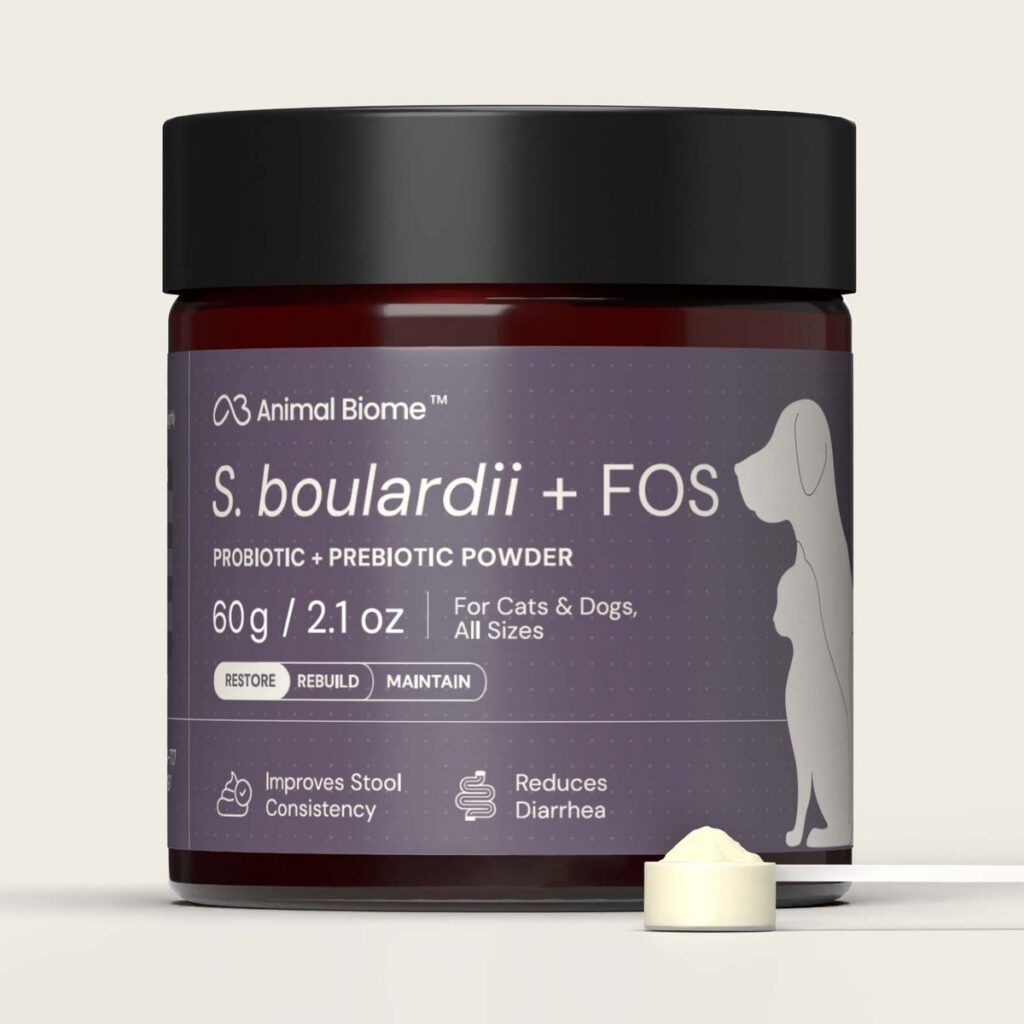
Animal Biome S. boulardii + FOS Powder for Cats and Dogs
A yeast probiotic plus prebiotic fiber for digestive support.
CFU describes the number of viable microorganisms in a serving. It does not establish that a larger number is better for every cat. Two products can list similar CFU counts while differing in strain, serving size, accompanying fiber, or intended use. Those differences are especially relevant when instructions found online refer to capsules instead of powder.
There is also a distinction between evidence about probiotics generally and evidence about a specific formulation. A controlled study of cats receiving clindamycin evaluated a multistrain bacterial synbiotic, not this S. boulardii product. Its findings should not be presented as proof of what CNCM I-3799 will do for an individual cat.
For the same reason, a report involving dogs, another yeast strain, or another combination formula cannot supply your cat’s dose. Use research to understand the question a product is meant to address, then use the actual formulation and your cat’s circumstances to guide the decision.
Choosing S. boulardii for Your Cat’s Care Plan
Start by naming the purpose of the supplement. An owner seeking ongoing support for a cat whose stools are currently well controlled has a different decision from an owner whose cat has newly developed diarrhea. In a cat with inflammatory bowel disease, or IBD, a supplement also needs to fit the established treatment plan.
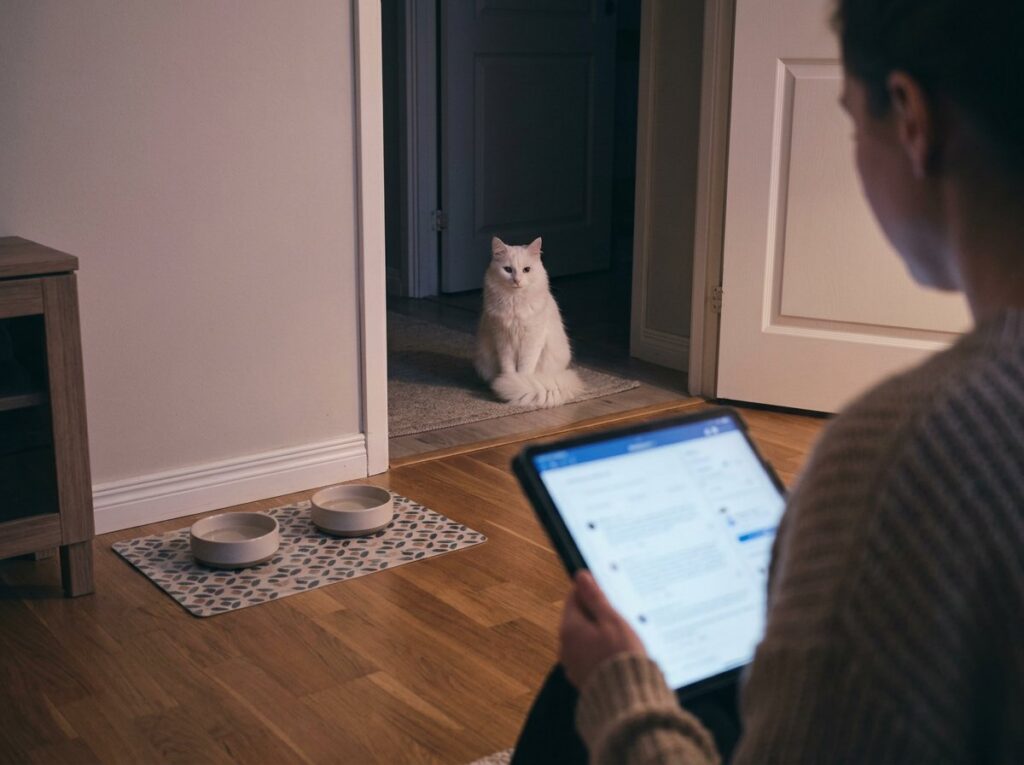
A useful conversation begins with the information you already have: when the change started, what the cat eats, current medications, previous testing, and whether appetite or weight has changed. That history helps your veterinarian decide whether the immediate priority is investigating a cause, adjusting an existing plan, or trying an appropriate supportive product.
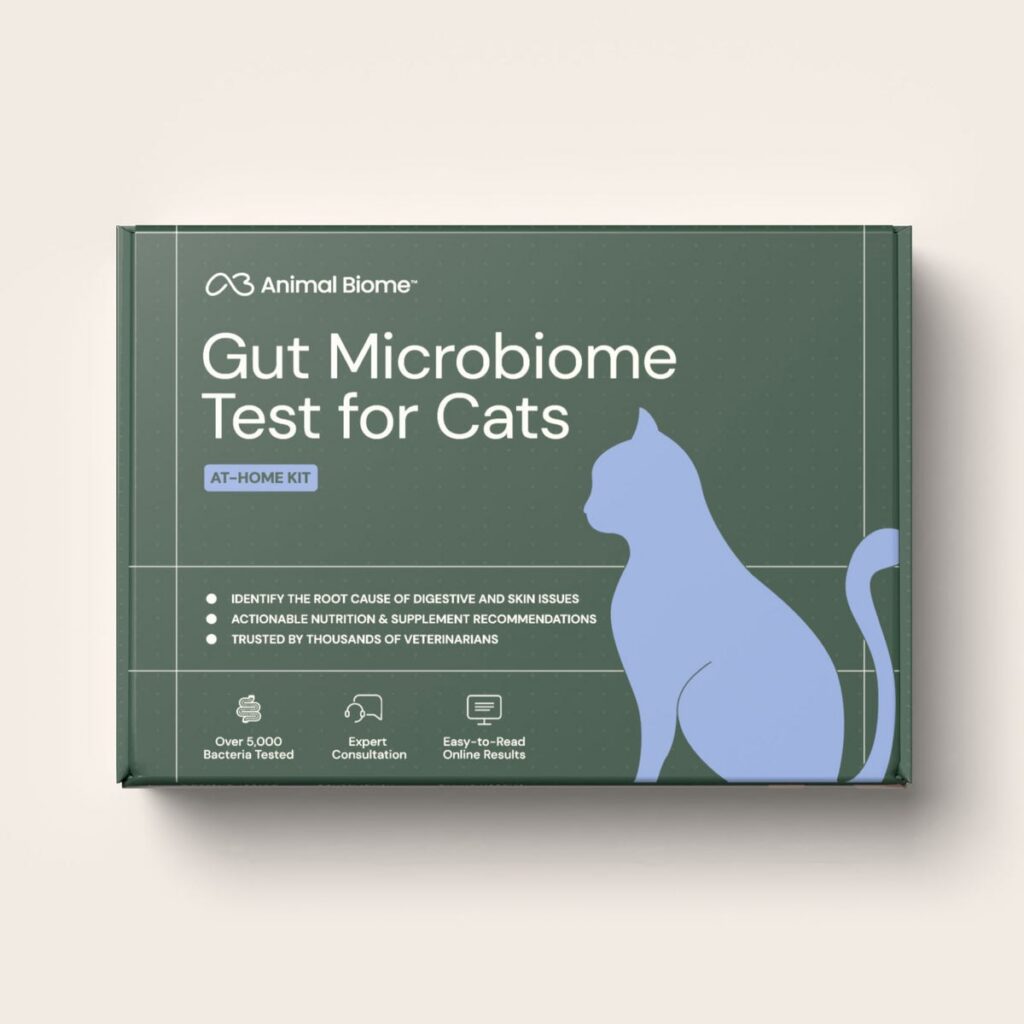
Animal Biome Gut Microbiome Test for Cats
Bacterial microbiome profiling for an informed ongoing support discussion; not a parasite diagnostic test.
For a more detailed look at bacterial composition, Animal Biome’s Gut Microbiome Test for Cats uses a stool sample to profile the types and proportions of bacteria present. The report can support a discussion about ongoing microbiome care. It does not diagnose an enzyme deficiency, food allergy, Giardia, or intestinal worms, and it does not measure whether your cat needs S. boulardii.
Once the intended role is clear, compare the label rather than the product name alone. Animal Biome’s powder is labeled for cats and dogs, but its directions still depend on body weight and whether the cat currently has soft stools. A shared species label does not make another product’s serving size transferable.
Pay particular attention to the ingredient paired with the yeast:
- FOS means fructooligosaccharides. The current powder lists GOFOS, a source of FOS, alongside the named yeast strain.
- MOS means mannan-oligosaccharides. It is a different ingredient that appears in some other digestive-support formulations.
- A teaspoon is a volume, not a universal probiotic amount. Powders can differ in concentration and density.
- A capsule is not a standardized serving across brands. Its contents may differ in both CFU and other active ingredients.
FOS is different from MOS. Instructions for an S. boulardii-and-MOS product therefore should not be copied onto an S. boulardii-and-FOS product. Even if the yeast name looks familiar, changing the accompanying ingredient changes the formula you are giving.
Key Takeaways
- Check the named yeast strain and CFU per scoop on the current label.
- Remember that FOS is different from MOS when comparing formulas.
- Measure with the supplied scoop and distinguish the maintenance amount from the advanced support amount.
The same reasoning applies within one brand’s range. A product may be useful for a different microbiome goal without being an equivalent substitute for the yeast powder. Identify the role first, then consider the format, ingredients, and how it will fit your cat’s meals.
A practical way to prepare for a product discussion is to bring photographs of both the front and back of each container. The front identifies the product; the back supplies the formulation and instructions. Include supplements given only occasionally, since an intermittent addition can still change the day’s total prebiotic intake.
Ask focused questions rather than simply asking whether a product is “good”:
- What are we trying to improve or maintain?
- Does this formula fit my cat’s diagnosis, food, and medications?
- Which label directions apply, and what should prompt us to reconsider?
- When should we review the response?
A research citation can help you ask better questions about a formulation. For example, a 2025 study in healthy adult breeding cats examined a yeast identified as DSM 34246. Animal Biome’s current powder identifies CNCM I-3799. Recognizing those different strain names is a practical label-reading skill, not a reason to assume that one study supplies instructions for both products.
When assessing a research reference, separate three questions:
- What was given? Match the organism, strain, accompanying ingredients, and serving description to the actual product.
- Who received it? Healthy adult cats, kittens, and cats with diagnosed disease are different study populations.
- What was measured? A bacterial profile, stool observation, and clinical outcome answer different questions.
This also helps you use an owner review appropriately. A review may describe acceptance of a powder or a change noticed at home. It usually cannot separate the supplement from a simultaneous food change, prescribed medication, or the natural course of a digestive episode. Treat it as a prompt for practical questions rather than a personalized dosing guide.
If microbiome sampling is part of the care plan, discuss its timing before changing the routine. A sample collected before a new product and one collected afterward represent different points in that routine. Record which foods and supplements were being used when each sample was taken so the report has useful context.
Prepare the sampling plan with the veterinary team:
- Confirm whether the purpose is to describe the current routine or compare two planned time points.
- Follow the kit’s collection instructions and record the collection date.
- Ask how any preparation instructions apply to prescribed treatment before changing it.
- Keep a copy of the product label with the sample history.
Animal Biome’s test instructions recommend a brief probiotic pause before sampling. Coordinate that instruction with the veterinarian when the cat is receiving a prescribed regimen; do not independently interrupt necessary treatment. The goal is an interpretable sample and a clear history. A bacterial report can then contribute to the broader care discussion without being mistaken for a measurement of the yeast powder’s dose or a diagnosis of the original problem.
Is Saccharomyces boulardii safe for cats?
S. boulardii is used in products formulated for cats, including Animal Biome’s powder, but suitability depends on the individual cat and the complete formula. The official product directions advise consulting a veterinarian before use, particularly when a pet has a health condition. They also acknowledge that diarrhea can occasionally worsen.
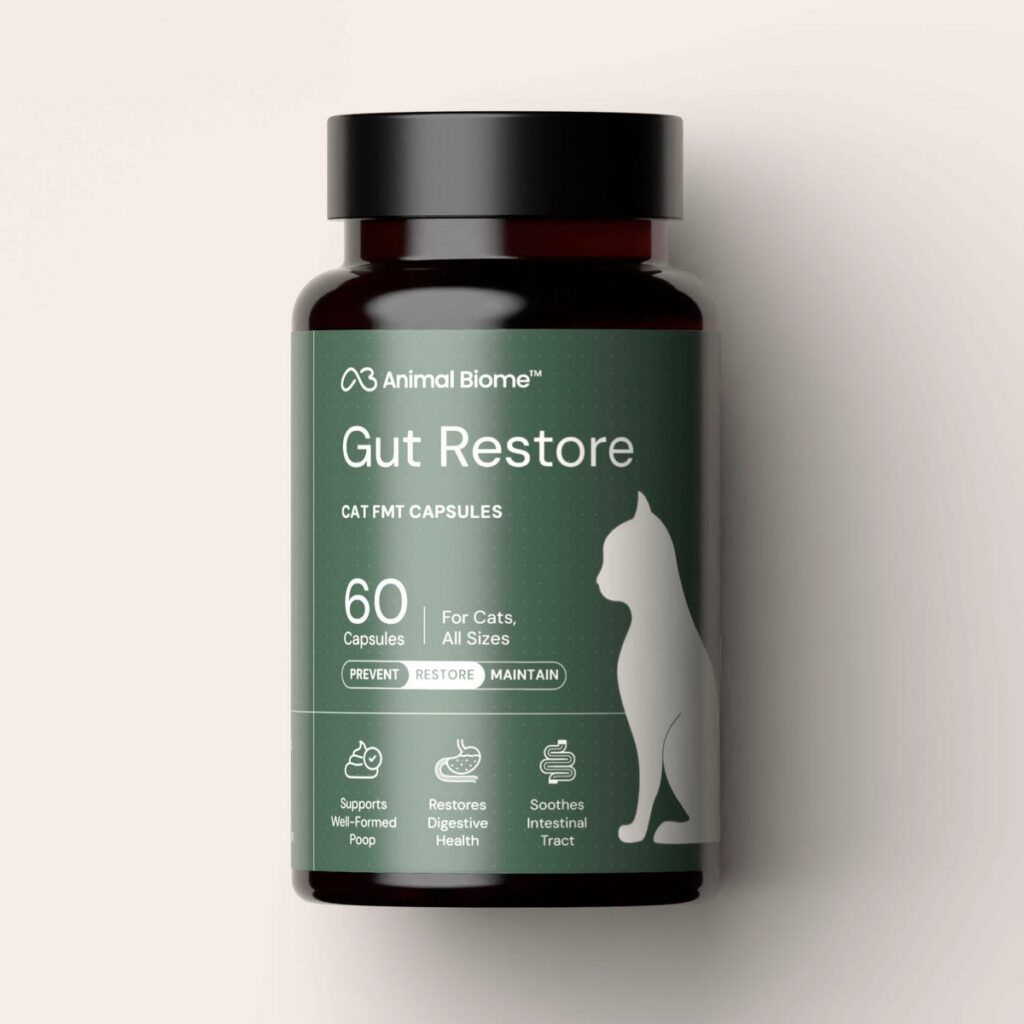
Animal Biome Gut Restore for Cats
Species-specific microbial restoration for an appropriate veterinary-guided plan.
Bring up the cat’s age, diagnosis, medications, and previous reactions to supplements. For a cat with IBD, the decision should fit the prescribed diet and treatment. An appropriate supportive product can have a defined place in that plan without replacing the work of controlling the underlying disease.
Animal Biome also offers Gut Restore for Cats for a different microbiome-support role. It contains screened, cat-derived fecal microbes in a delayed-release capsule. It is not a conventional single-strain probiotic, and its capsule instructions differ from powder instructions. A veterinarian can help determine whether that kind of restoration belongs in the cat’s plan.
Choosing among these roles is not a requirement to use several products. Sometimes the most useful next step is a clearer diagnosis or a simpler routine. When a supplement is selected, give it a specific purpose so the response can be evaluated.
How Much S. boulardii Should You Give a Cat?
The amount depends on the exact product, the cat’s weight, and the directions selected for that cat. For Animal Biome’s S. boulardii + FOS Powder, use the supplied scoop and the current container directions. Do not convert another brand’s capsules or internet teaspoon instructions into an assumed equivalent.
The label separates a maintenance amount, intended for pets not currently experiencing soft stools, from an advanced support amount, intended for pets currently experiencing soft stools. These are daily totals. “Advanced” describes a label category; it does not establish the cause of diarrhea or mean that every worsening symptom calls for more powder.
For the current formula, the published directions give these examples:
- Cats weighing up to 10 pounds: The maintenance amount is one-half scoop daily; the advanced support amount is one scoop daily.
- Cats weighing 11–20 pounds: The maintenance amount is three-quarters of a scoop daily; the advanced support amount is one and one-half scoops daily.
- Cats outside those ranges or between listed boundaries: Confirm the appropriate instruction with your veterinarian or the manufacturer instead of rounding into a category.
- When starting: The manufacturer recommends beginning with half the recommended daily amount and increasing gradually.
These examples describe the current product label, not a personalized prescription. Check the package you have, particularly after a reformulation or a change in the cat’s weight. If your veterinarian has supplied different instructions for your cat, clarify those instructions before making a change.
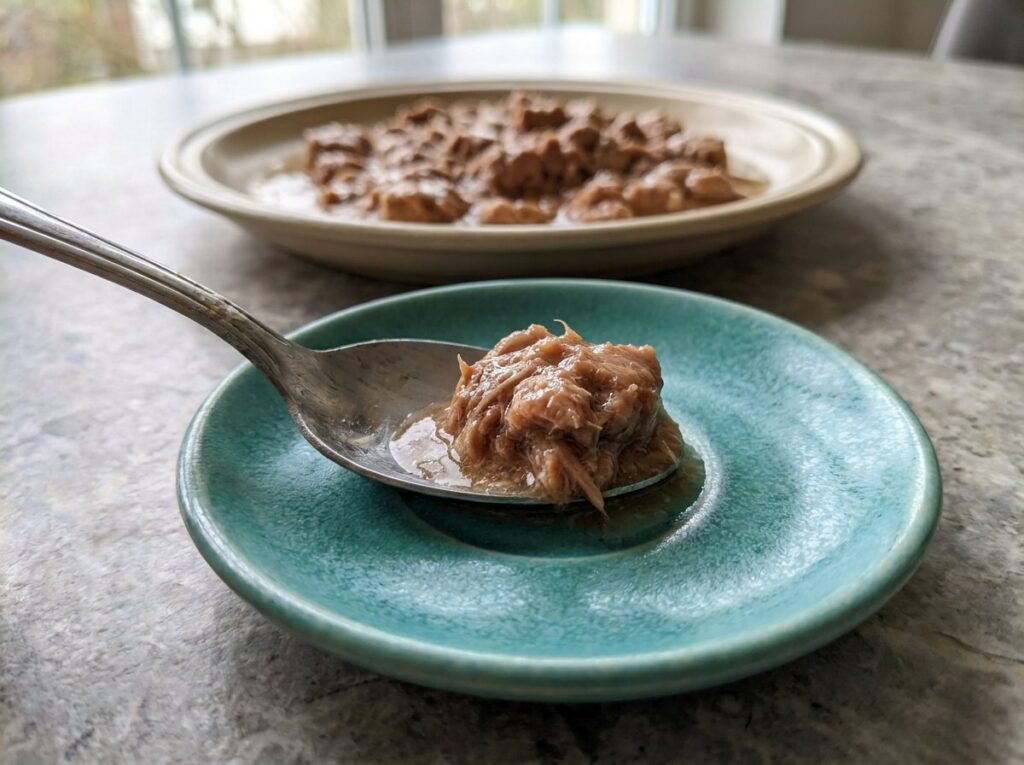
Mix the measured powder into food at mealtime as directed. A small portion of a familiar food can make it easier to see whether the cat actually eats the supplemented portion before you offer the remainder. Avoid mixing it into an entire day’s food supply when several cats share bowls, because you may not know which cat consumed it.
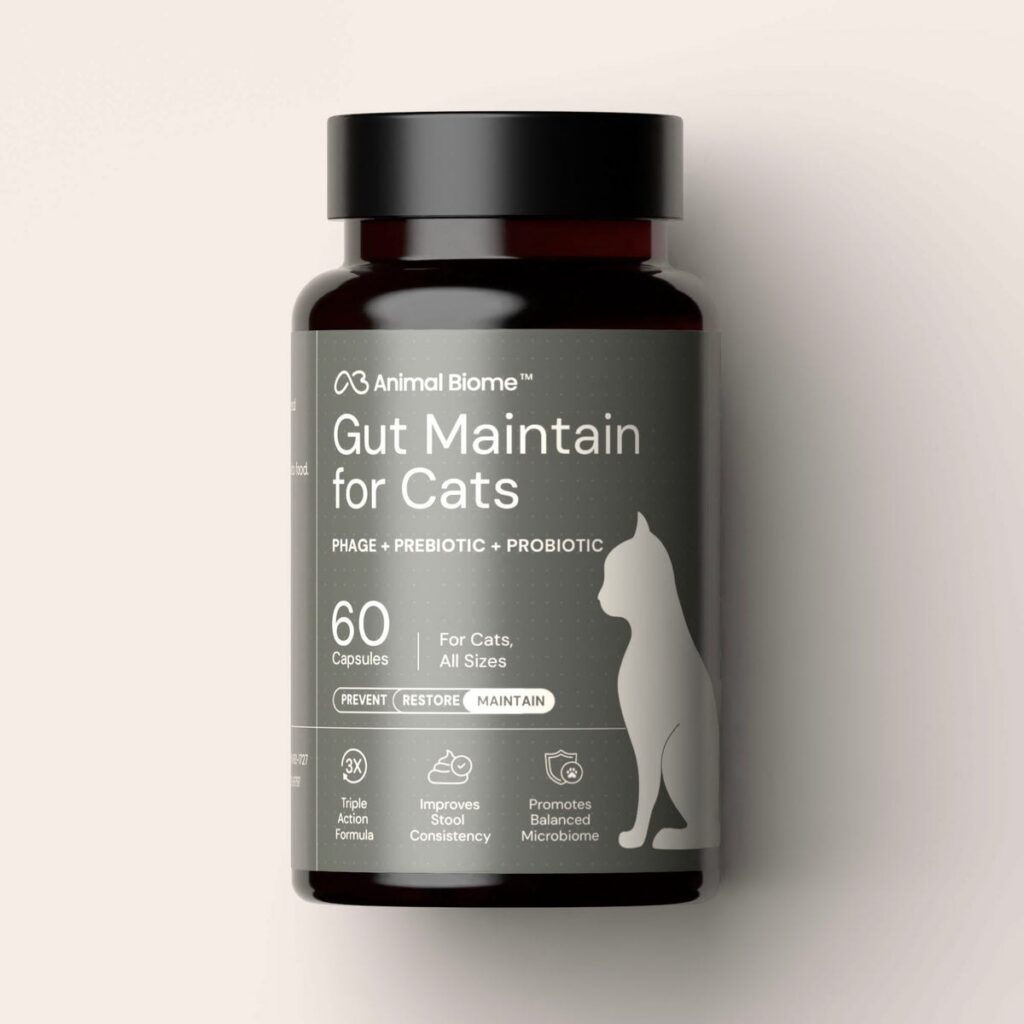
Animal Biome Gut Maintain for Cats
Daily microbiome maintenance after the immediate concern is addressed.
Consistency is more useful than elaborate administration. Keep the scoop with its own container and write down the daily amount in ordinary terms. If two people feed the cat, agree on who gives the supplement and how to mark that it has been given.
For cats whose immediate concern has settled and whose goal is routine support, Animal Biome Gut Maintain for Cats is a separate option to discuss. Its formula includes S. boulardii, BIO-MOS, and a phage blend. It has its own capsule-based directions, so switching to it is a formulation decision rather than a scoop-for-capsule exchange.
Several small details can prevent confusion during everyday use:
- Record the total daily amount, especially if it is divided between meals.
- Note whether a meal was fully eaten, partly eaten, or refused.
- Keep another pet’s supplement and scoop separate.
- Ask how to handle an uncertain or missed serving instead of automatically doubling the next one.
- Record any other new food, treat, medication, or supplement introduced at the same time.
If the cat leaves food behind, you may not be able to determine exactly how much powder was consumed. That uncertainty belongs in the feeding notes. Adding another full serving immediately can turn an incomplete observation into an excessive daily amount.
A change from advanced support to maintenance should also be deliberate. Agree on what improvement you are looking for and when to review the next step. A single better bowel movement may be encouraging, but the wider pattern of appetite, comfort, and stool consistency matters more than one result.
What to Monitor After Starting S. boulardii
A short, consistent record is more useful than trying to remember whether the litter box seemed “better.” Begin with the cat’s usual routine and then note changes after the supplement starts. The aim is to describe what happened, not to diagnose the cause from stool appearance.
Useful observations include:
- Stool frequency: How many bowel movements you can reasonably identify in a day.
- Stool consistency: Whether stools are formed, soft, or watery, using the same description each time.
- Appetite: Whether the cat eats its normal quantity and accepts the supplemented portion.
- Other digestive signs: Vomiting, straining, urgency, or apparent discomfort.
- The routine itself: Product amount, missed servings, and changes in food or medication.
Vetstreet’s guide to what stool changes can tell you can help you describe observations clearly. A photograph may be useful if your veterinarian asks for one, but appearance alone cannot identify IBD, an infection, or the need for a particular supplement.

Bring a useful follow-up record
Record stool frequency, consistency, appetite changes, and the amount actually eaten. If the cat worsens, contact your veterinarian rather than increasing the supplement automatically.
In a multicat home, identify whose stools you are seeing before drawing conclusions. Shared litter boxes can make a daily count uncertain. It is fine to record “not sure” and explain the household setup; a precise-looking number that belongs to the wrong cat is less useful.
Evaluate the whole cat as well as the stool. A cat whose bowel movements appear firmer but who is eating less still needs attention. Likewise, an improvement that coincides with a diet change or a prescribed treatment cannot confidently be attributed to the supplement alone. For related reading, see Petful’s guides to cat diarrhea after antibiotics and mucus in cat poop.
What Changes Should Prompt a Call to Your Vet?
Possible disadvantages of S. boulardii products include individual intolerance and difficulty separating a supplement reaction from the original digestive problem. Animal Biome’s label notes that diarrhea can rarely develop or worsen and advises discontinuing the product if severe side effects occur. Worsening signs should prompt a review of the plan, not an automatic increase.
Contact your veterinarian promptly about reduced appetite, repeated vomiting, lethargy, apparent pain, substantial blood in the stool, or a marked deterioration. Cornell’s Feline Health Center explains that diarrhea can have many causes and that persistent diarrhea accompanied by systemic signs warrants veterinary care. Fluid loss is another reason to assess the entire cat. Read about recognizing dehydration in pets, and ask your veterinarian about any suspected dehydration. Keep fresh water available, but do not assume that seeing the cat drink means fluid losses have been corrected.
For mild changes in an otherwise comfortable cat, follow the review plan you agreed on. For worsening or significant symptoms, contact the clinic sooner. The purpose of monitoring is to help you make that distinction and provide useful information when the plan needs adjustment.
Questions About Giving S. boulardii to Cats
There is no single best choice for every cat with IBD. The appropriate option depends on the individual treatment plan, current diet, medications, and the reason for adding a specific probiotic formulation. A yeast product and a bacterial blend should not be assumed to produce identical results. Vetstreet’s guide to probiotics for cats with diarrhea explains broader selection considerations. Bring the exact label to the veterinarian managing the IBD so the supplement has a defined role and a sensible review point.
If a cat with diagnosed IBD develops worsening signs, contact the treating veterinarian and describe what changed, when it started, and whether the cat is eating. Keep following the prescribed diet and medication unless that veterinarian directs otherwise. Do not respond by withholding meals, changing several foods, increasing supplements, or altering prescribed drugs on your own. Repeated vomiting, poor appetite, marked lethargy, pain, or significant bleeding can require prompt assessment. The next step is to reassess the cat’s condition and treatment needs, rather than assume that an additional probiotic serving will settle the episode.
Because S. boulardii is a yeast probiotic, antibacterial medications do not affect it in the same way they can affect susceptible bacteria. Animal Biome describes its powder as suitable for use during antibiotic treatment. Still, confirm the plan with the prescribing veterinarian, including the full product formulation and any other medications. Yeast identity alone does not establish that a product will prevent every digestive side effect. If the cat develops diarrhea, vomiting, or a reduced appetite while taking an antibiotic, report those changes rather than stopping or changing the prescribed antibiotic yourself.
The current Animal Biome powder is intended for both occasional support and ongoing use, and its label provides a maintenance amount for pets without current soft stools. Daily use should still have an ongoing purpose. Review with your veterinarian whether the same formula remains appropriate after the original concern changes, particularly if the cat’s food, medications, or other supplements change. A routine that was useful during one period does not need to continue unchanged indefinitely. Keep the amount, tolerance, and reason for use in the cat’s care record so future decisions are straightforward.
For storage after opening, Animal Biome recommends keeping this powder in the refrigerator after opening and says to use within 60 days. Write the opening date on the container, keep the original label available, and use a clean, dry scoop. The manufacturer notes that the powder can clump in humid conditions because it has no flow agents or fillers. Follow the instructions on your current package and contact the manufacturer if storage conditions were uncertain. Do not transfer storage directions from a different yeast product or from a capsule formulation.