Prebiotics for Cats: What They Do and How to Choose Them
Published on November 02, 2026
Sponsored by Animal Biome. This article contains affiliate links. We may earn a commission if you purchase through them. Vetstreet receives compensation from Animal Biome.
Prebiotics for cats provide nourishment for beneficial gut microbes. They may already be present in your cat’s food, and they also appear in supplements, including products that combine them with probiotics or digestive enzymes. Choosing one starts with understanding the ingredient and the purpose of adding it.
The most useful comparison includes your cat’s entire feeding routine: its regular food, current supplements, and any proposed addition. This guide explains what prebiotics contribute, how Animal Biome’s different formulas fit distinct support goals, and how to make one manageable change while tracking your cat’s response.
All featured products are chosen at the discretion of the author. However, Vetstreet may make a small affiliate commission if you click through and make a purchase.
How Prebiotics for Cats Work
The gut microbiome is the community of microorganisms associated with the digestive tract. Different microbes carry out different functions, and the substances available to them influence their activity. Prebiotics nourish beneficial microbes by providing materials those organisms can use.
FOS, short for fructooligosaccharides, is one example. Inulin is another ingredient name you may encounter when reading about prebiotic sources. These ingredients are often discussed alongside fermentable fiber because microbial fermentation is part of how they are used in the gut.
Keep three ideas separate:
- Fiber describes a broad group of dietary components. A fiber claim does not identify one specific prebiotic ingredient or establish a particular effect.
- Prebiotic describes a relationship with microbes and a benefit. It is more specific than simply saying that a product contains plant material.
- The complete formula matters. Ingredient identity, amount, food, and the individual cat all affect the practical decision.
Microbial fermentation can produce short-chain fatty acids, including compounds such as butyrate. These are part of the gut’s chemical environment. That biological role helps explain the interest in prebiotics, but it does not mean every added fiber produces the same result in every cat.
A study involving eight healthy adult cats evaluated diets containing short-chain FOS, galactooligosaccharides, or both. The supplemented diets increased certain fecal bacterial populations, including Bifidobacterium. Some fermentation measures also changed, while fecal dry matter and output did not differ between treatments. That study supports a focused conclusion: selected ingredients can influence measures of feline gut microbial activity. It was not a trial showing that any prebiotic supplement treats diarrhea, and its food formulations do not supply dosing instructions for a different product.
Animal Biome S. boulardii + FOS Powder makes its prebiotic component identifiable on the label. Each supplied scoop contains 225 milligrams of GOFOS alongside the yeast probiotic S. boulardii. That transparency lets you recognize the two ingredient roles before deciding whether the combination suits your cat’s plan.
Prebiotics and Probiotics Are Different Parts of Gut Support
Prebiotics provide food for beneficial microbes. Probiotics provide live microorganisms. One supplies a usable ingredient; the other supplies organisms. The names sound similar, but the distinction is central to understanding combination products.
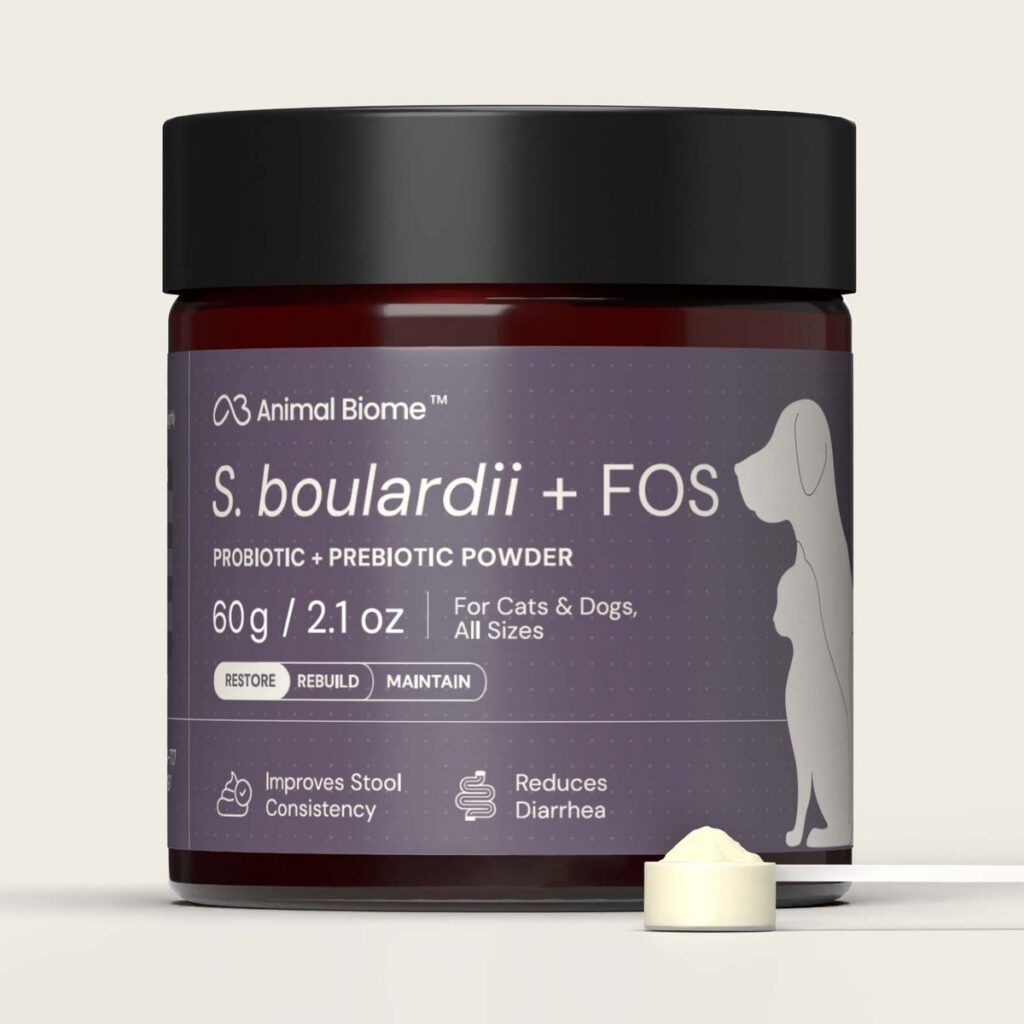
Animal Biome S. boulardii + FOS Powder for Cats and Dogs
A yeast probiotic plus prebiotic fiber for product-specific digestive support.
An ingredient does not become a probiotic simply because it is intended to support digestion. Fiber is not a live organism. Likewise, a probiotic is not always a bacterium: S. boulardii is a yeast, and it appears in several different digestive-support formulations.
When comparing probiotics and prebiotics for cats, identify:
- The prebiotic: Look for a named ingredient, such as FOS, rather than relying only on the front-of-package phrase “gut support.”
- The probiotic: Look for the organism and, when supplied, the strain and CFU per serving.
- Other categories: A combination product may also contain enzymes or additional ingredients with separate roles.
The current S. boulardii + FOS Powder contains yeast and prebiotic FOS. Daily Digest Blend includes enzymes as well as FOS and yeast. Gut Maintain for Cats has another formulation, with S. boulardii, BIO-MOS, and a phage blend. These are different products, even though each participates in a broader digestive-support discussion. Choosing among them is not a requirement to combine them. First decide whether the goal concerns a particular prebiotic addition, a yeast-containing formula, everyday meal support, or ongoing microbiome maintenance. Then examine the specific product’s directions.
If your main question is which probiotic to choose, Vetstreet’s guide to probiotics for cats with diarrhea covers that broader selection decision. The appropriate option depends on the cat’s circumstances and the formulation, rather than a universal “best” organism or the largest CFU number.
For prebiotic selection, the key follow-up is what the cat already receives. A combined probiotic and prebiotic product can add fiber even when its name emphasizes the probiotic. Recognizing that contribution helps you build a clear inventory before adding anything else.
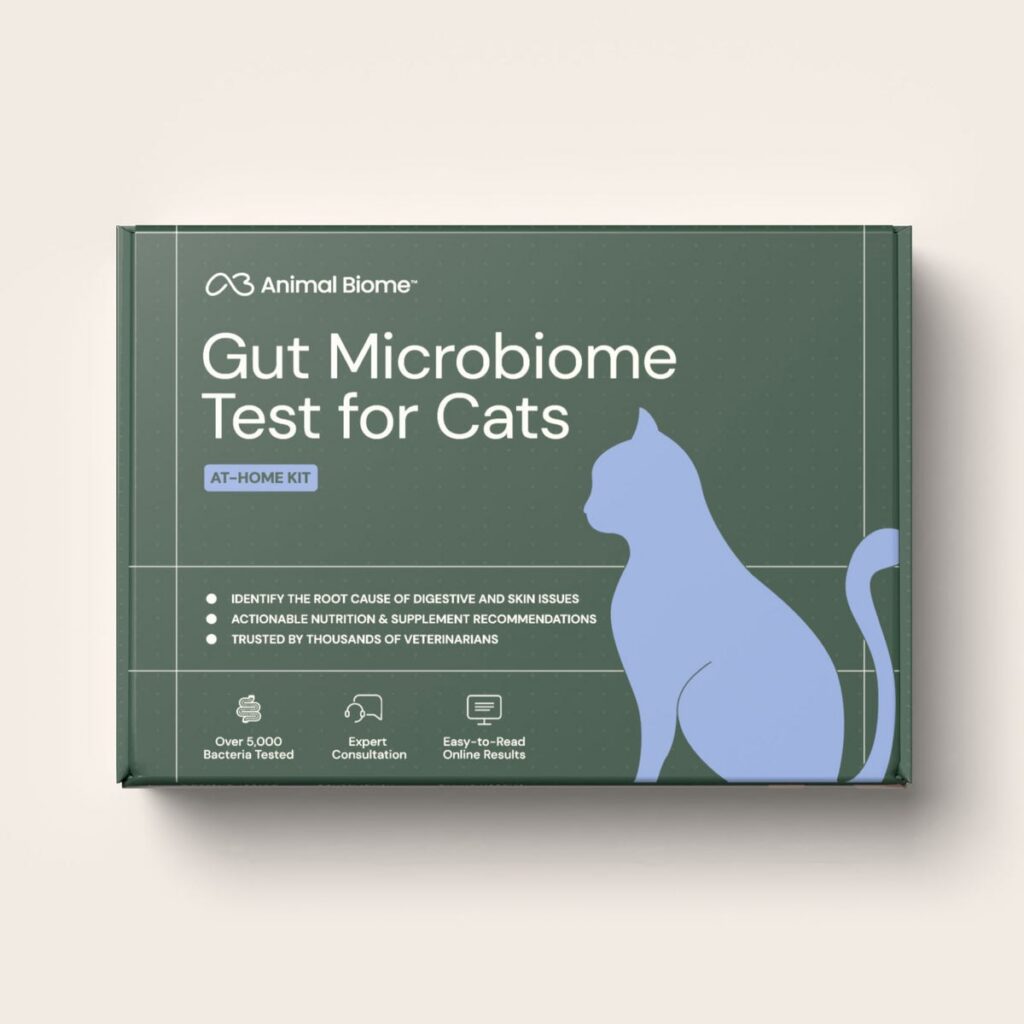
Animal Biome Gut Microbiome Test for Cats
Bacterial microbiome profiling for an informed ongoing support discussion; not a parasite diagnostic test.
When Prebiotics May Be Part of a Cat’s Care Plan
There is no visible sign that specifically diagnoses a need for prebiotics. Soft stools, a changing appetite, or occasional digestive upset can have several explanations. Those observations may justify reviewing the feeding plan, but they do not prove that the cat has a prebiotic deficiency.
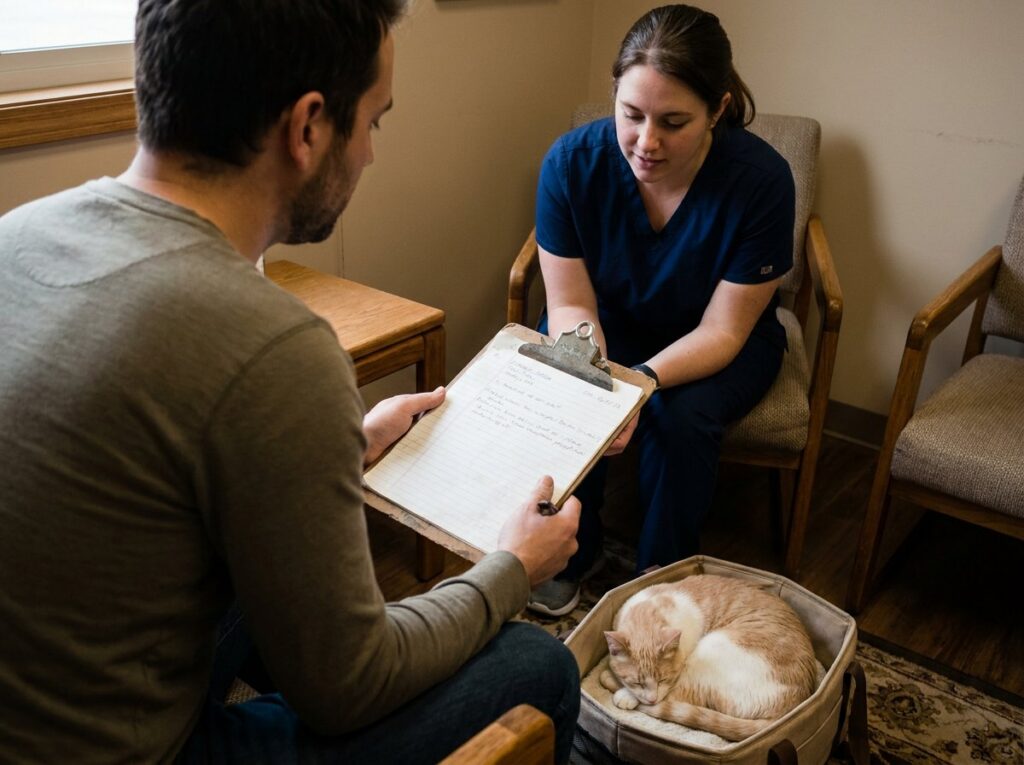
A useful care-plan conversation starts with the cat’s usual state. Is it comfortable, eating normally, and maintaining weight? Is the goal routine support, or is a new problem developing? Those are different starting points, and the next step should reflect the difference.
For owners seeking more information about bacterial composition, Animal Biome’s Gut Microbiome Test for Cats profiles bacteria in a stool sample. Its report can support a discussion about the gut community and ongoing care. It does not diagnose Giardia, worms, food allergy, or pancreatic enzyme deficiency.
A microbiome profile also does not automatically translate into “add more fiber.” Results need to be considered alongside the cat’s food, symptoms, medications, and veterinary history. The practical value comes from connecting information to a suitable plan, rather than treating each result as an instruction to buy another supplement. Before discussing prebiotics for a cat with diarrhea, prepare:
- The date the stool change began and whether it has happened before.
- The exact food and approximate amount eaten each day.
- Recent treats, food transitions, medications, or supplements.
- Changes in appetite, activity, body weight, or vomiting.
- Previous diagnoses and the plan already recommended for them.
The Cornell Feline Health Center describes a wide range of causes of feline diarrhea. Persistent or recurrent signs deserve attention, especially when accompanied by poor appetite, vomiting, or lethargy. A supplement should not become a reason to postpone that assessment.
For a cat with IBD, prebiotic use belongs within the existing treatment and nutrition plan. A veterinarian may consider a specific food or supplement as part of that plan, but changing several ingredients at once makes the response harder to interpret. Keep prescribed food and medications consistent unless the treating veterinarian directs a change.
A cat that is currently doing well presents another decision. You can review whether its complete food already provides the ingredients and feeding pattern needed for its routine. An additional supplement should have an identifiable purpose, not simply be added because prebiotics sound beneficial. Define that purpose in plain language. It might be maintaining a routine selected with the veterinarian or evaluating tolerance of a specific product. Agree on what to observe and when to review it. This makes the next decision easier than relying on a general impression that the cat’s “gut health” must have improved.
Where to Find Prebiotics on Food and Supplement Labels
Start with the cat food label. Before looking for a new product, identify the prebiotic ingredients in the food your cat already eats. Wet food, dry food, and therapeutic diets can have different formulations; the format of the food alone does not tell you whether it contains a particular prebiotic.
Use the exact food name and recipe, not just the brand. Two recipes from the same company may have different ingredient lists. If you feed both wet and dry food, or rotate between several products, include each one in the inventory.
Look in three places:
- The ingredient list: This identifies ingredients that are present, though it may not give the amount of each.
- The manufacturer’s feeding information: This can clarify the intended purpose, life stage, and how the food fits a complete diet.
- Additional product details: A manufacturer may supply information about a named prebiotic that is not fully explained on the package.
FOS may be written as fructooligosaccharides or listed under a named ingredient source. Inulin is another term worth recognizing. If a label mentions chicory root or another plant source, do not assume you know the amount of a specific prebiotic just from that name.
A general fiber statement is also incomplete. The crude fiber figure does not identify which prebiotic ingredient is present or how much of that ingredient a cat consumes. It answers a different labeling question. When a particular prebiotic matters to the plan, seek information about that ingredient itself.
The phrase “natural prebiotics” requires the same attention. Natural origin does not remove the need to identify the ingredient and its amount. A food containing a plant source of fiber and a supplement listing a measured prebiotic ingredient are not automatically equivalent.
Build an Inventory of What Your Cat Eats
Make the inventory concrete enough to discuss with your veterinarian. A photograph of a label is useful, but pair it with the amount the cat actually eats. A food offered in a bowl and a food consumed by the intended cat are not always the same thing, particularly in a multicat home.
Record the current food, current supplements, and proposed addition separately. That structure reveals whether you are adding a genuinely new ingredient or another source of one already present. It also makes it easier to notice when a combination product contributes more than its name suggests.
Review the whole feeding routine before adding a prebiotic
| Part of the routine | What to record | What the comparison can reveal |
|---|---|---|
| Current food | Exact recipe, amount eaten, and prebiotics already in the food | Whether the diet already includes a relevant prebiotic source |
| Current supplements | Product name, daily amount, and FOS in the ingredient list or another named prebiotic | Ingredients the cat receives beyond its regular food |
| Proposed addition | Complete formula, serving unit, and intended daily amount | Overlapping prebiotic ingredients that need to be considered together |
Here is how that comparison works in practice. An owner may think of one product as “the probiotic” and another as “the digestive enzyme powder.” Looking at the labels can reveal FOS in both. The overlap does not tell you that a combination is always inappropriate; it tells you that the combined routine needs to be assessed deliberately.
Animal Biome’s current formulas provide specific examples. S. boulardii + FOS Powder lists 225 milligrams of GOFOS per scoop. Daily Digest Blend lists 432.21 milligrams of NutraFlora FOS within its 600-milligram ProBiome Enzyme Blend per scoop.
Those are amounts per scoop, not a recommendation to give a scoop of each product. The cat’s actual daily intake depends on the directions chosen for that formula and how much supplemented food is eaten. Compare the actual planned daily amounts, rather than assuming that identical-looking scoops contain identical ingredients.

Daily Digest Blend also illustrates why “enzyme blend” does not mean the entire stated blend weight consists only of enzymes. Its detailed breakdown includes prebiotic FOS. The official page makes that information available, allowing a more useful comparison with a separate prebiotic product.
For any formula, distinguish these label details:
- Ingredient identity: What substance is being provided?
- Amount per serving: How much is in the stated scoop or capsule?
- Serving unit: Which measuring tool or capsule does that amount describe?
- Daily directions: How much is intended over the whole day?
- Actual intake: How much of the supplemented food does the cat consume?
Do not convert a scoop to a household teaspoon by appearance. The volume of a scoop and the density of a powder can differ between products. Keeping each supplied scoop with its original container prevents an avoidable measurement error.
If an ingredient amount is not stated, record it as unknown. Do not infer a precise quantity from where the ingredient appears in the list or from another product in the same range. A manufacturer may be able to clarify the information needed for the veterinary discussion.
- The same principle applies to dry cat food with prebiotics. A label can confirm that a named ingredient is included without establishing that an extra supplement is necessary. Consider the food’s complete nutritional role, the cat’s daily intake, and the intended reason for adding something.
- Treats and meal toppers belong in the inventory too. An occasional product can still matter when it is used frequently, and a supplement mixed into a treat is part of the day’s intake. Include what actually happens in the household, rather than only the ideal feeding schedule written on a bag.
- Keep the complete and balanced diet at the center of the plan. A prebiotic addition is not a substitute for an appropriate feline food, and a collection of supplements does not make an unbalanced diet complete. If the cat is eating poorly, the priority is to address intake and its cause.
Consider a cat that eats dry food during the day and a wet meal in the evening. The dry recipe lists a prebiotic ingredient, but its amount is not provided. The owner is considering a powder with a stated quantity per scoop. The useful next step is to document both foods and the planned powder amount, not to assume that the food contributes nothing because its precise quantity is unknown.
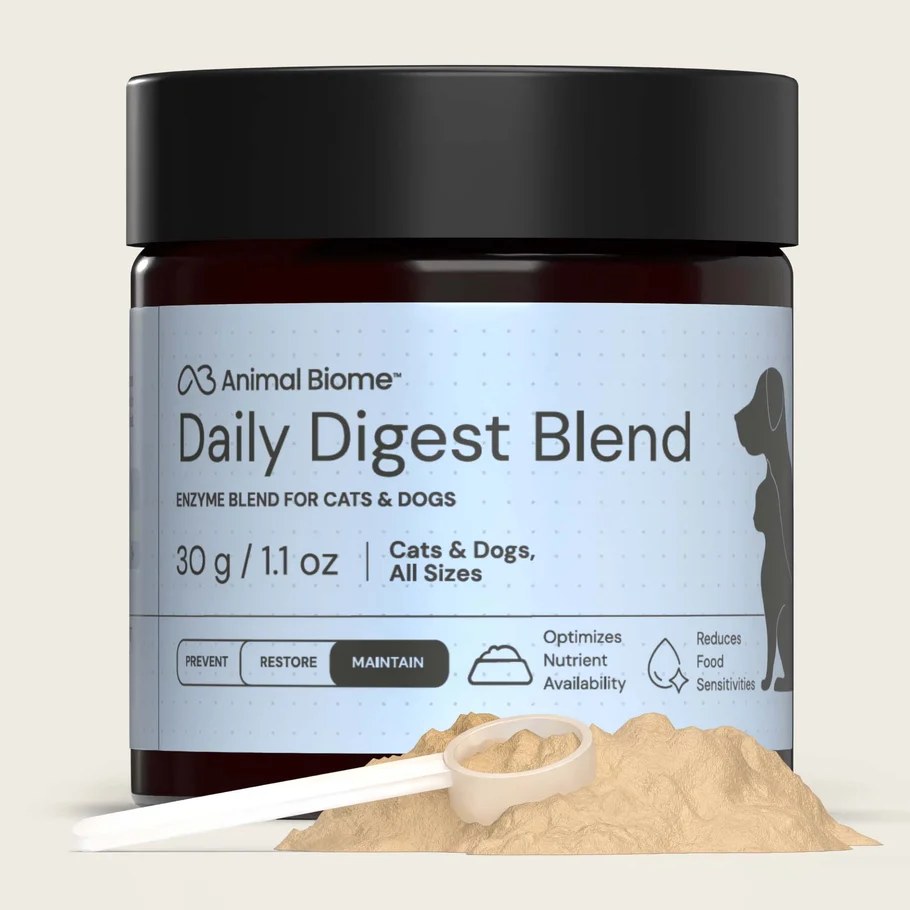
Animal Biome Daily Digest Blend
Meal-associated enzyme and prebiotic support, distinct from prescribed pancreatic replacement.
For that household, the inventory can distinguish:
- The dry recipe offered and the approximate amount actually eaten.
- The wet recipe and whether its ingredient list includes a named prebiotic.
- The supplement’s stated amount per scoop and the proposed daily serving.
- Any information that remains unavailable and would affect the decision.
A second example is a cat whose owner wants to change the delivery format rather than add another product. The cat currently receives a powder, but a capsule that can be opened seems easier to manage. Before treating the switch as a simple convenience change, compare the complete formulas. A different prebiotic, yeast quantity, or additional ingredient means the owner is changing more than the packaging.
Write down whether the proposed product is intended to replace an existing addition or accompany it. That single distinction prevents an old supplement from quietly remaining in the routine after a new one starts. If replacement is the plan, clarify the transition with the veterinarian; do not create an overlap merely to finish an open container.
Useful questions for a manufacturer or veterinary team include:
- Is the listed quantity per scoop or per recommended daily serving?
- Does the stated blend weight include the prebiotic ingredient?
- Is the same formula used across the container sizes being compared?
- Which instructions apply when the cat receives several small meals?
- How should an incomplete or refused serving be recorded?
An incomplete serving deserves particular attention in a cat that grazes. If powder is mixed into a measured portion and only half the food is eaten, you may know the food amount without knowing the exact distribution of powder through it. Record that uncertainty. Do not assume an exact supplement intake or immediately add another full amount.
Keep the inventory current when the food recipe changes, even if the brand stays the same. A switch between flavors, a new therapeutic diet, or a different topper may change the ingredient picture. Save the relevant labels so a later discussion reflects what the cat actually received at each point.
This level of detail is useful because it supports a concrete next step. It can show which information is missing, whether a proposed change is a substitution, and how reliably the intended serving can be delivered. The inventory remains a practical feeding record rather than a calculation that promises a particular clinical result. The most useful inventory ends with a decision. You may discover that the proposed product has a clear role, that another product should be reconsidered, or that more label information is needed. Make one change at a time so the effect of that decision can be observed.
How to Choose a Prebiotic Supplement for Your Cat
The best prebiotics for cats are not defined by a single ingredient, the largest serving, or the most enthusiastic reviews. A suitable supplement matches the purpose of the care plan and can be used consistently. It also has enough label information to understand what the cat will receive.
Begin by completing a sentence: “We are considering this product because…” If the answer is only that it promises general gut health, make the goal more specific. A clear reason helps distinguish a useful addition from an expanding collection of overlapping products.
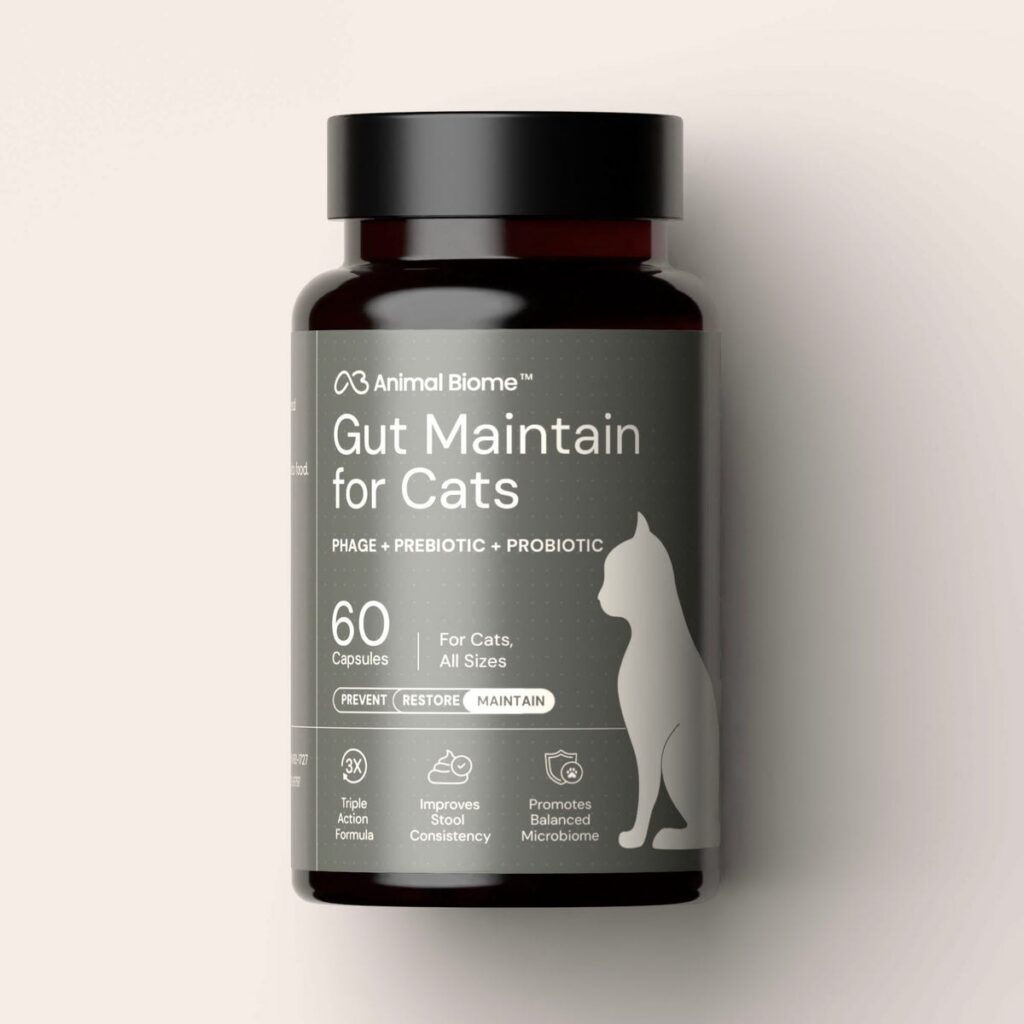
Animal Biome Gut Maintain for Cats
Daily microbiome maintenance after the immediate concern is addressed.
Compare the candidates using a small set of practical criteria:
- Purpose: Does the intended role match the reason for use?
- Ingredient identity: Is the prebiotic named clearly?
- Amount and directions: Can you understand the daily plan?
- Other active ingredients: Does the formula also provide yeast, bacteria, enzymes, or other components?
- Food compatibility: Can it fit the cat’s current meals and any prescribed diet?
- Administration: Will the cat reliably accept the form?
For routine microbiome support, Animal Biome Gut Maintain for Cats has a distinct formula. The current label lists S. boulardii, BIO-MOS, and a phage blend called PreforPro. It is designed for ongoing maintenance and has its own feline capsule directions.
This formula is not the same as S. boulardii + FOS Powder. BIO-MOS and FOS are different ingredients, and the amounts and delivery forms differ. A choice between them should consider the intended role and the cat’s routine, rather than treating one capsule as an equivalent amount of the powder. Gut Maintain’s label also allows the capsule to be opened and the contents mixed with food if needed. That is a product-specific instruction. Do not assume that every capsule in a digestive-support range can be handled the same way; some formulations are intended to remain intact.
Products labeled for cats and dogs need equally careful interpretation. The shared species label can be convenient in a household with both, but directions may vary by weight or species. Keep the cat’s plan separate and use the instructions that apply to that animal. A practical comparison can then focus on the household:
- A cat that finishes individual meals may readily accept a measured powder.
- A cat that grazes needs a plan for confirming the supplemented portion was eaten.
- A cat in a shared feeding area may need a separate bowl and supervision.
- A cat on a prescribed diet needs an addition that fits that diet’s purpose.
- A sensitive cat benefits from a clear introduction plan and a simple timeline.
Consider these examples as decision patterns, not product prescriptions. A cat already receiving an FOS-containing supplement may not need a second FOS source simply because the second product has a different front-label description. The inventory tells you what to discuss before deciding. A cat whose goal is routine maintenance may be considering a different formulation from one receiving a time-limited supportive plan. In either case, the current label and the veterinarian’s advice should define the amount and review point. The word “maintenance” is not a reason to stop reassessing the routine when health or diet changes.
For a cat with ongoing digestive symptoms, product choice should follow the clinical assessment. A supplement can have a useful supportive role, but the presence of diarrhea or IBD does not identify the ideal prebiotic ingredient or amount. The condition, food, treatments, and tolerance all belong in that decision.
Pay attention to how evidence is described. A study measuring bacterial populations in healthy cats answers a different question from a trial measuring clinical improvement in cats with disease. A product review describing firmer stools answers another question again: it reports one owner’s experience without controlling other changes. Ask for evidence that is relevant to the claim you are evaluating:
- Was the research conducted in cats?
- Was it studying the same ingredient or complete formulation?
- Were the cats healthy or affected by the condition being discussed?
- Did the study measure microbial changes, stool outcomes, or something else?
- Does the result support the specific benefit being claimed?
This does not require every owner to become a researcher. It simply prevents a narrow finding from becoming an overly broad promise. A measured change in one bacterial group does not establish protection from every digestive disease or a predictable result for every cat.
Reviews can still help with practical details. They may raise questions about mixing, acceptance, or packaging that are worth checking. Use the manufacturer’s current directions to confirm those details, and do not copy another owner’s amount because their cat appeared similar in size.
Before purchasing, check that the full current label and storage instructions are available. Keep the original container so ingredient, lot, and opening-date information can be found later. If the cat’s veterinarian changes the plan, that information makes it easier to identify exactly what was being given.
Introduce One Change and Track Your Cat’s Response
Once you have selected a product, make the introduction easy to interpret. Keep the familiar complete food and usual routine as consistent as practical. Follow the product-specific directions and any individualized instructions from your veterinarian.
Gradual introduction does not mean inventing one schedule for every prebiotic. The starting amount and pace depend on the actual formula. Animal Biome’s S. boulardii + FOS directions, for example, recommend beginning with half the recommended daily amount and increasing gradually. Another product may have different instructions.

Before the first serving, write down:
- The product’s exact name and the reason for using it.
- The planned amount and whether it is a daily total.
- The date the introduction begins.
- The cat’s usual appetite and stool pattern.
- Any other treatments or food changes already underway.
- The agreed review date.
A small portion of a familiar food can help you observe whether the cat accepts the addition. Offer the rest of the normal meal afterward. If the cat leaves some behind, record that uncertainty rather than assuming the full amount was consumed.
Avoid withholding ordinary meals to persuade a cat to take a supplement. Food refusal changes the clinical picture and deserves attention. A usable support routine is one that fits adequate feeding, not one that makes the cat’s intake harder to maintain.
Key Takeaways
- Make one change at a time so the response is easier to interpret.
- Track stool consistency alongside food intake and appetite changes.
- Record the amount actually eaten and review the plan if tolerance or the cat’s condition changes.
Use the same observations each day. A simple description such as formed, soft, or watery is more useful than changing your scoring method every time. Note frequency and urgency as well, particularly if the cat’s usual pattern is changing. Petful’s guides to mucus in cat poop and why cat poop smells really bad describe other stool changes worth recording.
Vetstreet’s guide to what stool changes can tell you can help you describe the pattern. It cannot tell you which prebiotic the cat needs, and neither can a single photograph. The purpose is to make the follow-up discussion more accurate.
Check Appetite Alongside Stool
Appetite deserves equal attention. Record whether the cat eats the supplemented portion and its normal daily food. A seemingly improved stool pattern is not a satisfactory result if the cat is eating less, losing weight, or becoming less active.
Decide what happens at review
At the agreed review date, compare the original goal with the amount actually eaten and the cat’s overall response. New or worsening signs call for veterinary reassessment, rather than automatically adding another product.
If the cat is comfortable and the routine is going as intended, bring the record to the planned review. If there is no clear change, discuss whether the purpose remains appropriate and whether the product was consistently consumed. An unchanged result does not automatically mean the amount should be increased. If new digestive upset develops, review the complete routine. The timing may identify a recent addition, but it does not prove the ingredient caused every symptom. Food changes, medications, and the original health concern can also affect the same observations.
Seek veterinary advice promptly for significant or worsening signs, including poor appetite, repeated vomiting, lethargy, pain, or concerning blood in the stool. Fluid loss can become important when diarrhea or vomiting continues. Vetstreet’s guide to signs of dehydration explains observations to discuss with the veterinary team.
Keep the decision at follow-up specific. Continue a useful, tolerated plan; adjust a routine that is difficult to administer; or investigate a concern that remains unexplained. The benefit of tracking is that the next step can follow the cat’s actual experience.
Questions About Prebiotics, Probiotics, and Everyday Foods

Some feline probiotic products are intended for daily use, but follow the product-specific daily directions and confirm an ongoing reason for use. Daily administration is a question about the whole formulation, not only the organism’s name. Food, medications, health conditions, and other supplements may change over time, so a routine that once fit should still be reviewed when those circumstances change. Animal Biome Gut Maintain for Cats is designed for ongoing maintenance, while other products have different purposes. Keep the product name, daily amount, and reason for use in the cat’s care record.
Pumpkin supplies dietary fiber; it is not a live-microorganism supplement. That makes it different from a probiotic. A food’s fiber content also does not establish that it is equivalent to a measured prebiotic formulation. Whether a small food addition is appropriate depends on the cat’s diet, condition, and intended goal. If you are considering pumpkin for an ongoing stool problem, discuss the cause and feeding plan with your veterinarian rather than assuming it replaces a prescribed food or digestive-support product. Keep the complete feline diet central to the routine.
Homemade fermented foods can contain unstandardized microorganisms, so they are not interchangeable with a feline product that identifies its organisms and directions. Their composition, preparation, and accompanying ingredients can vary. There is no need to replace a complete and balanced diet with homemade additions to pursue microbiome support. If your goal is to introduce a probiotic, choose a defined formulation with suitable feline instructions and a clear reason for use. If your goal is additional fiber, that is a different discussion about the food and a possible prebiotic ingredient.
Yogurt may contain live cultures, but dairy tolerance varies, and it is not interchangeable with a feline probiotic. The presence of cultures does not establish that the organisms, amount, or complete food are appropriate for your cat’s digestive-care goal. A flavored or sweetened dairy product also adds ingredients unrelated to that goal. Instead of choosing yogurt as a supplement substitute, review the intended purpose and a product designed for feline use. A cat with digestive symptoms needs a plan that considers its ordinary food and tolerance, rather than an assumed benefit from a human food.
There is no single “most natural” choice that is best for every cat. An identified ingredient and an appropriate amount are more useful criteria than naturalness alone. FOS and inulin are recognizable prebiotic ingredient names, but their source does not by itself tell you how much the cat receives or whether an addition is needed. Check the current food first, then compare a proposed supplement’s complete formulation. A naturally sourced food ingredient and a concentrated supplement should not be treated as equivalent servings simply because they share a plant origin.
Follow the label directions and build a consistent meal routine that makes administration easy to observe. There is no universal best clock time for every probiotic formulation. Some products are given with food, and storage or preparation instructions may matter as much as morning versus evening. Use the product-specific directions, record the daily total, and coordinate between caregivers so the cat does not receive duplicate servings. If a medication schedule complicates the routine, ask the prescribing veterinarian how to arrange it without changing the medication plan yourself.