How to Make Bone Broth for Dogs (and When to Buy It Instead)
Published on September 16, 2026
This article is sponsored by The Honest Kitchen. Vetstreet maintains editorial control and uses current product information plus independent pet-nutrition and veterinary sources. Vetstreet may earn a commission if you purchase through links in this article.
Learning how to make bone broth for dogs starts with a simpler recipe than most human cooks expect. A dog-appropriate broth needs plain animal bones and water, careful cooling and straining, and absolutely no onion, garlic, chives, bouillon, seasoning blends, or added salt. The finished broth can add moisture and aroma to a meal, but it is an occasional topper, not a complete diet or a treatment for joint, digestive, or other health problems.
Homemade broth is worthwhile when you can supervise the full cook-cool-strain process and confidently remove every bone and fragment. A dog-specific product can be the more practical choice when time, travel, predictable directions, or food-safety concerns matter more. The Honest Kitchen offers both instant powdered broths and ready-to-pour toppers, giving owners convenient ways to add broth without handling cooked bones at home.
Key Takeaways
- Make broth with plain animal bones and water. Leave out alliums, seasoning, bouillon, and added salt.
- Never give a dog the cooked bones. Cool the broth, remove hardened excess fat, and strain it meticulously before serving.
- Treat broth as a moisture and palatability aid, not a complete meal or a remedy for illness.
- Choose a dog-specific prepared broth when you want consistent ingredients, label-based portions, easy storage, or less preparation risk.
- Count broth or topper calories within the dog’s daily intake and ask a veterinarian about use for a dog with a medical condition or prescribed diet.
What Bone Broth Can and Cannot Do for Dogs
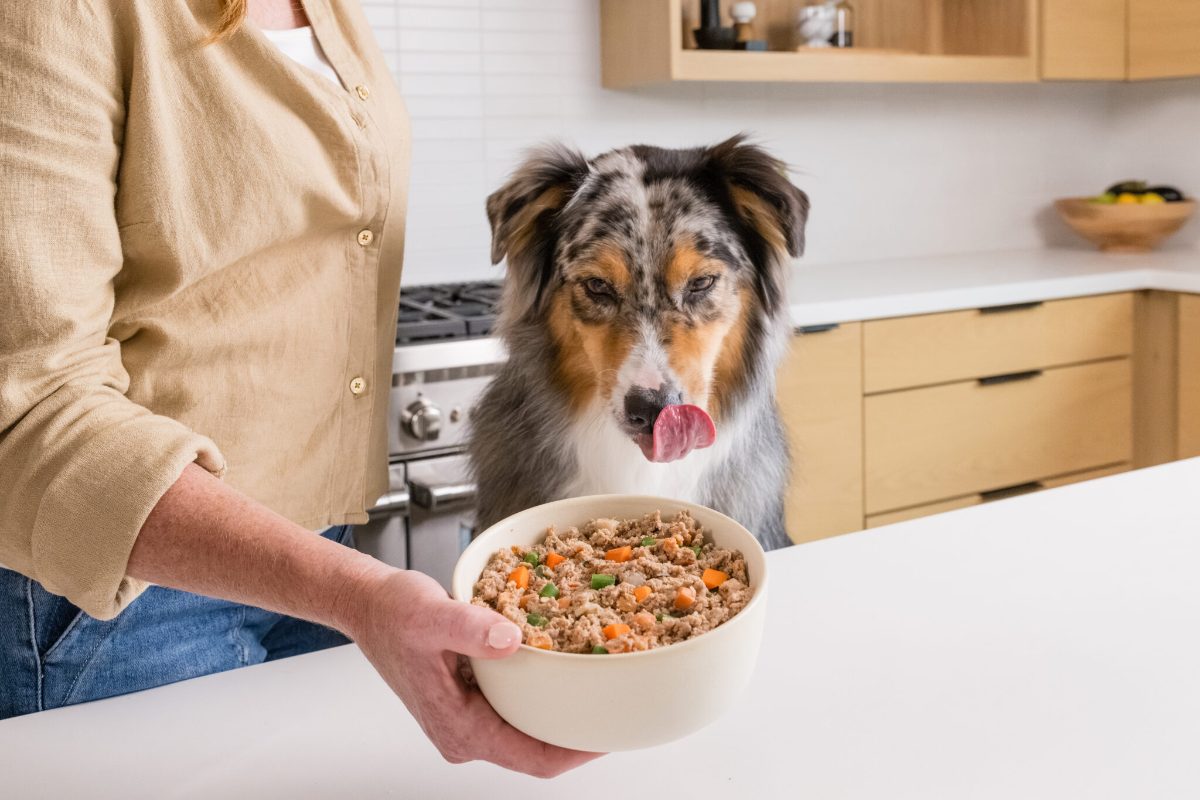
Bone broth is the liquid left after bones and connective tissues simmer in water. Cooling may give it a soft gel texture because collagen-derived gelatin moves into the liquid during cooking. Its most dependable role for a dog is practical: it can moisten dry food, change meal texture, add aroma, or encourage fluid intake in a dog that is otherwise medically stable.
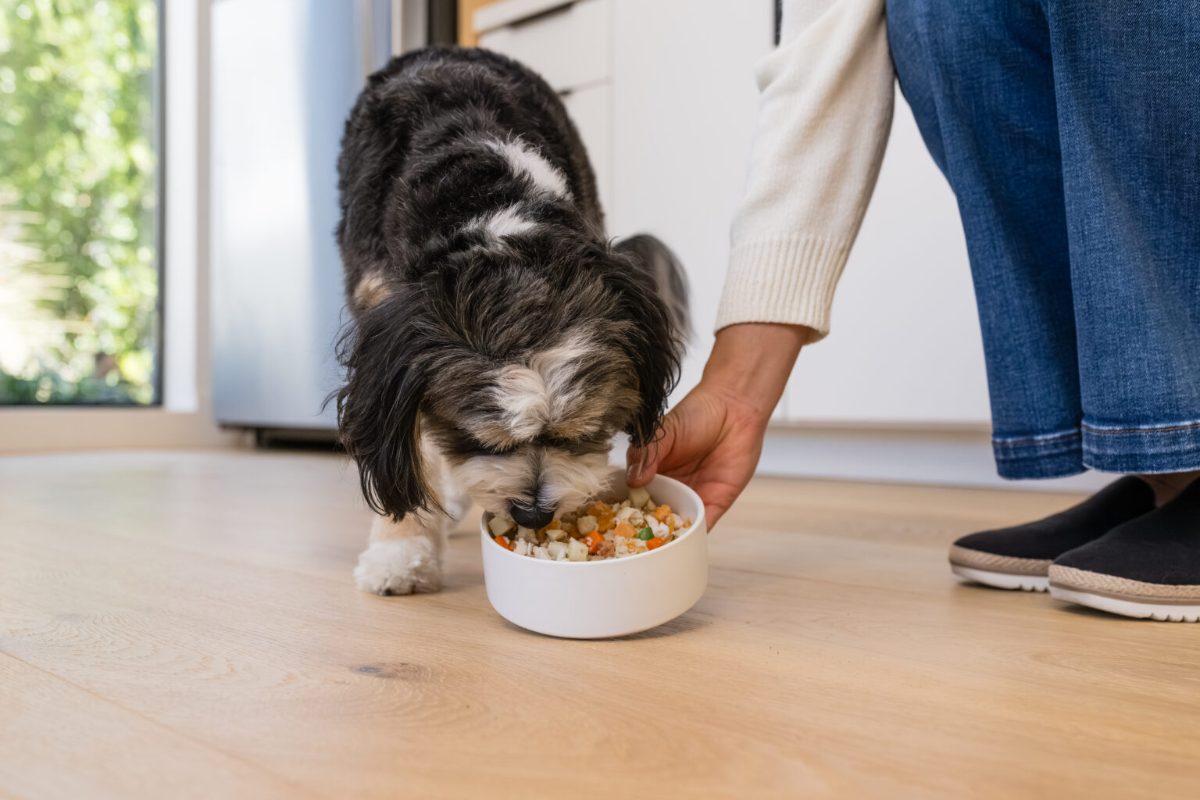
Those uses are modest, but they can still be helpful. Some dogs enjoy a spoonful mixed through their normal food. A frozen portion can become an occasional enrichment item. A small amount may make a familiar complete meal more interesting without replacing it. Broth also gives owners a way to adjust moisture while keeping the base diet recognizable.
The limits are just as important. Broth does not contain the full balance of protein, fat, vitamins, and minerals required for a sole diet. It should not displace substantial portions of a complete-and-balanced food. The FDA’s explanation of complete and balanced pet food notes that nutritional adequacy depends on the product’s adequacy statement, not on a food sounding wholesome or containing a familiar ingredient.
Bone broth also should not be described as a joint treatment, a gut healer, a detox, or an alternative to veterinary care. A dog that is vomiting, refusing food, painful, weak, dehydrated, or having persistent diarrhea needs an appropriate veterinary plan. Adding broth may change flavor and fluid intake, but it does not diagnose or resolve the reason for those signs.
| What broth may do | What broth cannot be assumed to do | Better next step when health is the concern |
|---|---|---|
| Add moisture to a familiar meal | Provide complete daily nutrition | Keep a complete-and-balanced food as the nutritional base |
| Add aroma and a different texture | Guarantee that a dog will eat | Investigate a new or persistent appetite change with a veterinarian |
| Work as an occasional topper | Treat arthritis, digestive disease, or dehydration | Use veterinary diagnosis and a condition-specific treatment plan |
| Offer a small enrichment portion | Replace fresh drinking water | Keep clean water available at all times |
| Make mixed feeding more appealing | Add unlimited calories without consequence | Reduce other extras or base-food calories when appropriate |
If a veterinarian has prescribed a therapeutic food, fluid plan, sodium restriction, low-fat diet, or ingredient elimination trial, ask before adding any broth. Even a dog-specific product can be unsuitable for an individual medical plan. The correct question is not simply whether broth is safe for dogs generally, but whether that particular recipe and portion fit that particular dog.
Ingredients and Equipment for Dog-Safe Bone Broth
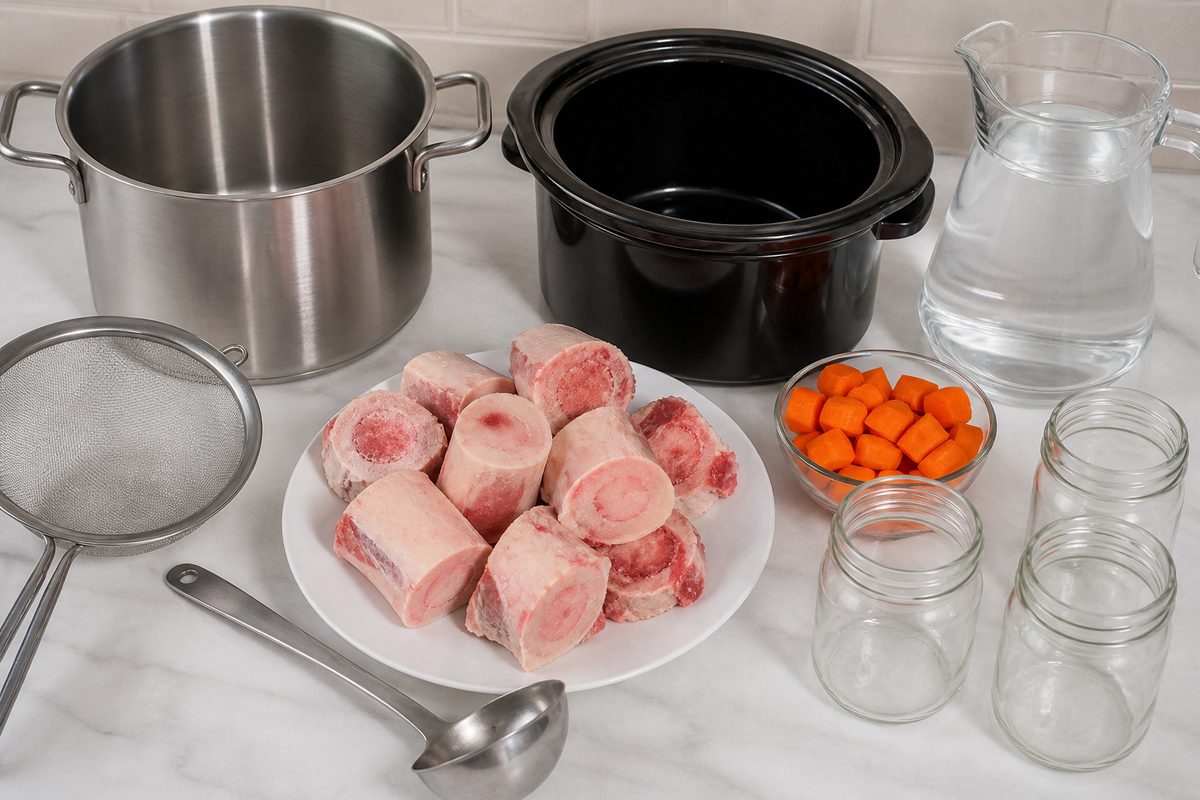
The safest ingredient list is intentionally short:
- Plain animal bones appropriate for stock making
- Fresh water
That is enough. Vegetables, herbs, vinegar, and seasonings are not required to make a useful dog topper. A minimal recipe makes it easier to control what the dog receives and reduces the chance that a human-food ingredient slips into the pot.
Use a stockpot, slow cooker, or other appliance that can maintain a controlled simmer. You will also need a heat-safe utensil, a fine mesh strainer, a second clean container, refrigerator-safe storage containers, and enough refrigerator space to cool the liquid promptly. A second pass through a clean fine strainer can help catch smaller particles. For owners who are not confident they can remove every fragment, buying a dog-specific broth is the more sensible option.
Keep the recipe plain: Onion, garlic, and chives belong to the allium family and can damage red blood cells in pets. Bouillon, packaged stock, pan drippings, and seasoning blends may also contribute unsafe amounts of salt or hidden alliums. Start with bones and water, not a human soup recipe.
The ASPCA’s list of people foods to avoid identifies onion, garlic, chives, and excessively salty foods as hazards for pets. This is why simply diluting ordinary grocery-store stock is not a reliable shortcut. A package labeled “low sodium” can still contain onion or garlic, and “natural flavors” do not tell a pet owner enough to assume suitability.
Do not use bones left on a dinner plate if they were cooked with sauce, seasoning, onion, garlic, or large amounts of salt. Do not include rotisserie chicken bones, seasoned ribs, or the liquid from a cooked roast. The goal is control from the first ingredient to the final serving.
Raw-meat handling hygiene matters before cooking. Wash hands, clean surfaces and utensils, avoid cross-contamination with foods eaten raw, and refrigerate ingredients until use. Keep pets away from the preparation area so they cannot steal a raw or cooked bone.
How to Make Bone Broth for Dogs Step by Step
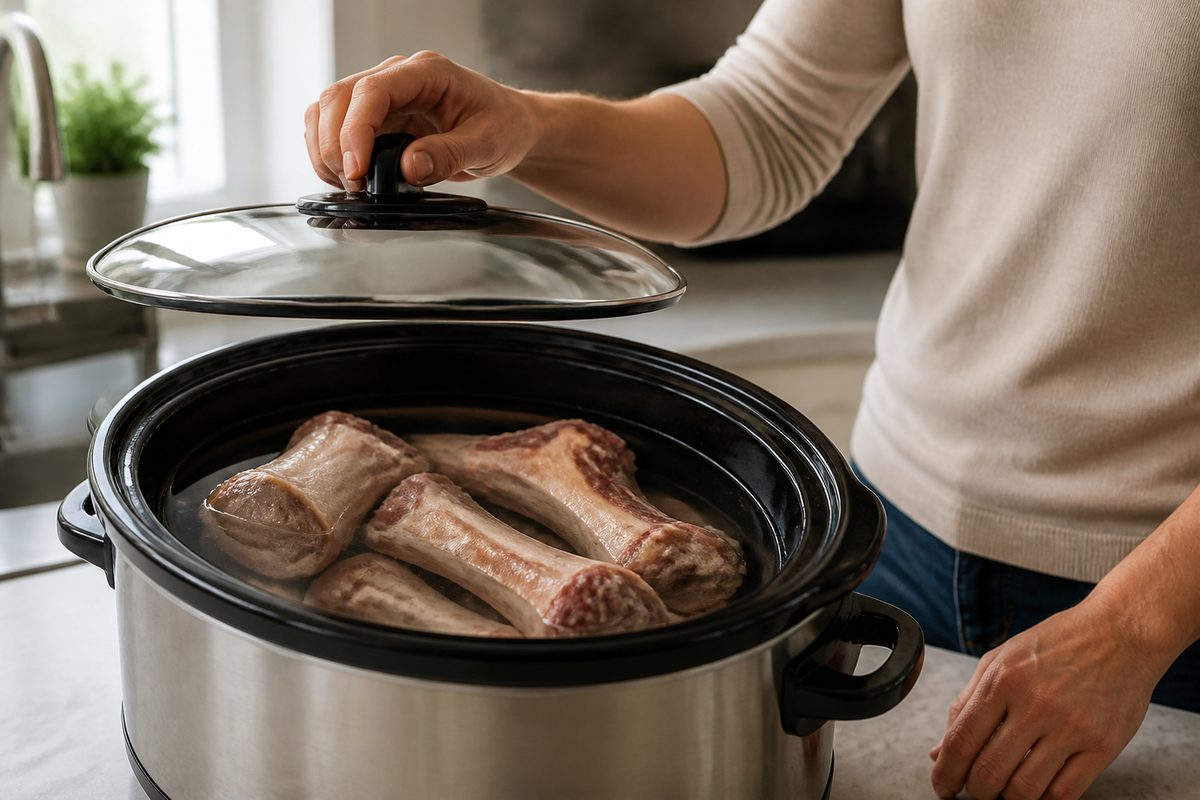
The process is less about culinary complexity and more about eliminating hazards at every stage. AKC veterinary guidance on bland foods and broth likewise emphasizes plain preparation and the exclusion of unsafe flavorings.
| Stage | Action | Safety checkpoint |
|---|---|---|
| 1. Inspect | Start with plain bones and water | Reject seasoned, sauced, spoiled, or questionable ingredients |
| 2. Cover | Place bones in the pot and add enough water for the cooking method | Do not add bouillon, salt, onion, garlic, chives, or seasoning |
| 3. Cook | Maintain a controlled simmer using the appliance’s safe operating instructions | Keep the pot supervised as required and prevent pets from reaching it |
| 4. Separate | Remove the large bones with a utensil | Place bones directly into a pet-proof discard container |
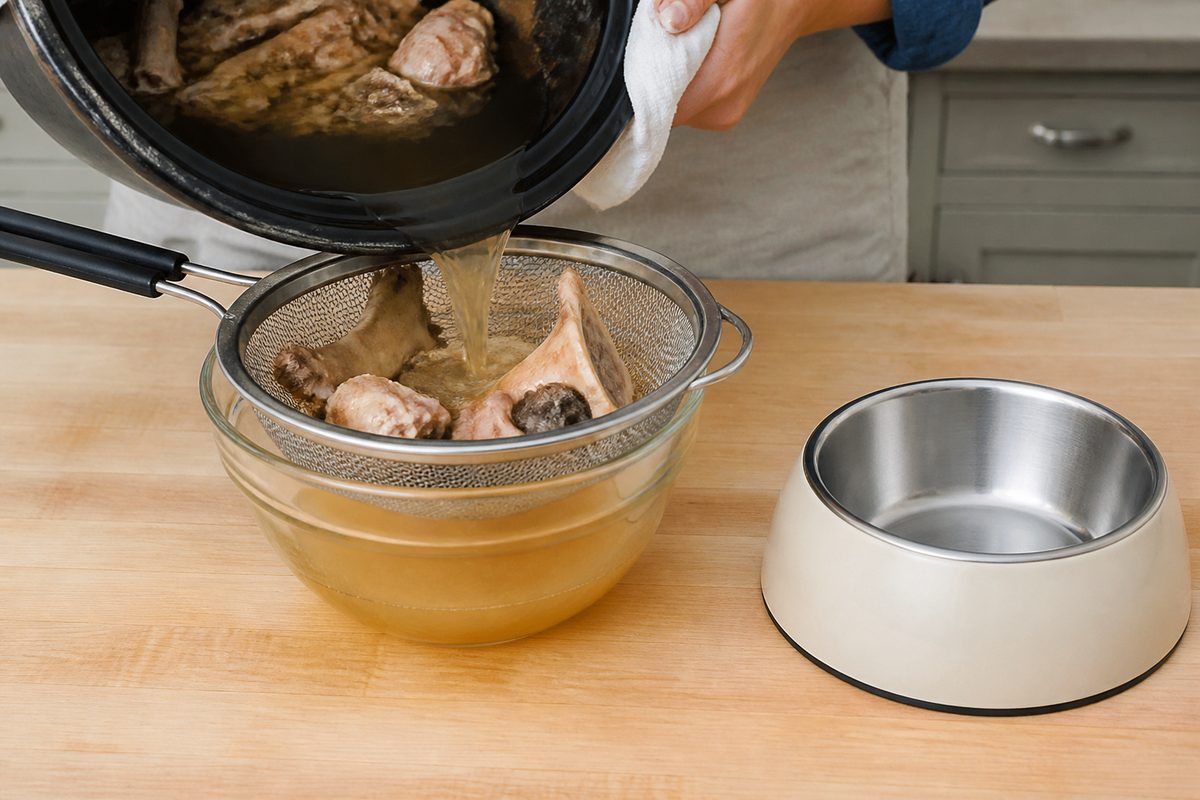
| 5. Strain | Pass the liquid through a fine mesh strainer into a clean container | Inspect for small splinters and strain again if there is any doubt |
| 6. Cool | Cool the broth promptly, then refrigerate | Do not leave a large warm container at room temperature for extended periods |
| 7. Defat | Once chilled, remove the hardened layer of excess fat | Extra fat can be inappropriate for some dogs, especially those on a low-fat plan |
| 8. Portion | Divide into small, clearly labeled portions | Choose portions that supplement rather than replace the dog’s meal |
1. Inspect the bones and preparation area
Confirm that the bones are plain, fresh, and free from cooked-on seasoning. Set out the strainer and clean storage containers before cooking begins. Planning the strain-and-cool stage in advance is safer than searching for equipment while a hot pot sits unattended.
2. Add water without flavoring
Place the bones in the cooking vessel and add water appropriate to the vessel and quantity. The bones should have enough surrounding liquid to produce broth without the pot drying out. Follow the appliance manufacturer’s minimum- and maximum-fill rules. Do not add salt “for taste.” Dogs do not need a human-style seasoned stock.
3. Simmer under control
Use a gentle, controlled cooking method rather than a hard boil that can increase splashing and agitation. Cooking time varies with the appliance, bone size, and recipe source, so follow safe equipment guidance instead of relying on one universal clock. The broth is not safer because it cooked unusually long. Safety comes from full cooking, clean handling, prompt cooling, and total removal of bones and fragments.
4. Remove every bone
Use a utensil to lift out the large pieces. Transfer them directly into a secure trash container that the dog cannot open. Never set them on a low counter or in an open bin. A cooked bone can splinter, choke a dog, injure the mouth, or obstruct or perforate the digestive tract. The bones have served their role in making broth and have no safe second use as a chew.
5. Strain with patience
Pour the liquid through a fine mesh strainer into a clean heat-safe container. Work in manageable batches if the pot is heavy. Inspect both the strainer and the liquid. If the broth contains visible grit or if you are uncertain, strain it again through a clean fine mesh. “Probably no fragments” is not an acceptable safety standard.
6. Cool promptly and remove excess fat
Move the strained broth into shallow or reasonably sized containers so it can cool efficiently, then refrigerate it promptly. Once chilled, fat often collects as a firm top layer. Removing excess fat makes portions easier to control and may reduce digestive upset. Dogs with a history of pancreatitis or a prescribed low-fat diet need veterinary advice before receiving even defatted broth.
7. Portion for the way you will use it
Small refrigerator containers, silicone molds, or freezer-safe portions can prevent repeated warming and cooling of the full batch. Label the date and contents. A portion intended to moisten one meal should be much smaller than a human serving of soup. Begin with a little and observe the dog’s stool, appetite, and comfort.
How to Cool, Strain, Store, and Serve It Safely
Food safety does not end when the heat turns off. A large volume of broth can remain warm in the center for a long time, so dividing it into smaller containers supports faster cooling. Keep containers covered in the refrigerator and use clean utensils for each serving. Discard broth that develops an off odor, unusual appearance, mold, or other sign of spoilage.
For freezing, leave appropriate expansion space in the container and label each portion. Thaw a portion in the refrigerator rather than on the counter. Do not repeatedly thaw and refreeze. If serving a chilled portion, it can be brought toward a comfortable eating temperature without making it hot. Always test the temperature before it reaches the bowl.
Introduce broth conservatively. A teaspoon or small spoonful may be enough for a small dog, while a larger dog may use a modest splash. There is no universal serving because calorie needs, health, diet, and broth concentration vary. The finished liquid is also not nutritionally standardized in the way a labeled commercial product is.
If the broth loosens stool, causes vomiting, seems to worsen itching, or changes appetite, stop serving it and contact the dog’s veterinarian when appropriate. A new food can disagree with an individual dog even when its ingredients are generally dog-appropriate.
Ingredients and Bones to Keep Out
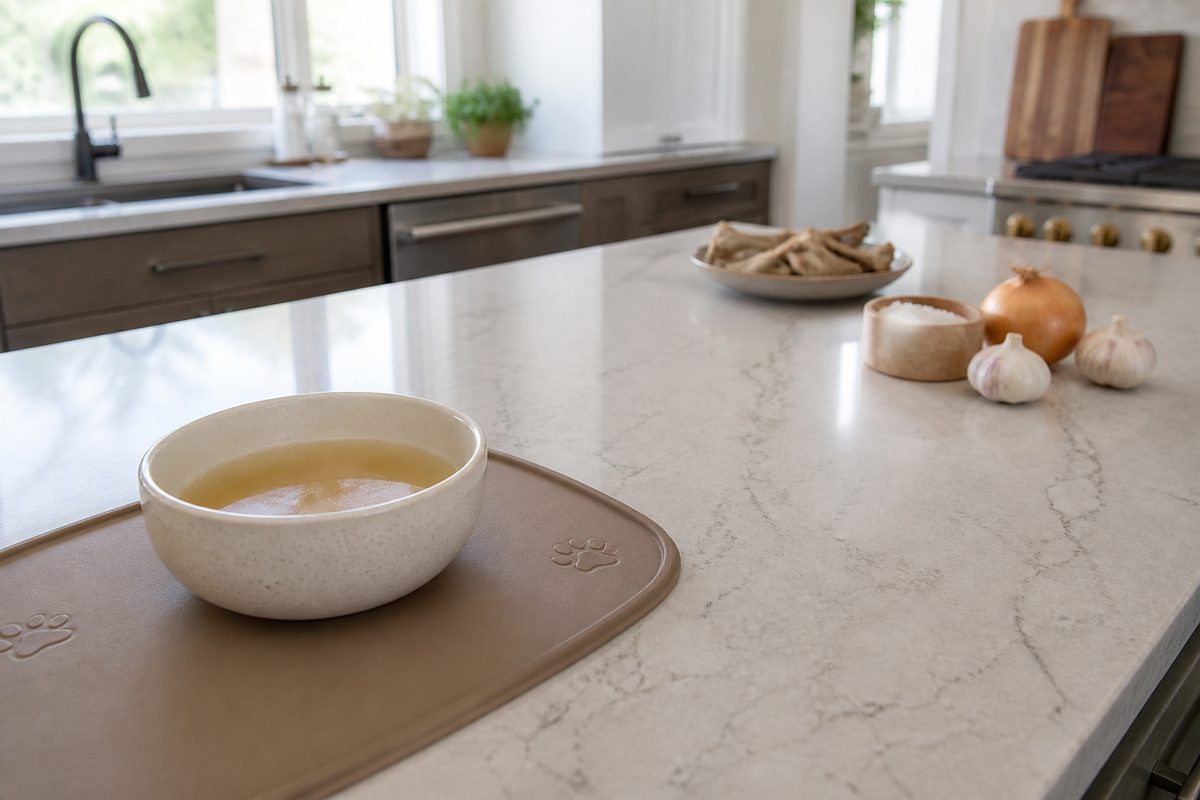
Avoid these additions and shortcuts:
- Onion, garlic, chives, leeks, and powders made from them
- Bouillon cubes, soup base, packaged gravy, or human stock unless a veterinarian has reviewed the exact label
- Added salt, soy sauce, seasoning blends, and spice rubs
- Bones that were roasted or served with seasoned human food
- Cooked meat drippings with concentrated fat and salt
- Sweeteners, especially any product that could contain xylitol
- Moldy, spoiled, or improperly stored ingredients
- Any cooked bone or fragment in the serving bowl
The danger of a cooked bone is physical as well as nutritional. Even when it appears softened after simmering, it can split into sharp pieces. Straining is therefore a required step, not a texture preference. If a dog gets into the discarded bones, contact a veterinarian promptly for guidance rather than inducing vomiting without instruction.
Some owners add apple cider vinegar to stock recipes. It is not necessary for a safe dog broth, and leaving it out preserves the simplest formula. The same logic applies to herbs and vegetables: if an ingredient does not need to be there, omitting it reduces uncertainty.
Homemade vs. Store-Bought Bone Broth for Dogs
Homemade broth gives you direct control over the starting bones and water. It can also be economical when made as part of an already-planned food preparation routine. Its cost is time: cooking, handling a hot pot, removing bones, double-checking fragments, cooling, defatting, portioning, labeling, and cleaning.
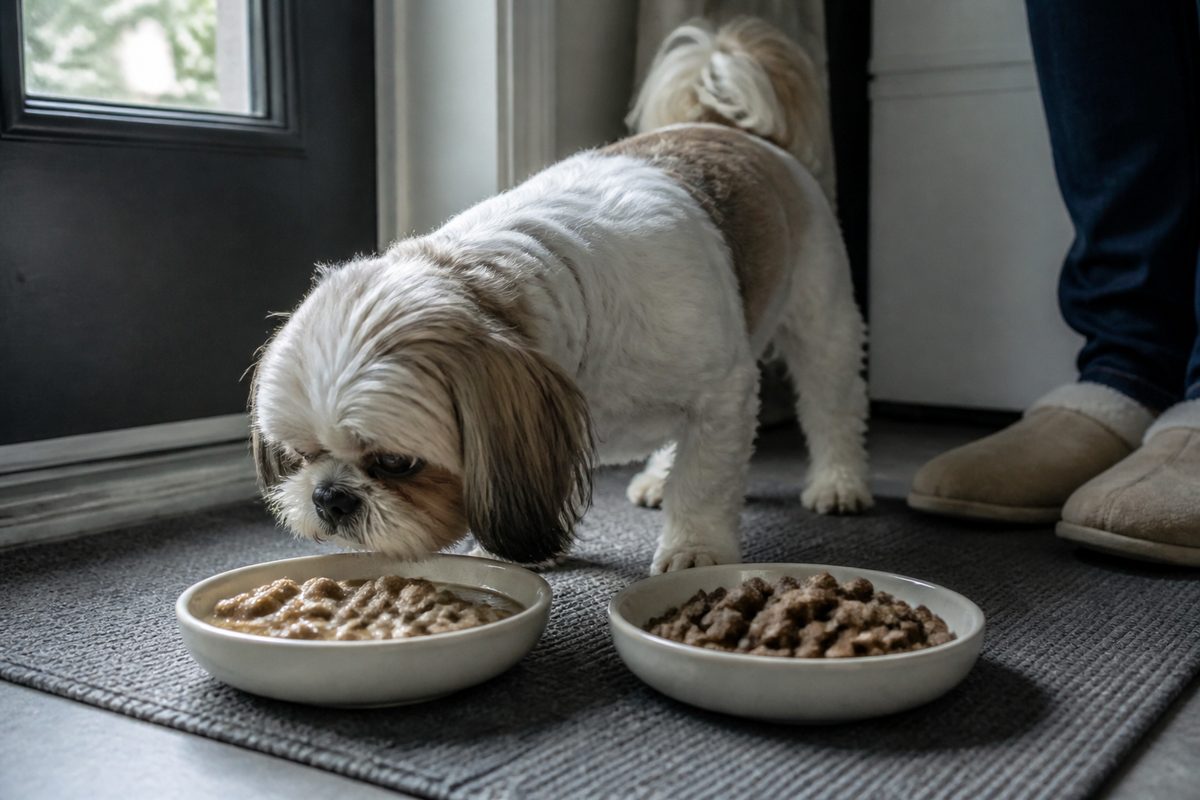
A dog-specific prepared broth trades that labor for predictable label directions and storage. It is especially useful for travel, small households that do not need a full batch, owners uncomfortable handling bones, and moments when a shelf-stable product avoids food waste. The correct choice is the one the owner can use safely and consistently.
| Ingredient control | High when the cook starts with plain ingredients | High when the label is clear and the formula fits the dog |
| Time | Long cook, cool, strain, portion, and cleanup cycle | Mix or pour according to the label |
| Bone-fragment management | Owner must remove and securely discard every fragment | No cooked bones handled in the home |
| Consistency | Batch strength and calories can vary | Directions and product form are more predictable |
| Storage | Requires refrigerator or freezer space | Unopened storage depends on the package; prepared portions still need label-based handling |
| Travel | Often inconvenient | Powdered or packaged forms may be easier to carry |
| Best fit | Owners confident in food handling who want a plain custom batch | Owners prioritizing convenience, repeatability, and simpler cleanup |
When The Honest Kitchen Bone Broth Is the Easier Choice
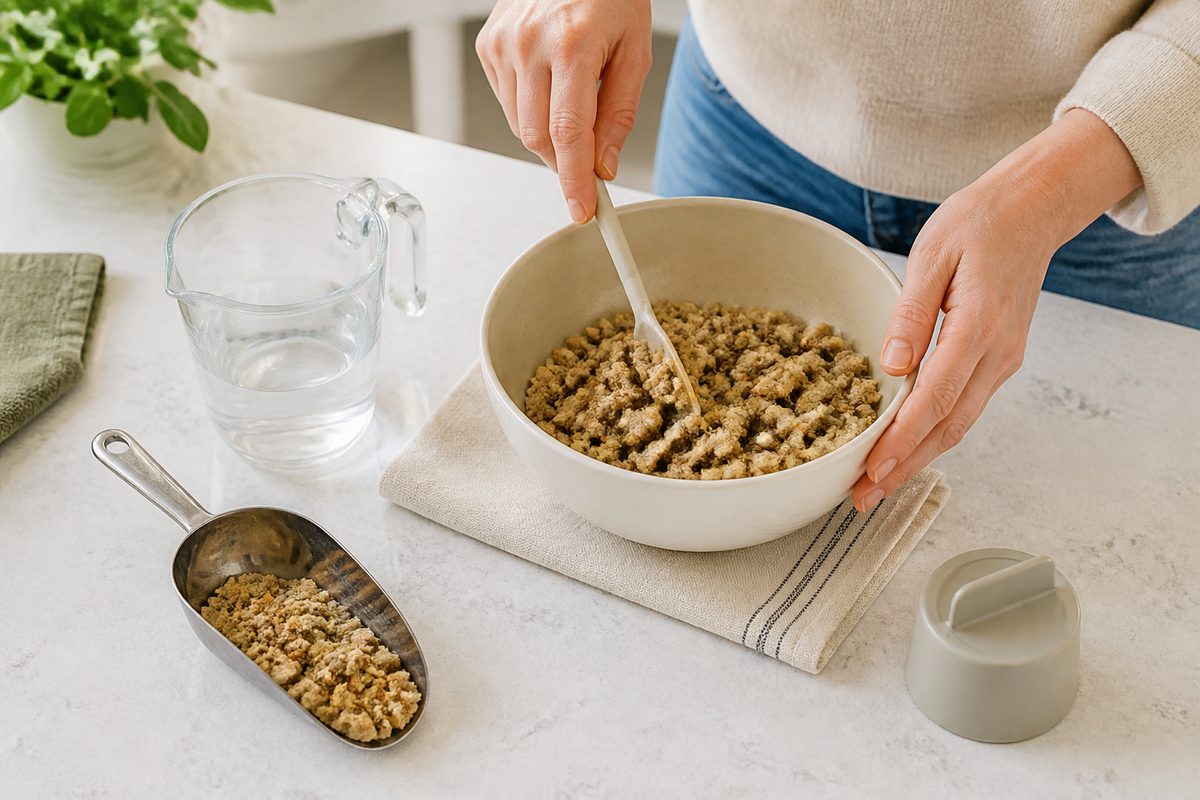
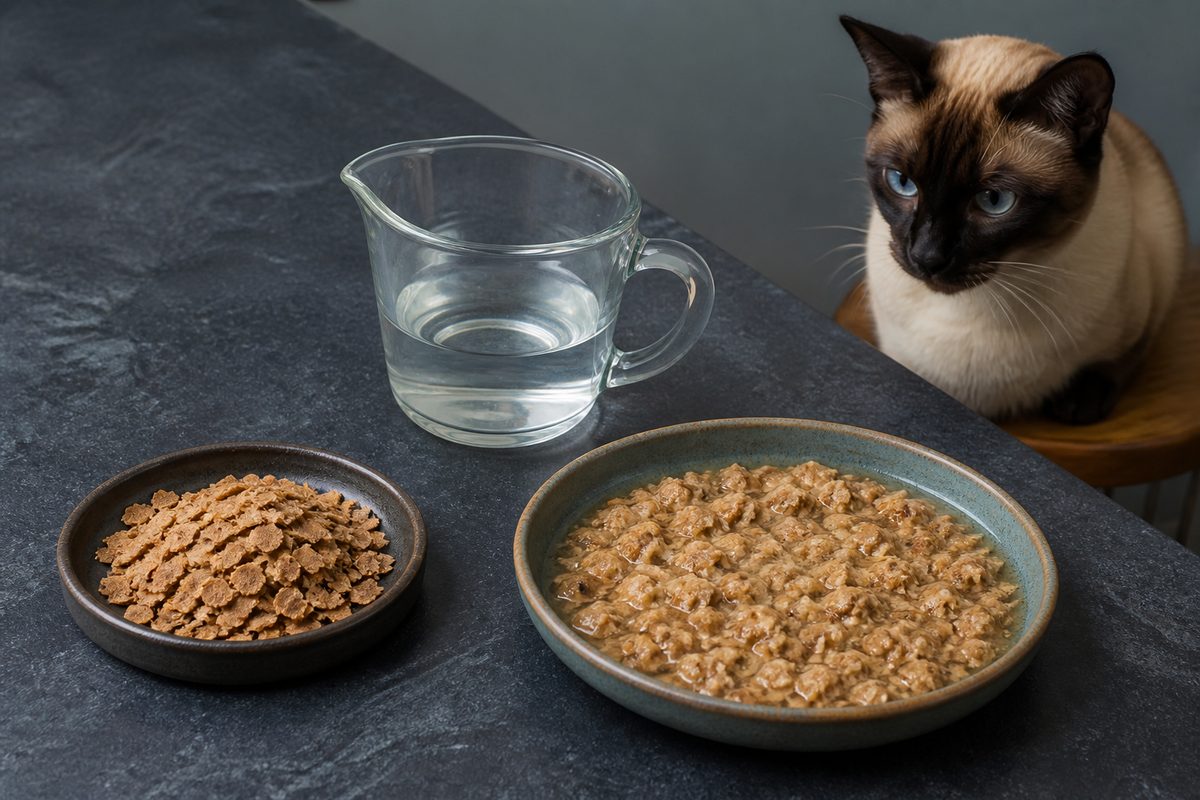
The Honest Kitchen Instant Turkey Bone Broth with Turmeric is a powdered supplemental broth made with turkey broth, turkey, pumpkin, parsley, and turmeric. The current brand direction is to mix one-half tablespoon of dry product with one-quarter cup of water per 25 pounds of body weight. That ratio belongs to this specific product and current label; owners should recheck the package in hand before serving.
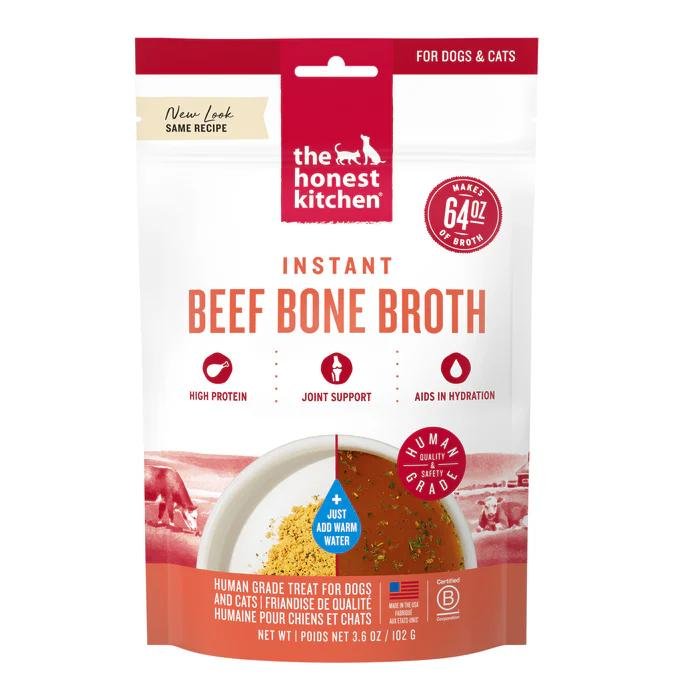
The Honest Kitchen Instant Beef Bone Broth with Turmeric offers a similar instant format with beef-based ingredients. It is also for intermittent or supplemental feeding. For owners who would rather pour than mix, The Honest Kitchen Bone Broth Pour Overs with Chicken is a ready-to-serve topper or snack, not a full meal.
These products make particular sense when:
- You do not have time for a controlled cooking and cooling cycle.
- You are concerned that a fragment or unsafe seasoning could be missed.
- You need directions tied to a specific labeled product.
- You want a compact option for travel or occasional use.
- Your dog benefits from a small amount of added moisture and aroma, but a homemade batch would create waste.
Prepared does not mean unlimited. Follow the product’s current directions, refrigerate leftovers as the label instructs, and factor the topper into the dog’s overall intake. If the dog has a diagnosed condition, a therapeutic diet, or sensitivities to any listed ingredient, bring the label to the veterinarian first.
How Much Bone Broth to Give Your Dog
There is no single homemade-broth dose that fits every dog because a home batch does not have standardized calorie, fat, sodium, or nutrient values. Start with a small amount relative to the dog’s size and normal meal, use it as an addition rather than a replacement, and observe tolerance. A veterinarian can give more specific guidance for a dog with calorie restriction, gastrointestinal sensitivity, kidney or heart disease, pancreatitis risk, or another medical need.
For a commercial product, use the package directions. Do not borrow the instant turkey broth ratio for a Pour Over, another flavor, or a different brand. Product formats and concentrations are not interchangeable. Also remember that a label serving is not a requirement to use the maximum amount. A smaller amount may accomplish the practical goal of moistening or scenting the meal.
Treats and toppers should remain a small share of daily intake so the complete-and-balanced base diet keeps doing the nutritional work. If you use broth every day, review the total extras rather than considering each one in isolation.
Frequently Asked Questions
No. Onion, garlic, chives, and related alliums can damage red blood cells in dogs. Powders and concentrated flavorings count too. Do not try to make a seasoned broth safe by diluting it. Use a batch made without those ingredients.
No. Cooked bones can splinter and cause choking, mouth injury, intestinal obstruction, or perforation. Remove every bone and fragment, strain the broth carefully, and discard the solids in a pet-proof trash container.
Storage time depends on preparation and refrigerator conditions. Cool the broth promptly, keep it covered and cold, and use a conservative food-safety window. Freeze portions that will not be used soon and discard any broth with spoilage signs. A veterinarian can advise when a medically vulnerable dog requires stricter handling.
No. Bone broth is a supplemental liquid or topper. It does not provide the verified nutrient profile of a food labeled complete and balanced for the dog’s life stage.
Some dogs may tolerate a small daily amount, but daily use should still fit the dog’s calories, diet, health, and ingredient needs. Use label directions for commercial products and consult a veterinarian for dogs on therapeutic diets or with medical conditions.
It can be the better option when you lack time for the cook-cool-strain process, worry about bone fragments or hidden seasoning, need portable storage, or want predictable directions. Choose a dog-specific product, check the ingredient list, and follow its current label.
The Bottom Line
Safe bone broth for dogs is plain, carefully strained, modestly served, and kept in its proper role. Homemade broth works when an owner can control every ingredient and complete every handling step. A product such as The Honest Kitchen’s instant or ready-to-pour bone broth can simplify that routine while offering clear ingredients and directions.
Whichever route you choose, keep the dog’s complete-and-balanced food at the center of the bowl. Broth can make a meal more appealing and add moisture. It should never add avoidable hazards, replace necessary nutrition, or delay veterinary care.
Sources
- The Honest Kitchen Instant Turkey Bone Broth with Turmeric
- The Honest Kitchen Instant Beef Bone Broth with Turmeric
- The Honest Kitchen Bone Broth Pour Overs with Chicken
- ASPCA: People Foods to Avoid Feeding Your Pets
- American Kennel Club: Food and Broth Guidance for Dogs With Stomach Upset
- FDA: Complete and Balanced Pet Food