Liquid Joint Supplements for Dogs: How to Choose the Right Formula
Published on October 26, 2026
Sponsored by Pup Labs. Vetstreet may earn a commission if you purchase through the links in this article.
Liquid joint supplements for dogs can make a daily routine easier when a dog spits out tablets or leaves chews untouched. Choosing one starts with a practical question: can you measure the intended serving accurately and give it consistently?
Then look beyond the bottle. The ingredients, their amounts and the evidence behind the formula matter more than whether a supplement pours or crunches. This guide explains how to compare labels and daily costs, with Pup Labs Freedom Joint Drops as a liquid-format example.
When a liquid joint supplement fits your dog
A liquid may fit a dog that accepts a supplement mixed into food more readily than a separate chew. It can also suit a household that prefers measuring a serving to dividing tablets, provided the supplied tool makes that serving easy to read.
Key takeaways
- Choose ingredients and a serving plan with your veterinarian before choosing a format.
- Compare ingredient amounts per daily serving, not bottle size or the length of an ingredient list.
- Confirm what the measuring marks mean, especially for a small dog.
- Calculate cost per day using the amount your dog actually needs.
- Treat convenience as a reason to choose liquid, not proof of superior absorption or faster results.
Taste still matters. A dog that rejects a flavored liquid may do better with another format, and adding it to a whole meal can turn a supplement problem into an unfinished dinner. A useful choice is one your dog accepts and you can give as directed.
New difficulty chewing deserves attention, too. If your dog previously ate chews comfortably but now drops them or avoids them, tell your veterinarian rather than assuming a format change answers the problem.
Compare ingredients and amounts, not just the liquid format
Two liquids can have very different formulas. A prominent ingredient on the front of a bottle tells you little about how much your dog receives, and a longer ingredient list does not establish a better product.
Compare the amount of each relevant ingredient in the labeled daily serving. For a glucosamine powder, multiply the listed milligrams of glucosamine per scoop by the daily number of scoops; for a liquid, multiply milligrams per milliliter by the daily milliliters. Use the same calculation separately for chondroitin or other listed ingredients. A scoop’s total powder weight and a bottle’s liquid volume are not equivalent ingredient amounts, so neither alone tells you which formula is the better choice.
Separate ingredient research from formula evidence
Cornell’s guide to joint supplements describes uneven evidence across ingredients and identifies fish-derived omega-3 fatty acids as having particularly strong support. That does not mean every oil or every combination formula delivers the same result.
Use these distinctions when reading a label:
- Glucosamine and chondroitin: Finding both names does not establish the effectiveness of a particular liquid. Check their stated amounts and ask what evidence applies to that formula.
- MSM and hyaluronic acid: Compare the specific ingredient information rather than assuming that adding either makes a product equivalent to one used in a study.
- Omega-3 fatty acids: Look for EPA and DHA amounts. A total fish-oil quantity alone does not tell you how much of those individual fatty acids the serving contains.
- Blends: A combined blend weight cannot show the amount of every component unless those quantities are also listed.
If a manufacturer references a study, ask whether it tested the same finished formula in dogs, at the same serving level and for the outcome being claimed. Research about one ingredient is useful context, but it cannot establish that every product containing that ingredient works equally well.
Check the complete ingredient list
For a dog with dietary restrictions, review flavorings and other ingredients as well as the highlighted joint-support ingredients. Do not infer that a liquid is shellfish-free, vegetarian or hypoallergenic from its format or product name.
Ask the manufacturer to confirm ingredient sources when that distinction matters for your dog. Share the complete list with your veterinarian, particularly if your dog follows an elimination diet. A small daily supplement is still part of what your dog consumes.
Read the serving directions in milliliters
A drop, a dropper and a milliliter are different descriptions. Milliliters measure liquid volume; milligrams describe an ingredient amount. Neither the bottle’s volume nor a picture of its dropper tells you the concentration of the ingredients inside.
Read the label in this order:
- Find the intended user. Check that the product is for dogs and review any age or other restrictions.
- Find your dog’s serving category. Use a current weight, then check whether the directions describe a total daily amount or an amount given on each occasion.
- Match the serving to the measuring tool. Identify the exact marked line or other manufacturer-defined measure. Do not assume a squeeze fills a dropper to a standard volume.
- Connect that volume to the ingredient panel. Check whether quantities refer to one milliliter, one serving or another stated amount.
- Read the handling instructions. Follow any directions for shaking, storage and use after opening.
For a small dog, confirm that the tool can measure the required amount clearly. Estimating a fraction of an unmarked dropper is not the same as measuring to a marked line. If the directions leave you guessing, ask the manufacturer or veterinary team to demonstrate the correct measurement.
Keep those instructions with the bottle. Anyone else giving the supplement should use the same tool and understand the same daily total. Recheck the label when opening a replacement bottle, especially if the packaging or formula has changed.
Calculate the cost per day for your dog
Bottle prices can be misleading because different liquids have different daily serving volumes. Start with the labeled amount for your dog, then work out how long a bottle will last.
The calculation has two steps:
- Days per bottle = bottle volume in milliliters ÷ daily serving in milliliters.
- Cost per day = bottle price ÷ days per bottle.
The following comparison is entirely hypothetical. These are made-up products and serving amounts for demonstrating arithmetic, not Freedom Joint Drops prices or directions and not dosing advice.
| Hypothetical comparison | Example A | Example B |
|---|---|---|
| Bottle price | $36 | $48 |
| Bottle volume | 60 milliliters | 120 milliliters |
| Assumed labeled daily serving for the example dog | 1 milliliter | 3 milliliters |
| Days per bottle | 60 ÷ 1 = 60 days | 120 ÷ 3 = 40 days |
| Cost per day | $36 ÷ 60 = $0.60 | $48 ÷ 40 = $1.20 |
Example B contains twice as much liquid, yet lasts fewer days at its assumed serving. Example A costs less per day in this calculation. That does not establish that A supplies equivalent ingredients or is the better clinical choice.
Compare formulas first and costs second. A higher concentration can change the volume needed, but a smaller serving is not automatically more effective. Ingredient quantities and your veterinarian’s recommendation remain part of the decision.
Use the price for the purchase option you actually intend to buy. If you are considering a subscription, distinguish the first-order offer from recurring costs and check the delivery interval. Include shipping or other charges consistently when comparing your household’s total expense.
Where Freedom Joint Drops fit
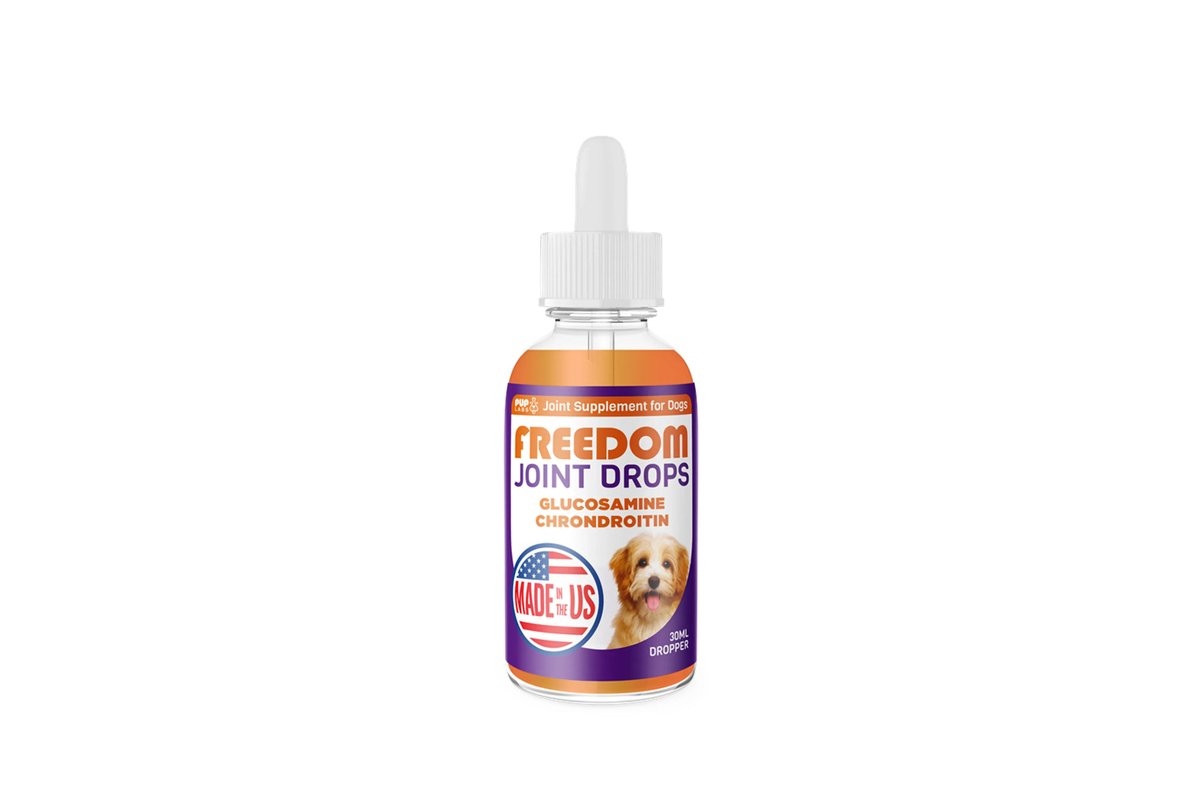
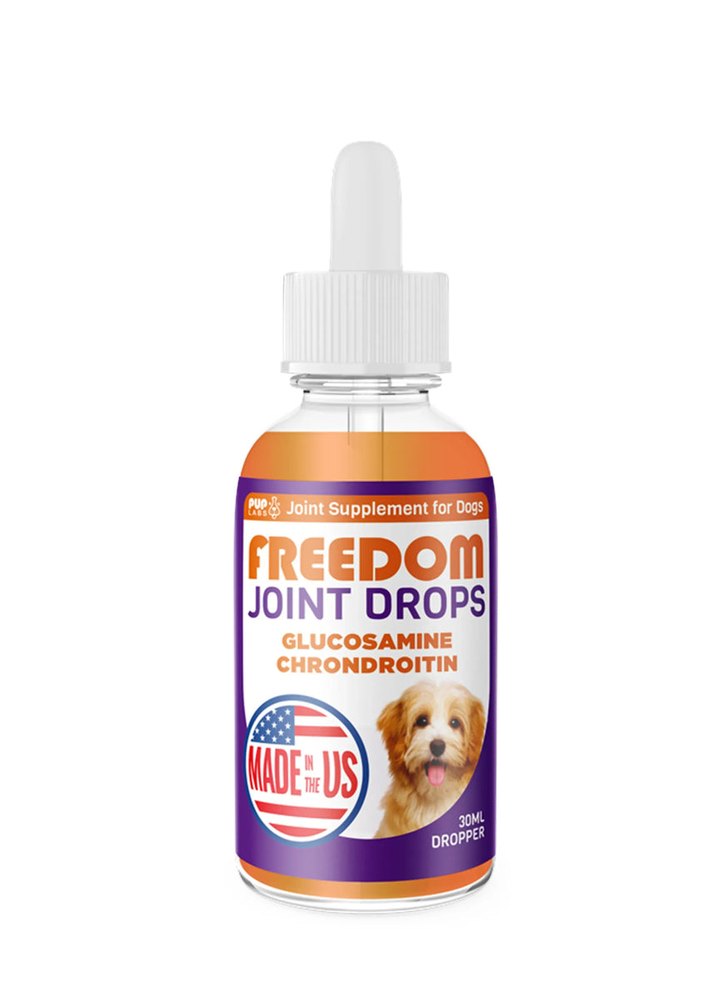
Pup Labs Freedom Joint Drops offers a dropper-bottle option for owners exploring this format. Official product imagery shows a 30 mL bottle, and Pup Labs describes adding the liquid to food or water. That format may be practical for a dog that resists tablets or chews.
Before starting, read the current bottle’s full ingredient panel and serving directions with your veterinarian. Match the directions to your dog’s weight and the supplied measuring tool. Once you know the daily volume, you can use the bottle’s 30 mL capacity to calculate how long it will last and compare the available purchase options.
With that information clarified, apply the same label sequence and cost calculation used for any liquid. The useful question is whether the confirmed formula and routine fit your individual dog.
For a wider look at the brand, read Petful’s Pup Labs review, and for the rest of the range see Petful’s comparison of dog dental powder vs. dental chews and WebVet’s guide to prebiotics for dogs.
Build a routine your dog will actually follow
Make the routine easy to repeat and easy to check. When a product’s label permits mixing with food, a small portion can help you see whether your dog has consumed the intended serving before you offer the rest of the meal.
Use these practical steps:
- Measure each serving according to the current directions rather than pouring by eye.
- If mixing into food, supervise that portion so another pet cannot eat it.
- Keep a simple record when multiple people share feeding duties.
- Store the bottle as directed and keep it beyond your dog’s reach.
- Note any missed or partly consumed serving instead of automatically adding more.
A shared water bowl makes individual intake hard to judge. Even in a one-dog household, water left in the bowl means you cannot assume the full added amount was consumed. Ask your veterinary team which permitted administration method gives you the clearest routine.
If your dog leaves part of a treated meal, avoid guessing how much supplement to replace. Get guidance on handling an uncertain serving and follow the product’s instructions for missed amounts.
When to involve your veterinarian
If stiffness or limping prompted your search, start with an assessment. Similar-looking mobility changes can have different causes, and a supplement trial should not postpone care for a dog that is painful or struggling to move.
Cornell recommends veterinary guidance before starting joint supplements and places them within a broader plan that may include weight management and appropriate activity. A supplement is one possible part of that plan.
Bring the bottle or clear label photographs to the discussion, together with a list of other supplements and medications. Ask your veterinarian to check for overlapping ingredients and whether the proposed product fits your dog’s health needs.
What are the side effects of liquid glucosamine?
VCA’s glucosamine and chondroitin guidance identifies mild gastrointestinal upset, including gas and soft stools, as possible side effects. A liquid format does not remove that possibility, and combination products contain other ingredients that also need consideration.
Stop the supplement and contact your veterinarian if new symptoms develop after starting it. Seek prompt veterinary advice for worsening mobility or signs of pain rather than increasing the serving yourself. Keep the packaging available so the veterinary team can identify the exact product and amount given.
How liquid formulas fit the wider joint-supplement choice
If your dog accepts several formats, compare the broader choices in Vetstreet’s guide to joint supplements for dogs. Use this liquid-specific checklist alongside that overview to assess the serving and day-to-day practicality of a candidate product.
There is no universal best format for every household. A suitable formula is easier to use successfully when its directions are clear and the daily routine is sustainable.
Questions about liquid joint supplements
They may be easier for some dogs to take, but liquid format alone does not prove better absorption or effectiveness. Compare ingredients and formula-specific evidence, then choose a format that supports consistent use.
Yes, if the product label allows it. Start with a small portion that your dog will finish, then offer the rest of the meal. Keep other pets away while your dog eats that portion.
Agree on a review date with your veterinarian based on the product and your dog’s needs. Record changes in everyday movement and comfort, plus any unwanted effects. Do not wait for that date if symptoms worsen or new pain develops.
Final thoughts: Choose for your dog and your routine
A useful liquid joint supplement choice brings a suitable formula together with clear serving instructions. Confirm those details first, compare daily costs and choose a routine you can maintain. Your veterinarian can help put that decision into a broader plan for comfortable movement.