Best Dog Food for Bichon Frises: Choosing Food for a Small Companion
Published on October 20, 2026

Compare four JustFoodForDogs choices for Bichon Frises, then build a feeding routine around life stage, measured portions, manageable textures, and body condition beneath that fluffy coat.
This article is sponsored by JustFoodForDogs.
The best dog food for Bichon Frises starts with complete nutrition for the right life stage, then comes down to portions your dog can manage and a routine you can maintain. A small bowl, a white coat, and an enthusiastic appetite do not tell you how many calories your particular Bichon needs.
Fresh, wet, dry, and properly prepared dehydrated foods can all deserve consideration. The useful questions are whether the recipe is suitable for your dog’s age, how much of it supplies the daily allowance, and whether you can store and serve it correctly.
Key Takeaways
- Choose complete nutrition for your Bichon’s life stage
- Compare calories per gram before comparing portion sizes
- Divide one daily allowance among meals and rewards
- Feel beneath the coat when tracking body condition
Choose food for your Bichon as a small companion
The Bichon Frise’s companion-dog personality makes shared routines an important part of everyday life. Feeding can fit that pattern without turning every interaction into another snack. Start with a food that meets your dog’s nutritional needs, then build a predictable schedule around it.
What is the healthiest dog food for small dogs? There is no single recipe that earns that title for every dog. For a healthy Bichon, useful selection criteria include a complete-and-balanced statement for the appropriate life stage, manageable texture, clear calorie information, and a manufacturer that provides the information needed to feed the product correctly. The FDA explains what complete and balanced means and why the intended life stage matters.
Before comparing Bichon Frise food recommendations, answer four practical questions:
- Is this a puppy or an adult? Adult-maintenance food is not a substitute for a growth-appropriate diet.
- How much food supplies the daily calories? Equal spoonfuls of different recipes may provide different amounts of energy.
- Can your dog eat the texture comfortably? Observe actual eating rather than assuming that all small dogs need the same format.
- Can you finish opened food on time? Package size and refrigerated storage limits matter when meals are small.
A breed name on the package does not settle these questions. Nor does a particularly appealing ingredient list. Vetstreet’s guide to ingredients versus nutrition on dog-food labels explains why the full nutritional picture deserves attention.
The four JustFoodForDogs choices below illustrate different fits within one brand. They are compared using current product information, life-stage suitability, calories, and handling requirements. This is a label-based selection guide, with no claim that we tested these meals with Bichons.
Four JFFD choices for Bichon households
Two recipes below carry all-life-stages statements, while two are adult-maintenance choices. That distinction comes before convenience, flavor preference, or whether a meal needs freezer space.
| Recipe | Potential household fit | Life-stage statement | Calories per gram | Important handling distinction |
|---|---|---|---|---|
| Chicken & Rice | Fresh frozen food with rice for a puppy or adult | All life stages, including growth of large-size dogs | 1.530 | Refrigerate after thawing |
| Fish & Sweet Potato | A less calorie-dense fresh frozen option | All life stages, including growth of large-size dogs | 0.922 | Shorter refrigerated storage window |
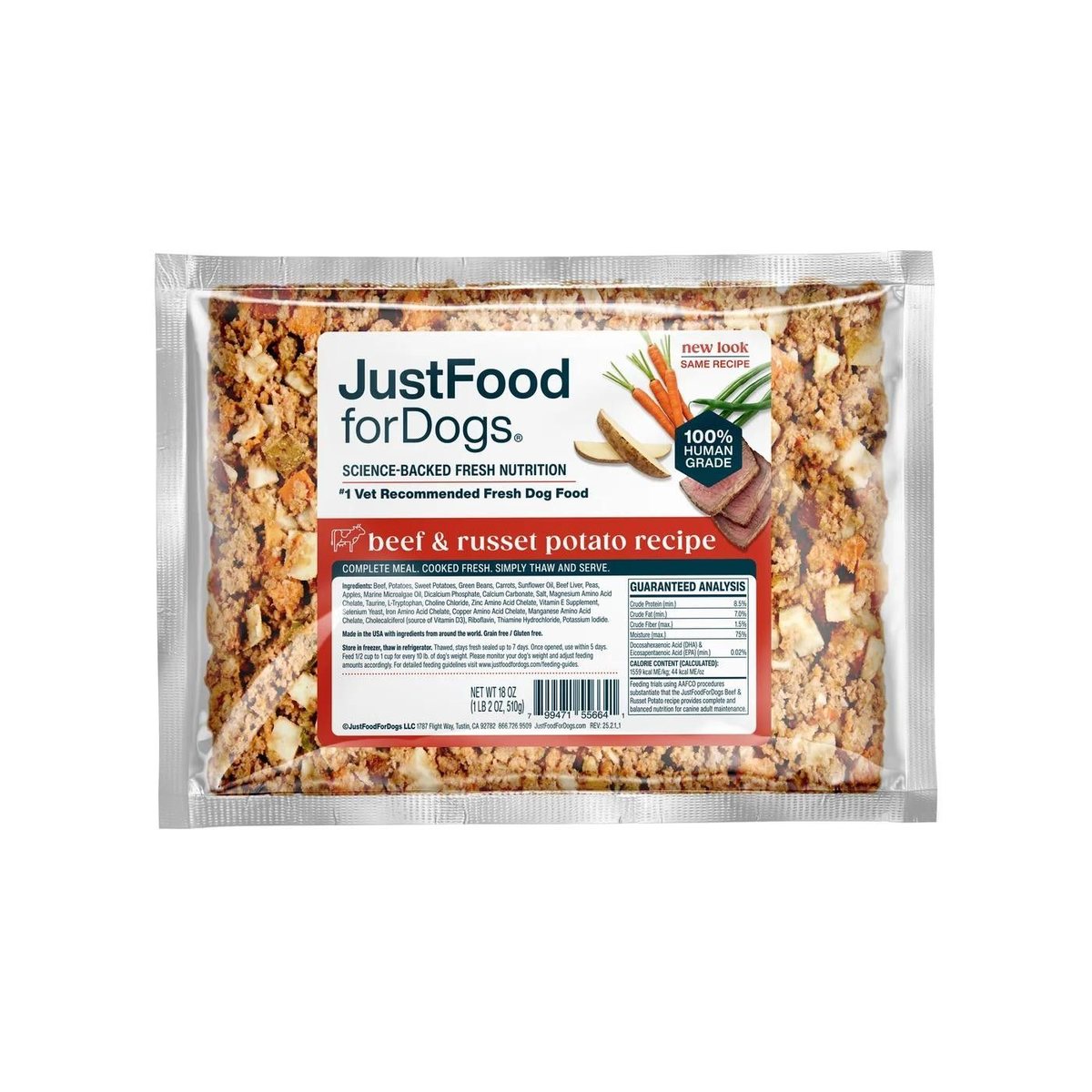
| Beef & Russet Potato | A fresh frozen beef recipe for an adult | Adult maintenance | 1.559 | Not a complete puppy-food choice |
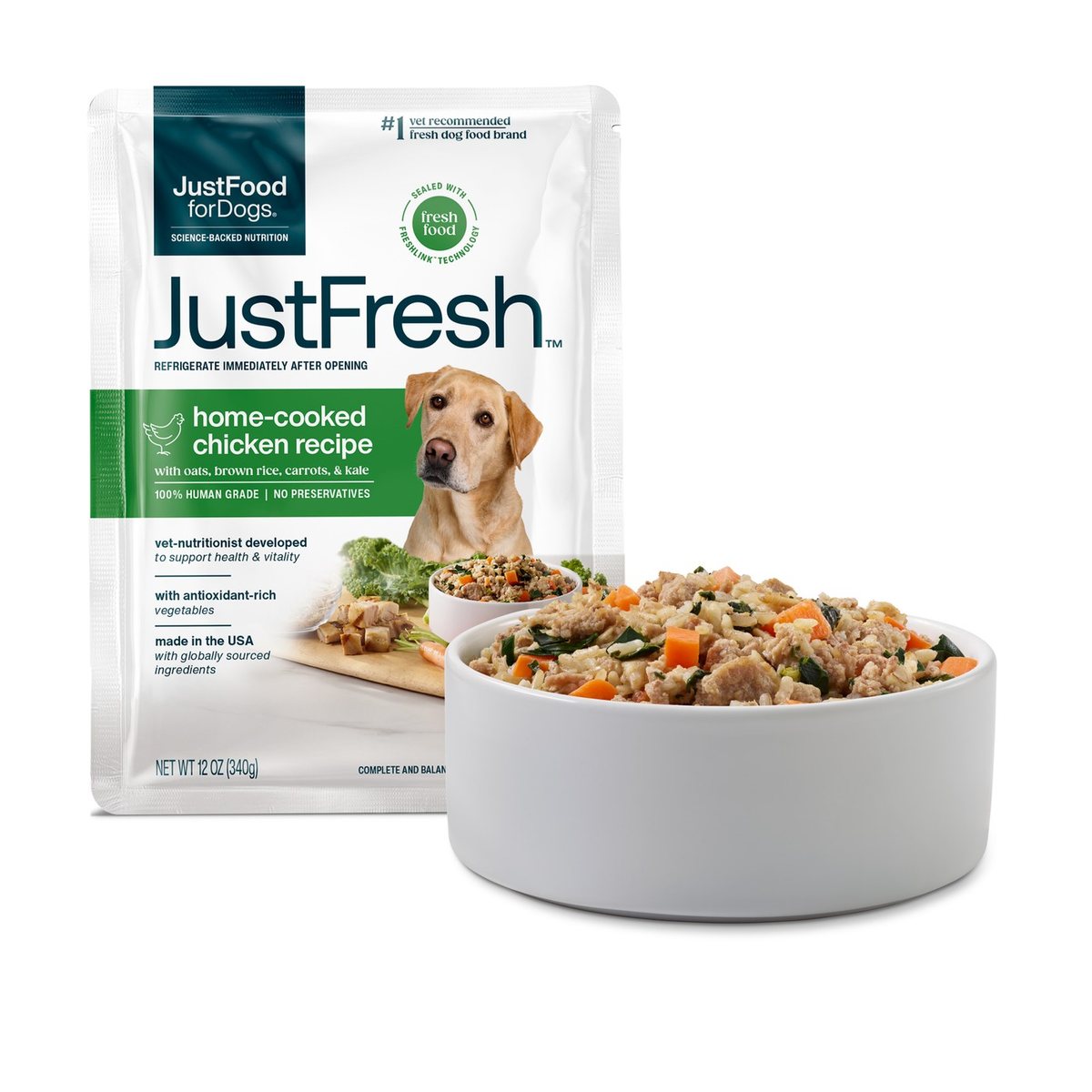
| JustFresh Home-Cooked Chicken | An adult meal stored at room temperature before opening | Adult maintenance | 1.254 | Refrigerate and use within three days after opening |
JustFoodForDogs Chicken & Rice
Chicken & Rice is a practical starting point for a household that wants fresh frozen food and has room to thaw small portions in the refrigerator. Its current nutritional statement covers all life stages, including growth of large-size dogs. That makes it eligible for consideration for a Bichon puppy as well as an adult.
The recipe contains white and brown rice and provides 1,530 calories per kilogram, or 1.53 calories per gram. Its energy density means a measured portion supplies more calories than an equal weight of the Fish & Sweet Potato recipe below. That difference matters when you are comparing how full the bowl looks.
Consider it if:
- You want a grain-inclusive fresh recipe.
- You can organize freezer storage and refrigerator thawing.
- You want a recipe whose life-stage statement includes growth.
For a small dog, work backward from the amount eaten per day before opening a package. JustFoodForDogs lists up to seven refrigerated days for sealed, thawed non-fish Fresh Frozen meals and up to five days once opened. Date the package when it thaws and opens, and follow any more specific instructions on the product you receive.
A small fresh meal still needs measuring. A few generous spoonfuls can vary from day to day, especially when more than one person feeds the dog.
JustFoodForDogs Fish & Sweet Potato
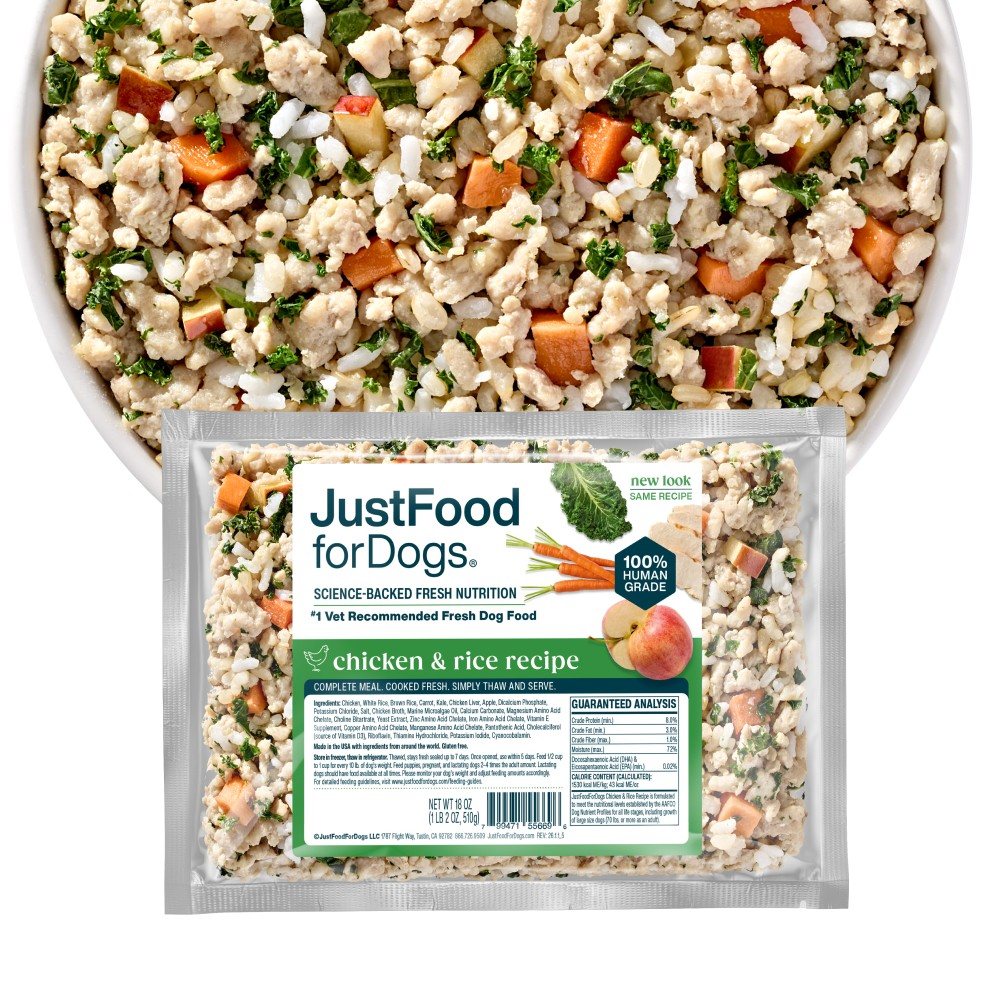
Fish & Sweet Potato offers a different protein combination and substantially fewer calories per gram than the other three recipes here. The current fish blend includes cod, pollock, and haddock. Describing it simply as a cod-only meal would miss that distinction.
At 922 calories per kilogram, or 0.922 calories per gram, the recipe requires a larger weighed portion to supply the same calories as Chicken & Rice or Beef & Russet Potato. That can be useful information when comparing serving size, but it does not make the recipe a prescribed weight-loss food.
Its practical features include:
- An all-life-stages statement that includes growth of large-size dogs.
- A fish blend rather than a single named fish species.
- A shorter refrigerated storage window than the non-fish Fresh Frozen meals.
JustFoodForDogs specifies up to five refrigerated days sealed after thawing and three days once opened for its Fresh Frozen fish meals. A Bichon eating small servings may therefore need especially careful package planning. Marking the opening date is more dependable than remembering when you first used it.
Choose this recipe based on its complete nutritional profile and your dog’s individual suitability. Fish ingredients do not, by themselves, establish that a food is appropriate for diagnosing or managing a suspected food allergy.
JustFoodForDogs Beef & Russet Potato
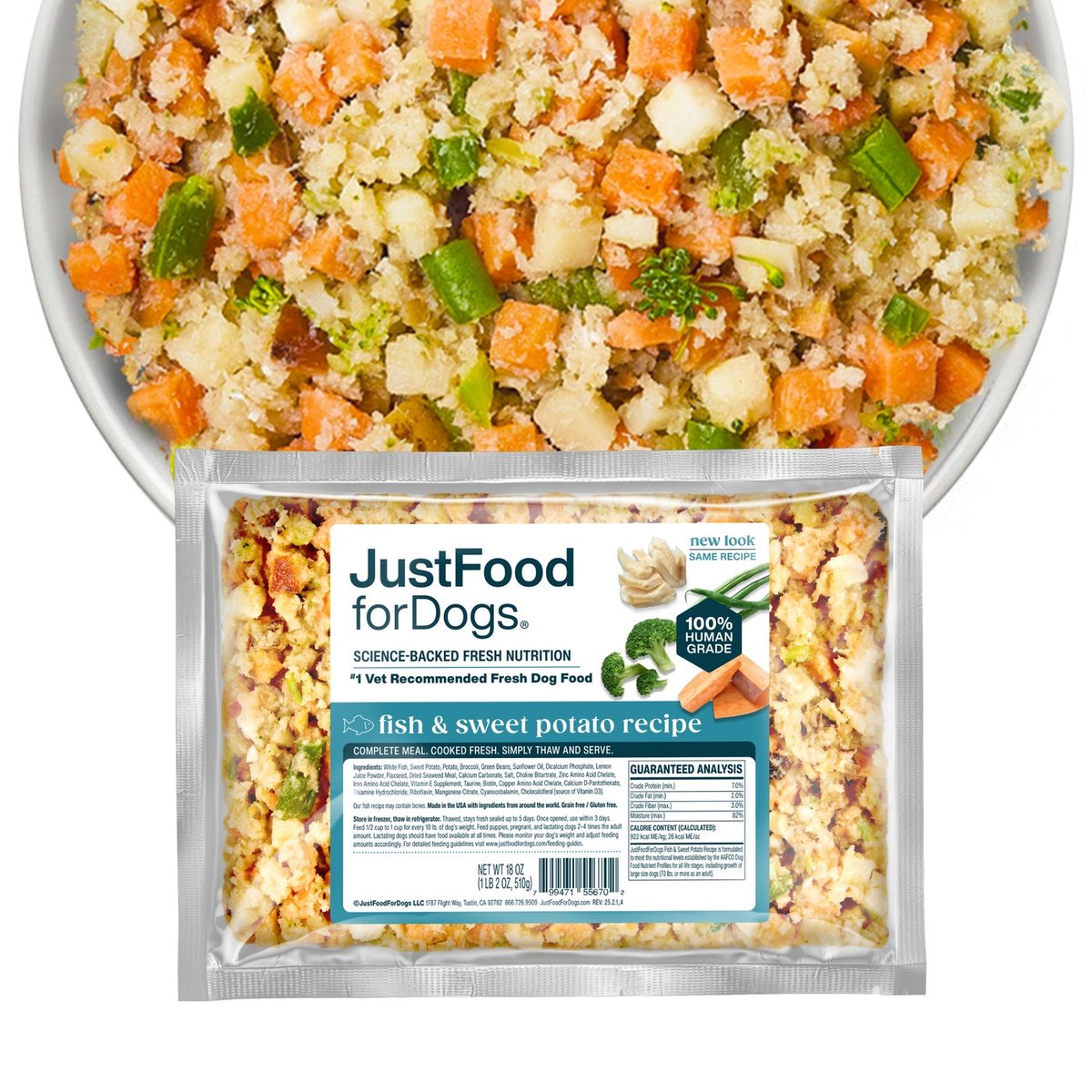
Beef & Russet Potato is an adult-maintenance option for households that want a fresh frozen beef recipe. The manufacturer’s nutritional adequacy statement is supported by animal feeding tests using AAFCO procedures for adult maintenance. That statement does not make it a complete diet for a growing Bichon puppy.
The recipe supplies 1,559 calories per kilogram, or 1.559 calories per gram. It is the most calorie-dense of these four choices, although its calorie content is close to Chicken & Rice. Measure it in grams instead of assuming that a visually similar serving of another recipe is equivalent.
It may fit an adult Bichon household that:
- Wants a beef-based fresh meal.
- Can maintain frozen and refrigerated storage.
- Prefers to weigh a relatively smaller serving for the same calorie allowance.
Use the same package-planning approach as for other non-fish Fresh Frozen meals: track thawing and opening dates, keep the food refrigerated, and observe the manufacturer’s limits. Buying a larger package is useful only if your household can handle it within the instructions.
If you have a puppy and an adult dog, label their portions clearly. Similar-looking fresh meals can have different nutritional purposes, and sharing a refrigerator does not make the recipes interchangeable.
JustFoodForDogs JustFresh Home-Cooked Chicken
JustFresh Home-Cooked Chicken is the adult-maintenance choice here for households that value storage convenience before opening. It contains oats and brown rice and supplies 1,254 calories per kilogram, or 1.254 calories per gram.
Its current nutritional adequacy statement covers adult maintenance. Do not confuse it with the Fresh Frozen Chicken & Rice recipe, whose statement includes growth. Two foods featuring chicken can differ in life-stage suitability, calories, and storage requirements.
The main practical distinctions are:
- Shelf-stable storage before opening.
- A manufacturer-stated unopened shelf life of up to two years from manufacture.
- Refrigeration and use within three days after opening.
For a small companion, the three-day opened-food window deserves a place in the buying decision. Calculate how much your Bichon would eat over that period, then compare it with the package size. Shelf stability before opening does not extend the refrigerated limit afterward.
Vetstreet’s earlier JustFoodForDogs review offers historical context about the brand. Use the current package and current manufacturer instructions for this particular product’s nutrition and handling details.
Compare textures and portions your Bichon can manage
The best Bichon Frise food type is one your dog can eat comfortably and your household can serve consistently. Fresh food is not automatically the right fit for every home, and dry food is not automatically unsuitable for a small mouth.
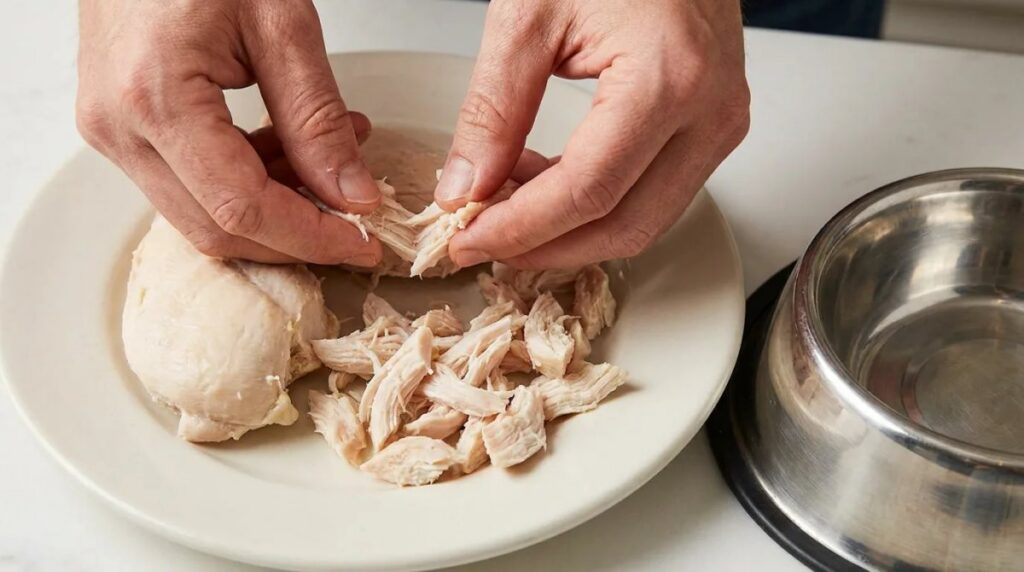
Watch a normal meal. Notice whether your dog picks up pieces easily, leaves a particular component behind, or struggles with chewing. A new difficulty eating deserves veterinary attention rather than repeated experiments with softer food.
Compare formats using the work each one requires:
- Dry food: Check piece size, calories per gram or cup, and the complete-and-balanced statement.
- Wet food: Consider portioning, refrigeration after opening, and whether a container can be used within its instructions.
- Fresh food: Allow for weighing, cold storage where required, thawing, and shorter opened-food windows.
- Dehydrated food: Follow the exact preparation directions and confirm whether the product is a complete meal, a base mix requiring additions, or a topper.
Keep the food format separate from dental claims. Ordinary crunchy kibble should not be assumed to provide the proven plaque or tartar benefits of a specifically evaluated dental product.
If you combine two complete foods, add their calories together before deciding portions. Half a bowl of one food plus half a bowl of another does not necessarily equal half of each daily ration. Similarly, adding water changes the weight and volume of a serving without adding food calories. For a rehydrated product, calculate from the manufacturer’s specified dry or prepared measurement.
Measure the daily allowance before dividing it into meals
There is no universal quarter-cup prescription for Bichons. A cup of one food can provide substantially different calories from a cup of another, and two Bichons can need different daily allowances. Age, body size, activity, and current body condition all influence the starting plan.
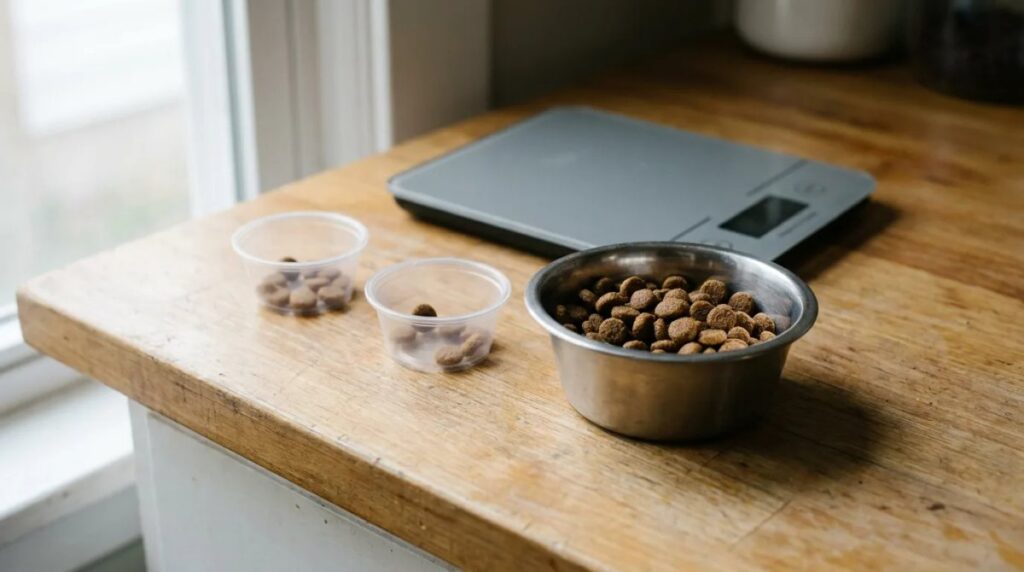
Use the package feeding guide and your veterinary team’s advice to establish an initial daily calorie allowance. The WSAVA calorie guide for healthy adult dogs provides starting estimates, not a guarantee of what an individual dog should eat indefinitely.
Then convert calories into a measurable ration:
- Write down the total daily allowance.
- Subtract the calories reserved for treats, chews, and other extras.
- Divide the remaining calories by the food’s calories per gram.
- Weigh that amount for the day.
- Divide it among the planned meals.
For illustration only, imagine an adult dog with an established allowance of 400 calories per day. If 40 calories are reserved for extras, the complete food must supply 360 calories. This is a calculation example, not a calorie recommendation for every Bichon.
| Recipe | Calculation for 360 food calories | Approximate food per day | Approximate amount in each of two meals |
|---|---|---|---|
| Chicken & Rice | 360 ÷ 1.530 | 235 g | 118 g |
| Fish & Sweet Potato | 360 ÷ 0.922 | 390 g | 195 g |
| Beef & Russet Potato | 360 ÷ 1.559 | 231 g | 116 g |
| JustFresh Home-Cooked Chicken | 360 ÷ 1.254 | 287 g | 144 g |
Rounding explains small differences between the daily and per-meal figures. Use the current calorie information on your own package if it differs.
One allowance, several servings
Divide the daily allowance, not an extra meal. A third meal or a training session should receive part of the planned ration rather than automatically increasing the day’s food.
AAHA’s nutritional guidance identifies excessive treats and other extras as a nutritional risk. Keep those items together within no more than 10 percent of daily calories unless your veterinary team directs otherwise. That is a shared ceiling, not a separate allowance for biscuits, dental chews, and table food.
A kitchen scale is particularly useful when several people feed the same dog. Set aside the day’s ration and rewards in clearly marked containers. Anyone giving an extra then draws from the same budget, making accidental double-feeding easier to prevent.
How many times a day should you feed a Bichon Frise?
For many healthy adult Bichons, two measured meals provide a workable routine. VCA’s feeding-frequency guidance discusses regular meal schedules and their role in making feeding predictable. Your dog’s medical needs or individual tolerance may call for a different plan.
Puppies need a schedule suited to their growth and age. Texas A\&M’s puppy timeline describes four to five small meals around weaning at five to six weeks, reducing to three meals around eight to nine weeks. Those early milestones are not a universal instruction to move every puppy to two meals at a particular later age.
For a puppy coming home, get a clear handoff:
- Ask what food the puppy currently eats and how much is offered daily.
- Record the number and timing of meals.
- Confirm that the food is complete for growth.
- Review the schedule and portions with your veterinary team as the puppy grows.
For an adult, choose times the household can keep reasonably consistent. If three smaller meals work better than two, split the same allowance into three portions. Do not add another full serving simply because the schedule now has another feeding time.
Predictable meals also make changes easier to notice. Record persistent reduced intake, repeated unfinished meals, or a sudden appetite change rather than treating every hesitation as evidence that you need a new brand.
Check puppy growth and adult-maintenance labels
A Bichon puppy needs food suitable for growth. A healthy adult can eat an appropriate adult-maintenance diet. “Small breed,” “fresh,” “natural,” and a picture of a puppy do not replace the nutritional adequacy statement.
Among the four recipes in this guide:
- Chicken & Rice is labeled for all life stages, including growth of large-size dogs.
- Fish & Sweet Potato has the same life-stage coverage.
- Beef & Russet Potato is an adult-maintenance recipe.
- JustFresh Home-Cooked Chicken is an adult-maintenance recipe.
The mention of large-size growth in the first two statements does not make those foods exclusively for large dogs. It describes the scope of nutritional suitability. Serving size still needs to match the individual puppy.
Check the exact recipe rather than transferring information from another product in the same range. Brand familiarity can make that step easy to overlook, especially when two packages share the same main protein.
What is the number one vet recommended dog food for puppies?
There is no independently established number-one recommendation that applies to every puppy in this guide. A useful veterinary recommendation considers the puppy’s growth, health history, food tolerance, and the manufacturer’s nutritional information.
For your Bichon puppy, ask concrete questions:
- Does this exact food provide complete nutrition for growth?
- What starting daily amount fits this puppy?
- How often should we reassess weight, growth, and body condition?
- How should treats fit into the allowance?
- When should we review the eventual transition to adult food?
That conversation is more useful than an unsupported ranking. It also gives you a feeding plan that can change as your puppy develops, instead of a fixed scoop amount carried through the entire first year.
Look beneath the coat when tracking body condition
A Bichon’s fluffy outline can make visual assessment difficult. Look beneath the coat by using your hands as well as your eyes, and keep a weight record alongside what you observe.

The WSAVA body-condition chart describes an ideal adult condition around four to five on its nine-point scale, with ribs readily felt beneath appropriate fat covering, a visible waist, and an abdominal tuck. Ask your veterinary team to demonstrate those landmarks on your own dog, particularly when coat volume obscures them.
Use a repeatable check:
- Feel the ribs gently with your dog standing comfortably.
- Assess the waist and abdominal outline while accounting for the coat.
- Record weight using a consistent weighing method.
- Compare the trend with the measured food and extras being given.
Muscle condition is a separate assessment. A stable number on the scale does not tell you everything about whether a dog is maintaining muscle, particularly with aging or illness.
Review the ration when weight or condition changes, and consider what changed in the routine. More snacks, shorter walks, a recipe switch, and inaccurate scooping can all alter the feeding picture. Unexplained weight loss, persistent appetite changes, or difficulty eating call for veterinary assessment rather than simply increasing or decreasing portions on your own.
Does a white coat mean my Bichon needs allergy food?
No. Coat color does not diagnose Bichon Frise food allergies. Choosing food marketed for white dogs does not identify the cause of itching or digestive trouble. Recurrent symptoms need an individual assessment, rather than an assumption based on appearance.
VCA’s food-allergy guidance explains the role of a controlled dietary trial in diagnosis. Randomly rotating proteins or choosing fish does not provide the same answer. The regular recipes compared here are not treatment diets.
Make the feeding history useful to your veterinarian:
- Record the full product names and recent changes.
- Include treats, chews, supplements, and foods used for medication.
- Note when symptoms appeared and what else changed in the routine.
- Ask what every caregiver may offer if a dietary trial is prescribed.
Keep the written instructions beside the food. A trial requires consistency across meals and extras; a small snack is not automatically permitted because it fits the calorie allowance.
Bichon food questions
Not necessarily. A food does not need “Bichon Frise” on the package to provide appropriate complete nutrition. Start with the nutritional adequacy statement, life stage, calorie information, and your dog’s individual needs. A small-breed recipe may offer convenient piece size or serving guidance, but still check those details. Choose a format your dog eats comfortably and a storage routine your household can maintain. Breed branding is one product feature, not proof that a food is the best match.
Bring the food packages or clear label photographs, a list of every extra, and dated notes about symptoms and recent feeding changes. Include foods given by other caregivers. That history helps your veterinarian decide what to investigate before you choose another recipe.
Yes, but an everyday homemade diet needs a complete formulation appropriate for your dog’s life stage and health. Meat, rice, and vegetables are not automatically a balanced meal, even when each ingredient is safe to eat. Use an individualized recipe from a qualified veterinary nutrition professional or a complete system with clear, applicable preparation instructions. Weigh ingredients, include the specified supplements, and avoid substitutions unless the formulator approves them. Changing the protein, leaving out an oil, or using a different supplement can change the nutritional result. Keep the recipe and preparation details available for your veterinary team, and reassess the plan when your dog’s life stage or health needs change. Homemade feeding still requires measured portions, safe storage, and a daily budget for extras.
No. Dehydrated products can be complete diets, toppers, or base mixes that require additional ingredients. Check the nutritional adequacy statement and intended use before relying on one as the main food. Follow the exact rehydration directions and calorie information, noting whether quantities refer to the dry product or the prepared meal. Water increases serving weight and volume without adding calories. Once prepared, follow the manufacturer’s storage instructions rather than assuming the dry product’s shelf life still applies.
Do not assume that ordinary kibble provides proven dental cleaning simply because it is crunchy. Dental benefits depend on the particular product and the evidence supporting its claim. The Veterinary Oral Health Council’s accepted-products list identifies products accepted for specified plaque or tartar claims. Ask your veterinary team about an appropriate home-care routine and dental assessment. If a dental chew is part of that plan, count its calories with all other extras rather than adding it outside the daily allowance.