
Best Dog Food for Westies: Choosing for Size, Age, and Daily Routine
Published on October 20, 2026

Compare four JustFoodForDogs options for Westies and build a practical feeding card covering life stage, measured portions, treats, storage, and observations to share with your veterinarian.
This article is sponsored by JustFoodForDogs.
The best dog food for westies is a complete and balanced recipe that fits the individual dog’s life stage, calorie needs, and everyday routine. A white coat does not create a universal list of ingredients to avoid, and a small bowl does not make portion measurement unimportant.
Start with a suitable recipe, establish the daily amount, and make the plan easy for everyone in the household to follow. These four JustFoodForDogs options provide different ways to build that routine.
What is the best food to feed a Westie?
The best Westie food provides appropriate nutrition in an amount that supports the dog’s condition. A useful Westie food recommendation should identify an exact recipe and serving plan, rather than relying on the breed name or an appealing ingredient.
First, read the nutritional adequacy statement. It should identify the appropriate life stage, such as growth or adult maintenance. Vetstreet’s guide to dog food labels, ingredients, and nutrition explains why the ingredient list is only one part of evaluating a food.
Key Takeaways
- Choose complete and balanced food for the appropriate life stage
- Measure the daily food and treat allowance
- Use one feeding record across caregivers
- Investigate symptoms before excluding ingredients
Build a feeding routine rather than an ingredient blacklist:
- Choose a recipe with suitable life-stage adequacy.
- Find its calories per gram or another clearly measured unit.
- Count treats and other foods alongside meals.
- Check weight and body condition over time.
- Record meaningful changes in appetite, digestion, or skin.
Our West Highland White Terrier profile provides broader breed context. Feeding decisions still need to account for your particular Westie’s age, health, and activity.
Four JFFD choices for a Westie’s everyday routine
These options differ in growth suitability, calorie density, and storage format. Their roles below follow current manufacturer information, without assuming one recipe is right for every Westie.
| Recipe | Life-stage fit | Calories per gram | Practical fit |
|---|---|---|---|
| Chicken & Rice | All life stages, including growth | 1.530 | Grain-inclusive fresh food for a puppy or adult plan |
| Fish & Sweet Potato | All life stages, including growth | 0.922 | A fish-based option requiring more grams for the same calories |
| Beef & Russet Potato | Adult maintenance | 1.559 | A complete fresh beef recipe for adults |
| JustFresh Home-Cooked Chicken | Adult maintenance | 1.254 | Convenient unopened shelf storage |
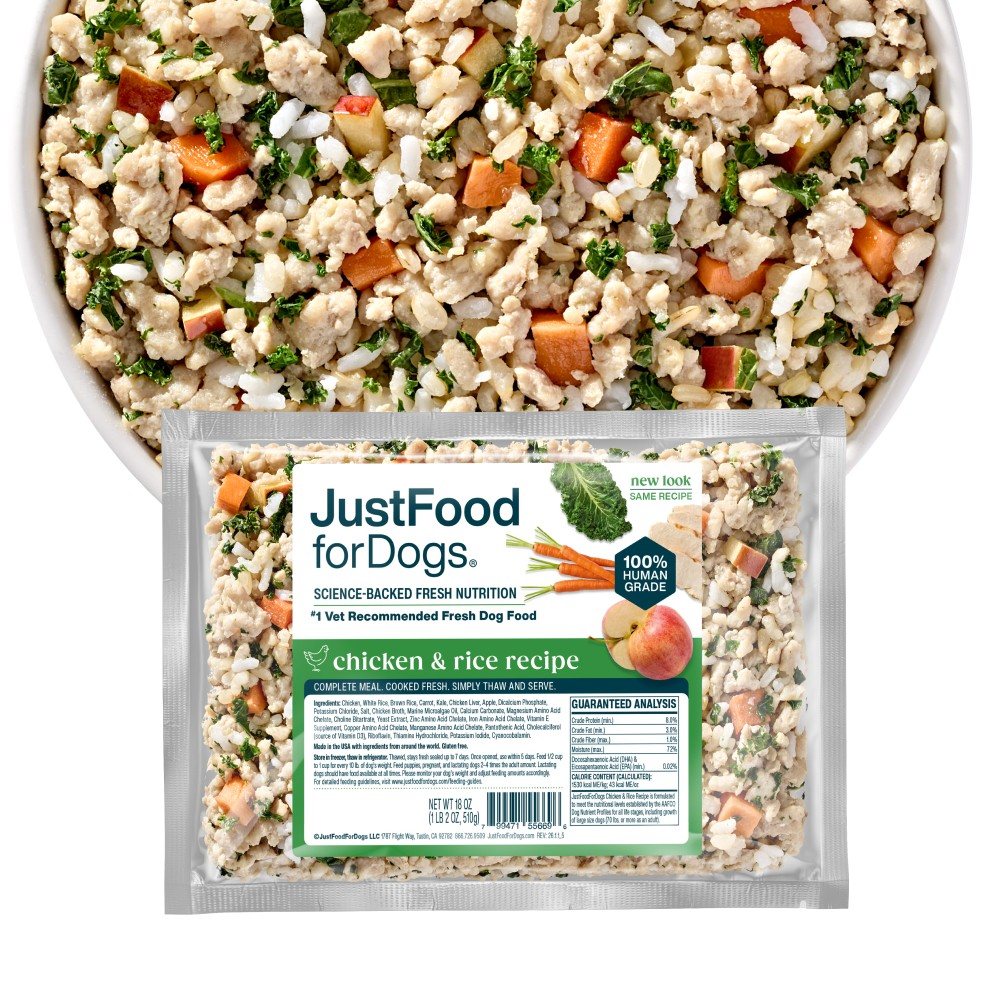
JustFoodForDogs Chicken & Rice
Chicken & Rice is a fresh-frozen option for households considering one recipe that can fit either a puppy or an adult. Its current formulation includes chicken with white and brown rice.
The manufacturer’s recipe information lists 1,530 kcal/kg and all-life-stages adequacy, including growth. Dividing by 1,000 gives 1.530 calories per gram.
- Useful fit: A growth-appropriate, grain-inclusive fresh-food routine.
- Portion consideration: Use the exact recipe’s calorie density when weighing meals.
- Household consideration: Plan refrigerator space and thawing before the current supply runs out.
The recipe name does not describe a homemade chicken-and-rice meal. The complete formulation includes the nutrients needed for its stated life stages.
JustFoodForDogs Fish & Sweet Potato
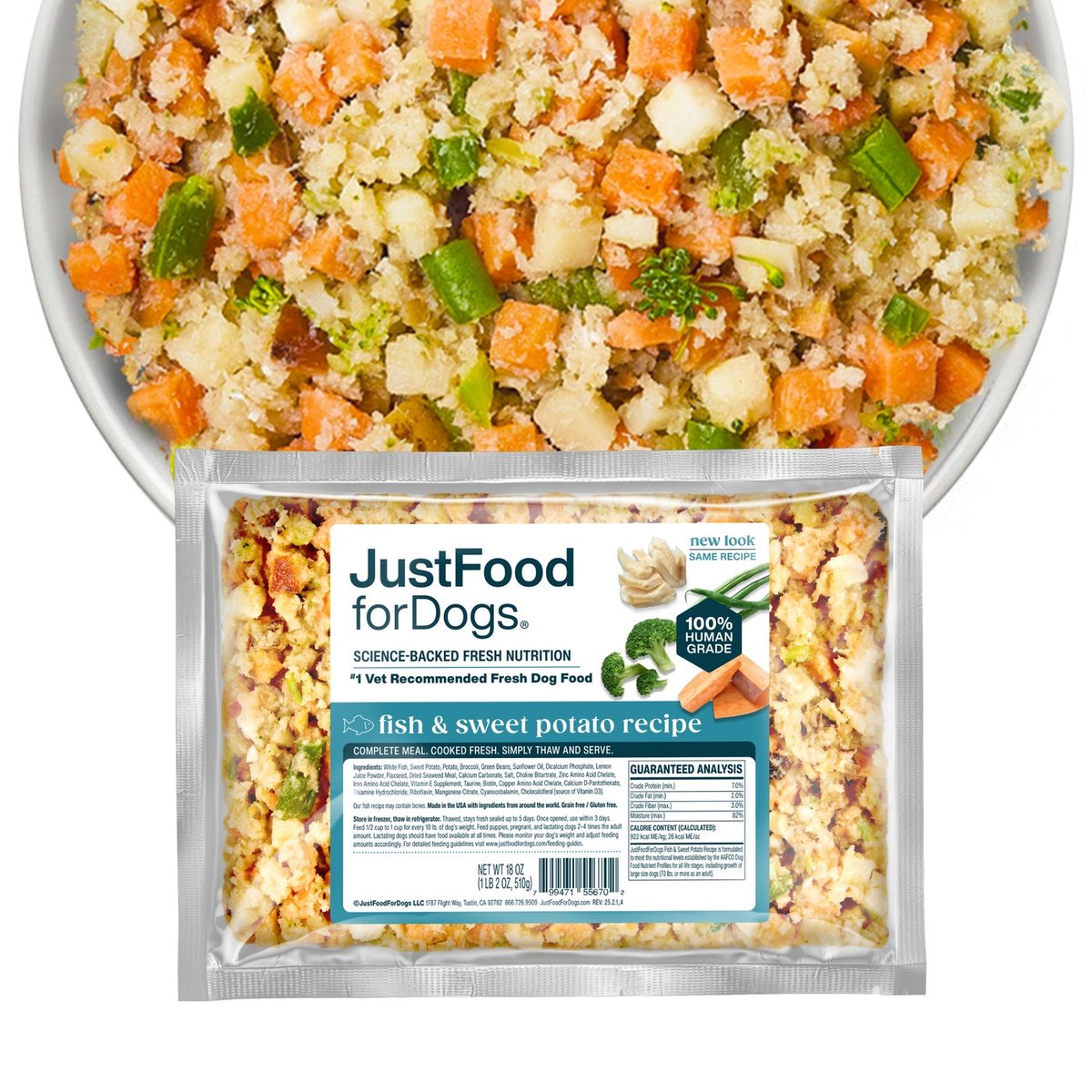
Fish & Sweet Potato is another growth-appropriate option. Its current fish blend includes cod, pollock, and haddock, rather than cod alone.
At 922 kcal/kg, it supplies 0.922 calories per gram. A Westie receiving a set calorie allocation would eat more grams of this recipe than of Chicken & Rice.
- Useful fit: A suitable fish-based recipe for a puppy or adult.
- Portion consideration: Recalculate grams when switching from a more calorie-dense food.
- Household consideration: Check the fish-specific refrigerated-use instructions.
A fish recipe is not automatically an allergy treatment. Its lower calorie density is a portion-planning fact, not a prescription for weight loss.
JustFoodForDogs Beef & Russet Potato
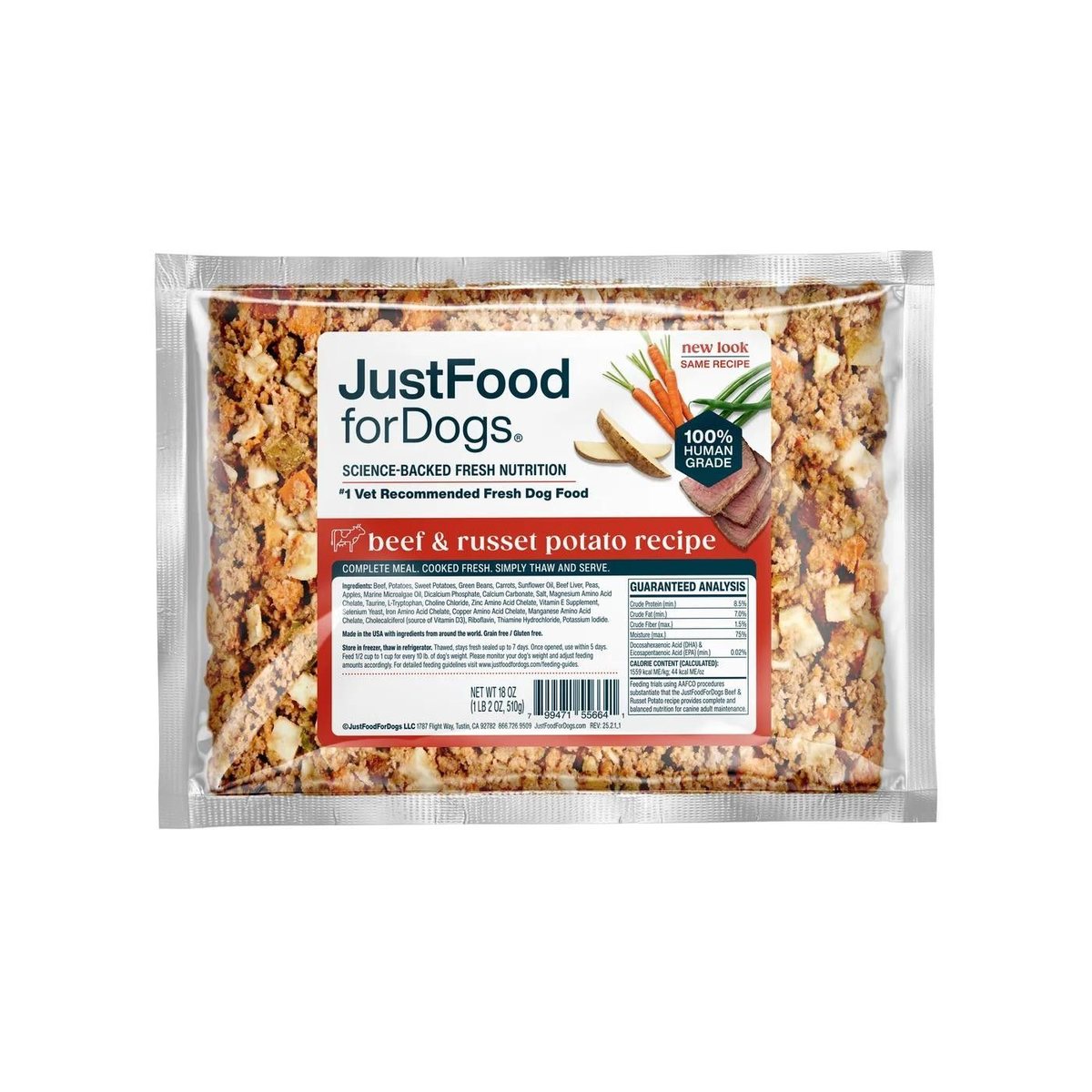
Beef & Russet Potato is a complete adult-maintenance option. It is not intended as the complete diet for a growing Westie puppy.
The current product information lists 1,559 kcal/kg, or 1.559 calories per gram. Adult-maintenance adequacy is substantiated through feeding trials using AAFCO procedures.
- Useful fit: An adult whose nutritional needs suit this complete beef recipe.
- Portion consideration: Measure its serving even if it looks similar to another fresh food.
- Household consideration: Label containers if an adult and puppy eat different recipes.
There is no basis for excluding beef from every Westie’s diet solely because of breed or coat color. An individual diagnosed food reaction would be a different consideration.
JustFoodForDogs JustFresh Home-Cooked Chicken
JustFresh Home-Cooked Chicken is an adult-maintenance recipe with unopened shelf-storage convenience. Its current formulation includes oats and brown rice.
The recipe information lists 1,254 kcal/kg, or 1.254 calories per gram. It is a different product from fresh-frozen Chicken & Rice and is not a complete puppy diet.
- Useful fit: An adult routine where pantry storage before opening is helpful.
- Portion consideration: Use its own calorie information.
- Household consideration: Refrigerate opened food and plan how quickly it will be used.
For background on the brand, see Vetstreet’s JustFoodForDogs review. Use the current recipe label for today’s feeding and storage decisions.

How much should I feed a Westie?
The amount depends on the dog’s individual calorie allowance and the selected food’s calorie density. Start with an appropriate estimate, then change portions from observed body condition and weight trends with veterinary guidance when needed. Avoid abrupt, large reductions based on a generic breed chart.
For healthy adults in ideal condition, WSAVA’s calorie guidance provides starting estimates. Puppies, dogs needing weight management, and dogs with medical conditions require an appropriate individual plan.

Calculate the daily portion: daily grams = calories assigned to that recipe ÷ calories per gram.
For illustration, suppose an adult dog’s established plan assigns 360 calories to Chicken & Rice. Dividing 360 by 1.530 gives approximately 235 grams for the day. This is arithmetic, not a recommended daily allowance for every Westie.
Before measuring meals:
- Establish the total daily calorie allowance.
- Subtract calories reserved for noncomplete treats and extras.
- Divide the remaining calories among the complete foods used.
- Convert each recipe’s calories to grams.
- Divide those grams into the dog’s meals and any complete-food training rewards.
Keep all noncomplete extras combined within the general 10% daily-calorie ceiling, unless the dog’s individual plan requires less. AAHA identifies higher contributions as a nutritional risk. That allowance covers the whole day’s extras, not 10% for each person giving treats.
Use a Westie feeding chart by life stage
A Westie feeding chart by age should help you recognize when the plan needs reassessment. It should not assign an identical ration to every dog of the same age.
The best puppy food for Westies must be appropriate for growth. Among these choices, Chicken & Rice and Fish & Sweet Potato meet that criterion. Adult-maintenance-only food should not become a puppy’s main diet just because the serving is increased.
| Life stage | Food check | What to monitor |
|---|---|---|
| Puppy | Complete and balanced for growth | Growth, body condition, actual intake, and meal schedule |
| Adult | Appropriate adult-maintenance or all-life-stages food | Weight trend, activity, portions, and extras |
| Older adult | Continued suitability for individual health needs | Appetite, muscle condition, comfort eating, and unexplained weight change |
Update the written amount after an agreed adjustment. Keep the full recipe name on the chart so a new bag or similar-looking package does not inherit the wrong instructions.
What age is a Westie considered senior?
There is no single birthday that makes every Westie nutritionally senior. AAHA defines senior dogs in relation to the final quarter of their estimated lifespan, with individual variation.
Use aging as a reason to reassess feeding and health. It does not automatically require a new recipe, reduced protein, or a fixed calorie cut. Your veterinarian can evaluate whether the current food and amount still suit your dog’s condition.
Build a predictable meal and treat routine
A one-page feeding card turns a food choice into instructions another caregiver can follow. Keep it beside the food or in a shared note.

Include these fields:
- Dog and date: Identify whose current plan this is.
- Exact recipe: Include the full product name.
- Daily food: Record grams of each complete food.
- Meal division: Write the amount served at each meal.
- Rewards and extras: Reserve the daily allowance before feeding begins.
- Meals given: Record the time and feeder.
- Observations: Note reduced intake or other meaningful changes.
A treat container helps make the shared allowance visible. If several people train the dog, they should draw from that supply rather than each opening a separate bag.
Follow JustFoodForDogs’ current handling guidance. Opened refrigerated fresh-frozen non-fish recipes should be used within five days; fish recipes and JustFresh within three days. Respect thawed-storage limits as well. Labeling a new container does not restart the food’s storage history.
Read skin and food symptoms without inventing a blacklist
Westie food allergies cannot be diagnosed from coat color, itching alone, or a list of ingredients someone says the breed should avoid. Skin and digestive changes can have different causes.

If you are concerned about Westie food allergy symptoms, record:
- When the change began.
- The exact foods and treats being served.
- Recent diet or medication changes.
- Whether appetite or digestion also changed.
- What the skin or ears looked like over time.
VCA’s food-allergy guidance describes controlled dietary trials and food challenges in diagnosis. Repeatedly switching ordinary recipes does not provide the same evidence. The regular JFFD recipes discussed here are not prescription allergy treatments.
Persistent symptoms deserve an assessment. Bring the feeding card and observations to the appointment rather than removing several ingredients simultaneously and trying to interpret the result afterward.
Compare fresh and dry formats for your household
The best kibble for Westies should meet the same basic nutritional checks as another complete format: appropriate life-stage adequacy, suitable portions, and individual fit. Manageable piece size and easy measurement can make dry food convenient.
Fresh food has its own practical considerations. Weighing portions can be straightforward, but the household needs refrigerator capacity and a plan for opened packages. Neither format is universally superior simply because of its texture.
Compare your options through daily use:
- Dry: Check calorie density, piece size, and storage instructions.
- Fresh-frozen: Plan thawing, measured meals, and refrigerated use.
- Shelf-stable moist: Separate unopened pantry storage from opened refrigeration.
- Mixed: Divide calories between suitable complete foods before calculating grams.
If adding a second complete food, replace some of the first food’s calories. Adding an unmeasured spoonful to an already complete daily ration changes the total. The right format is one you can feed accurately and consistently.
Westie feeding questions
Westies need the same toxic-food protections as other dogs. Follow the FDA’s guidance on potentially dangerous foods and contact a veterinarian or pet poison service promptly after suspected exposure. These safety boundaries do not establish a breed-wide ban on ordinary dog-food ingredients such as rice or beef. Individually diagnosed reactions require their own feeding instructions.
Not simply because it is a Westie. Choose a suitable complete recipe, and restrict an ingredient only when the individual dog has a supported reason. Grain-free is not a general guarantee of better nutrition, while including grains does not guarantee that every recipe is appropriate for every dog.
They can contribute to total intake, so a record may reveal that the dog has already eaten more than expected. Have every caregiver log extras. Do not assume treats explain a sudden or persistent appetite change, particularly when the dog also seems unwell.
Repeated changes can make the history harder to interpret. Keep the food record and seek an assessment for persistent itching. If a veterinarian recommends a dietary trial, follow its exact food and treat instructions instead of substituting ordinary recipes independently.
An all-life-stages recipe can provide complete nutrition for an adult when it suits that dog’s individual needs. Reassess the calorie allowance and portion as growth ends. Eligibility for adulthood does not mean the puppy’s previous amount should continue unchanged.