Best Dog Food for Jack Russell Terriers: Matching Meals to Activity
Published on October 20, 2026
Compare four JustFoodForDogs recipes for Jack Russell Terriers, calculate portions in grams, and use an activity-and-intake record to keep meals and training rewards within one daily plan.
This article is sponsored by JustFoodForDogs.
The best dog food for Jack Russell Terriers provides complete nutrition for the right life stage and enough calories for the dog’s actual routine. A terrier who enjoys neighborhood walks and short training sessions may need a different feeding plan from one doing sustained, demanding work.
Start with what your dog eats, does, and weighs. Then compare recipes by nutritional suitability, calories per gram, serving size, and the practical work of storing and feeding them. Those details tell you more than an energetic breed description or an impressive-looking ingredient list.
Feed the Jack Russell in front of you, not an activity stereotype
Jack Russells have a well-earned reputation for enthusiasm. Vetstreet’s Jack Russell Terrier breed profile describes the lively companion many owners recognize. That personality is useful context, but it does not reveal how much energy your individual dog uses over a typical week.
An eager dog may spend substantial time waiting between activities. A training class might involve brief exercises, watching other dogs, and settling beside the handler. Conversely, sustained work can involve much more physical effort than its duration alone suggests. Feeding decisions should reflect those differences.
Think about which description matches your current routine:
- Household companion: Regular walks, play, and ordinary home life, with substantial rest between activities.
- Frequent learner: Several training sessions or classes, sometimes with many food rewards but relatively little continuous physical work.
- Dog doing sustained demanding activity: Repeated periods of substantial exertion that warrant an individualized feeding plan and closer monitoring.
These are descriptions for organizing observations, not calorie categories. They do not provide multipliers, establish a need for performance food, or replace assessment of body condition.
Key Takeaways
- Match food to life stage and actual activity
- Compare calories per gram before changing portions
- Training calories belong in the daily total
- Review weight and body condition alongside the activity log
A useful Jack Russell food guide starts by checking whether the current routine is working. If your dog eats comfortably, maintains an appropriate weight and body condition, and receives complete nutrition for their life stage, being lively does not automatically create a reason to change recipes.
If the routine is changing, write down the change before deciding what to buy. Starting a weekly class, beginning a demanding work schedule, and adding one longer weekend walk are different situations. A clearer description helps you decide whether to adjust how the existing ration is distributed, review the total allowance, or discuss a different food with your veterinarian.
Use this order when evaluating food:
- Confirm the exact recipe’s nutritional adequacy statement.
- Check suitability for growth or adult maintenance.
- Find its calorie content and calculate a practical serving.
- Consider how meals and training rewards will share the allowance.
- Check whether storage, preparation, and cost fit the household.
Do not let the front of the package answer all five questions. Vetstreet’s explanation of ingredients versus nutrition on dog-food labels provides context for reading beyond the marketing language.
The four JustFoodForDogs options below offer different combinations of energy density, life-stage suitability, and storage convenience. The comparisons use current product information and practical feeding considerations. They do not represent a feeding trial in Jack Russells or a claim that one recipe is best for every dog.
Four JFFD recipes for different Jack Russell routines
These four choices include three Fresh Frozen recipes and one shelf-stable recipe for adult dogs. Two are suitable for consideration during growth, while two are adult-maintenance foods. Make that distinction before comparing protein sources or package convenience.

| Recipe | Useful point of comparison | Nutritional life stage | Calories per gram | Main planning consideration |
|---|---|---|---|---|
| Chicken & Rice | Grain-inclusive fresh frozen option | All life stages, including growth of large-size dogs | 1.530 | Freezer space and advance thawing |
| Fish & Sweet Potato | Fewer calories per gram than the other three choices | All life stages, including growth of large-size dogs | 0.922 | Larger weighed servings and a shorter refrigerated window |
| Beef & Russet Potato | Most calorie-dense of these four recipes | Adult maintenance | 1.559 | Correct adult-only use and measured portions |
| JustFresh Home-Cooked Chicken | Room-temperature storage before opening | Adult maintenance | 1.254 | Refrigeration and a three-day limit after opening |
JustFoodForDogs Chicken & Rice
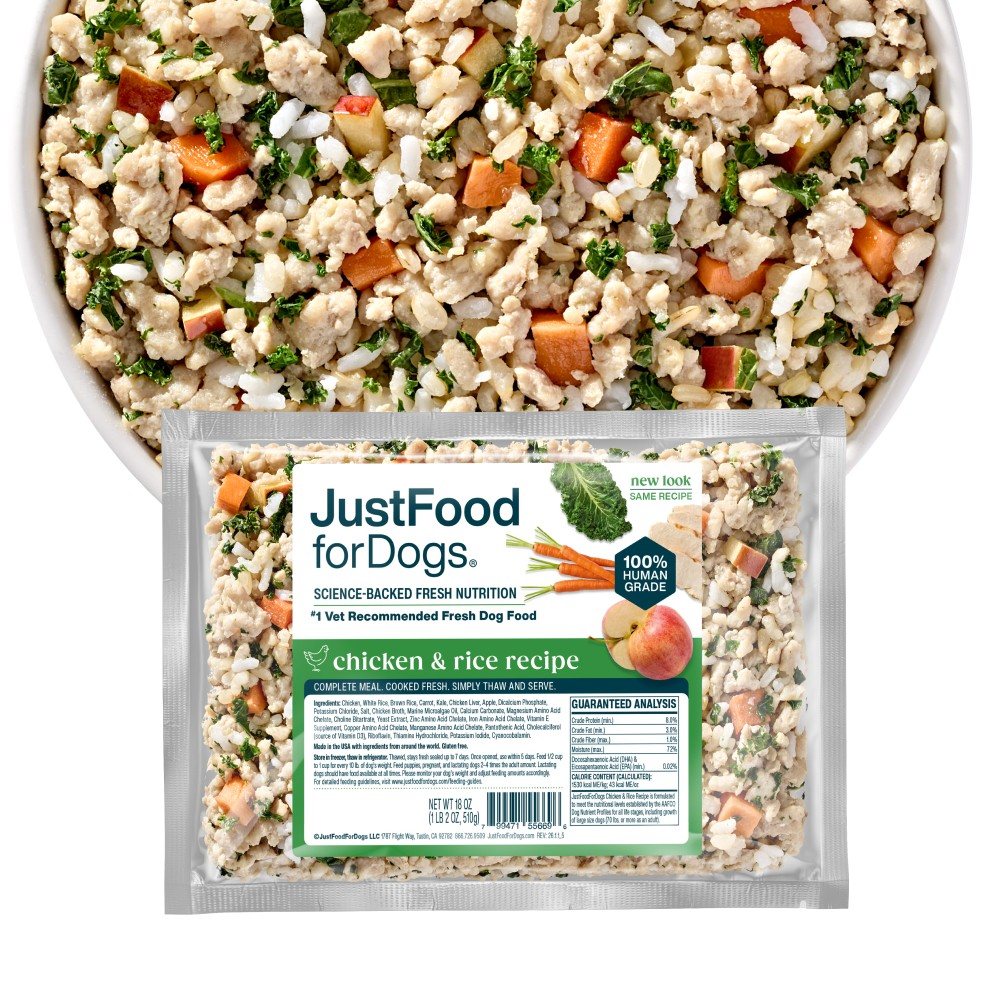
Chicken & Rice is a useful starting point for a household that wants a grain-inclusive fresh frozen food. Its current formulation includes white and brown rice, and its nutritional adequacy statement covers all life stages, including growth of large-size dogs.
That growth statement makes it eligible for consideration for a Jack Russell puppy as well as an adult. It does not mean both should receive the same amount or follow the same schedule. The puppy’s growth and the adult’s maintenance needs still require separate feeding plans.
The recipe provides 1,530 calories per kilogram, equivalent to 1.53 calories per gram. Once you have an appropriate calorie allowance, that figure lets you weigh the day’s food and reserve part for training where practical.
When Chicken & Rice fits the routine
- You prefer a fresh meal containing rice.
- You can maintain freezer storage and thaw food ahead of time.
- You want a recipe whose life-stage statement includes growth.
- You are comfortable measuring portions rather than judging by bowl volume.
For an active household, the practical question is whether the storage routine survives busy mornings and evenings. According to the JustFoodForDogs handling FAQ, non-fish Fresh Frozen meals can be refrigerated for up to seven days sealed after thawing and five days after opening. Follow the instructions on your own package if they are more specific.
Label the thawing and opening dates, and check how many daily portions the package contains. If someone else feeds the dog after a class or walk, a labeled container makes the intended amount clear.
Chicken & Rice is not automatically a performance diet because it contains chicken, and it does not need to be. Its potential fit comes from complete nutrition, life-stage suitability, and a measurable ration that works within your dog’s overall plan.
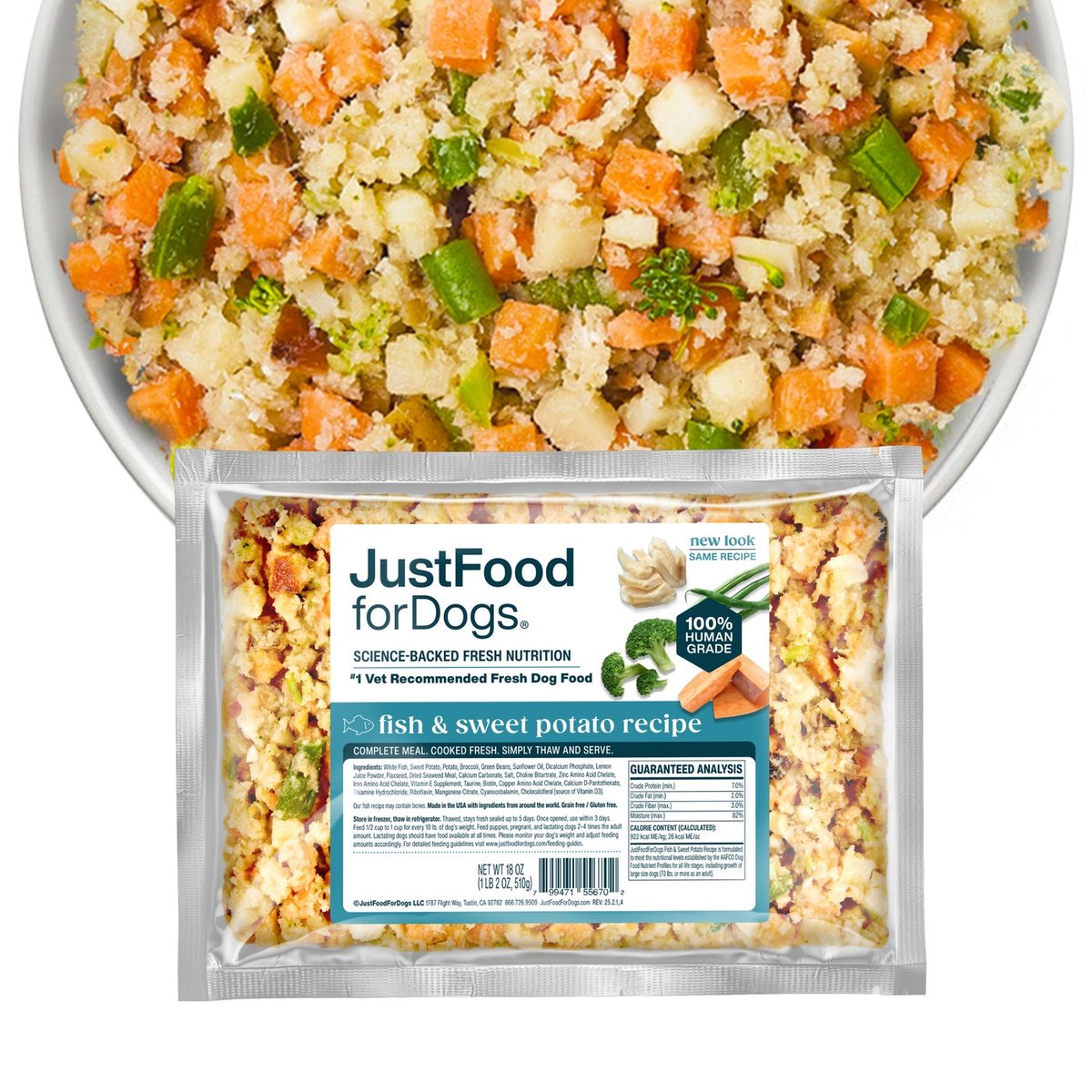
JustFoodForDogs Fish & Sweet Potato
Fish & Sweet Potato supplies 922 calories per kilogram, or 0.922 calories per gram. It is less calorie-dense than the other three recipes here, so a larger weighed serving is needed to provide the same energy.
That difference can be useful when comparing practical portions. It does not establish that the recipe is a weight-loss treatment, nor does it make it unsuitable for every active dog. The relevant question is whether the appropriate amount works for your dog and household.
The current fish ingredients are a blend of cod, pollock, and haddock. The recipe should not be treated as a cod-only food or assumed to be suitable for an allergy investigation simply because fish is its main protein category.
What distinguishes Fish & Sweet Potato
- An all-life-stages nutritional statement, including growth of large-size dogs.
- A fish blend rather than one fish species.
- A relatively larger serving weight for a given calorie allowance.
- A shorter refrigerated storage window than the non-fish Fresh Frozen recipes.
JustFoodForDogs gives fish-specific refrigerated limits of up to five days sealed after thawing and three days after opening. Those shorter limits matter if you alternate meals or feed only part of a package each day.
Before choosing this recipe, calculate the intended daily serving and compare it with the package amount. A dog eating it as the main food may use an opened package at a different pace from a dog receiving a small portion alongside another complete diet.
If your Jack Russell leaves food behind, record what was actually eaten. Weighing the offered ration is only half the picture when leftovers are common. Persistent reduced intake deserves attention rather than an assumption that the larger serving is being consumed.
JustFoodForDogs Beef & Russet Potato
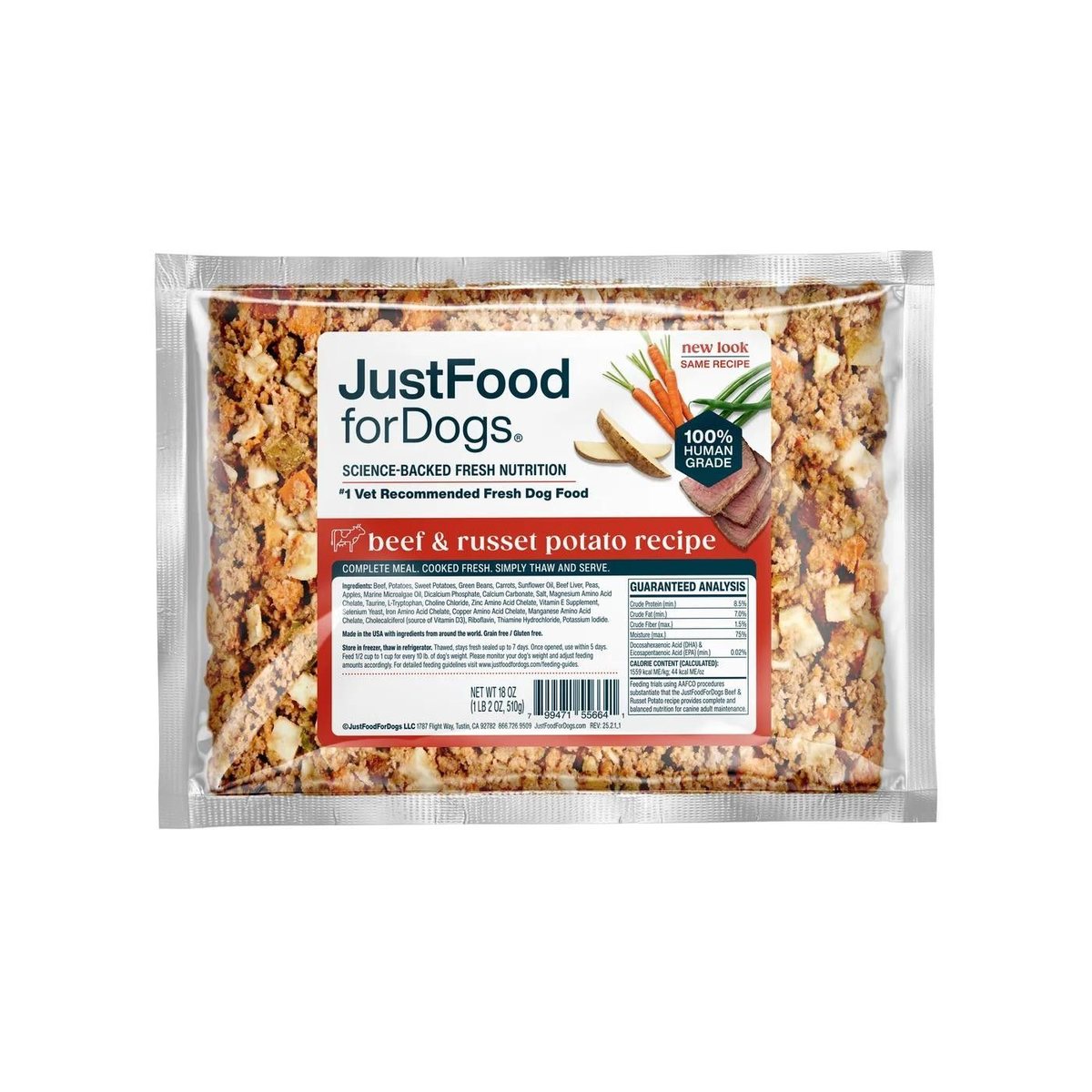
Beef & Russet Potato is an adult-maintenance recipe. Its nutritional adequacy statement is supported by feeding tests using AAFCO procedures for adult maintenance. It is not intended to serve as a complete diet for growing puppies.
At 1,559 calories per kilogram, or 1.559 calories per gram, it has the highest energy density of these four options. The difference from Chicken & Rice is small, while the difference from Fish & Sweet Potato is much larger.
For an adult Jack Russell, that means the weighed serving needed for a fixed calorie allowance will be relatively compact. It does not mean the dog needs this recipe because they enjoy chasing a ball or attending training.
When Beef & Russet Potato fits the routine
It may suit a household that:
- Wants a beef-based fresh frozen meal for an adult dog.
- Has the cold-storage capacity to manage deliveries and thawing.
- Prefers to work with a smaller serving weight for the same calories.
- Can keep portions separate from those intended for a puppy.
The distinction between serving weight and calorie allowance is especially useful when switching recipes. If you previously fed a less calorie-dense food, copying its gram amount into the new bowl could increase daily intake without an obvious change in how much you think you are feeding.
Use the non-fish Fresh Frozen handling limits, track dates, and check the exact package instructions. Plan for the amount your dog actually eats, including any food allocated to training or another caregiver.
In a home with more than one dog, identify the recipe as well as the dog’s name on prepared containers. Similar-looking meals are not interchangeable when one dog needs growth nutrition and another is eating an adult-maintenance diet.
JustFoodForDogs JustFresh Home-Cooked Chicken
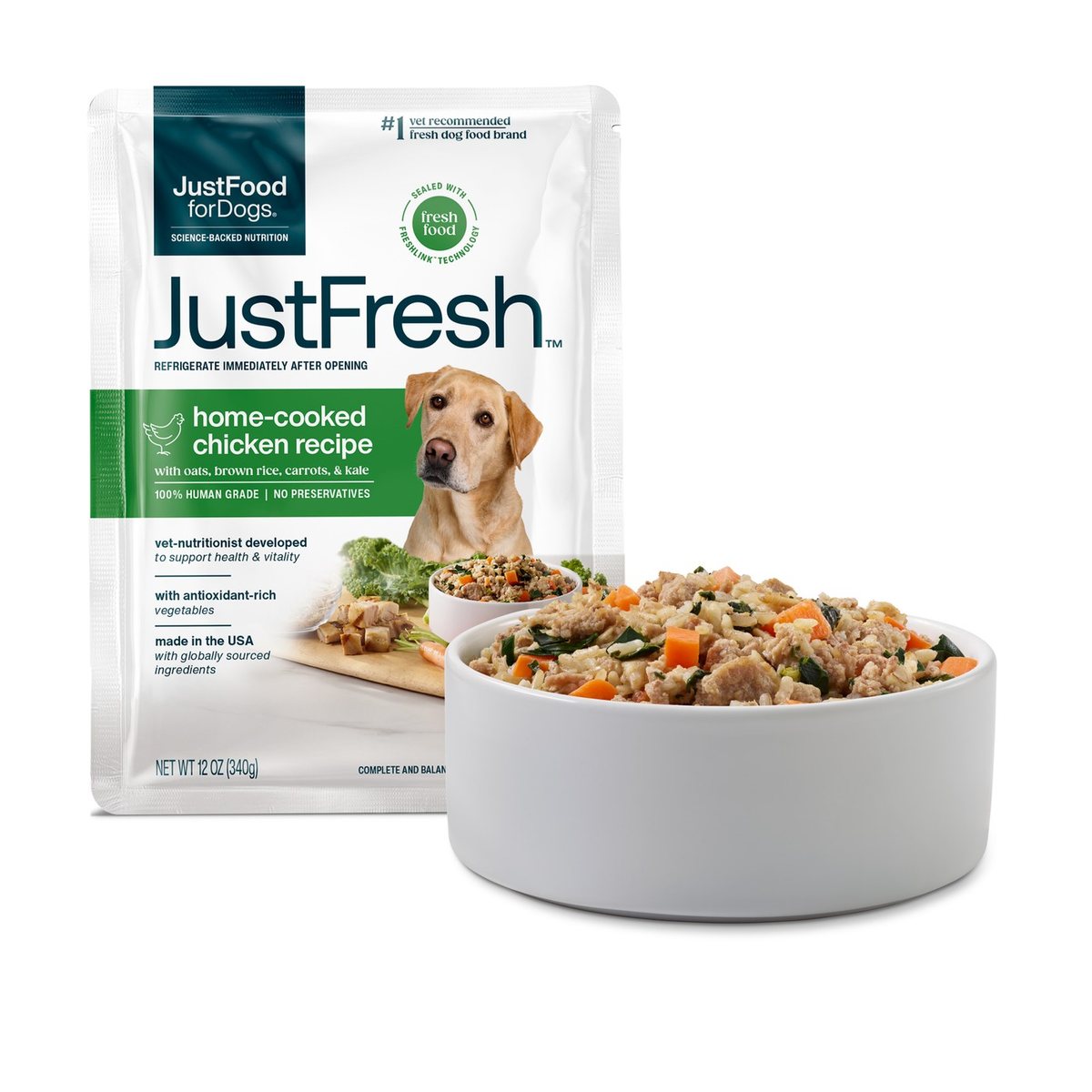
JustFresh Home-Cooked Chicken offers a different storage arrangement: the unopened product is shelf stable. It is formulated for adult maintenance and is not a complete puppy-food choice.
The recipe contains oats and brown rice and supplies 1,254 calories per kilogram, or 1.254 calories per gram. Do not transfer the life-stage statement or calorie content from Fresh Frozen Chicken & Rice simply because both feature chicken.
Its practical appeal is clearest for owners who:
- Want an adult meal without freezer storage before opening.
- Need straightforward unopened-food storage for a sitter or trip.
- Can refrigerate leftovers promptly.
- Can use an opened package within the specified period.
JustFoodForDogs states an unopened shelf life of up to two years from manufacture. After opening, refrigerate the food and use it within three days. Shelf stability before opening does not make an opened package suitable for an entire day in a warm bag or vehicle.
For a trip, plan where the opened food will be refrigerated and how individual servings will be handled. Taking an unopened package solves only the first part of the storage question. Bowl hygiene and leftover handling remain part of the routine.
This recipe can simplify feeding logistics for a healthy adult whose nutritional needs it meets. Convenience is a legitimate selection factor when it helps you serve the correct food consistently.
Check current product information
Vetstreet’s earlier JustFoodForDogs review provides historical context about the brand. For this particular recipe, rely on its current label and manufacturer instructions for calories, life-stage suitability, and storage.
Calculate Jack Russell food portions in grams
The useful amount of Jack Russell food per day is the amount that supplies an appropriate calorie allowance for that individual dog. A breed-wide scoop recommendation skips both the dog’s needs and the recipe’s energy density.
Grams make portions easier to reproduce, but weighing does not make an unsuitable calorie target correct. Establish the starting allowance first, then convert it into food.

Establish a starting calorie allowance
Use the food’s feeding guide, your dog’s current intake and condition, and your veterinary team’s advice. The WSAVA calorie estimates for healthy adult dogs are starting points for appropriate adult dogs, not fixed requirements for every terrier.
If your dog already maintains an appropriate weight and body condition on a measured diet, documenting that intake is valuable. Record the exact recipe, grams eaten, and all extras before assuming a new calculator provides a better answer.
For a first feeding review, collect:
- Current weight and the date measured.
- The exact food name and calories per kilogram.
- Grams offered and any consistent leftovers.
- Treats, chews, training rewards, and food used with medication.
- A description of the normal week’s activity.
- Any appetite, digestion, or weight changes.
A puppy, a dog with a medical condition, or a dog that needs to gain or lose weight requires a plan appropriate to that situation. Do not apply a healthy-adult example to those circumstances simply because the dog is a Jack Russell.
Convert food calories into a daily weight
First divide calories per kilogram by 1,000 to obtain calories per gram. Then divide the calories allocated to that food by its calories per gram.
For example, Chicken & Rice provides 1,530 calories per kilogram:
- 1,530 ÷ 1,000 = 1.53 calories per gram.
- If the food allocation is 450 calories, calculate 450 ÷ 1.53.
- The result is approximately 294 grams for the day.
Here is the same calculation for all four recipes. The example assumes an established total allowance of 500 calories, with 50 calories reserved for noncomplete extras and 450 supplied by complete food. Those numbers illustrate the method; they are not a feeding recommendation for all Jack Russells.
| Recipe | Calories per gram | Calculation for 450 food calories | Approximate daily amount |
|---|---|---|---|
| Chicken & Rice | 1.530 | 450 ÷ 1.530 | 294 g |
| Fish & Sweet Potato | 0.922 | 450 ÷ 0.922 | 488 g |
| Beef & Russet Potato | 1.559 | 450 ÷ 1.559 | 289 g |
| JustFresh Home-Cooked Chicken | 1.254 | 450 ÷ 1.254 | 359 g |
The substantially different serving weights all supply approximately the same calories. This is why comparing bowls by appearance can be misleading.
Use the current label if its calorie information differs from the figures above. Set the empty bowl on the scale, zero the display, and add the intended food. Check that the scale is showing grams rather than ounces.
You do not have to use the entire permitted allowance for extras. If fewer treats are given, the complete-food allocation can account for that difference within the overall plan.
Divide the ration before the day begins
Once you have the daily amount, decide which portion belongs in meals and which portion may be used as suitable food rewards. This avoids measuring full meals and then adding a separate training supply.
Using the Chicken & Rice example, approximately 294 grams supplies 450 calories. If about 52 grams is reserved for food rewards, approximately 242 grams remains for meals. Dividing that remaining amount into two meals gives about 121 grams per meal, with minor differences from rounding.
A simple daily setup is:
- One container for breakfast.
- One container for dinner.
- One clearly identified training allocation.
- A separate, measured allowance for any noncomplete treats.
This arrangement makes the plan visible to everyone who feeds the dog. A reward given by a second person then comes from an existing allocation rather than silently increasing the daily total.
For moist foods, keep the training allocation refrigerated until needed and follow the product’s handling instructions. Suitability as a reward includes practical storage and delivery, not just nutritional completeness.
Calculate mixed meals separately
If you feed two complete foods, work out each food’s calories separately. Equal weights do not necessarily contribute equal calories, and “half fresh, half dry” is ambiguous unless you specify whether that means calories, weight, or volume.
Suppose the 450 food calories in the example are divided equally between Chicken & Rice and Fish & Sweet Potato. Each recipe would contribute 225 calories:
- Chicken & Rice: 225 ÷ 1.53 = approximately 147 grams.
- Fish & Sweet Potato: 225 ÷ 0.922 = approximately 244 grams.
The combined serving weighs approximately 391 grams, although the calorie allocation remains 450. Both foods must still be appropriate for the dog’s life stage.
When changing recipes, record the proportions and calculate the calories at each stage of the transition. Follow the manufacturer’s transition guidance or your veterinary team’s instructions. That keeps a recipe change from becoming an unintended increase in food.
Match the feeding plan to the activity you actually observe
A useful activity record connects what your dog does with what they eat and how their body condition changes. It does not need to estimate calories burned on every walk.
Begin with a representative week that includes ordinary weekdays and the weekend. Write down the routine as it happens instead of reconstructing it from memory at the end. If that week is unusual, label it as unusual.

Record duration, intensity, and pauses
“An hour outside” can describe a gentle sniffing walk, a class with substantial waiting, or sustained physical work. The duration alone does not distinguish them.
Use straightforward descriptions:
- Activity: What the dog actually did.
- Duration: Approximate time, separating active periods from long pauses where possible.
- Intensity: Gentle exploration, brisk walking, intermittent running, or sustained demanding work.
- Context: An ordinary day, an unusual outing, restricted activity, or a new routine.
These descriptions are deliberately practical. You do not need a precise physiological measure to notice that a class with five short turns differs from continuous work.
Include rest and changes to the normal schedule. If bad weather shortens outings or a caregiver changes the walking routine, record that. The purpose is to capture actual activity rather than breed reputation.
Put food and activity in the same record
An activity log becomes more useful when the day’s intake appears beside it. Record food actually eaten, training rewards, and any unplanned extras. If you are unsure of a quantity, mark it as unknown instead of filling in a reassuring estimate.
| Record field | What to note | Why it helps |
|---|---|---|
| Main meals | Exact recipe and grams eaten | Shows the measurable foundation of intake |
| Training food | Recipe or treat, amount, and calories when available | Makes rewards visible |
| Other extras | Chews, scraps, supplements, medication foods | Identifies calories outside meal bowls |
| Activity | Type, approximate duration, intensity, and pauses | Distinguishes ordinary movement from sustained work |
| Appetite and digestion | Meaningful changes or repeated problems | Provides context for veterinary review |
| Weight and condition | Dated measurements and periodic observations | Shows the longer-term result of the routine |
Do not interpret a blank entry as zero. A household may discover that the least measurable part of the plan is the dog walker’s rewards or a chew given by another family member. Solving that information gap can be more useful than immediately changing food.
For training classes, ask what rewards are provided by the instructor. If treats come from several people, bring a shared allocation or agree on how they will be recorded. Food from someone else still belongs in the dog’s intake.
Use three common scenarios to interpret the record
Scenario one: the enthusiastic household companion
Your dog has regular walks, several short play sessions, and plenty of rest. Weight and body condition are stable on a measured allowance. That record supports continuing the successful plan, even if your dog is always ready for another game.
The next step is to preserve consistency. Keep measuring portions, maintain the reward budget, and review the plan when the routine changes. Enthusiasm alone does not demonstrate a calorie deficit.
Scenario two: the beginner attending frequent classes
Your dog now receives many more rewards, but the class includes waiting and brief turns. The meaningful change may be food intake rather than sustained exertion.
Before increasing meals, examine:
- How many reward calories were added.
- Whether rewards can come from the complete-food ration.
- Whether the instructor’s treats are being counted.
- Whether body weight or condition is trending upward.
A dog can train more often without needing a larger total food allowance. The record helps reveal whether the new schedule mainly calls for redistributing the existing food.
Scenario three: the dog starting sustained demanding work
Your dog’s routine now involves repeated, substantial exertion. The workload is sustained over time, and maintaining condition may become more challenging.
Bring the log to your veterinary team before choosing a feeding strategy solely from a performance label. Useful questions include whether the calorie allowance remains suitable, whether the current recipe can meet needs in a practical amount, and how to monitor condition as the work continues.
If the dog is losing weight unexpectedly, eating poorly, or showing other changes, do not assume extra work explains everything. Those findings need assessment. An activity record provides context without making a diagnosis.
Review trends rather than rewarding one busy day
One unusually active afternoon does not, by itself, establish a need for a different formula or an automatic percentage increase in dinner. Likewise, one quiet day does not justify a large reduction.
Look for a repeatable pattern. Compare the normal routine, measured intake, and weight and condition over time. The plan may need revisiting when:
- Demanding activity becomes a sustained part of the week.
- An injury or another circumstance substantially reduces activity.
- Training rewards increase and are not replacing other food.
- Weight or body condition moves away from the agreed target.
- Appetite or the ability to finish the intended ration changes.
For a healthy adult, a planned check using the same weighing method is easier to interpret than scattered measurements from different scales. Record the date and relevant context, and ask your veterinary team how often to reassess your particular dog.
Body-condition assessment adds information beyond body weight. The WSAVA dog body-condition chart describes an ideal adult condition around four to five on a nine-point scale, with ribs readily felt beneath appropriate covering, a waist, and an abdominal tuck.
Ask for a hands-on demonstration if you are unsure. A rough coat can affect the outline you see, and comparing your dog with a photograph of another terrier is less useful than learning the landmarks on your own dog.
Check muscle separately from body weight
Muscle condition is a separate consideration. A stable scale reading does not prove that muscle is being maintained, particularly in an older dog or one with illness.
Bring observations to the feeding review
Take the food label, measured daily intake, reward totals, activity record, and dated weight observations. Together, they give your veterinary team a clearer basis for changing the plan.
When an adjustment is agreed, write down what changes and what stays the same. Changing the recipe, total calories, treats, and exercise routine simultaneously makes the result harder to interpret. A documented plan helps the whole household follow the same decision.
How many times a day should a Jack Russell Terrier eat?
For many healthy adult Jack Russells, two measured meals are a workable routine. VCA’s guidance on feeding times and frequency discusses regular meal schedules and the role they play in predictable feeding.
The number of meals does not determine the total daily allowance. If you divide an appropriate ration into three smaller meals, the dog should not automatically receive three of the previous two-meal portions.
For example, a 300-gram daily ration could be divided into two 150-gram meals or three 100-gram meals. That example explains allocation only. It does not establish that 300 grams is suitable for your dog or recipe.
Keep puppy schedules separate from adult routines
A growing puppy needs a schedule appropriate to age and development. Texas A\&M’s puppy timeline describes four to five small meals around weaning at five to six weeks, moving toward three meals around eight to nine weeks.
Those milestones should not be turned into an unsupported rule that every Jack Russell must move to two meals at the same later age. Get an individual plan from the puppy’s veterinary team and review it as growth progresses.
When a puppy joins the household, record:
- The exact food currently being fed.
- The measured daily amount.
- The number and timing of meals.
- How treats are being used.
- The planned weight and growth checks.
Continue a clear routine while discussing any intended changes. A puppy’s adult-looking enthusiasm does not mean adult-maintenance food or an adult portioning plan is appropriate.
Make the schedule workable for everyone
Choose feeding times the household can maintain. If work, a class, or another commitment changes who feeds the dog, label prepared portions and record when each one is served.
A calendar or simple checklist can prevent two common errors: a second person repeating a meal, or everyone assuming someone else fed it. This matters especially when some of the ration is being used during training.
Useful instructions for another caregiver include:
- Which container belongs to each meal.
- Which food is reserved for training.
- What extras, if any, remain available.
- How to refrigerate and handle leftovers.
- Who to contact if the dog repeatedly refuses food.
Avoid imposing a universal exercise-adjacent feeding timetable from this guide. A dog doing demanding work or managing a medical condition may need specific advice. For an ordinary household routine, focus on consistent measured meals and an individualized plan rather than an invented timing rule.
Provide access to fresh drinking water, and note persistent appetite changes. A schedule helps make changes visible; it should not become a reason to ignore repeated missed meals or difficulty eating.
Choose puppy food before choosing fresh or dry
When selecting the best dog food for a Jack Russell puppy, nutritional suitability for growth comes before food format. Fresh, wet, and dry products can differ substantially within their own categories, so the category name cannot answer the life-stage question.
The FDA’s explanation of complete-and-balanced pet food describes the importance of nutritional adequacy statements. Find the statement on the exact recipe you are considering, not merely on another product from the same brand.

For the four foods compared here:
- Chicken & Rice: Formulated for all life stages, including growth of large-size dogs.
- Fish & Sweet Potato: Formulated for all life stages, including growth of large-size dogs.
- Beef & Russet Potato: Adult maintenance.
- JustFresh Home-Cooked Chicken: Adult maintenance.
The reference to large-size growth in the first two statements does not restrict those foods to large breeds. It describes the scope of their nutritional suitability. A Jack Russell puppy still needs an individualized portion and growth-monitoring plan.
An adult-maintenance food should not become the puppy’s main diet simply because the puppy enjoys it, it is softer, or an adult dog in the home already eats it. Separate containers and written instructions help prevent mix-ups in a multi-dog household.
Compare the complete feeding routine
A food can look appealing online yet be awkward to manage every day. Consider how it will be stored, measured, served, and used alongside training.
| Format | Practical advantage to assess | Work to plan for |
|---|---|---|
| Dry | Easy-to-measure pieces may work as food rewards | Correct portioning and suitable dry storage |
| Fresh frozen | Weighed portions and a moist texture | Freezer space, thawing, refrigeration, and opened-food limits |
| Shelf-stable wet or fresh-style | Convenient storage before opening | Refrigeration and timely use after opening |
| Rehydrated | Prepared texture can be adjusted according to instructions | Correct preparation, calorie interpretation, and storage after mixing |
There is no nutritional winner based on convenience alone. A food that suits your storage arrangements still needs the correct nutritional adequacy statement, and a food with that statement still needs appropriate portions.
For a puppy, ask the veterinary team to review weight and growth alongside the feeding plan. The goal is suitable development and condition, not making the puppy grow as quickly as possible.
If using rehydrated food, establish whether calorie and portion information refers to the dry product or the prepared meal. Adding water changes weight and volume without adding food calories. Also confirm whether the product is a complete diet, a base mix requiring additions, or a topper.
What is the best dry dog food for a Jack Russell Terrier?
The best dry food for a Jack Russell Terrier is an appropriate complete diet that fits the dog’s life stage, individual needs, calorie allowance, and practical eating habits. This fresh-food comparison does not establish a single winning kibble, and the four JFFD recipes above are not dry foods.
Evaluate a dry option with the same questions used for fresh food:
- Does the exact recipe provide complete nutrition for the intended life stage?
- Are calories per kilogram or per serving clearly stated?
- Can the dog comfortably pick up and eat the pieces?
- Does the manufacturer provide usable feeding and storage information?
- Can you measure meals and any pieces reserved for training?
A food labeled for puppies or all life stages must still be checked for the actual adequacy statement. A breed illustration or small piece size is not a substitute.
For dry food, grams can be helpful even when the package also lists cups. A standard measuring cup describes volume, and eight fluid ounces of volume does not mean eight ounces of kibble by weight. Different piece shapes and food densities also make a scoop from one recipe a poor guide to another.
If kibble is convenient for training, reserve an appropriate portion from the daily ration before meals are served. Using complete food as rewards can simplify nutritional accounting, provided it is suitable for that dog and the calories remain within the plan.
Compare nutrient information on a fair basis
Do not rank fresh and dry foods by putting their printed protein percentages side by side without accounting for moisture. A moist meal and a dry kibble are being described on different as-fed bases.
Tufts’ explanation of the guaranteed analysis explains why minimum and maximum guarantees also have limits. They are not a complete measure of nutritional quality or a substitute for more detailed manufacturer information.
For a practical selection:
- Establish complete nutrition and the correct life stage first.
- Use calories to calculate how much food will be eaten.
- Ask the manufacturer for additional nutrient information when a meaningful comparison requires it.
- Avoid treating one prominent percentage as proof of athletic suitability.
An “active” description, a high-meat claim, or a grain exclusion cannot determine whether a recipe fits your dog’s actual workload. That decision still rests on the whole diet, the individual dog, and the feeding outcome.
Keep training rewards inside the daily allowance
Training calories belong in the daily total. A small reward repeated many times can make a meaningful contribution, even when each piece looks insignificant.
Start by deciding which rewards come from complete food and which are noncomplete extras. Both contribute calories, but the distinction matters because complete food supplies the nutritional foundation of the diet.
AAHA’s nutritional-risk guidance identifies excessive treats and extras as a concern. As a general ceiling, keep noncomplete extras together within no more than 10 percent of daily calories unless your veterinary team provides different instructions.
That shared amount includes more than obvious training treats:
- Biscuits and soft reward pieces.
- Dental chews and other edible chews.
- Table food and cooking scraps.
- Foods used to hide medication.
- Any other calorie-containing extras outside the complete ration.
The ceiling is not a target you must fill. If your dog is content with fewer extras, there is no need to add more simply because some of the allowance remains.
Allocate rewards before filling the pouch
Choose the day’s reward supply before leaving for a walk or class. Record the product and quantity, and use its calorie information to estimate the allocation.
Suppose a dog’s established allowance is 500 calories and a training treat provides two calories per piece. Twenty pieces would supply 40 calories. If a chew adds another 20, the combined extras would total 60 calories, exceeding a 50-calorie ceiling.
The correction is not necessarily to stop rewarding the dog. Options include:
- Using fewer of the noncomplete treats.
- Dividing suitable treats into smaller pieces.
- Reserving appropriate complete food for some rewards.
- Reducing another extra so the shared total stays within the plan.
Check the actual product information rather than borrowing the example’s two-calorie value. When a label lacks calories, ask the manufacturer; a guessed value can undermine otherwise careful accounting.
For a group class, tell the instructor which foods and amounts are available. If the dog is following a medically directed diet, reward selection needs to follow that plan as well.
Use complete-food rewards where practical
Food taken from the dog’s appropriate complete ration can serve as rewards when the texture, storage, and training setup allow it. The calories still count, but you are redistributing the main food rather than adding a separate unbalanced supply.
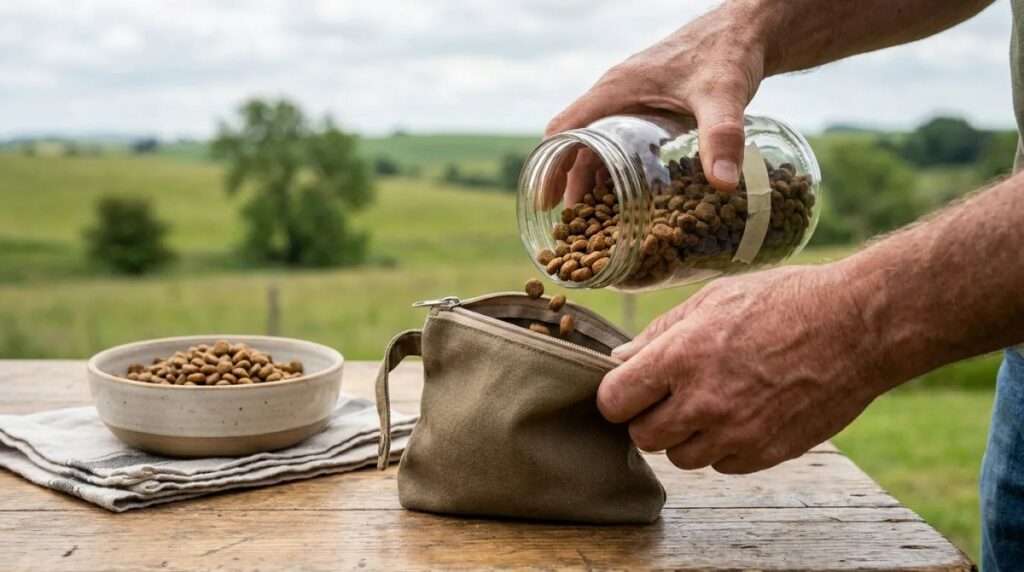
Dry pieces may be convenient in a pouch. A moist food may require a different delivery method and careful temperature control. Choose a method that works without leaving perishable food out for prolonged periods.
The FDA’s pet-food storage guidance advises promptly refrigerating or discarding unused canned and pouched food and washing food bowls and utensils. Follow the manufacturer’s specific instructions for the recipe you use.
Serve moist rewards during a short session
- Set aside the intended amount and use clean utensils or another suitable serving method.
- Keep the rest refrigerated.
- Track the portion’s time out of refrigeration instead of repeatedly topping up the same container.
When using a second complete food as rewards, confirm that it is also appropriate for your dog’s life stage. Calculate its calories separately. Ten grams of one food may contain substantially more energy than ten grams of another.
Reconcile what was actually used
At the end of training, record the amount used rather than assuming the entire prepared allocation was eaten. Also note rewards supplied by other people.
For dry food, weighing the pouch before and after use can help when the amount is too small to count conveniently. Account for the container’s weight and any spilled or discarded pieces. For other formats, use a method appropriate to their handling requirements.
If some of the planned complete-food ration remains unused, it is still part of the day’s food allocation if it has been handled safely. Keep the distinction clear between food not yet served and food that should be discarded because its storage history is unsuitable.
Tell the next feeder what remains
- “This container is the remaining dinner portion.”
- “The training allocation has already been used.”
- “The dog has already received today’s chew.”
- “Do not add another full meal after class.”
Revisit reward plans when training changes
A new puppy class, recall program, or behavior plan can substantially change how often food is given. Review the reward budget when training becomes more frequent rather than waiting for a weight change.
The daily log may reveal that the main meals were carefully measured while rewards were replenished without limit. In that situation, the first useful change is clearer allocation and communication.
Bring persistent problems back to the relevant professional. A trainer can help adapt the reward method, and the veterinary team can help maintain appropriate nutrition and condition. The aim is a feeding plan that supports learning while keeping the total diet clear and measurable.
Does my Jack Russell need an allergy formula?
Breed identity alone does not establish Jack Russell food allergies. Recurrent itching, ear problems, or digestive signs warrant assessment, but those signs can have several causes. A food choice should follow the individual findings rather than an assumption that every terrier needs an ingredient exclusion.
VCA’s food-allergy guidance explains controlled dietary trials. Choosing a food because it contains fish, excludes grain, or says “sensitive” does not provide the same diagnostic answer. The regular recipes compared here are not treatment diets.
Before changing the training menu:
- Record all foods, treats, chews, and supplements currently given.
- Include anything used with medication and rewards supplied by instructors.
- Ask which rewards are permitted if your veterinarian prescribes a trial.
- Give the same instructions to everyone handling the dog.
The ordinary reward-calorie budget still tracks intake, but it does not determine which foods are permitted during a trial. Keep the diagnostic instructions and the daily portion record together.
Jack Russell food questions
Jack Russells share the same major food-toxicity risks as other dogs. Keep chocolate, grapes and raisins, alcohol, onions and garlic, and products containing xylitol out of reach. Check ingredients in foods considered for training, including spreads and baked goods. The FDA’s guide to potentially dangerous items for pets provides examples. An item being familiar human food does not make it a safe reward. If you suspect a toxic-food exposure, contact your veterinarian or an animal poison-control service promptly with the product, estimated amount, and time of exposure. Do not wait for symptoms or attempt home treatment without instructions.
No. Enthusiasm, quick movements, and a desire to play do not establish a need for a performance diet. Consider the duration and intensity of actual work, the food already eaten, and weight and body-condition trends. A dog attending classes may receive more calories in rewards while spending much of the session waiting. A dog doing sustained demanding work may need a different plan. Use the activity-and-intake record to distinguish those situations and review meaningful changes with your veterinary team. A performance label should answer an identified feeding need rather than stand in for an assessment.
Yes, but an everyday homemade diet needs a complete formulation for the dog’s life stage and individual needs. An improvised combination of meat, vegetables, and rice does not establish nutritional balance, even when all the ingredients are safe. Use a properly formulated recipe from a qualified veterinary nutrition professional or an appropriate complete system with explicit preparation instructions. Weigh the ingredients, include the specified supplements, and avoid unapproved substitutions. The recipe also needs a calorie-based portion plan and safe storage. A dog’s activity level is not a reason to increase meat or add supplements without considering the effect on the complete diet.
Only if the veterinarian directing the trial permits them. Confirm the exact reward product and any food used with medication before the next session. Give instructors the approved supply and ask them to record anything else offered.
No. Review actual activity, appetite, weight, body condition, muscle condition, and health rather than making an automatic age-based cut. Some older dogs become less active, while others continue a demanding routine. A stable weight also does not reveal every change in muscle. Bring a measured feeding record and recent observations to your veterinary team, especially if you notice unexplained weight loss, reduced appetite, difficulty eating, or a change in stamina. Any revised allowance should fit the dog’s current needs. Continue counting training rewards and other extras, even when formal exercise becomes less frequent.