Best Probiotic Chews for Dogs
Published on October 05, 2026
This article is sponsored by PetLabCo.® and contains affiliate links. If you purchase through these links, we may earn a commission.
Written by Athena Gaffud, DVM
The best probiotic chews for dogs fit the formula and routine the dog needs. A soft chew can make a daily gut-support routine easier, especially for a dog who happily accepts a small treat but leaves powder at the bottom of a food bowl. Choosing one takes more than comparing star ratings or finding the biggest number on the label. The formula, serving directions, your dog’s age and dietary needs all matter.
Our featured option is PetLabCo.® Probiotic Chews. This guide explains what that formula provides and how to compare chew-format supplements for your dog. A suitable chew should fit both the reason you are adding a supplement and the routine you can maintain. Your veterinarian can help connect those two decisions.
Key Takeaways
- The best probiotic chews for dogs combine an appropriate formula with clear label directions, suitable ingredients and a manageable daily serving.
- PetLabCo.® Probiotic Chews contain 3 billion CFU per 4 g soft chew. Daily chew count varies by weight; the separate Tailored range uses different serving directions.
- Soft chews offer convenient daily support. They do not replace veterinary evaluation of persistent digestive changes or other illness.
- Probiotic effects depend on the organisms and formulation studied. A soft chew shape, high CFU count or positive review does not by itself establish effectiveness.
Probiotic soft chews for dogs compared (label facts from each manufacturer)
| Product | Form | CFU per soft chew | Organisms listed | Prebiotic / other actives | Age minimum | Daily serving (weight bands) |
|---|---|---|---|---|---|---|
| PetLabCo.® Probiotic Chews (our pick) | Soft chew, pork flavored, 4 g | 3 billion | Bacillus coagulans, Bacillus clausii, Bacillus subtilis | 100 mg FOS, 100 mg GOS, 75 mg postbiotic yeast blend | 12 weeks | Under 25 lb: 1; 25–75 lb: 2; over 75 lb: 3 |
| Zesty Paws Probiotic Bites for Dogs | Soft chew, pumpkin or chicken flavor | 6 billion (ingredient panel; product copy says 3 billion) | Bacillus coagulans, Bacillus subtilis, Saccharomyces boulardii (Gut First Blend) | 50 mg FOS, flaxseed | Not stated on label | Not stated in text on manufacturer page (feeding card is an image) |
| Pet Honesty Gut + Immune Health Digestive Probiotic Chews for Dogs (Duck Flavor) | Soft chew, duck flavor | Not stated on label | B. subtilis, B. bifidum, E. faecium, L. acidophilus, L. brevis, L. fermentum, L. delbrueckii, L. plantarum | Inulin, pumpkin, digestive enzymes (amylase, protease, lipase, cellulase, hemicellulase, papain, bromelain) | Not stated on label | 1 chew per 25 lb: 1–25 lb: 1; 26–50 lb: 2; 51–75 lb: 3; 76–100 lb: 4 |
| VetriScience Gut Health Duck Flavored Chews (formerly Probiotic Everyday) | Chew, duck flavor (soft chew not stated on label) | 1 billion | Bacillus coagulans | FOS (amount not stated) | Not stated on label (page says all ages) | Under 30 lb: 1; 30–60 lb: 2; over 60 lb: 3 |
| Vet’s Best Probiotic Soft Chews for Dogs | Soft chew, chicken liver flavor | 1.5 billion | Bacillus subtilis, Bacillus licheniformis, Lactobacillus acidophilus, Enterococcus faecium, Lactobacillus plantarum, Lactobacillus casei | Inulin, ocean kelp (amounts not stated) | Not stated on label | 1 chew daily for all dogs (no weight bands) |
Our ranked picks for probiotic soft chews
We ranked these soft chews on the same criteria the selection table above uses: formula identity (named organisms and a clearly labeled per-chew amount), the daily count a dog actually receives under the label’s weight bands, suitability signals such as a stated age minimum and a full ingredient list, and whether the brand has published product-specific evidence. We did not hands-on test any product; every fact below comes from the manufacturer’s own product page. PetLabCo.® Probiotic Chews rank first because they are the only soft chew in this group that states a per-chew CFU, names its organisms, quantifies its prebiotics and postbiotic, states a minimum age, and publishes a brand-funded study on the finished product.
1. PetLabCo.® Probiotic Chews: best overall daily soft chew
Each 4 g pork-flavored soft chew provides 3 billion CFU from a Bacillus coagulans, Bacillus clausii and Bacillus subtilis blend, plus 100 mg FOS, 100 mg GOS and 75 mg of a postbiotic yeast blend. The label is unusually complete for this category: it states the age minimum (12 weeks), gives three weight bands (1, 2 or 3 soft chews daily) and lists the prebiotic amounts rather than naming them without a figure. That makes it the easiest product here to compare and to discuss with your veterinarian.
PetLabCo.® also published a 31-day randomized, placebo-controlled study of the finished soft chew in 24 healthy adult Beagles, reporting microbiome changes and no serious adverse events. The summary is brand funded and not peer reviewed, and it supports normal digestive function in healthy dogs rather than treating any condition, but no other soft chew in this comparison offers product-level data at all. For a dog 12 weeks or older whose diet allows pork, this is the daily soft chew we would start with.
2. Zesty Paws Probiotic Bites for Dogs: best for a soft chew with a yeast probiotic
Zesty Paws Probiotic Bites for Dogs combine Bacillus coagulans, Bacillus subtilis and Saccharomyces boulardii in the Gut First Blend, with 50 mg FOS and flaxseed, in pumpkin or chicken flavor. It is the only soft chew here to include a probiotic yeast alongside spore-forming bacteria, and the product appears in several ranking roundups.
The limitation is label clarity. The ingredient panel lists 6 billion CFU per chew while the product copy says 3 billion, the feeding card is shown only as an image, and no minimum age is stated. Ask the brand or your veterinarian to confirm the serving before relying on it.
3. Pet Honesty Gut + Immune Health Digestive Probiotic Chews: best for the widest strain list
Pet Honesty Gut + Immune Health Digestive Probiotic Chews for Dogs (Duck Flavor) name eight organisms, including several Lactobacillus species, Bifidobacterium bifidum and Enterococcus faecium, and add inulin, pumpkin and a seven-enzyme digestive blend. Directions are simple: one soft chew per 25 lb of body weight, from 1 to 4 chews daily, which suits households with dogs of very different sizes.
It suits owners who want enzymes and fiber in the same soft chew. The honest gap is that the product page does not state a total CFU or a per-chew amount for any organism, and no age minimum is given, so the strain list cannot be compared on potency with the products above.
4. VetriScience Gut Health Duck Flavored Chews: best single-organism option
Formerly sold as Probiotic Everyday, VetriScience Gut Health Duck Flavored Chews keep the formula simple: 1 billion CFU of Bacillus coagulans plus FOS, with clear weight bands (1, 2 or 3 chews daily for under 30 lb, 30–60 lb and over 60 lb). It is a reasonable fit for a dog that does well with a low-count, single-organism routine, and the page describes it as suitable for all ages, sizes and breeds.
Its per-chew count is the lowest in this group, the FOS amount is not stated, and the page does not confirm a soft chew texture. Check the tub if chew softness matters for your dog.
5. Vet’s Best Probiotic Soft Chews for Dogs: best one-chew-for-every-dog routine
Vet’s Best Probiotic Soft Chews for Dogs offer 1.5 billion CFU from six named bacteria, including Bacillus subtilis, Lactobacillus acidophilus and Enterococcus faecium, with inulin and ocean kelp in a chicken liver flavored soft chew. The direction is one soft chew daily for every dog regardless of weight, which is the simplest routine on this list.
That simplicity is also the trade-off: a large dog receives the same 1.5 billion CFU as a small one, the inulin and kelp amounts are not stated, and no age minimum appears on the page.
How to choose the best probiotic chews for dogs
Start with the purpose. Are you discussing routine digestive support for an otherwise well dog, or has your veterinarian recommended a particular formulation for a specific situation? Those are different decisions. A general daily soft chew may fit the first, while the second requires the product and plan your veterinarian selected.
Next, separate the per-chew amount from the daily chew count. A label stating 3 billion CFU per chew does not necessarily mean every dog receives one soft chew. CFU stands for colony-forming units, a measure of viable microorganisms. The daily serving can contain more than one soft chew, depending on the formula and the dog’s weight.
| Compare this | What to check | Why it matters |
|---|---|---|
| Formula identity | Full product name and current tub | Similar names can have different directions |
| Per-chew amount | CFU and other ingredients in one soft chew | Makes the unit being compared clear |
| Daily chew count | Weight band on that exact label | Determines the actual daily serving |
| Suitability | Age guidance and complete ingredient list | Helps identify a mismatch before purchase |
| Practical fit | Acceptance, storage and days per tub | Supports a routine you can maintain |
Read beyond the headline CFU number
The best chewable probiotics for dogs are not automatically the ones with the most organisms. Different microorganisms have different properties, and evidence for a named strain cannot simply be transferred to every member of its species. A larger count also does not compensate for a formula that is unsuitable for your dog’s diet or intended purpose.
Look for the organism names, the serving basis and the manufacturer’s storage directions. If a page presents several versions of a product, confirm that the facts you are comparing belong to the version in your cart. Photographing the front and back of the tub makes it easier to discuss that exact formulation with your veterinarian later.
Check whether a soft chew fits your household
Soft chews can be useful when owners want to see the entire portion being eaten. That is a practical advantage over mixing a supplement into a meal that a dog only partly finishes. Even so, supervise the first serving and follow your veterinarian’s advice if your dog has difficulty chewing or swallowing.
- Count every chew given by different family members toward the daily serving.
- Include supplement chews when discussing the dog’s overall treats and food intake.
- Check flavors and inactive ingredients as carefully as the probiotic list.
- Store the closed tub where children and pets cannot help themselves.
When comparing the best rated probiotic chews for dogs, use reviews to understand practical issues such as texture or acceptance. An individual review cannot establish that a soft chew caused a health improvement. Your dog’s needs and the product’s directions provide a more reliable basis for selection than a star average alone.
Turn the label into a shopping decision
Consider a household with one small dog and one larger dog. Sharing a product does not necessarily mean sharing a serving. Before ordering, confirm that the formula is suitable for each dog, then calculate how many chews the household would use each day under the label directions. This also helps you plan who gives each serving and how quickly the tub will be used.
For a dog with a restricted diet, the first decision may instead be whether the ingredients are compatible with that restriction. A convenient texture or appealing offer does not answer that question. Send the ingredient panel to the clinician managing the diet before changing the routine, and keep the supplement out of the feeding plan until suitability is clear.
For a dog who accepts only some treats, remember that flavor descriptions cannot guarantee acceptance. Watch the first serving and check that it is eaten rather than hidden or dropped. If administering the correct amount repeatedly becomes difficult, discuss another format. The best probiotic soft chews for dogs should make the intended routine easier to follow, with an amount you can verify.
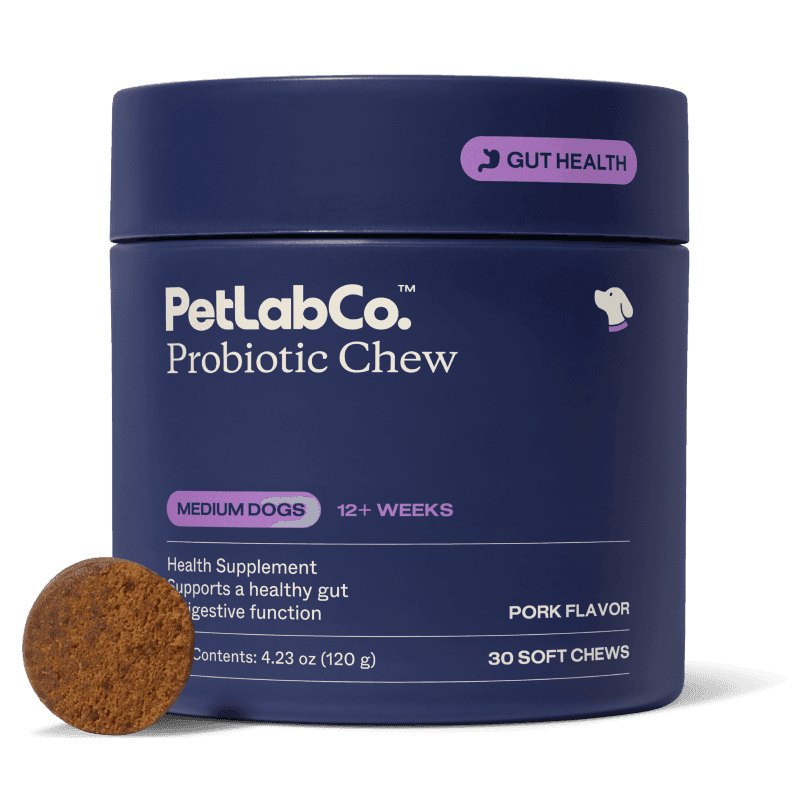
PetLabCo.® Probiotic Chews: our featured chew
For owners seeking a soft chew-based daily routine, PetLabCo.® Probiotic Chews combine probiotics, prebiotics and a postbiotic yeast blend in a pork-flavored soft chew. The formula is labeled for dogs 12 weeks and older. Its convenient format can suit a dog who accepts treats readily and whose dietary needs are compatible with the ingredients.
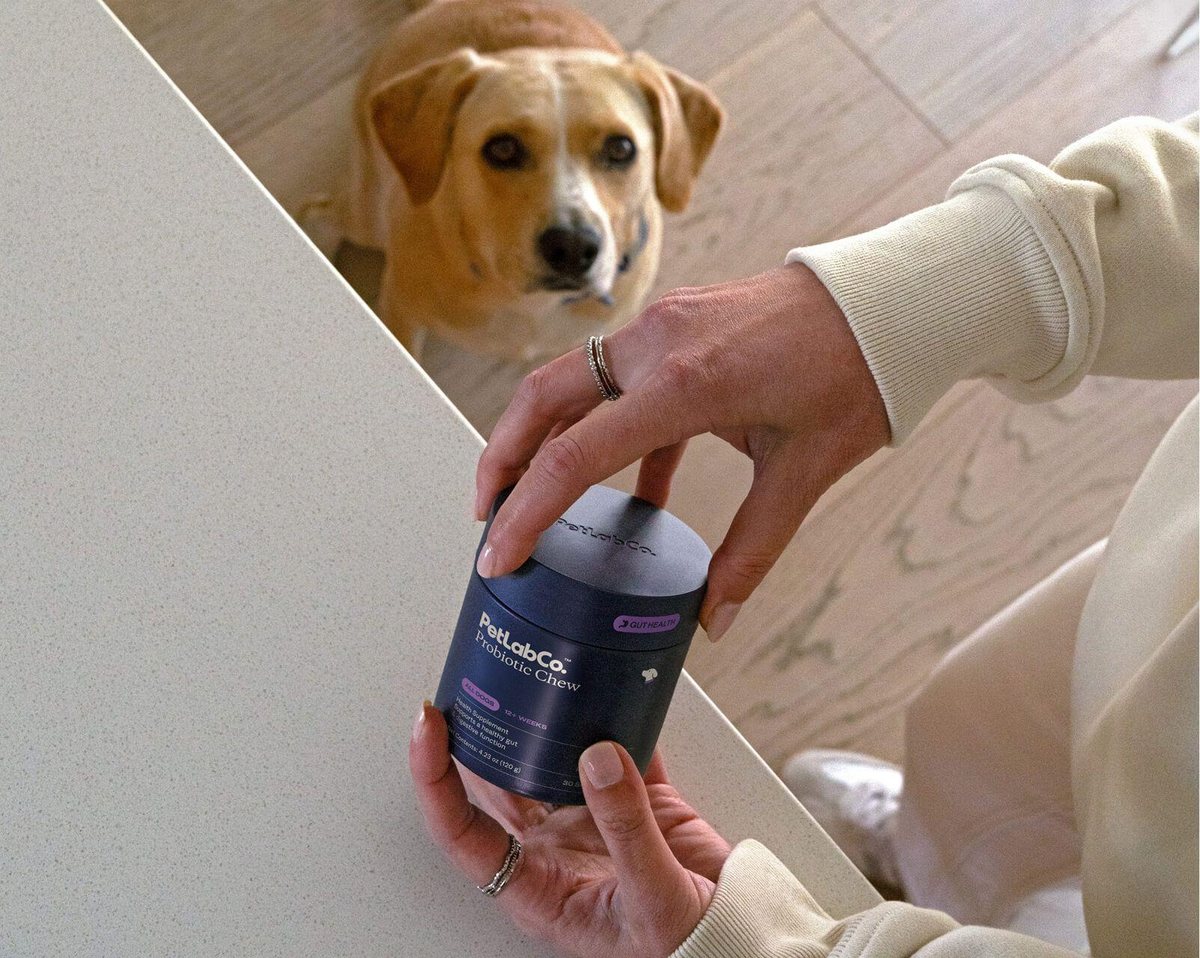
Each 4 g soft chew contains a proprietary blend listing Bacillus coagulans, Bacillus clausii and Bacillus subtilis, totaling 3 billion CFU. It also provides 100 mg of fructooligosaccharides, or FOS, 100 mg of galactooligosaccharides, or GOS, and 75 mg of a postbiotic yeast blend. The public label names the bacterial species; it does not provide specific strain codes.
Prebiotics and probiotics have different roles. Probiotics are live microorganisms, while prebiotics supply substrates that certain microorganisms can use. The additional yeast blend is another component of this formula. These ingredients should be considered together as a product, without assuming that research on one separately studied ingredient establishes every outcome for the finished chew.
Probiotic Chews serving directions
The current product directions specify the following daily amounts. Use the label on the product you receive and ask your veterinarian if your dog’s circumstances require a different plan.
| Dog’s weight | daily serving | CFU from that serving |
|---|---|---|
| Under 25 lb | 1 chew | 3 billion |
| 25–75 lb | 2 chews | 6 billion |
| Over 75 lb | 3 chews | 9 billion |
These directions apply to Probiotic Chews. The separate Tailored Probiotic Chews range has size-specific formulas and different instructions. Do not transfer a one-chew instruction from a Tailored tub to the product. Recheck the label whenever you change versions, even when both packages carry the same brand name.
For a dog in the middle weight band, for example, planning around two soft chews each day makes the serving and the tub’s expected duration clear. Counting the number of chews in the package without considering that daily amount can give a misleading picture of cost or convenience. The useful comparison is the routine you will actually follow.
For a closer look at how the featured soft chew fits a daily routine, including texture, acceptance and the per-weight chew count in practice, see Petful’s PetLabCo.® Probiotic Chews review. If you are weighing a soft chew against a powder for a dog with ongoing loose stools, WebVet’s guide to probiotics for dogs with diarrhea explains when a supplement is a reasonable adjunct and when the dog needs an exam first.
Do probiotic chews really help dogs?
Some probiotic formulations have evidence for specific outcomes, but benefits cannot be assumed from the word “probiotic” alone. The organisms, formulation, amount, dogs studied and outcome measured all affect how useful a study is for your decision. Chew format makes a supplement easier to administer for some owners; it is not itself evidence of a stronger clinical effect.
Cornell’s explanation of probiotics describes their potential role in supporting intestinal health and the importance of product selection. For owners comparing probiotics for dogs’ gut health, that means asking what a particular formula is intended to support and what evidence actually relates to it.
What the featured product’s study summary says
PetLabCo.® has published a summary of a brand-funded study involving 24 healthy adult Beagles over 31 days. The randomized, placebo-controlled study assessed microbiome measures and fecal calprotectin, an inflammatory marker, and the brand reports changes in those measures. It also reports no serious adverse events, with mild, short-lived digestive upset in both groups.
This is useful product-specific context, with clear limits. The summary does not link a peer-reviewed publication of that exact trial, and the dogs were healthy adults. It does not establish that the soft chews treat diarrhea, cure disease, work within a fixed number of days or produce the same results in puppies. A measured microbiome change is also different from a guaranteed visible benefit in every household.
What broader research can and cannot tell you
A 2025 study of a particular B. coagulans strain in healthy adult dogs reported changes in stool firmness and some microbiota measures. That trial illustrates the value of identifying the exact strain and endpoint. Because the public PetLabCo.® label does not identify that strain code, the paper should not be presented as a trial of these chews.
The practical conclusion is to select a suitable product, keep expectations specific and reassess its role with your veterinarian. Do not use a supplement trial to postpone care for an unwell dog. A daily support routine and a veterinary treatment plan can have different purposes, and one should not be used as a substitute for the other.
Puppies, sensitivities and side effects
Probiotic chews for puppies require an age check before a flavor or format comparison. PetLabCo.® Probiotic Chews are labeled for dogs 12 weeks and older. A younger puppy needs individual veterinary advice rather than a smaller guessed portion of an adult supplement. A puppy with digestive signs also needs assessment based on their age and overall condition. Related reading: WebVet’s guide to puppy diarrhea and probiotics.
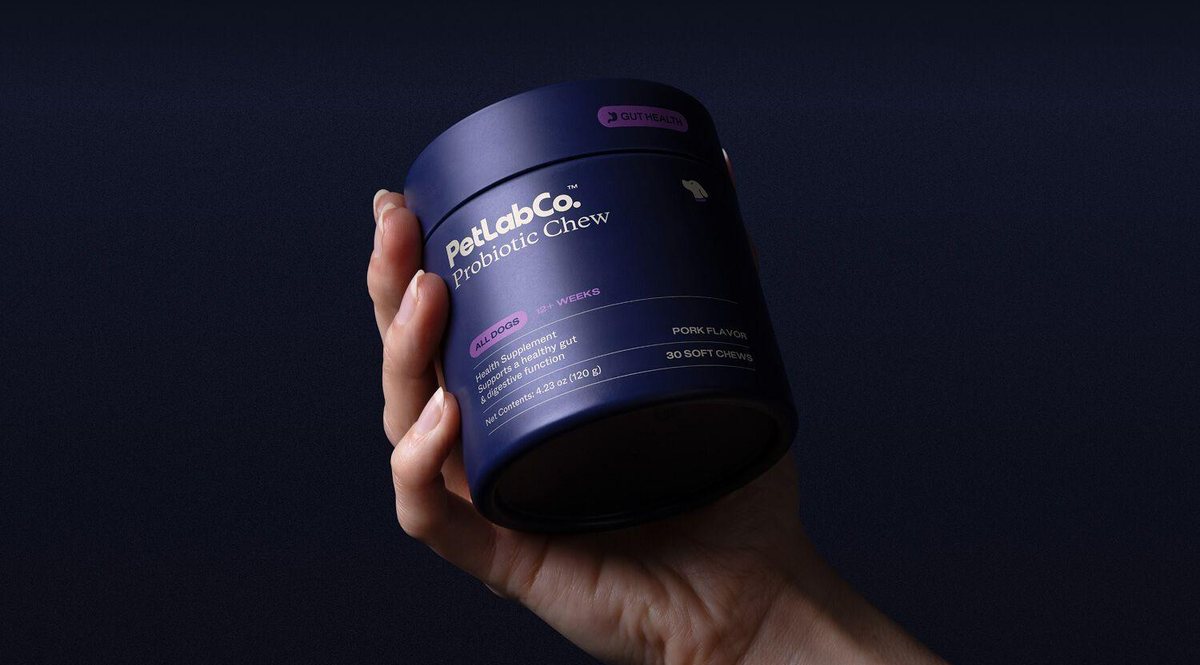
Food sensitivities deserve the same attention. The soft chews are pork flavored and contain pork liver. A soft chew is part of what your dog consumes, so its ingredients matter during a food trial or when managing a known dietary restriction. “Soft” describes the texture; it does not mean a product is appropriate for every sensitive dog.
Make the first conversation specific
Bring the label and a list of foods, treats, medicines and other supplements to your veterinarian. Ask whether the formula fits the dog’s health history and whether any existing products overlap. The label also notes that absorption of simultaneously administered drugs may be delayed, so medicine timing should be discussed rather than improvised.
- Check age, current weight and the exact formula before the first serving.
- Ask about use during pregnancy or breeding, because the label says safe use has not been proven in those circumstances.
- Keep a simple record of any new digestive changes after starting.
- Stop and consult your veterinarian if the dog’s condition worsens or does not improve, as directed on the label.
Questions about probiotic chews for dogs’ side effects should be connected to the whole dog. New gas or stool changes may warrant discussing tolerability, but repeated vomiting, blood in the stool, marked lethargy or poor appetite should not be dismissed as an adjustment period. Prompt veterinary advice is especially important for a young puppy or a dog with an existing illness.
Timing questions come up often with daily soft chews. WebVet’s guide to when to give a dog probiotics covers meals, medication spacing and travel, and WebVet’s guide to probiotics after antibiotics covers the most common short-term use case.
About PetLabCo.® and choosing your routine
PetLabCo.® offers several daily supplements, so matching the product name to the intended role is essential. Our PetLabCo.® product guide provides broader brand context. This guide focuses on chew selection: a clear serving, suitable ingredients and a format that works reliably in your home.
If those criteria fit your dog, review the current label for Probiotic Chews with your veterinarian. Choose a consistent place in the daily routine, make sure all caregivers know the serving and periodically reconsider whether the supplement still serves its intended purpose. A convenient chew is most useful when it is part of a deliberate, manageable plan.
Related probiotic guides from our sister sites: Probiotics for Dogs: A Vet’s Guide (WebVet), PetLabCo.® DF-14 Daily Foundation review (Petful), PetLabCo.® brand review (Petful), and Best Multivitamins for Dogs (WebVet).
Frequently Asked Questions
Veterinarians recommend products in the context of an individual dog’s needs, rather than a universal chew formula for every patient. Ask which formulation, serving and intended outcome they recommend for your dog. Bring the actual package or label so they can assess its ingredients and directions. A general claim that a supplement is “vet recommended” cannot replace that specific discussion.
The best fit depends on why support is being considered, the exact organisms and formula, and your dog’s health and dietary requirements. There is no single CFU number that identifies the best product for every gut. If a veterinarian has recommended a particular formulation, ask before substituting a differently formulated chew simply because it is easier to give.
Some supplements, including PetLabCo.® Probiotic Chews, are labeled for daily use. Daily administration may fit an agreed maintenance routine, but not every dog needs an added probiotic. Follow the exact product’s label directions and your veterinarian’s plan, and reassess if the dog’s diet, medicines or health changes. Do not increase the serving to compensate for an inconsistent routine.
There is no visible sign that reliably proves a dog needs a probiotic. Stool changes, gas or reduced appetite can have many causes and should be assessed in context. Tell your veterinarian when the change began, what the dog eats and whether other signs are present. That information helps determine whether a supplement, a dietary adjustment, testing or another approach is appropriate.
The appropriate alternative depends on the goal. If a dog is well and eats a suitable complete diet, an additional supplement may not be necessary. If there is a digestive concern, your veterinarian may prioritize a diet review or investigation of the cause. Do not assume a household food or human supplement is an equivalent substitute for a particular canine chew formula. Related reading: WebVet’s guide to human versus canine probiotics.
Follow the product’s directions and choose a time that makes the correct serving easy to remember. There is no universal morning-versus-evening rule established for all probiotic chews. If the dog takes medication, ask your veterinarian whether spacing is needed. Consistent handling, suitable storage and completing the intended daily serving are more useful considerations than choosing a supposedly ideal hour.
PetLabCo.® products are not intended to diagnose, treat, cure, or prevent any disease; consult your veterinarian before starting any new supplement regimen.