7 Changes in Senior Dogs That Shouldn’t Automatically Be Dismissed as Old Age
Published on November 16, 2026
Sponsored by PawOrigins.
—
The dog who used to sleep until breakfast is walking the hallway at two in the morning. The familiar greeting at the door has become a quiet glance from another room. Yesterday, there was an accident beside the bed, even though the back door had been open just minutes earlier.
Senior dog behavior changes can arrive in small, easily explained-away moments. You adjust the blanket, clean the floor, or tell yourself that your dog is getting older. Yet age describes a stage of life; it does not explain why a particular behavior has changed.
There may be something you can help with. The useful next step is to notice the pattern, arrange a veterinary conversation, and make everyday life easier while the cause is assessed. A calmer household and a more comfortable dog start with that understanding.
All featured products are chosen at the discretion of the author. However, Vetstreet may make a small affiliate commission if you click through and make a purchase.
What senior dog behavior changes can tell you
Senior dog behavior changes are a reason for medical evaluation, especially when they are new, recurring, or getting worse. Pain, sensory changes, illness, medication effects, and cognitive dysfunction can produce overlapping signs. One dog’s new restlessness may have a different explanation from another dog’s apparently similar behavior.
The American Animal Hospital Association’s senior-care guidance emphasizes taking a detailed history that includes movement, eating and drinking, toileting, attitude, vision, and hearing. Your everyday observations help supply that history. A change from baseline is often more useful than comparing your dog with a younger pet or an internet checklist.
Senior dog behavior problems also need context. A dog who has always disliked visitors presents a different question from a previously sociable dog who suddenly hides. Tell the veterinary team what is familiar, what is new, and what was happening around the first change.
Key takeaway: Use these seven changes as prompts for observation and a veterinary conversation. They are not a test for dementia, anxiety, or any other diagnosis. You do not need to see all seven before asking for help.
PawOrigins Primal-Vitality 6-in-1 Bone Broth Powder

1. Pacing at night instead of sleeping
An older dog pacing at night may circle between rooms, repeatedly change resting places, or stand beside the bed after everyone else has settled. Note whether your dog seems unable to get comfortable, wants to go outside, or is responding to something in the environment.
Senior dog anxiety at night is one possibility, but the clock does not identify the cause. Vetstreet’s veterinarian-written guide to nighttime pacing explains that discomfort, anxiety, and changes affecting brain function can all contribute. A new pattern deserves attention even if your dog appears comfortable during the day.
- Record when the pacing begins and how long each episode lasts.
- Note toilet trips, panting, vocalizing, difficulty lying down, and any recent medication changes.
- Keep the route to a familiar bed and toilet exit clear and safely lit.
- Let the veterinary team know if the dog and household are losing substantial sleep.
Avoid trying to exhaust your dog with a much longer walk or adding an unplanned sleep aid. Those choices can complicate the picture before you know what your dog needs. Describe the night as it happened: “walked between the kitchen and bedroom four times” is more useful than “was impossible again.”
2. Staring, getting stuck, or seeming lost at home
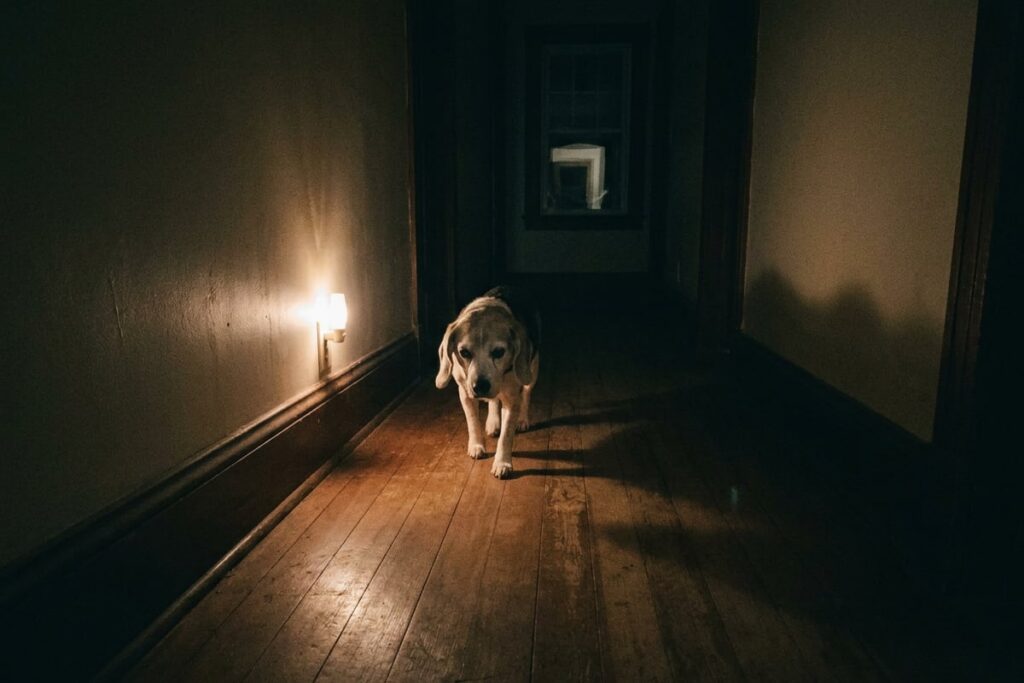
A dog may pause at the wrong side of a door, have trouble navigating around furniture, or look uncertain in a once-familiar room. Staring at a wall can feel particularly alarming when it happens for the first time. Try to note what you actually see, including how long it lasts and whether your dog responds to a familiar cue.
Cornell’s overview of cognitive dysfunction syndrome includes disorientation among the changes owners may notice. However, recognizing a possible sign is different from establishing its cause. Vision problems and other medical conditions can also affect how a dog moves through the home.
- Keep familiar furniture and important resources in consistent locations.
- Block access to stairs or other hazards when supervision is not possible.
- Film a brief episode if doing so is safe and does not delay needed care.
- Record whether the difficulty happens mainly in dim light or in one particular place.
Do not repeatedly rearrange obstacles to “test” your dog’s memory. Your goal is to make the environment easier to navigate and give the veterinarian useful information. If the change is sudden or severe, call promptly rather than waiting for more examples to accumulate.
3. Accidents after years of reliable housetraining
Finding urine beside the bed can feel like your dog has forgotten a familiar rule. There are other possibilities: increased urgency, leakage, trouble reaching the exit, discomfort using steps, or a change in awareness. An accident is an observation, not proof that your dog has become careless.
Vetstreet’s guide to common senior-dog health conditions explains why changes in thirst and urination belong in a veterinary conversation. Mention those changes together. Also distinguish urine from stool accidents, leakage during sleep from deliberate squatting, and an occasional missed trip from a suddenly frequent problem.
- Offer easier access to the usual toilet area and additional comfortable opportunities to go out.
- Keep a record of timing, water intake changes, and what the accident looked like.
- Use washable bedding and clean the area without scolding your dog.
- Ask the clinic whether it wants a urine sample and how it should be collected.
Do not restrict drinking water to reduce cleanup. And avoid assuming that a crate will solve the issue: confinement does not address urgency or discomfort. If your dog strains but cannot pass urine, seek urgent veterinary advice. Household management should support the dog while the underlying problem is investigated.
4. Becoming unusually clingy, worried, or easy to startle
A dog who once rested comfortably in another room may begin following every move you make. Another may jump when approached or become unsettled by everyday sounds. Look for the situations that bring on the change rather than deciding immediately that your dog has developed a particular anxiety disorder.
The ASPCA’s guidance on behavior in older dogs describes how medical problems and sensory changes can affect confidence and responses to contact. It also stresses checking for medical causes before treating a new behavior as an age-related behavioral problem.
- Approach where your dog can notice you rather than surprising them from behind.
- Allow quiet company if your dog seeks it, without holding them in place.
- Tell visitors and children to let a resting dog choose whether to interact.
- Note whether worry appears during departures, after dark, around sounds, or throughout the day.
Your observations can change the next conversation from “she is anxious all the time” to “she begins following me when I pick up my keys.” Neither description establishes a diagnosis, but the second gives the veterinary team a starting point. Avoid forcing independence through prolonged distress; ask for a plan that matches the cause and the individual dog.
5. Withdrawing from familiar people or activities
The dog who no longer brings a toy may be less interested, less comfortable, or less able to participate in the same way. A quieter greeting does not tell you which explanation fits. Notice whether your dog still seeks other forms of contact, such as sitting nearby or enjoying a gentle sniff outside.
Social and activity changes are part of the broader picture clinicians consider when assessing older dogs. AAHA’s guidance on cognitive dysfunction and behavioral anxiety supports considering cognitive concerns alongside other health and comfort needs. The useful question is what has changed for this dog, rather than whether every senior dog should enjoy the same activities.
- Offer a familiar activity in an easier form and let your dog opt out.
- Note whether withdrawal affects everyone or only particular situations.
- Record changes in appetite, grooming tolerance, movement, or sleep alongside it.
- Avoid adding a puppy or a demanding new routine as an automatic solution to low engagement.
There can be meaningful differences between a dog who declines fetch but enjoys a slow sniff walk and one who has stopped engaging with nearly everything. Share those distinctions. They help explain how the change affects daily life and what a useful improvement might look like.
PawOrigins Mobility-Max Advanced Hip & Joint Support Chews

6. Moving less or resisting touch
What are signs a senior dog is in pain? They can include reluctance to rise, difficulty with stairs, changes in posture, reduced interest in activity, or a new objection to grooming and handling. Some dogs become irritable instead of visibly limping. The absence of a cry does not rule out discomfort.
VCA’s guidance on recognizing pain in aging dogs explains why everyday behavior can be an important clue. Vetstreet’s discussion of senior-pet aches and pains also encourages paying attention to changes at home that may not be obvious during an examination.
- Notice how your dog gets up after rest and moves across different floor surfaces.
- Describe specific handling difficulties, such as pulling away during brushing.
- Offer nonslip footing and a comfortable resting place with easy access.
- Avoid repeatedly pressing, stretching, or manipulating an uncomfortable area to locate pain.
If your dog growls when touched, pause and create space. Do not punish the warning or ask a child to try again. A veterinarian can assess pain and advise on safe handling, movement, and treatment. Do not give human pain medicine or change a prescribed dose on your own.
7. New whining, barking, or difficulty settling
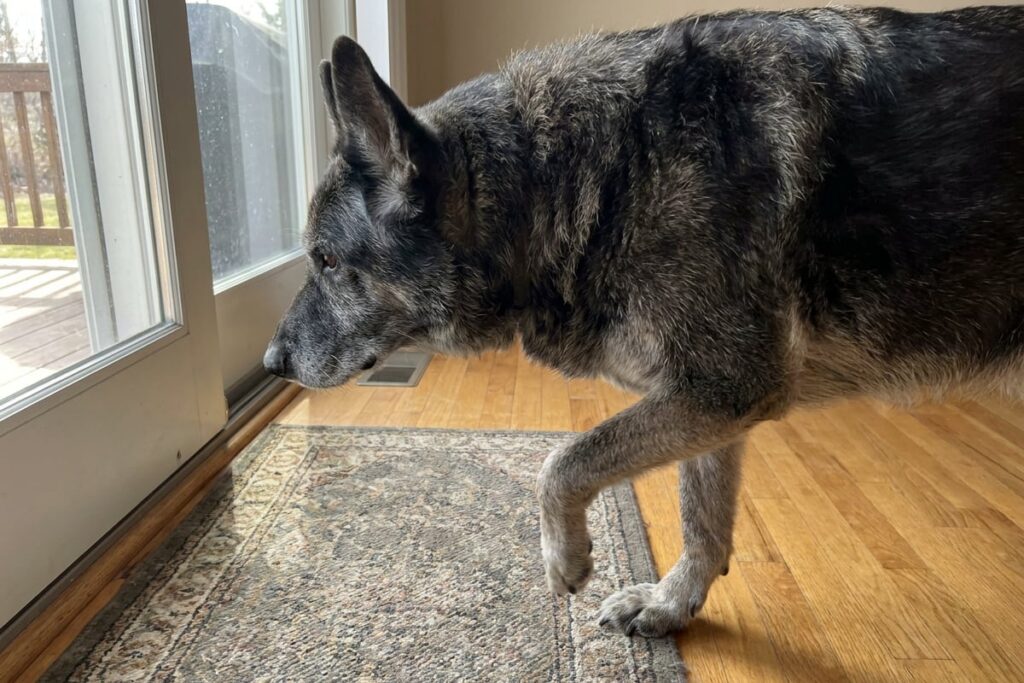
A previously quiet dog may begin calling from another room, whining after lying down, or barking without an obvious trigger. Before deciding the dog is asking for attention, consider the context: being alone, needing to eliminate, difficulty hearing, or another change may be relevant.
The pattern matters as much as the sound. Write down whether your dog settles when you appear, needs an outdoor trip, repeatedly changes position, or seems confused. A camera can sometimes help show what happens when you leave, provided using it is practical and does not delay a veterinary appointment.
- Check immediate needs such as safe access to water, a comfortable temperature, and a toilet opportunity.
- Keep your response calm while recording what happened before and after the noise.
- Tell the veterinarian about any accompanying physical or behavioral changes.
- Avoid punishment or a bark-suppression device as the first response to unexplained new vocalization.
You are not required to solve the meaning of every bark before asking for help. A short description of two or three typical episodes is enough to begin the conversation. If the behavior is disrupting sleep or creating safety concerns, say that plainly; the effect on the family is relevant to planning care, too.
Why one calming tip may miss the larger problem
Think of a familiar home as a room with a thermostat. When conditions change, the room becomes harder to keep comfortable. In an older dog’s life, discomfort, diminished senses, disrupted sleep, or a changed routine can make familiar situations harder to manage. A household solution aimed at just one visible behavior may leave another need unresolved.
The metaphor is useful for organizing the problem, but it is not a diagnosis of a malfunctioning biological “thermostat.” Nor does it establish that your dog needs a particular product. A new bed may improve access to a resting place while a medical condition still needs treatment. A sound machine may soften some background noise without explaining new pacing.
- Cleaning up an accident addresses the mess, not necessarily the cause.
- Correcting a growl can interrupt a warning without making touch comfortable.
- A longer walk may be the wrong response to a dog who is already sore.
- A supplement cannot tell you why a previously settled dog is now distressed.
This does not make those earlier efforts foolish. They are often compassionate responses to an unclear problem. The next step is to connect them to an assessment and an agreed goal, so each part of the plan serves a purpose.
PawOrigins Clear-Allergies Dog Allergy Chews

Turn seven worries into one useful observation diary
Start with a short record that another person can understand. An observation diary does not need an app, a perfect spreadsheet, or footage of every episode. A notebook or shared phone note is enough. Record the first change you remember, then add examples as they happen without delaying care to complete the diary.
Use the following prompts to separate facts from interpretations:
- What happened? “Stood at the hinged side of the door” is an observation. “Forgot everything” is an interpretation.
- When and where? Include the room, time of day, and whether the lights were on.
- What happened just before? Note waking from rest, a visitor, a meal, a medication, or a change in routine.
- What happened afterward? Describe a toilet trip, returning to sleep, continued pacing, or seeking company.
- What else changed? Mention drinking, appetite, stool, urination, movement, and responses to touch.
- How did it affect the day? Record missed sleep, difficulty getting outside, or activities the dog stopped enjoying.
For example, a useful entry might read: “Monday, 10:40 p.m.: got up from the bedroom bed, walked to the back door, urinated outside, returned indoors and lay down. Tuesday: repeated twice, with more drinking than usual.” This is an illustrative record, not a case history or a diagnosis.
If several people care for your dog, agree on the same simple descriptions. One person may notice daytime changes while another sees the night pattern. Ask a caregiver to report what they saw rather than guessing what the dog felt. Keep the original observations even when you later learn the cause; they can help you judge whether treatment is improving everyday life.
What to bring to the veterinary conversation
Bring the diary, a medication and supplement list, and brief videos of ordinary behavior when available. Include products used only occasionally. Also describe practical limits: stairs at home, work schedules, lifting difficulties, and whether another pet makes rest or feeding harder. A useful plan has to work in the household your dog actually lives in.
Questions worth asking include:
- Which medical, pain-related, or sensory causes need assessment first?
- Could any current medicine or supplement be contributing?
- What changes can we make safely at home while testing or treatment proceeds?
- What would improvement look like, and when should we check back?
- Which changes mean we should call sooner or seek emergency help?
The veterinarian may recommend an examination, laboratory testing, or other assessment based on the history and findings. There is no single test list that every dog needs. If cognitive dysfunction is considered, ask how other possible causes are being assessed and what support is appropriate for your dog.
Do not wait for a routine appointment if your dog develops breathing difficulty, collapses, cannot urinate, has a seizure, or becomes suddenly severely disoriented or painful. These warrant urgent veterinary attention. Contact a veterinary service promptly for instructions. Those situations should not be treated as ordinary aging or managed first with a calming product.
Build a support plan around the cause
Senior dog anxiety symptoms should lead to an individualized plan, not a race through unrelated calming tips. After assessment, senior dog anxiety treatment may involve medical care, behavior support, changes at home, or a combination. Ask the veterinary team how the pieces fit together and which change to begin first.
Support sleep and comfort by keeping familiar resources accessible and daily events predictable. Preserve activities your dog still enjoys, adapted to ability. A short sniffing outing, an easy food-search game, or quiet company may be more inviting than repeating an activity that has become physically difficult. Ask about appropriate food-based enrichment if your dog has dietary restrictions.
- Routine: Keep meals, toilet opportunities, rest, and caregiver handoffs reasonably consistent.
- Environment: Clear routes, improve footing, and provide comfortable choices for resting.
- Engagement: Offer manageable activities without insisting that the dog participate.
- Follow-up: Review the original concern and any new changes with the veterinary team.
Where practical, adjust one change at a time so you can tell what helped. This does not mean postponing several medically necessary treatments; follow the veterinarian’s instructions. It means avoiding a new bed, feeding schedule, supplement, and exercise routine all at once simply because you are anxious to see progress.
Make the follow-up goal observable rather than asking only whether your dog seems “better.” You might discuss these examples with the team:
- Can the dog reach the preferred resting place without struggling or avoiding the route?
- Are nighttime interruptions becoming less frequent, and is the dog comfortable between them?
- Has the dog resumed a familiar activity voluntarily, even in a simpler form?
- Are accidents changing in frequency, timing, or circumstances?
These observations do not prove which treatment caused an improvement. They give the team a shared picture of daily life and help you explain what still needs attention at the next check-in.
PawOrigins Happy-Furever Full-Spectrum CBD Oil

Where Happy-Furever fits in the conversation
Once the reasons behind a change are being assessed, additional supportive care can become a thoughtful conversation. PawOrigins’ Happy-Furever Oil is a full-spectrum CBD oil for dogs and cats. The brand presents it within a broader approach to everyday wellbeing, alongside routine, comfort, and veterinary guidance.
CBD research often discusses the endocannabinoid system, a network involved in regulating several body functions. That scientific context does not show that an individual dog’s pacing comes from an endocannabinoid deficiency, or establish that a particular oil will resolve it. A newly unsettled senior dog still needs a veterinary assessment; CBD has not been established as a treatment for cognitive decline.
For an owner interested in considering the product, the next step can be a practical review with the veterinarian:
- Bring the exact product label and current ingredient information.
- Discuss existing medicines, supplements, and relevant health conditions.
- Ask what the goal would be and how to monitor the dog’s response.
- Agree on when to stop and contact the clinic if an unwanted change occurs.
Cornell’s explanation of CBD use and efficacy notes potential effects on liver enzymes and medication metabolism. That makes an individualized discussion especially useful for a senior dog already receiving treatment. Research on CBD generally should not be read as proof of Happy-Furever’s effectiveness in your dog.
Interested readers can learn more about Happy-Furever Oil from PawOrigins and bring the product information to that conversation. The purpose is a considered next step within the care plan you are building, with attention to the dog in front of you.
Questions owners often ask
Possible early signs include becoming disoriented in familiar places, altered social interactions, sleep changes, or housetraining lapses. They are not specific enough to diagnose dementia at home. An individual dog needs veterinary assessment for other causes, including discomfort and sensory or medical changes. Vetstreet’s established guide to signs of canine cognitive dysfunction provides additional context; bring new observations to your veterinarian rather than using a checklist to decide the diagnosis.
Yes, 13 is old for many dogs, but size, breed, health, and individual history affect what it means. A birthday does not explain a new accident, a painful movement, or sudden confusion. Compare your individual dog with their usual baseline and seek veterinary assessment for meaningful changes. Also mention abilities and activities your dog still enjoys, so the conversation includes quality of life and practical support rather than age alone.
There is no single age at which most dogs can be considered old: size and individual health matter. Larger dogs generally reach later life stages earlier than smaller dogs, and health needs vary within those groups. Your veterinarian can help identify the appropriate senior-care schedule for your individual dog. Regardless of the label, a change in behavior deserves attention on its own merits. You do not have to wait until a dog reaches a particular birthday to raise a concern.
The amount should fit the individual dog’s comfort, mobility, health, and veterinary assessment. Ask for guidance if exercise tolerance has changed, rather than applying a universal number of minutes. Shorter, comfortable outings with opportunities to sniff may be easier to adapt than one demanding walk. Watch how your dog moves during the outing and after resting afterward, and tell the veterinary team if reluctance, limping, or unusual fatigue appears.
Keep the next step specific
You do not have to turn seven possible changes into seven separate projects. Start with the behavior that changed, write down a few clear examples, and contact your veterinary team. Keep the household comfortable and predictable while the cause is assessed.
Your dog may need a different routine, treatment, environmental support, or several of those together. The useful goal is concrete: easier rest, more comfortable movement, reliable access to necessities, and continued enjoyment of familiar life. Paying attention gives you and your veterinarian a better place to begin.