What Is the 95% Rule in Dog Food? Naming Rules Explained
Published on November 03, 2026
The 95% rule in dog food says that when a product is named for an ingredient, such as “Beef Dog Food,” that ingredient must make up at least 95 percent by weight of the product, excluding added water, and at least 70 percent of the total product once water is counted. The rule comes from the model pet food regulations published by the Association of American Feed Control Officials, and AAFCO explains it in plain terms on its Reading Labels page.
It is only one of a family of naming rules. A few small words on the front of the package, such as “dinner,” “with,” or “flavor,” change the minimum amount of the named ingredient from 95 percent to 25 percent, 3 percent, or no fixed percentage at all. This guide walks through each rule, shows the water math with a simple batch, explains who writes and enforces the rules, and then reads a real fresh dog food label line by line.
This article is sponsored by Get Real, Chewy’s gently cooked fresh dog food line. Vetstreet may earn a commission if you purchase through links in this article.
Key Takeaways
- The 95 percent named ingredient rule applies when a food is named for an ingredient alone, such as Beef Dog Food: the named ingredient must be at least 95 percent of the product excluding added water.
- Words like dinner, entree, and platter trigger the 25 percent rule, so the named ingredient can be as little as 25 percent of the product excluding water.
- Under the 3 percent with rule, Dog Food with Beef needs only 3 percent beef.
- A flavor name needs no minimum percentage, only an ingredient that provides the flavor.
- Naming rules tell you how much of an ingredient is present, not whether the food is complete and balanced; check the nutritional adequacy statement for that.
What is the 95% rule in dog food?
The 95% rule covers product names built from an ingredient and nothing else, like “Beef Dog Food” or “Chicken and Rice Dog Food.” AAFCO’s Reading Labels guidance states that the named ingredients “must account for at least 70% of the total product by weight, and at least 95% of the product by weight, not counting added water.” The leftover 5 percent is mostly the vitamins, minerals, and small formulation ingredients that make the food nutritionally useful.
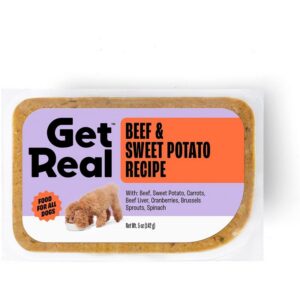
Get Real Beef & Sweet Potato Recipe. Beef is the first ingredient in this gently cooked fresh recipe, followed by sweet potato, so the protein named on the front leads the ingredient list on the back.
AAFCO also notes that the rule protects what the name implies. A food called Beef Dog Food must be mostly beef meat, not beef meal or beef byproduct. Contracted or playful spellings do not get a pass either. AAFCO’s own example is that a made-up spelling like “Chik’n” in a product name still has to meet the 95% rule.
The rule matters most for canned and other high-moisture foods, because water is added to help process them. Dry foods also get water during mixing, but most of it is driven off during drying. That is why the rule is written with two numbers: one that ignores added water and one that includes it.
Each naming rule is set off by its own label trigger words and carries its own minimum percentage threshold:
| Rule | Label trigger words | Minimum percentage threshold (AAFCO) | Example product name |
|---|---|---|---|
| 95% rule | Ingredient name alone | 95 percent excluding added water; 70 percent of the total | Beef Dog Food |
| 25% rule | Dinner, entree, platter, and similar descriptors | 25 percent excluding added water; 10 percent of the total | Beef Dinner for Dogs |
| 3% with rule | With | 3 percent of the total for each named ingredient | Dog Food with Beef |
| Flavor rule | Flavor or flavored | No minimum percentage; a listed ingredient must provide the flavor | Beef Flavor Dog Food |
When you compare two foods, read the exact words in the product name first, then match them to a row. The difference between “Beef Dog Food” and “Dog Food with Beef” looks small on the shelf, but under AAFCO’s rules the first must be at least 95 percent beef by weight excluding water, while the second only needs 3 percent.
The 25% rule: dinner, entree, platter, and similar words
The 25 percent dinner rule applies when the product name pairs an ingredient with a descriptor word. AAFCO’s examples include “Chicken Dinner,” “Beef Entrée,” and “Lamb and Rice Platter,” and its guidance says descriptors such as dinner, entrée, platter “and so on” work the same way. In full, the 25 percent rule covers dinner, entree, platter, nuggets, formula, and similar descriptors; the complete descriptor list lives in the AAFCO Model Regulations for Pet Food (PF3, product names). According to AAFCO, the named ingredient must make up at least 10 percent of the total product by weight and at least 25 percent of the product by weight not including added water.
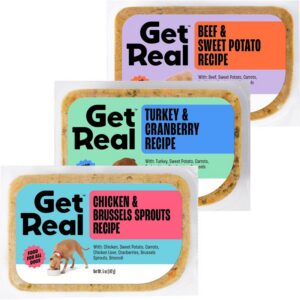
Get Real Sampler Pack, Beef, Chicken & Turkey Gently Cooked Fresh Dog Food, 6 pack bundle (2 of each recipe). A way to compare the beef, chicken, and turkey recipes in the same fresh format and see which named protein your dog prefers.
That is a big drop from the 95% rule. A food called “Beef Dinner for Dogs” can legally contain far less beef than one called “Beef Dog Food.” AAFCO compares it to a restaurant order: a sirloin dinner arrives with vegetables, potatoes, and salad, not just the steak. The descriptor tells you the named ingredient is a meaningful part of the food, but the rest of the recipe may be built around other proteins, grains, or vegetables.
Combination names under the 25% rule follow an extra condition. If more than one ingredient appears in a “dinner” style name, the named ingredients together must meet the 25 percent threshold, and AAFCO adds that no single named ingredient can be less than 3 percent of the total product. Named ingredients also appear in the name in order of predominance, so “Lamb and Rice Platter” should contain more lamb than rice.
- Read the descriptor word: dinner, entree, platter, formula, or a similar descriptor means the 25% rule, not the 95% rule.
- Check the ingredient list: the named ingredient should appear near the top, but it may not be first.
- Look for other proteins: a “Beef Dinner” may list chicken or another meat ahead of beef.
- Compare names carefully: two foods with the same protein on the front can follow different rules.
The 25% rule is not a sign of a lower-quality food. Many balanced recipes pair a protein with vegetables or grains, and a descriptor name simply reflects that. If you want a food built around one main protein that still includes vegetables, compare the ingredient order on each label, and try more than one protein if your dog has not settled on a favorite. The Get Real Sampler Pack bundles the beef, chicken, and turkey recipes for that kind of side-by-side comparison.
The 3% “with” rule
The 3 percent with rule is the most forgiving of the percentage-based naming rules. AAFCO’s Reading Labels page explains that the word “with” allows an ingredient to be named on the label at an inclusion rate of at least 3 percent of each named ingredient. Its examples are a dog food “With Chicken,” which should contain at least 3 percent chicken, and a cat food “with Tuna and Rice,” which should contain at least 3 percent tuna and 3 percent rice.
This is where shoppers most often misread a package, because “Dog Food with Beef” reuses the exact words of “Beef Dog Food.” The word “with” is often printed in smaller letters, which makes the named ingredient look like the main event.
- “Dog Food with Beef”: at least 3 percent beef.
- “Dog Food with Beef and Rice”: at least 3 percent beef and at least 3 percent rice.
- “Beef Dinner for Dogs with Carrots”: the 25% rule for beef, plus at least 3 percent carrots.
A “with” name is perfectly legal and useful for highlighting an added ingredient. It just tells you little about the main protein. For that, the ingredient list is the better guide, because ingredients are listed in order of predominance by weight, from most to least.
The flavor rule
The flavor rule sets the lowest bar of all: there is no minimum percentage. According to AAFCO’s labeling guidance, a flavor designation may appear in a product name as long as a listed ingredient provides the flavor and the flavor descriptor is printed in the same font and as conspicuously as the name of the designated flavor.
So a bag of “Beef Flavor Dog Food” does not have to contain a set amount of beef meat. The flavor can come from an ingredient such as beef broth, beef fat, or another listed source that gives a beef taste. AAFCO’s chicken example says you should find chicken fat or another ingredient providing chicken flavor in the ingredient list, with both words printed in the same type size.
- Look for the word flavor or flavored in the name.
- Find the ingredient that supplies the flavor in the ingredient list.
- Do not assume the named animal protein is a main ingredient.
Flavor names are common on treats and budget foods, where they help a product appeal to dogs without changing the core recipe. They are not misleading once you know the rule, but they tell you nothing about how much meat the food contains.
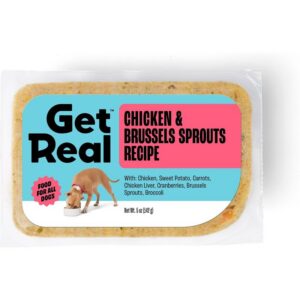
Get Real Chicken & Brussels Sprouts Recipe. A complete fresh recipe with chicken as the protein named on the front, gently cooked and pre-portioned, formulated to AAFCO nutrient profiles for all life stages.
How added water and combination names change the math
The water exclusion math is what makes the 95% and 25% rules confusing. The rule has two tests: the named ingredient must reach its threshold excluding added water, and it must also reach a lower floor of the total product with water included. For the 95% rule that floor is 70 percent with water; for the 25% rule it is 10 percent of the total product.
Here is a simple 100-pound batch for a canned food called “Beef Dog Food”:
- 72 pounds of beef
- 25 pounds of water added for processing
- 3 pounds of vitamins, minerals, and other formulation ingredients
Excluding added water, the batch weighs 75 pounds, and beef accounts for 72 of them, or 96 percent. Including the water, beef is 72 percent of the total. The food clears both tests: at least 95 percent excluding added water and at least 70 percent with water. Now change the batch to 65 pounds of beef, 30 pounds of water, and 5 pounds of other ingredients. Beef is still 65 percent of the total, but excluding water it is only about 93 percent, so the name “Beef Dog Food” no longer fits. A “Beef Dinner” name would, because that only needs 25 percent excluding water and 10 percent of the total.
Combination names add an ordering rule. AAFCO’s example is a “Chicken and Rice” food, where chicken and rice together must meet the 95% rule, and because chicken is named first there must be more chicken than rice. AAFCO adds that when more than one ingredient is in the name, no named ingredient can be less than 3 percent of the total product. A “Rice and Chicken” food would need the reverse order of weights.
Water also explains why fresh and canned foods look very different from dry food on the guaranteed analysis, even when the recipes are similar. Fresh, gently cooked foods are often around 75 percent moisture, so their protein and fat percentages look low on the package until you convert them to a dry matter basis. The FAQ below covers that conversion.
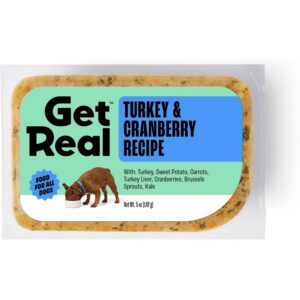
Get Real Turkey & Cranberry Recipe. A turkey and cranberry recipe in the same gently cooked, frozen format, made with 10 ingredients or less plus vitamins and minerals.
Where the naming rules come from: AAFCO and the FDA
AAFCO dog food guidelines are model regulations, not federal law on their own. AAFCO is an association of the officials who regulate animal feed, and it publishes model pet food regulations and the AAFCO nutrient profiles for dogs and cats. States can adopt those model rules into their own feed laws, and many have. The naming rules in this article come from those model regulations, which is why this article cites AAFCO’s Reading Labels page for every threshold.
The federal side belongs to the U.S. Food and Drug Administration. The FDA’s pet food program, run through its Center for Veterinary Medicine, covers requirements that apply to pet foods sold in the United States, including proper identification of the product, net quantity, the manufacturer or distributor’s name and address, and a list of ingredients in order of predominance. FDA also requires that pet food be safe to eat, produced under sanitary conditions, and truthfully labeled.

Pet food labeling requirements, then, come from layers working together:
- FDA sets the federal baseline for safe, truthfully labeled pet food.
- AAFCO writes the model pet food regulations, including product naming, guaranteed analysis, and nutritional adequacy statements.
- State feed control officials adopt and enforce those rules in their states.
One common misunderstanding is the phrase “AAFCO approved dog food.” AAFCO does not approve, certify, or test individual products. When a label refers to AAFCO, it means the food was formulated to meet, or tested in feeding trials against, the AAFCO nutrient profiles for a stated life stage. The rules give shoppers a shared vocabulary for what a name, a guarantee, or an adequacy statement means, whether the food is dry, canned, or fresh.
Because the same AAFCO label rules apply across formats, the naming rules work just as well on a frozen fresh food as on a bag of kibble. That makes it possible to compare very different products using the same three steps: read the name, read the ingredient list, then read the nutritional adequacy statement. The Get Real Chicken & Brussels Sprouts Recipe, for example, is formulated to meet AAFCO nutrient profiles for all life stages, including growth of large dogs, so it can be read with the same checklist you would use on any other complete food.
What naming rules do not tell you
Naming rules answer one question: how much of the named ingredient is in the food. They do not tell you about ingredient quality, whether the food is complete and balanced, how many calories it contains, or whether it suits your dog’s age and health. A product can follow the 95% rule perfectly and still be a poor fit, and a “dinner” product can be an excellent, balanced diet.
For most dogs, a good food is complete and balanced for the dog’s life stage, made from digestible ingredients, fed in the right calorie amount, and accepted by the dog over time. The name helps you find the main ingredient, but the nutritional adequacy statement, the guaranteed analysis, and the calorie statement do more of the work. For a deeper look at protein sources, see the Vetstreet guide to protein in pet food.
The nutritional adequacy statement is the completeness check. Look for wording that the food is complete and balanced for a life stage according to the AAFCO nutrient profiles, or that it passed AAFCO feeding trials.
Fat content varies widely by format and recipe, which is why the guaranteed analysis is required on every label. AAFCO lists four basic guarantees: minimum crude protein, minimum crude fat, maximum crude fiber, and maximum moisture. The word crude refers to the lab method used, not the quality of the nutrient. Fresh foods list lower fat numbers than dry foods largely because they contain much more water, so to compare fat fairly across formats, convert to a dry matter basis.
Clean label claims and third-party seals are a separate layer again. Groups like the Clean Label Project test products for contaminants such as heavy metals and publish their own certifications. Those programs are voluntary and separate from AAFCO naming rules; a clean label seal does not tell you whether a food meets the 95% rule, and the 95% rule does not tell you anything about contaminant testing.
- Nutritional adequacy statement: tells you if the food is complete and balanced, and for which life stage.
- Guaranteed analysis: minimum protein and fat, maximum fiber and moisture.
- Calorie statement: kilocalories per kilogram and per familiar unit such as a cup, can, or pack.
- Ingredient list: every ingredient in order of predominance by weight.
- Feeding directions: a starting amount to adjust for your dog’s body condition.
When a food clears those checks, the remaining choice often comes down to protein preference and format. A poultry option like the Get Real Turkey & Cranberry Recipe gives dogs a protein alternative within the same gently cooked, frozen line, and its label can be read with the same steps. If you are still deciding what suits your dog, the Vetstreet guide to choosing the right food for your dog covers life stage and body condition in more depth.
Reading a fresh dog food label: a worked example
To show how the rules work on an actual package, here they are applied to a real fresh-food label: the Get Real Beef & Sweet Potato Recipe, one of three recipes in Chewy’s Get Real fresh dog food line. Every number below comes from the published ingredient list and guaranteed analysis. Chewy does not publish the percentage of beef in the recipe, so the label is read here the way any shopper can read it. Pet food labels explained this way work on any format: a dog food ingredients label on a kibble bag or a can follows the same order-by-weight rule.
Start with the name. “Beef & Sweet Potato Recipe” pairs two ingredients with the descriptor word “recipe.” Because the name uses a descriptor rather than the ingredients alone, the most useful information is the ingredient order on the back of the pack. Here is how the first part of the published ingredient list reads, in order of predominance:
- Beef
- Sweet potato
- Carrots
- Beef liver
- Cranberries
- Brussels sprouts
- Spinach
Beef is listed first and sweet potato second, which matches the order of the name. Beef liver, a second beef ingredient, appears fourth. After the spinach come the ingredients that round out the nutrition: dicalcium phosphate, canola oil, potassium chloride, calcium carbonate, salt, fish oil, choline chloride, magnesium sulfate, a mineral blend, mixed tocopherols, and a vitamin blend. That structure lines up with Get Real’s description of 10 ingredients or less plus vitamins and minerals.
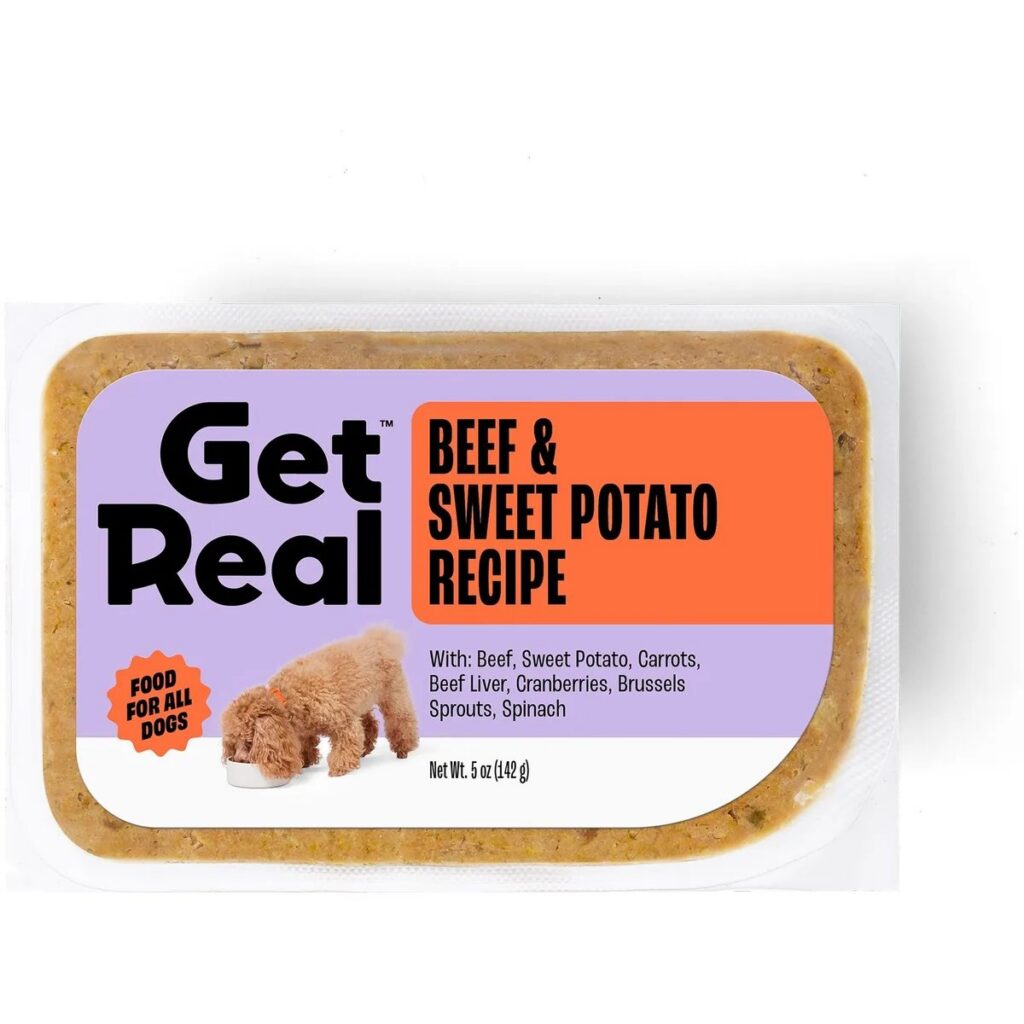
The guaranteed analysis on the Beef & Sweet Potato Recipe lists 9 percent minimum crude protein, 7 percent minimum crude fat, 1.5 percent maximum crude fiber, and 75 percent maximum moisture. The calories listed on Chewy’s product page are 451 kilocalories per 12 oz pack. Get Real recipes are formulated to meet AAFCO nutrient profiles for all life stages, including growth of large dogs expected to weigh 70 pounds or more as adults.
Put together, that label answers the questions the naming rules cannot:
- Main protein: beef, named first and listed first, with beef liver further down.
- Completeness: AAFCO nutrient profiles for all life stages, including large-breed growth.
- Fat: 7 percent guaranteed minimum as fed, a label floor rather than the actual fat content.
- Calories: 188, 451, and 902 kcal listed for the 5 oz, 12 oz, and 24 oz packs, for portioning.
- Format: gently cooked, then frozen, made with human-grade ingredients.
The same approach works on the other two recipes in the line, Chicken & Brussels Sprouts and Turkey & Cranberry. Both use the same “protein and produce Recipe” naming pattern, so the reliable check is again the ingredient order and the guaranteed analysis rather than a percentage on the front. If you want to read the label yourself, the Get Real Beef & Sweet Potato Recipe page on Chewy shows the details, and the line is sold only at Chewy in select markets. For help choosing between the three proteins, see our comparison of chicken vs beef vs turkey for dogs.
Related reading: Petful explains what “natural” means on a dog food label, and WebVet walks through the rest of the panel in How to Read a Dog Food Label.
Dog food naming rules: frequently asked questions
Frequently asked questions
Divide the guaranteed analysis fat by the dry matter, which is 100 minus the moisture percentage, then multiply by 100. As an illustration only, using a label’s guaranteed minimums and maximums rather than actual values: a fresh food guaranteeing at least 7 percent fat and at most 75 percent moisture works out to about 28 percent fat on a dry matter basis, while a kibble guaranteeing 15 percent fat and 10 percent moisture works out to about 17 percent. Guaranteed minimums and maximums do not establish the actual nutrient percentages, so treat the result as a rough comparison, not the food’s true fat content.
The 80/20 rule is a raw feeding ratio, usually described as about 80 percent muscle meat with the rest split between bone and organ, used by some home feeders. It is not an AAFCO rule and has nothing to do with product naming. A diet built only on that ratio is not automatically complete and balanced, so review any homemade plan with your veterinarian.
No. AAFCO does not approve, test, or certify pet foods. A label that mentions AAFCO means the food was formulated to meet, or passed feeding trials based on, the AAFCO nutrient profiles for a stated life stage.
The AAFCO dog food guidelines are the model pet food regulations and the AAFCO nutrient profiles for dogs. The model regulations cover labeling, including product names, guaranteed analysis, and nutritional adequacy statements, while the nutrient profiles set nutrient levels for growth and adult maintenance.
The Clean Label Project is a nonprofit that offers third-party certification based on testing for contaminants such as heavy metals. It is voluntary and separate from AAFCO naming rules, so a seal does not show whether a food meets the 95% rule or is complete and balanced.
Pet food labels are regulated at two levels. The FDA Center for Veterinary Medicine enforces federal requirements for safe, truthfully labeled pet food, and state feed control officials enforce labeling rules, many of which are based on AAFCO’s model regulations.
Under the flavor rule, a name like “Beef Flavor” needs no minimum amount of beef. A listed ingredient must provide a detectable flavor source, and the word flavor must be printed as prominently as the flavor name.