How Many Times a Day Should a Dog Eat? Feeding Frequency by Age and Size
Published on November 03, 2026
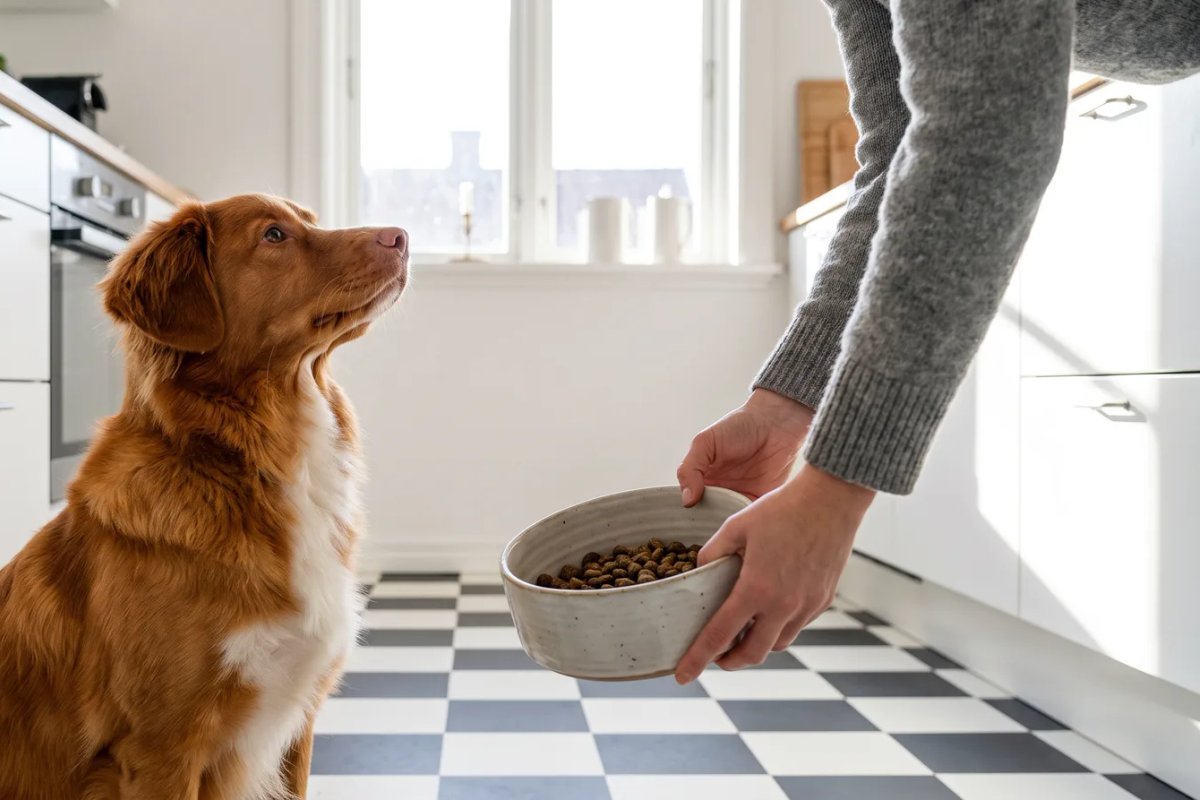
How many times a day should a dog eat? Most healthy adult dogs do well on two meals a day, about 8 to 12 hours apart, while puppies need three or four meals a day and some toy breeds, seniors, and dogs with medical conditions do better with smaller, more frequent meals. The honest answer for any single dog is that it depends on age, size, health, and routine.
This guide gives you a schedule by age and by size, explains the reason for each schedule, and walks through the once-a-day debate, free feeding, and the body condition check that tells you whether your plan is working. It also shows how pre-portioned fresh meals, such as Get Real from Chewy, make it easier to split a day’s food into evenly sized meals.
This article is sponsored by Get Real, Chewy’s gently cooked fresh dog food line. Vetstreet may earn a commission if you purchase through links in this article.
Key Takeaways
- Most healthy adult dogs do well on two meals a day, spaced roughly 8 to 12 hours apart.
- Puppies need three or four meals a day until about 4 to 6 months of age, then two or three.
- Toy breeds are prone to low blood sugar and large, deep-chested breeds are prone to bloat, so both benefit from smaller, regular meals.
- Senior dogs often do best on two or more smaller meals, adjusted to appetite and health.
- Body condition, not the number of meals, is the best sign that your dog is getting the right amount of food.
How many times a day should a dog eat?
Two meals keep hunger steady, make it easy to notice if your dog skips food, and suit most household routines: one meal in the morning and one in the evening. Veterinarians also like the predictability, because a dog that eats on a schedule usually eliminates on a schedule too, which helps with house training and with spotting digestive problems early.
That said, feeding frequency is less a rule than a starting point. The right number of meals depends on the dog in front of you. Consider two common situations:
- A healthy 3-year-old Labrador in a busy household eats two measured meals, one before work and one after dinner, and stays lean and energetic. Two meals is exactly right for that dog.
- A 12-year-old terrier with early kidney changes starts leaving half of each meal. Splitting the same daily amount into three or four smaller meals may help that dog finish its food and keep weight on.
Three meals a day is also fine for a healthy adult as long as the total daily amount stays the same and your dog stays at a healthy weight. Some owners prefer three smaller meals for dogs that get hungry, dogs that vomit bile on an empty stomach, or dogs with sensitive digestion. The key is to divide the day’s food, not to add a third full meal on top of two.
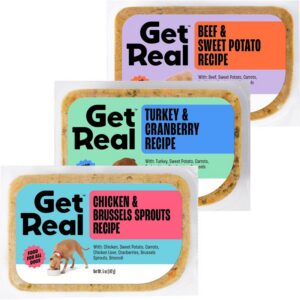
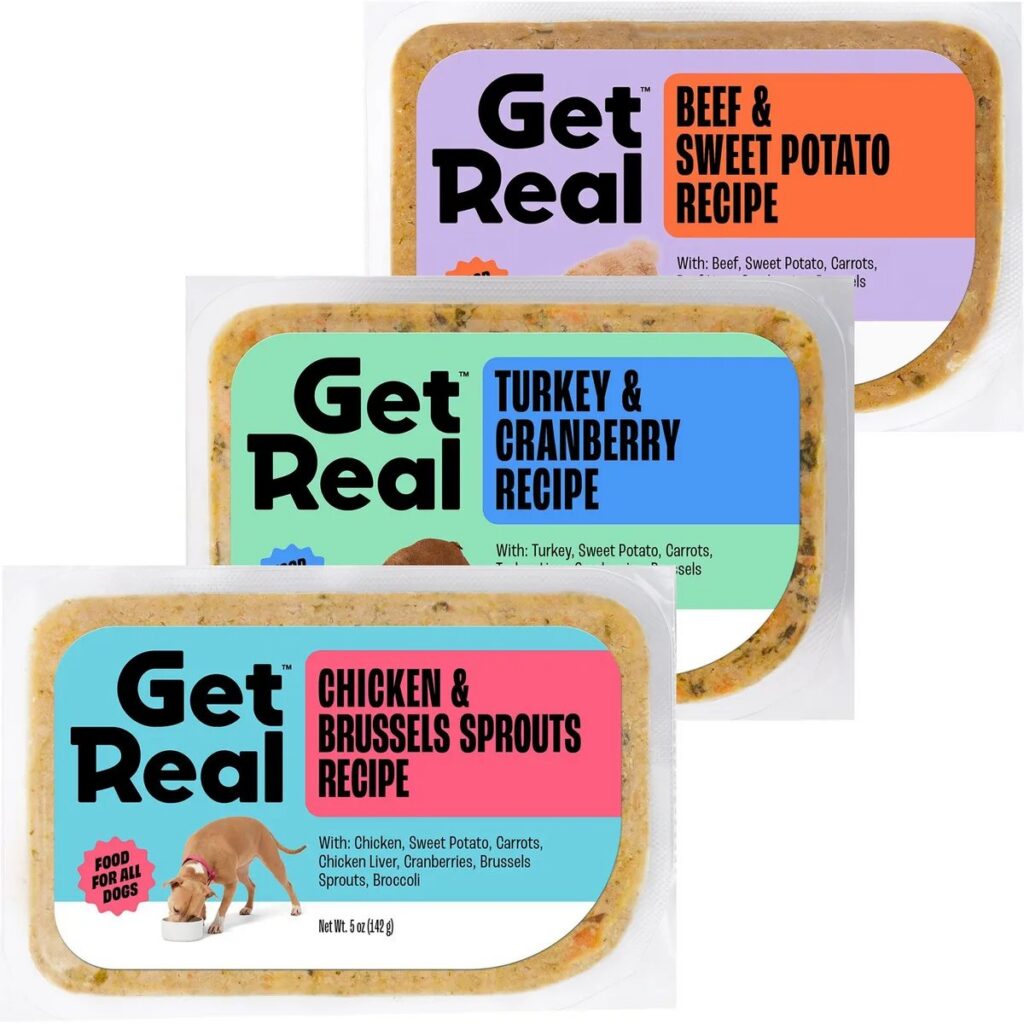
Get Real Sampler Pack, Beef, Chicken & Turkey Gently Cooked Fresh Dog Food, 6 pack bundle (2 of each recipe). A regular schedule is easier with a food your dog finishes, and this sampler of beef, chicken, and turkey recipes helps you find the one your dog looks forward to.
Whatever number of meals you choose, consistency matters more than the exact clock time. Feeding at roughly the same times each day helps regulate appetite and digestion, and a routine that fits your schedule is one you will actually keep. Pre-portioned food can make that routine simpler, because each meal starts from the same measured amount, and the Get Real Sampler Pack is an easy way to find one your dog eats readily.
Feeding frequency by age: puppies, adults, and seniors
Age changes how often a dog needs to eat more than anything else. Puppies grow fast and have small stomachs, adults need maintenance, and seniors may need adjustments for appetite, dental health, and chronic disease. The table below gives meals per day by age and size, with the reason behind each recommendation.
| Life stage and size | Meals per day | Reason for each schedule |
|---|---|---|
| Toy and small breed puppies (under about 6 months) | 3 to 4, sometimes more | Tiny energy reserves; skipped meals can cause low blood sugar |
| Medium breed puppies (under about 6 months) | 3 to 4 | Small stomach and fast growth need steady fuel |
| Large and giant breed puppies (under about 6 months) | 3 | Controlled growth and smaller meals help limit stomach overload |
| Puppies from about 6 to 12 months | 2 to 3 | Growth slows and stomach capacity increases |
| Healthy adult dogs of any size | 2 | Steady hunger, easy appetite monitoring, predictable routine |
| Toy breed adults | 2 to 3 | Small reserves; some are prone to low blood sugar |
| Large and deep-chested adults | 2 or more | Smaller meals are linked to lower bloat risk in large breeds |
| Senior dogs | 2 or more smaller meals | Appetite, dental, and medical changes; easier digestion |
Puppies need three or four meals a day until about 4 to 6 months of age. Their stomachs are small, their energy needs per pound are high, and their growth depends on a steady supply of nutrients. Around 4 to 6 months, most puppies can move to two or three meals a day, and by their first birthday most are eating like adults. Large and giant breed puppies grow for longer, often 12 to 18 months, and do best on a food that meets AAFCO nutrient profiles for growth of large-size dogs. The Vetstreet guide to how to feed a growing puppy covers growth rates and portions in more detail.
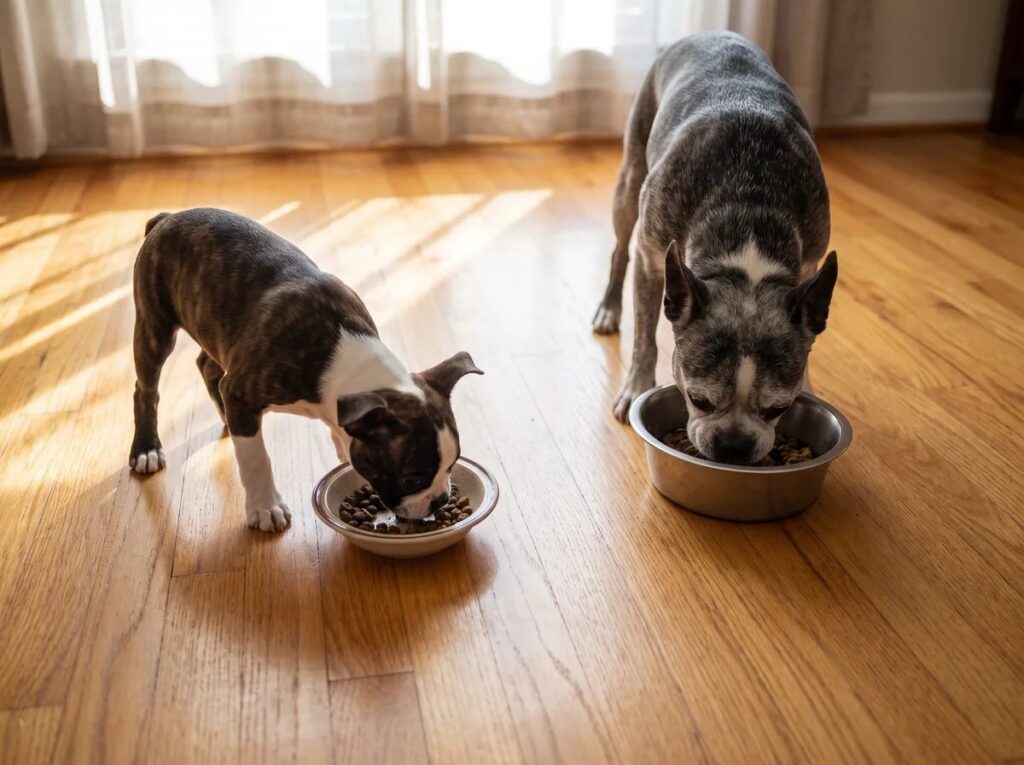
Adult dogs, from about 1 year until their senior years, do well on two meals a day in most cases. Nursing and pregnant dogs are the exception: their needs rise sharply late in pregnancy and during nursing, and they usually need more frequent meals or free access to food under a veterinarian’s guidance.
Seniors usually need at least two meals a day, and many finish their food more reliably on three smaller ones. Older dogs may have dental pain, reduced appetite, slower digestion, or conditions such as kidney disease that make large meals harder to finish. A senior’s schedule depends less on the calendar than on the individual dog, so watch for changes in appetite and talk with your veterinarian about the right food and routine. The Vetstreet article on senior dog nutrition explains how needs change with age.
At any age, a food that is complete for all life stages can simplify things in a multi-dog home, since a puppy and an adult can eat the same recipe in different amounts. Get Real recipes meet AAFCO nutrient profiles for all life stages, including growth of large-size dogs, and the Get Real Chicken & Brussels Sprouts Recipe is one of the three options.
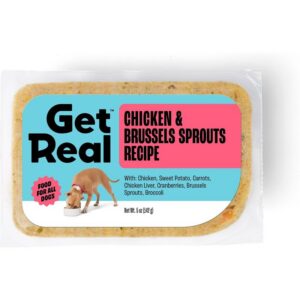
Get Real Chicken & Brussels Sprouts Recipe. Formulated for all life stages, including large-breed growth, so a puppy on three meals and an adult on two can share the same gently cooked recipe.
Feeding frequency by size: toy, small, and large breeds
Size shapes feeding frequency in two very different ways. At the small end, the concern is running out of fuel; at the large end, the concern is overloading the stomach. That is why size changes the number of meals, not just the amount. When using any dog feeding chart, read weight and age together: a 5-pound toy puppy and a 90-pound giant breed puppy of the same age need different meal counts as well as different portions.
Most small adult dogs eat two or three meals a day, and small and toy breed puppies three or four. Toy breeds such as Chihuahuas, Yorkshire Terriers, and Pomeranians have very small energy reserves and fast metabolisms. A toy puppy that skips a meal, vomits, or gets chilled can develop hypoglycemia, or low blood sugar, within hours. Frequent small meals are the main prevention. For a newly adopted tiny adult, ask the rescue or your veterinarian how often the dog was eating, since a sudden change to one or two meals can be too much of a gap for some toy dogs. The Vetstreet guide to the healthiest dog food for small dogs covers calorie density for small stomachs.
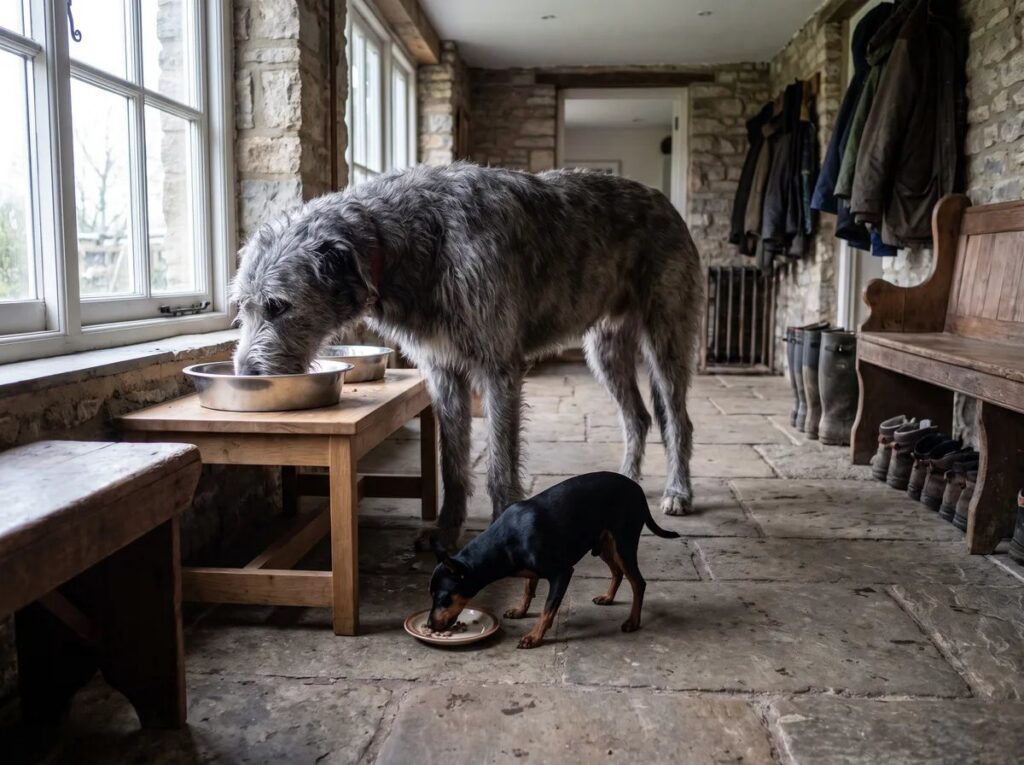
Large dogs need at least two meals a day. Large and giant breeds, especially deep-chested dogs such as Great Danes, Weimaraners, Standard Poodles, and German Shepherds, are at higher risk of gastric dilatation-volvulus (GDV), commonly called bloat. The Merck Veterinary Manual describes GDV as a life-threatening emergency in which the stomach fills with gas and can twist. Merck lists eating one large meal a day and eating quickly among the factors linked to higher bloat risk in large breeds.
Signs of bloat include a swollen or tight belly, repeated unproductive retching, restlessness, drooling, and weakness. Bloat is an emergency, so call your veterinarian or the nearest emergency clinic right away. In toy puppies, weakness, trembling, or wobbliness after a missed meal can signal low blood sugar and also needs prompt veterinary care.
These steps help lower bloat risk in large breeds:
- Feed two or more smaller meals instead of one large one.
- Slow down fast eaters with a puzzle feeder or slow-feed bowl.
- Avoid vigorous exercise for about an hour before and after meals.
- Keep mealtimes calm, especially in multi-dog households where dogs compete for food.
- Ask your veterinarian about preventive gastropexy for high-risk breeds.
For car trips, feeding the last meal a couple of hours before the ride can reduce motion sickness.
Once a day vs twice a day
Whether one meal a day is healthier is not settled. Once-daily feeding research from the Dog Aging Project, published in 2022, analyzed survey data from more than 24,000 dogs and found that dogs fed once a day had lower odds of several age-related conditions, including gastrointestinal, dental, and orthopedic problems, than dogs fed more often. That sounds like a clear win, but it comes with important caveats.
The study was observational. It shows an association, not proof that one meal a day caused better health. Dogs fed once daily may differ in other ways, such as breed, body weight, or how their owners care for them, and the data came from owner surveys rather than controlled feeding trials. The researchers themselves called for more study before anyone changes a dog’s routine based on these results. The results describe patterns in owner-enrolled companion dogs rather than a feeding plan for any one dog. Taking those caveats into account, the once-a-day research supports a balanced approach: a few healthy adult dogs may do well on one meal, while puppies, toy breeds, and dogs with medical needs should stay on two or more.
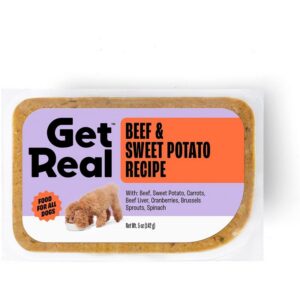
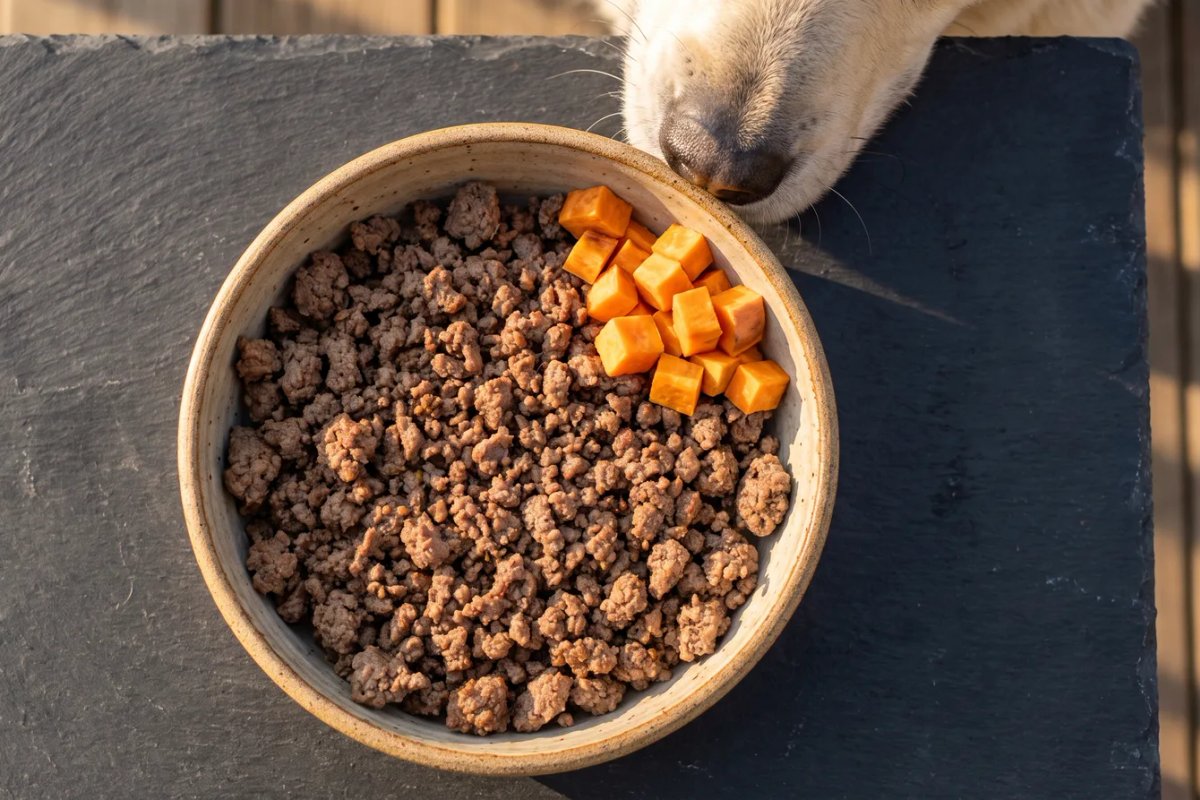
Get Real Beef & Sweet Potato Recipe. Whether your dog eats once or twice a day, this beef and sweet potato recipe lists its calories per pack, which makes it simple to divide a day’s food evenly.
How the tradeoffs usually fall:
- Possible benefits: simpler routine, possible association with healthy aging in the Dog Aging Project data, easy calorie control.
- Possible downsides: long gaps that can cause hunger, bile vomiting, or low blood sugar in small dogs; one large meal that may raise bloat risk in large breeds.
- Best fit: healthy, lean adult dogs whose veterinarian agrees with the plan.
These dogs are better served by two or more meals:
- Puppies and toy breeds, which can run low on energy between meals.
- Diabetic dogs, whose meals are timed with insulin.
- Dogs prone to vomiting bile on an empty stomach.
- Large, deep-chested breeds at risk of bloat.
For a healthy adult that is lean and thriving on one meal, there is no strong reason to change, but most veterinarians still recommend two meals as the default.
If you are considering a switch to one meal, talk to your veterinarian first, make the change gradually, and watch for hunger signs, vomiting, or changes in energy.
Free feeding vs scheduled meals
For most dogs, food should not be left out all day. Free feeding means keeping the bowl full so the dog can graze, and while it is convenient, it makes it hard to know how much your dog eats, it encourages weight gain in many dogs, and it lets wet or fresh food sit at room temperature longer than is safe. The Association for Pet Obesity Prevention has estimated that more than half of dogs in the United States are overweight or obese, and unlimited access to food is a common contributor.
The free feeding pros and cons come down to control: a few dogs benefit, and most do better on set meals. Some dogs genuinely self-regulate and maintain a healthy weight with constant access to dry food, and grazing can reduce stress around mealtimes for anxious eaters. Free feeding can also help some underweight dogs or nursing mothers take in enough food.
The drawbacks usually outweigh those benefits:
- It is harder to notice a loss of appetite, which is often an early sign of illness.
- In multi-dog homes, one dog may eat more than its share while another eats too little.
- Medications that must be given with food are harder to time.
- Fresh and wet foods spoil when left out; Get Real advises discarding food that has sat at room temperature for more than 2 hours.
Scheduled meals solve those problems. If you are moving a free-fed dog to scheduled meals, offer the food for 15 to 20 minutes at each mealtime, then pick up the bowl. Most dogs learn the new routine within a few days. A fresh topper such as the Get Real Turkey & Cranberry Recipe can make scheduled meals more appealing for a dog used to grazing.
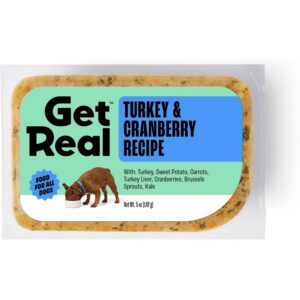
Get Real Turkey & Cranberry Recipe. Turkey and cranberry served at set mealtimes can help a former grazer look forward to a scheduled bowl instead of nibbling all day.
Most owners feed twice a day, in the morning and early evening, roughly 8 to 12 hours apart. A once-a-day dog can eat in the morning or the evening as long as the hour stays consistent, and an evening meal should come early enough to allow a bathroom break before bed.
Health conditions that change the schedule
Some medical conditions turn feeding frequency from a preference into part of the treatment plan. In these cases, the schedule should come from your veterinarian, and it is worth writing it down so everyone in the household follows it.
Diabetes is the clearest example. Most diabetic dogs receive insulin injections twice a day, timed with meals, and their food amount and timing need to stay consistent so blood sugar stays stable. The American Animal Hospital Association diabetes guidelines emphasize consistent feeding as part of insulin therapy. Never change a diabetic dog’s meal schedule without your veterinarian’s input. For complex cases, or for a home-cooked diet, a board-certified veterinary nutritionist can design both the recipe and the meal schedule.
Other conditions where meal frequency matters include:
- Pancreatitis and other digestive problems, where small, low-fat meals are often easier to tolerate.
- Megaesophagus, which may need small, frequent meals fed in an upright position.
- Kidney or liver disease, where appetite often drops and smaller meals help.
- Bilious vomiting syndrome, where an empty stomach overnight triggers vomiting and a late meal can help.
- Dental pain, which can make large meals uncomfortable.
Medications can shape the schedule as well. Some common drugs, including many anti-inflammatory pain relievers and some antibiotics, are best given with food to reduce stomach upset, so the meal times need to line up with the dosing times. If your dog takes medication once or twice a day, build the meal schedule around it rather than the other way around.
If your dog’s appetite, thirst, or eating speed changes suddenly, or your dog starts vomiting after meals, a schedule change is not the first step. See your veterinarian, since these can be early signs of disease that need diagnosis.
Body condition: the check that matters most
The number of meals matters less than the total amount of food and how your dog’s body responds to it. That is why body condition is the most useful check in any feeding plan.
Veterinarians use body condition scoring, usually on a 9-point scale, where 4 or 5 is ideal. The World Small Animal Veterinary Association publishes a body condition score chart that owners can use at home. You can check your dog in about a minute:
- Ribs: you should feel them easily with light pressure, with a thin layer of fat over them.
- Waist: looking down from above, you should see a waist behind the ribs.
- Abdominal tuck: from the side, the belly should rise up toward the hind legs.

Check your dog’s body condition every two to four weeks and weigh your dog when you can. If ribs are getting harder to feel, reduce the daily amount by about 10 percent, keeping the same number of meals, and recheck in a few weeks. If ribs and hip bones are becoming prominent, increase the amount and ask your veterinarian whether there is a medical reason. The Vetstreet guide to keeping your dog at a healthy weight walks through the process step by step.
Treats count too. Keep treats and extras to about 10 percent of daily calories, and subtract them from the meal amounts so the total stays where it should be.
When you change the number of meals, keep the daily total the same and divide it again. Moving from one meal to two, or from two to three, should not change how much your dog eats in a day, only how it is spread out. For senior dogs, also pay attention to muscle, not just fat. Older dogs can lose muscle over the spine, hips, and shoulders even while their weight stays stable, and a veterinarian can assess muscle condition alongside body condition at each checkup.
How pre-portioned meals make a schedule easier
The hardest part of feeding two or three meals a day is dividing the daily amount evenly, day after day. Scoops vary, family members guess, and small errors add up over months. Pre-portioned food takes much of the guesswork out of that step.
Get Real comes frozen in pre-portioned packs: a 5 oz mixer pack meant for topping kibble, plus 12 oz and 24 oz packs. Each pack has published calories per pack. For example, a 24 oz pack of Beef & Sweet Potato provides 902 kcal, and a 12 oz pack provides 451 kcal. Your dog’s daily amount comes from the online plan, which uses weight, breed, age, and activity level, so the example here is only about how to split the daily portion, not how much to feed.
Here is a worked example. If your dog’s plan calls for one 24 oz pack a day, splitting it into two meals gives two portions of about 451 kcal each, or the equivalent of two 12 oz packs. For a dog on three meals, the same pack divides into three portions of about 300 kcal. Because the calories per pack are fixed, every meal is the same size, and you can see at a glance how much of the day’s food is left. A few habits make splitting packs easy in a busy household:
- Portion the day’s food into two or three covered containers when you open the pack, and label them morning, midday, and evening.
- If more than one person feeds the dog, keep the containers in the same spot in the fridge so nobody doubles a meal.
- Use 5 oz mixer packs as a topper split between meals, not as a full meal on their own, and reduce the kibble to keep the daily total the same.
- Serve each portion soon after taking it out, and discard any food left in the bowl after the meal.
Thaw packs in the refrigerator, which takes 12 to 24 hours for 5 oz and 12 oz packs and 35 to 48 hours for 24 oz packs, and use thawed food within 3 to 5 days. Keep the next day’s packs thawing in the fridge so each meal is ready on time. If you are adding fresh food to kibble rather than replacing it, start with a small amount and increase over 7 to 10 days, or 10 to 14 days for a sensitive dog, and reduce the kibble so the daily total stays the same.
Get Real recipes are made with 10 ingredients or less plus vitamins and minerals, and they are human-grade and gently cooked before freezing. You can try the Get Real Beef & Sweet Potato Recipe as a full meal or a topper. Get Real is sold only at Chewy in select markets, by subscription that you can change, pause, or cancel anytime.
Related reading: Petful covers ratios for mixing fresh dog food with kibble, and WebVet’s dog feeding schedule by age sets meal counts for puppies, adults and seniors.
Dog feeding frequency: frequently asked questions
Frequently asked questions
Some dogs self-regulate well and stop eating when they have had enough, but many do not, especially with tasty food available all day. Dogs that self-regulate are the exception, so free feeding carries a real risk of weight gain. Scheduled, measured meals and regular body condition checks are the safer approach for most dogs.
The 7 7 7 rule is not a feeding rule. It is a puppy socialization guideline suggesting that a young puppy experience seven types of surfaces, toys, places, people, challenges, and feeding containers and locations. It can be a useful prompt for socialization, but it says nothing about how many meals a puppy should eat.
It is not inherently cruel to feed a healthy adult dog once a day, and some dogs do well on it. It is not a good fit for puppies, toy breeds, diabetic dogs, or dogs prone to bloat or bile vomiting. Ask your veterinarian before switching, and change gradually.
Yes. Evening meals are fine as long as you keep consistent meal times and allow time for digestion and a bathroom break before bed. Avoid feeding a large meal right before vigorous play or a long car ride, especially for large, deep-chested breeds.
Most senior dogs do well on two or more meals a day, and some eat better with three smaller meals. Watch for changes in appetite, weight, or thirst, since these can signal dental or medical problems. Your veterinarian can help you adjust the schedule and food as your dog ages.