Best Probiotic Powders for Dogs
Published on October 05, 2026
This article is sponsored by PetLabCo.® and contains affiliate links. If you purchase through these links, we may earn a commission.
Written by Athena Gaffud, DVM
A probiotic powder can fit naturally into a dog’s mealtime routine. You measure the serving, mix it with food and check that the dog eats the supplemented portion. That simplicity is appealing, but powders differ in more than flavor. Some focus on digestive support, while others include probiotics within a broader daily supplement.
Our featured option, PetLabCo.® DF-14 Daily Foundation, belongs to the second group. It is a multifunctional powder with ingredients for broader support, including a probiotic blend. This guide explains how to compare powder formulas, when a powder may fit better than a soft chew and what to check before adding one to your dog’s bowl.
Key Takeaways
- The best probiotic powder for dogs depends on the formula’s purpose, suitability and how reliably your dog consumes the serving.
- DF-14 Daily Foundation is a multifunctional powder with probiotic support. It is not an isolated gut-only formula.
- Use the correct weight-specific tub and supplied scoop. For a dog under 4 lb, DF-14 directions specify the little scoop from the Small tub.
- Powder format and a higher CFU count do not prove greater effectiveness. The organisms, formulation and relevant evidence matter.
- Discuss dietary restrictions, medicines and other supplements with your veterinarian before adding a new product.
Probiotic powders for dogs compared
| Product | Purpose | CFU per serving | Organisms listed | Other actives | Age minimum | Serving |
|---|---|---|---|---|---|---|
| PetLabCo.® DF-14 Daily Foundation (our pick) | Multifunctional daily powder with a probiotic blend (14 areas of support) | 14.5 million to 100 million CFU depending on tub and scoop | Bacillus subtilis, Bifidobacterium animalis subsp. lactis, Saccharomyces boulardii | Krill, glucosamine, chondroitin, taurine, L-carnitine, astragalus, sodium hexametaphosphate, postbiotic yeast, FOS, cranberry, lactoferrin, vitamin C, vitamin E, beta-carotene | 12 weeks | Once daily at mealtime: Small tub little scoop under 4 lb; Small tub big scoop 4–24.9 lb; Medium tub 1 scoop 25–75 lb; Large tub 1 scoop over 75 lb |
| Purina Pro Plan Veterinary Supplements FortiFlora Canine | Gut-only probiotic powder | 100 million CFU per 1 g sachet | Enterococcus faecium SF68 | Antioxidants (compounds not stated on label); inactive: liver flavor, yeast | Puppies and adult dogs (specific age not stated on label) | One packet daily, or as directed by your veterinarian |
| Native Pet Probiotic | Gut-only probiotic and prebiotic powder | 6 billion CFU per scoop | Bacillus coagulans, Enterococcus faecium, Bifidobacterium animalis, Bifidobacterium bifidum | Organic inulin (Jerusalem artichoke), organic pumpkin seed; base: dehydrated beef broth | 3 months | 1 scoop (about 4 g, half a tablespoon) per 50 lb body weight daily |
| Zesty Paws Probiotic Powder for Dogs | Gut-only probiotic powder in single-serve sachets | 800 million CFU per serving | Bacillus subtilis DE111, Saccharomyces boulardii | Inulin, flaxseed, pumpkin powder; pumpkin flavor | Not stated on product page (marketed for adult and senior dogs) | Sachet format, 30 per box; per-weight directions not stated on product page |
Our ranked picks for probiotic powders
We ranked these powders on four things: what the label actually lists (organisms, CFU per serving and other actives), how clearly the serving is tied to a dog’s weight, the age the manufacturer allows, and what job the formula is built to do. Every fact below comes from the manufacturer’s own product page, and none of the picks was tested hands-on. PetLabCo.® DF-14 Daily Foundation ranks first because it is the only powder here that pairs a three-organism probiotic blend with whole-body daily support, uses size-specific scoops and states a clear 12-week age minimum. The three gut-only powders that keep appearing in the search results follow it, each with the brief it suits best.
1. PetLabCo.® DF-14 Daily Foundation: best for probiotic support inside whole-body daily support
DF-14 Daily Foundation is a multifunctional powder, not an isolated gut formula. Its probiotic blend lists Bacillus subtilis, Bifidobacterium animalis subsp. lactis and Saccharomyces boulardii, supplying 14.5 million to 100 million CFU per serving depending on the tub and scoop. Around that blend sit 11 other actives: krill, glucosamine and chondroitin, taurine, L-carnitine, astragalus, sodium hexametaphosphate, a postbiotic yeast blend, FOS, cranberry, lactoferrin and vitamins C and E with beta-carotene. That is why it ranks first for an owner who wants probiotic support as part of one measured daily scoop that also supports joints, heart, skin, teeth and immune health.
The serving system is the other reason it leads. Small, Medium and Large tubs each carry their own scoop, with the Small tub’s little scoop covering dogs under 4 lb, so the amount scales with the dog rather than a one-size sachet. Directions call for once-daily mixing with wet food or moistened kibble for dogs 12 weeks and older. Because it is a broad formula with several animal-derived ingredients and a chicken-and-bacon flavor, bring the full label to your veterinarian if your dog already takes a joint product or multivitamin, and choose a gut-only powder instead if a gut-only formula is what your veterinarian asked for.
2. Purina Pro Plan Veterinary Supplements FortiFlora Canine: best for a veterinarian-directed gut-only brief
Purina Pro Plan Veterinary Supplements FortiFlora Canine is the powder most veterinarians name first, and its label is the most narrowly defined in this group. Each 1 g sachet supplies 100 million CFU of a single named strain, Enterococcus faecium SF68, with liver flavor and yeast as the only inactive ingredients and antioxidants for immune support. Purina states it is appropriate for puppies and adult dogs and directs one packet daily or as your veterinarian advises. If your clinician has asked for a specific, single-strain gut-only probiotic, this is the pick that matches that request most directly.
The trade-off is scope. FortiFlora covers digestive and immune support only, the sachet is the same size for a 5 lb dog and a 90 lb dog, and it carries no prebiotic or other daily actives, so owners wanting broader support would need to stack additional products.
3. Native Pet Probiotic: best for a multi-strain, higher-CFU gut-only powder
Native Pet Probiotic lists four organisms (Bacillus coagulans, Enterococcus faecium, Bifidobacterium animalis and Bifidobacterium bifidum) at 6 billion CFU per scoop, alongside organic inulin from Jerusalem artichoke and organic pumpkin seed as prebiotic fiber in a dehydrated beef-broth base. Dosing is weight-based at one 4 g scoop (about half a tablespoon) per 50 lb of body weight daily, and the manufacturer allows it for dogs over 3 months. It suits owners who want a gut-only powder with more than one strain and a prebiotic built in.
One neutral limitation: a higher CFU count and more strains do not by themselves show a formula works better, and the beef-broth base is worth checking for dogs on a restricted-protein plan. Like FortiFlora, it offers no support outside the gut.
4. Zesty Paws Probiotic Powder for Dogs: best for single-serve sachets with a pumpkin flavor
Zesty Paws Probiotic Powder for Dogs is a pumpkin-flavored sachet powder built around Bacillus subtilis DE111 plus Saccharomyces boulardii, at 800 million CFU per serving. Inulin, flaxseed and pumpkin powder round out the ingredient list, and the brand positions it for adult and senior dogs of any size who need digestive and immune support. It is a reasonable gut-only choice for an owner who prefers pre-measured packets over a scoop and tub.
The limitation is label detail. The product page states no age minimum, no weight-based serving and no serving weight in grams, so you are relying on one sachet per dog regardless of size. Owners who want size-specific dosing will find DF-14 or Native Pet clearer.
How to compare probiotic powders for dogs
Begin with the job you want the supplement to do. A veterinarian may recommend a specific gut-focused formulation for a particular circumstance. An owner may instead be considering broader daily support with probiotics included among several ingredients. Those purposes call for different comparisons, even when both products arrive as powders.
There is no single “number one” probiotic for every dog. A useful comparison connects the formula to your dog’s needs, rather than awarding the highest place to the longest ingredient list or biggest CFU number. CFU stands for colony-forming units, which expresses a count of viable microorganisms. It does not by itself establish which formulation is most appropriate.
Separate a measured serving from what the dog eats
Two practical checks make a powder routine easier to evaluate: the measured serving and complete meal consumption. The scoop tells you what went into the bowl. Watching the meal tells you whether the dog consumed the food carrying that amount. A powder can be a convenient dog food topper, but food left behind creates uncertainty about intake.
| Compare this | Question to ask | What it tells you |
|---|---|---|
| Purpose | Gut-focused or multifunctional? | Whether the broader formula matches the goal |
| Organism information | Which organisms are listed, and what research applies? | How specific the evidence is |
| Measured serving | Which tub, scoop and weight band? | How to prepare the intended amount |
| Complete meal consumption | Does the dog finish the supplemented food? | Whether the intended serving was consumed |
| Ingredient fit | Are flavors and other ingredients suitable? | Whether dietary restrictions affect the choice |
| Routine | Is measuring and mixing practical every day? | Whether the format is sustainable |
Compare the formulation, not just the format
The word “powder” describes how a supplement is supplied. It does not establish that the organisms are more effective than those in a soft chew or capsule. Cornell’s overview of probiotics explains why the particular product and organisms matter when considering their potential role in intestinal health.
Species names and strain identifiers also have different levels of detail. Research may concern a specific strain and amount, while a commercial label lists only the species. Do not assume a study on one named strain proves the same results for every product containing that species. Ask your veterinarian how closely the available evidence matches the formula under consideration.
Make a fair day-to-day comparison
When comparing value, use the labeled daily serving rather than the size of the tub alone. A tub intended for a different weight band may supply a different amount per scoop. Similarly, a soft chew comparison needs the correct number of chews per day. Package size and serving size answer different questions.
- Confirm the exact product name before comparing labels.
- Check the current weight band and the matching scoop or chew count.
- Look at the full ingredient list, including flavor sources.
- Consider whether the dog reliably eats meals or more readily accepts a soft chew.
A powder can be a strong practical fit when those details align. If your dog frequently leaves food or eats unpredictably, discuss a different administration plan or format. Convenience is valuable only when it results in a clear, suitable serving rather than repeated guesswork at the bowl.
DF-14 Daily Foundation: a multifunctional powder
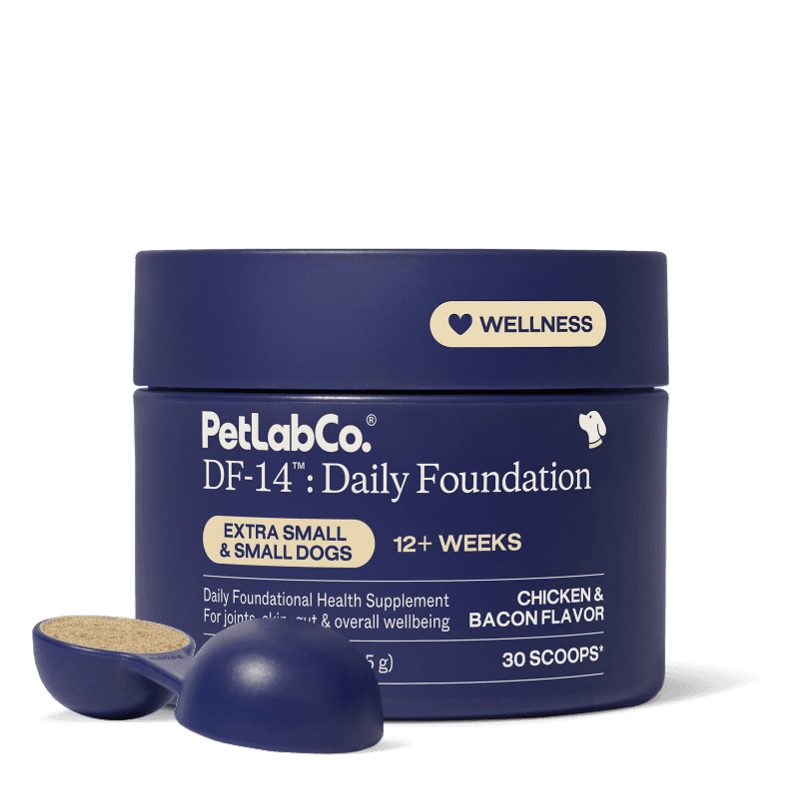
DF-14 Daily Foundation is PetLabCo.®’s multifunctional daily powder, designed for support across 14 areas of health. Its probiotic blend sits alongside ingredients with other nutritional roles, including taurine, L-carnitine, glucosamine, chondroitin and antioxidant nutrients. That broader scope is central to understanding where the product fits.
The probiotic blend lists Bacillus subtilis, Bifidobacterium animalis subsp. lactis and Saccharomyces boulardii. The formula also includes FOS and a postbiotic yeast blend. FOS is one of the prebiotics: ingredients that certain microorganisms can use, distinct from the live organisms in the probiotic blend. These are components of a multifunctional supplement, so the product should be reviewed as a whole when deciding whether it suits a dog already receiving other supplements.
This can appeal to an owner seeking broader daily coverage in one measured powder. It does not make DF-14 interchangeable with a veterinarian-selected gut-only formula. If a clinician has recommended a specific probiotic for a particular situation, ask before substituting another product simply because it contains probiotic ingredients too.
Match the tub and scoop to the dog’s weight
The current directions specify once-daily use at mealtime. DF-14 uses Small, Medium and Large tubs with their corresponding serving instructions. The Small tub also accommodates the extra-small weight band through its little scoop. Follow the directions on the product you receive rather than estimating from a household spoon.
| Dog’s weight | Tub and daily scoop | Powder weight | Probiotic blend per serving |
|---|---|---|---|
| Under 4 lb | Small tub, 1 little scoop | 0.75 g | 14.5 million CFU |
| 4–24.9 lb | Small tub, 1 big scoop | 1.5 g | 29 million CFU |
| 25–75 lb | Medium tub, 1 scoop | 2 g | 66 million CFU |
| Over 75 lb | Large tub, 1 scoop | 3 g | 100 million CFU |
The amounts in this table identify the labeled serving. They are not a universal probiotic dose for all dogs, nor a scale for ranking the product against formulas with different organisms or purposes. A different blend with a larger CFU number may be designed around a different formulation and should be assessed on that basis.
Check the whole ingredient list
DF-14 has a chicken-and-bacon flavor and includes several animal-derived ingredients. The formula contains krill, crawfish-derived glucosamine, bovine chondroitin, lactoferrin and hydrolyzed chicken liver flavor. Those details matter for dogs with food restrictions or a diet plan that needs close ingredient control.
Bring the full label to your veterinarian if the dog already takes a joint product, multivitamin or another multifunctional supplement. The point is to understand the combined routine, not to assume that adding one more daily scoop always provides a useful benefit. A coherent plan is easier to follow and reassess than several overlapping products.
For a hands-on account of measuring, mixing and how dogs took to the chicken-and-bacon flavor, see Petful’s PetLabCo.® DF-14 Daily Foundation review. For how the powder sits within the brand’s wider range, Petful’s PetLabCo.® brand review compares the daily products side by side.
How to serve a probiotic powder with food
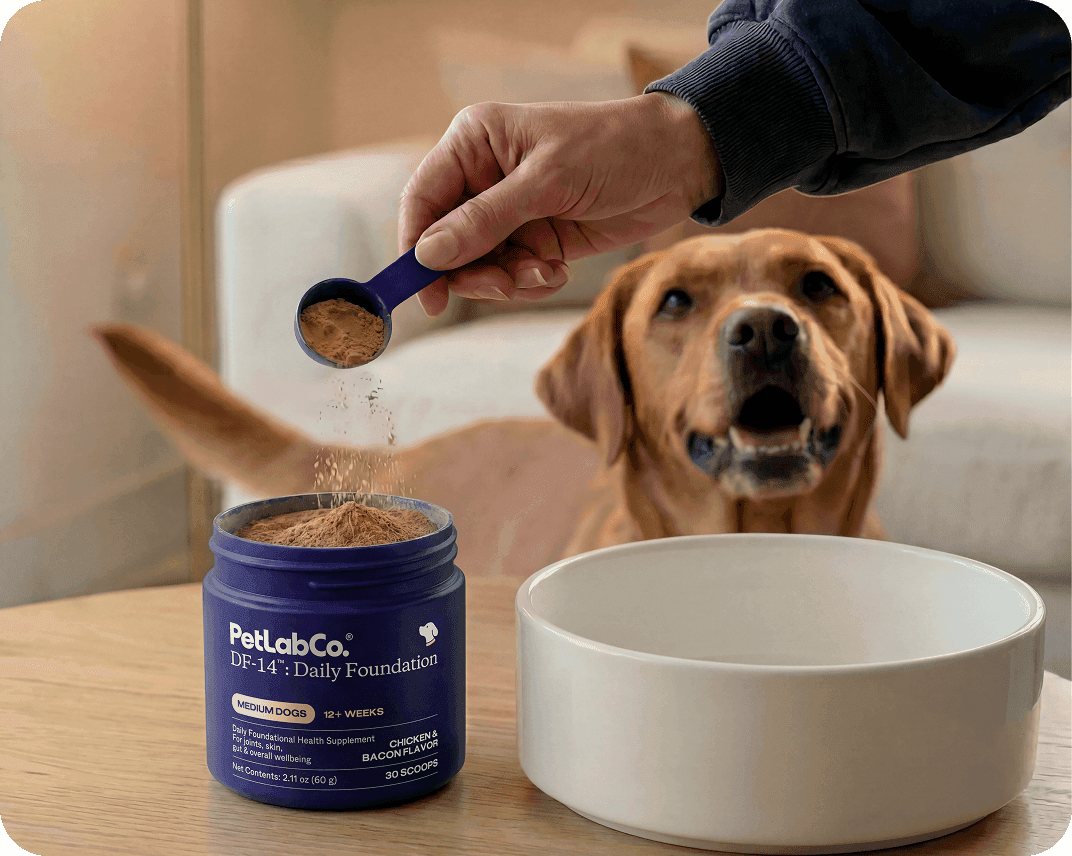
A probiotic dog food topper works best as a practical routine when measuring, mixing and checking intake are all straightforward. For DF-14, the directions are to mix the correct serving with wet food or slightly moistened kibble once daily at mealtime. Start with the correct tub and supplied scoop, then follow the current label consistently.
Do not assume that every scoop from every tub has the same volume or provides the same ingredient amounts. Keep the scoop with its original container, especially in a home with dogs in different weight bands. A clearly identified tub helps prevent accidentally transferring one dog’s instructions to another dog’s bowl.
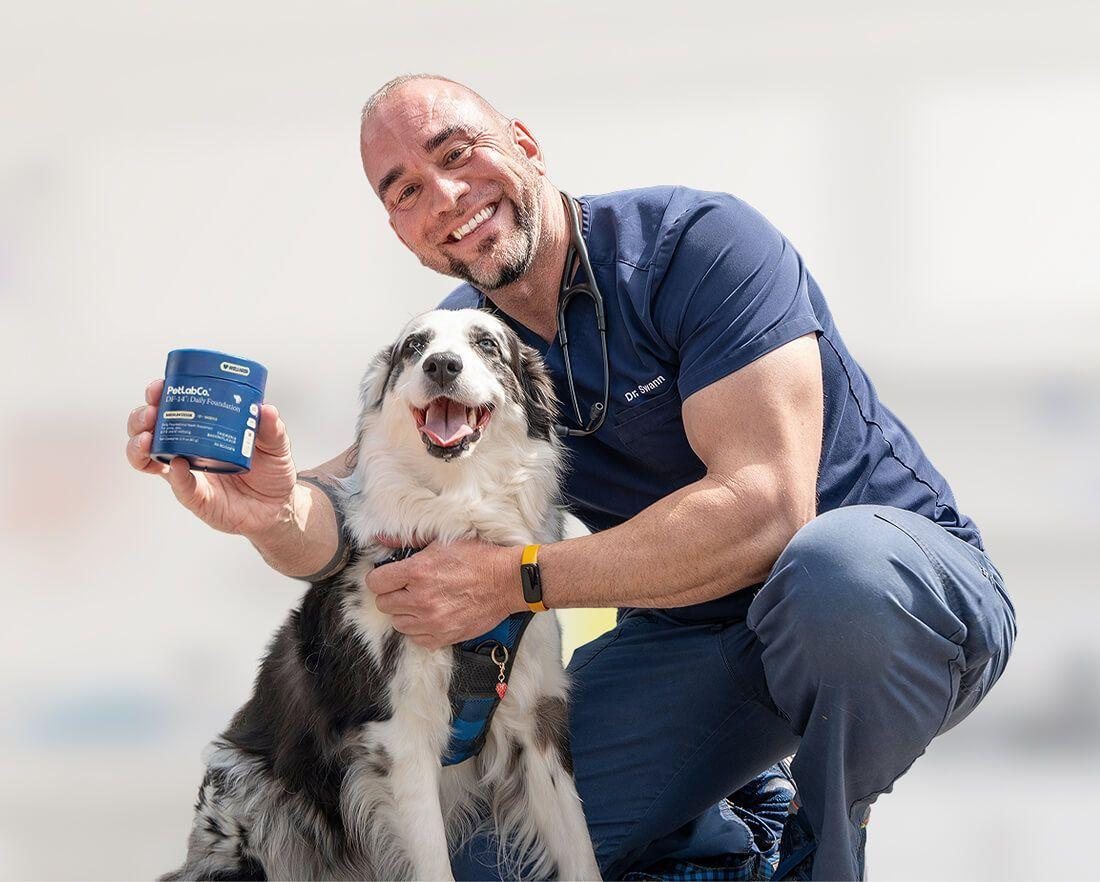
Build a repeatable mealtime sequence
Choose a meal at which someone can observe the dog eating. Mix as directed so the powder is incorporated into the food, then check that the intended portion is consumed. If the dog shares a feeding space with another pet, prevent bowl swapping so the supplement goes to the dog for whom it was measured.
- Confirm the dog’s current weight band and the matching container.
- Measure the labeled serving with that product’s scoop.
- Mix it into the food according to the directions.
- Watch for complete consumption and record any substantial leftovers.
If your dog often leaves food, ask your veterinarian or the manufacturer how best to administer the product as directed. Do not guess how much powder was eaten and add another scoop to compensate. The leftover food may contain an uneven amount, so a second guessed serving makes the total less clear.
Avoid changing several variables at once
When practical and consistent with veterinary advice, keep the rest of the feeding routine stable while establishing a new supplement routine. If food, treats, portion sizes and supplements all change together, it becomes harder to explain a change in appetite or stool to the veterinarian. A simple record of what changed and when can help.
Note the product name, start date, labeled serving and whether the dog finished the food. If a concern develops, those details are more useful than saying only that you added “a probiotic powder.” They also help distinguish an administration problem, such as unfinished meals, from a question about tolerability or the dog’s underlying health.
Store the product as directed
Follow the container’s storage guidance, including keeping DF-14 cool, dry, resealed and away from direct sunlight. Do not transfer the powder into an unlabeled kitchen container that loses its directions and identification. Keep it somewhere pets and children cannot reach, and check the package when opening a replacement tub.
Changes in flavor, formula or packaging are reasons to read the label again rather than assuming everything is unchanged. If you cannot confirm the serving for the product in hand, ask before using it. A reliable mealtime routine begins with clear instructions, not an estimate remembered from another version.
Because DF-14 bundles probiotics with vitamins, joint support and other actives, it is worth reading alongside WebVet’s guide to the best multivitamins for dogs and, for older dogs, WebVet’s guide to senior dog vitamins, so you can see where a multifunctional powder overlaps with products your dog may already take.
Are probiotic powders good for dogs?
An appropriate probiotic formulation can have a role in supporting a dog’s digestive health, but powder form alone does not establish effectiveness. The useful questions are what the formula contains, what evidence relates to it and whether its intended purpose fits the dog. AKC’s probiotic guidance describes several formats, making clear that owners have practical administration choices.
For a dog who reliably finishes a supplemented meal, a powder offers a convenient way to give a measured amount. For a dog who leaves food but accepts a suitable chew, the soft chew may be easier to administer consistently. That comparison concerns routine and intake; it should not be turned into a claim that either format is inherently more potent.
Keep ingredient research separate from product proof
DF-14 lists S. boulardii, a yeast used in some probiotic research. A small canine study published in 2018 examined that organism as an addition to standard treatment in dogs with chronic enteropathy. It was not a trial of DF-14, and its design and small population limit how broadly the results can be applied.
The presence of an ingredient is therefore a reason to understand the formula, not permission to promise treatment of a disease. Likewise, findings from another probiotic chew or a different bacterial strain should not be presented as clinical proof for this powder. Exact formulation, study population and measured outcome all matter.
Use a supplement within the dog’s broader plan
A daily powder cannot replace suitable food, access to water or veterinary assessment when a dog is unwell. Persistent diarrhea, repeated vomiting, blood in the stool, poor appetite or marked lethargy should prompt veterinary contact. Do not continue adding a supplement while waiting for a serious problem to resolve on its own.
For a well dog, discuss the purpose of supplementation and what would lead you to reassess it. That keeps daily use connected to a clear decision. If the dog’s food, medicines or health changes, revisit whether the same powder still fits instead of automatically carrying every part of the old routine forward.
Puppies, sensitivities and powder side effects
Selecting a probiotic powder for puppies starts with age and suitability, not a smaller estimated scoop. DF-14’s product guidance specifies dogs over 12 weeks. A younger puppy needs individual veterinary advice. If a puppy has digestive signs, do not wait through an informal supplement trial before seeking guidance about the cause.
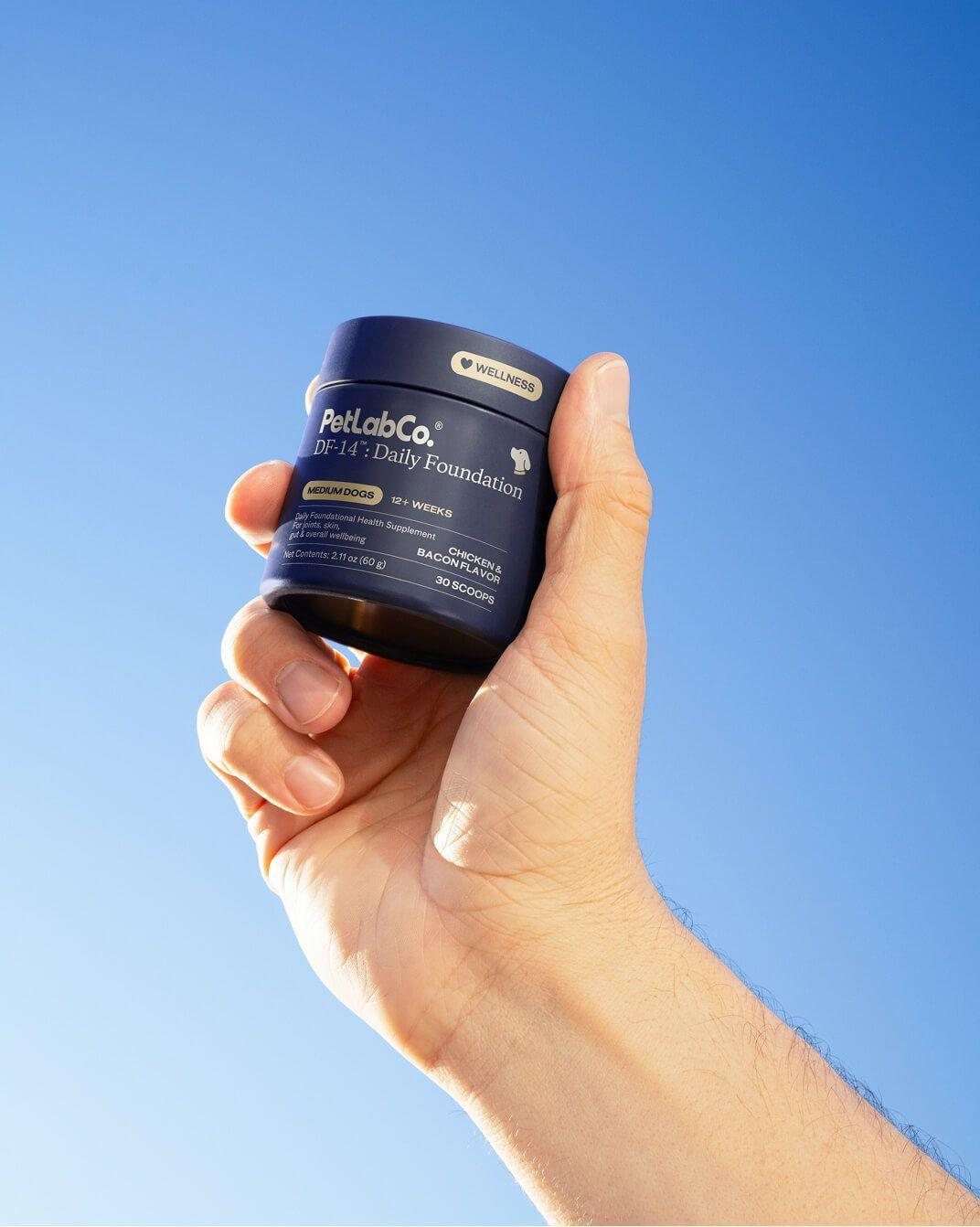
Dietary restrictions require an equally specific review. A multifunctional powder contains more than its probiotic blend, and flavor ingredients still count as part of what the dog eats. During a veterinarian-directed food trial, ask before introducing any new powder, chew or flavored supplement. Even a small daily addition may matter to the diet plan.
Review medicines and other supplements
DF-14’s label notes that absorption of simultaneously administered drugs may be delayed. Ask your veterinarian whether timing matters with the dog’s actual medications rather than using a generic spacing rule. The label also states that safe use in pregnant or breeding animals has not been proven, so those circumstances call for a specific discussion before use.
Avoid combining powders or adding a soft chew simply to obtain more probiotic organisms. That approach changes the amount of other ingredients too. If you want a different format or broader support, compare the full labels with your veterinarian and agree on one clear plan for the transition.
Notice changes without guessing the cause
New gas or stool changes after starting a powder may warrant a conversation about tolerability. They do not prove the probiotic blend caused the change, and they should not automatically be dismissed as expected. Tell your veterinarian what the dog consumed, what else changed and whether the dog’s appetite and behavior are normal.
- Follow the label’s instruction to stop and consult a veterinarian if the condition worsens or does not improve.
- Seek advice promptly for repeated vomiting, blood in the stool, poor intake or marked lethargy.
- Keep the container if an excessive amount was eaten so the clinic can review the ingredients.
- Do not add extra powder to compensate for uncertain intake or slow progress.
About PetLabCo.® and finding the right format
PetLabCo.® offers different types of daily supplements. Our PetLabCo.® product guide provides broader brand context; this guide focuses on the powder decision. A useful choice aligns the supplement’s scope with the dog’s needs and makes the labeled serving easy to give consistently.
For owners looking for a multifunctional mealtime supplement with built-in probiotic support, DF-14 Daily Foundation is an option to review with their veterinarian. Check the full formula, select the correct tub and scoop, and make sure the dog reliably eats the supplemented food. Those concrete details matter more than a universal ranking.
Powder or chew: which fits your dog?
Format choice is a practical part of supplement selection. Once your veterinarian has helped establish a suitable purpose and formula, think about the point in the day when you will actually give it. A powder connects the supplement to a meal. A soft chew allows you to offer and observe a separate portion. Neither routine is ideal for every dog or household.
When a powder may fit well
A dog who eats a predictable meal in their own bowl may make powder administration straightforward. The person preparing the food can check the tub, measure the serving and see whether the supplemented food is finished. DF-14’s mealtime directions fit that kind of routine when the wider formula is appropriate for the dog.
Powder can also appeal to an owner who prefers incorporating a supplement into food rather than offering another separate item. That convenience still depends on correct measuring. A powder is not permission to sprinkle an arbitrary amount across meals, and it should not be added to a communal bowl when you cannot tell which dog consumed the serving.
When a soft chew may be easier to manage
Some dogs finish a suitable chew readily but graze at meals, making a soft chew easier to observe. In that situation, the owner can confirm the labeled portion was eaten without estimating how much powder remained in the food. Check the soft chew’s own ingredients, age guidance and weight-based serving; the directions for a powder do not carry over.
For other dogs, chewing or swallowing a treat may itself be a concern to discuss with a veterinarian. The practical advantage of one format should not be assumed from texture alone. The goal is a suitable formulation administered in a way that is reliable for that particular dog, with the full daily amount kept clear.
Compare like decisions when changing formats
Moving from a powder to a soft chew, or the reverse, may also change the supplement’s scope. A multifunctional powder such as DF-14 contains ingredients beyond the probiotic blend. Replacing it with a gut-focused chew changes that broader formula too, so the decision involves more than choosing a different way to give the same organisms.
Bring both labels to your veterinarian and explain why you want to change. Unfinished food, difficulty measuring and trouble getting a soft chew accepted are useful practical reasons to reconsider the routine. Agree on how to make the change and what to observe. Avoid stacking both products by default while hoping to retain every ingredient from the earlier plan.
Related probiotic guides from our sister sites: Probiotics for Dogs: A Vet’s Guide (WebVet), Probiotics for Dogs With Diarrhea (WebVet), PetLabCo.® Probiotic Chews review (Petful), and Can Dogs Take Human Probiotics? (WebVet).
Frequently Asked Questions
Recommendations depend on the dog’s needs and the particular powder formula. A gut-focused product and a multifunctional powder answer different needs, so popularity alone does not identify the best fit. DF-14 is the featured multifunctional option in this guide. Review its broader ingredients and serving system with your veterinarian, especially if your dog already has a supplement or medical plan.
Some formulas are intended for daily administration. DF-14’s directions specify once-daily mealtime use, with the serving matched to weight and tub size. Daily use may fit a suitable dog’s routine, but it is not automatically necessary for every dog. Follow the exact label and veterinary guidance, and reassess when the dog’s diet, medicines, health or ability to finish meals changes.
Veterinarians select a formulation in the context of the individual dog and the intended goal. Ask which organisms or product they recommend, what serving to use and how to assess its ongoing role. Bring the actual powder label rather than just the brand name. That makes it possible to consider the entire formula, including ingredients unrelated to the probiotic blend.
No single sign proves that a dog needs probiotic supplementation. Gas, loose stool or appetite changes can have several causes, and a veterinarian may need to investigate them. Describe when the change began, the dog’s food and medicines, and any other signs. That assessment helps determine whether a supplement, a dietary change, testing or another part of care is appropriate.
The alternative depends on the purpose. A dog eating an appropriate complete diet may not need an additional supplement, while a dog with signs may need veterinary assessment or a different care plan. Household fermented foods and human supplements are not automatic substitutes for a canine powder formula. Ask what the dog actually needs before replacing one product with another.
PetLabCo.® products are not intended to diagnose, treat, cure, or prevent any disease; consult your veterinarian before starting any new supplement regimen.