CBD for Senior Dogs: A Guide to Mobility, Joint Support & Healthy Aging
Published on September 25, 2026
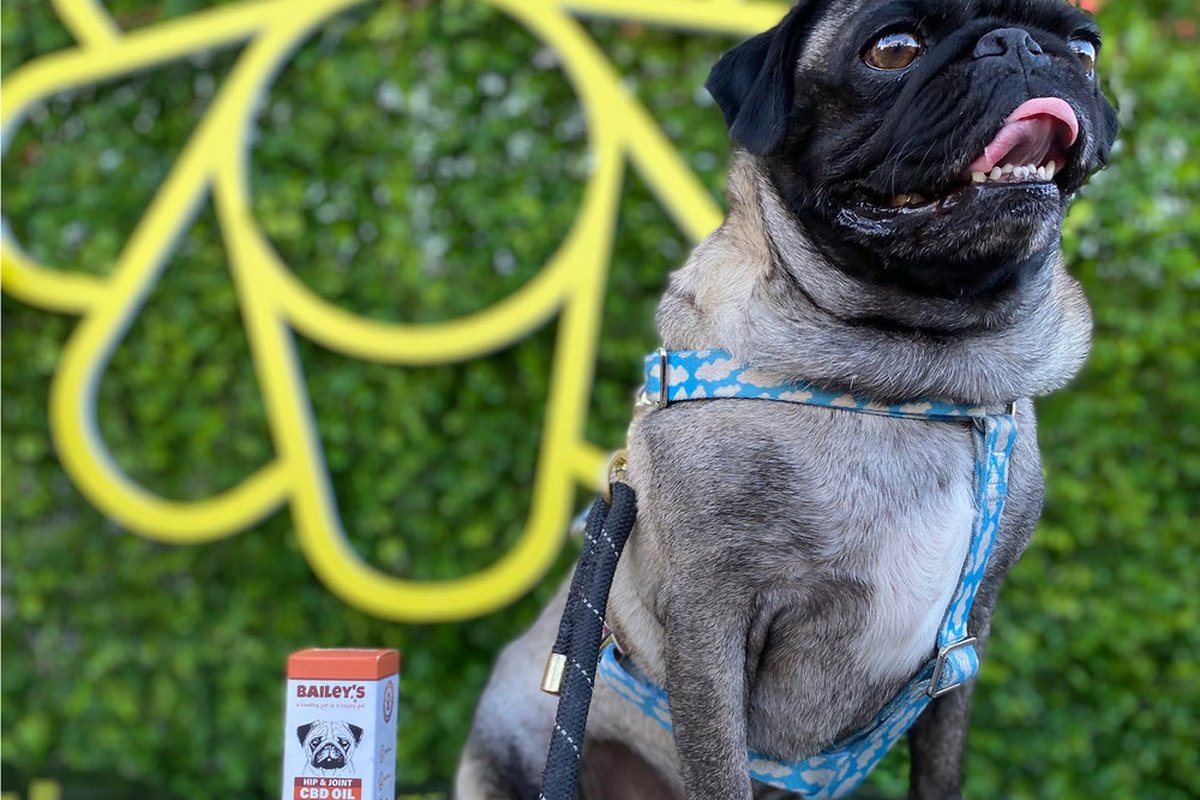
This content is sponsored by Bailey’s CBD. Vetstreet may earn a commission if you purchase through links in this article; opinions and guidance are our own.
CBD for senior dogs is often considered when an older pet takes longer to rise, hesitates at stairs or seems less eager to walk. Those changes deserve attention, but they do not identify the cause on their own. The best first step is a veterinary assessment, followed by a plan that makes everyday movement more comfortable and lets you track whether an intervention actually helps.
Research on cannabidiol, commonly called CBD, has produced encouraging findings in some dogs with osteoarthritis, yet products and study results are not interchangeable. Oils, joint chews and other supplements also vary in their added ingredients. This guide explains how to evaluate those choices alongside exercise, home adjustments and your dog's existing care.
How do wellness needs change as dogs age?
Aging dogs may need adjustments to activity, nutrition, the home environment and the frequency of health reviews. There is no single age at which every dog becomes a senior, and an individual dog's health matters more than a label. A dog that has always preferred short walks is different from one that suddenly stops enjoying a familiar route.
Try to separate a gradual pattern from a new change. Slowing down over months, developing a new limp overnight and pacing restlessly after dark are different observations. Each gives your veterinarian a more useful starting point than “my dog is getting old.”
Bring up changes in:
- Getting up, lying down or maintaining a comfortable resting position.
- Walking pace, willingness to exercise or use of stairs.
- Appetite, weight, drinking or toileting.
- Sleep, social interaction or orientation around the home.
- Tolerance of grooming or handling.
Do not assume that a change is unavoidable because the dog is older. Identifying the reason may reveal practical ways to help, whether or not CBD belongs in the eventual plan.
Which mobility changes should you track?
Observe ordinary activities that matter to your dog's life: rising from bed, walking to a favorite sniffing spot, stepping onto a low threshold or getting into a comfortable position. Repeatable observations are more useful than testing how far a dog can be pushed. Avoid deliberately provoking pain to obtain a comparison.
Specific notes might include:
- Hesitating before a familiar step.
- Slipping on a smooth floor.
- Taking longer to stand after rest.
- Ending a usual walk early.
- Avoiding a previously comfortable sleeping spot.
These observations do not prove arthritis. Pain, weakness, neurologic problems, injury and other issues can affect movement. A veterinarian can examine the dog and decide whether further testing is needed before recommending joint support, CBD or another intervention.
For a sudden inability to stand, marked pain, collapse or another major change, seek prompt veterinary advice rather than beginning a supplement trial. A mobility product is not an assessment of what went wrong.
If you are considering CBD for joint support, start by separating the mobility change from its cause. Age and a product label alone cannot identify the right option. Keep the observation specific enough for a veterinarian to investigate. For a dog with joint pain, the best next step is identifying its cause and the activities that need support.
| Change you notice | Questions to raise | Useful home record |
|---|---|---|
| Hesitation after rest or at steps | Could pain, weakness or a joint condition explain it? | Which movement is difficult and whether it changes through the day |
| Sudden limp or reluctance to bear weight | Does an injury or other urgent problem need assessment? | When it began and any preceding event |
| Night pacing, getting stuck or disorientation | Could pain, sensory changes, toileting needs or cognitive dysfunction contribute? | Sleep pattern, orientation and changes in familiar routines |
This comparison helps avoid treating every unsettled night as a joint issue. Mobility support and cognitive care can both matter to an older dog, but they address different questions. Keep the room arrangement predictable and bring a clear timeline to the appointment rather than trying several new supplements simultaneously.
Does CBD work for senior dogs?
CBD may help some senior dogs with selected outcomes, but it does not work as a general treatment for aging. Age alone does not predict a benefit. Much of the discussion around older-dog mobility comes from research involving osteoarthritis, not studies proving that CBD broadly improves aging. The relevant question is whether a particular intervention fits the dog's diagnosed problem and current care.
In a 2018 controlled crossover trial, dogs with osteoarthritis received a particular CBD-based oil or placebo. Some owner-reported pain and activity outcomes improved during CBD treatment. The study was relatively small and short, and its formulation cannot be assumed equivalent to every oil or joint chew on a store shelf.
That leaves several practical boundaries:
- A result in dogs with osteoarthritis does not establish a benefit for every cause of stiffness.
- Improved activity scores do not mean damaged joints were repaired.
- A study of one formulation does not prove the effectiveness of another finished product.
- CBD should not replace prescribed pain management without the treating veterinarian's direction.
Bailey's mobility products can be evaluated as product options, while the clinical evidence should be discussed separately. Keeping those two layers clear helps owners make an informed choice without turning an ingredient study into a treatment promise for a brand.
Build joint support around the whole dog
A useful mobility plan usually involves more than a supplement. Your veterinarian may discuss body condition, appropriate activity, rehabilitation, prescribed treatment or changes to the home. The right combination depends on the diagnosis and what the dog can comfortably manage.
At home, consider the tasks that create unnecessary difficulty:
- Place secure, nonslip surfaces along frequently used routes.
- Keep food, water and a comfortable bed easy to reach.
- Ask about a suitable ramp or assistance for awkward transitions.
- Use an activity routine matched to the dog's tolerance.
- Review weight and nutrition with the veterinary team.
These changes can also improve the quality of your observations. If a dog stops slipping after you add traction, that is a meaningful result even if you cannot attribute it to a supplement. Record the change instead of assuming every improvement came from the newest product.
What does “joint comfort” mean in practice?
Translate broad phrases into a small set of daily goals. You might want the dog to rise more readily, complete a comfortable short walk or settle in bed without repeatedly changing position. Those are concrete observations you can discuss, rather than a vague impression that the dog seems “younger.”
Choose goals that suit the individual. Regaining a demanding hike is not the same objective as making a necessary trip outside easier. A good plan respects the dog's limits and changes when the observations show that more help is needed.
CBD oil vs. joint chews for senior dogs
Oil and chews differ in how they are measured, accepted and combined with other ingredients. The best choice is not necessarily the strongest product. Look for a format you can administer reliably, with a clear CBD amount and an ingredient list that fits the dog's health and diet.
CBD dog treats for joints may be convenient when a dog enjoys the texture, while an oil offers a measured liquid format. A CBD joint supplement can repeat ingredients already in your dog's care plan. Compare the complete formulas, and check the strength on the current package.
| Bailey's option | Formula features to compare | Practical consideration |
|---|---|---|
| Hip & Joint CBD Oil | CBD, turmeric extract and an MCT carrier oil | A liquid option when measured administration fits the routine |
| Hip & Joint CBD Soft Chews | CBD, glucosamine, MSM and green-lipped mussel | Compare with existing joint supplements and food restrictions |
| Omega Hemp CBD Soft Chews | CBD with omega fatty acids | Review the fatty-acid details alongside the current diet and supplements |
These options offer different ways to organize a senior dog's supplement routine. The label comparison identifies what each contributes; it does not establish that combining them would provide additional benefit. Bring the exact product label and intended measured serving to the veterinary discussion.

When an oil may be convenient
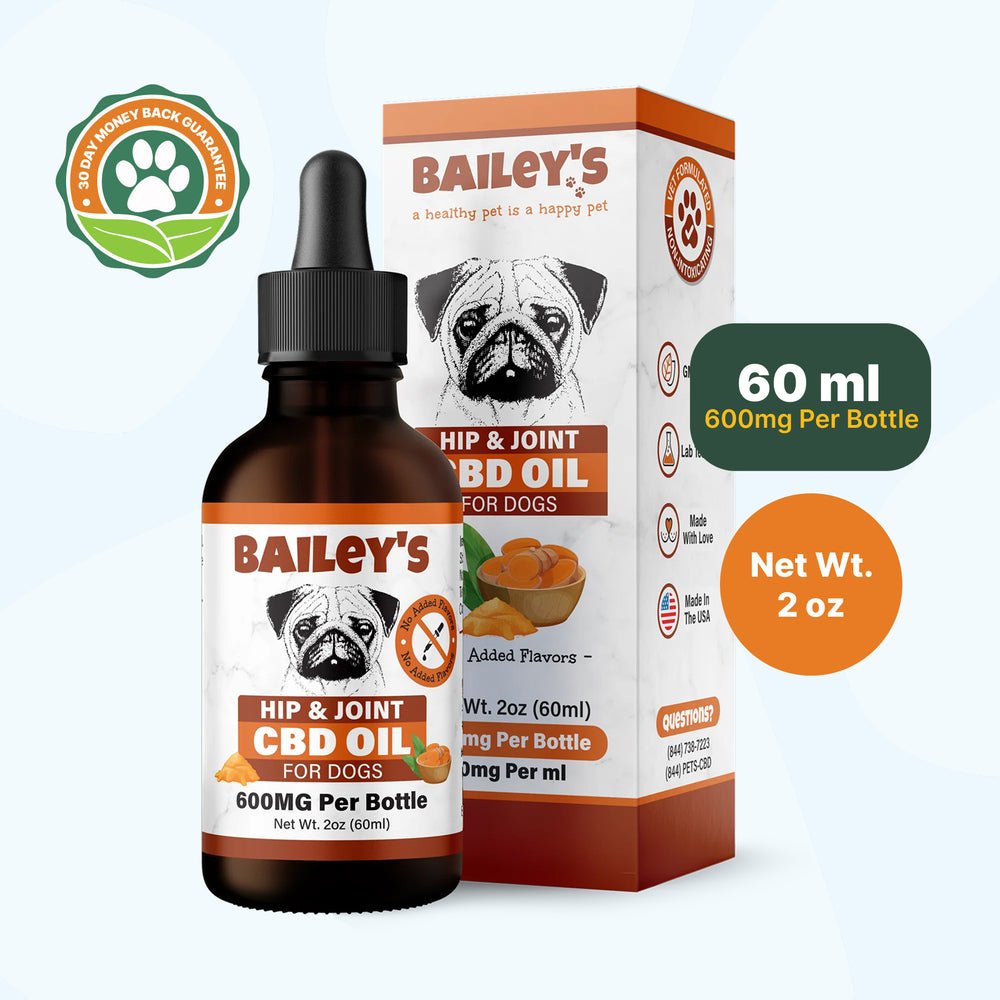
An oil may be practical when you can measure the specified liquid volume accurately and your dog reliably consumes it. Check the concentration per milliliter as well as the total bottle content. Ask about the recommended method of administration, particularly if appetite is inconsistent or the dog sometimes leaves food behind.
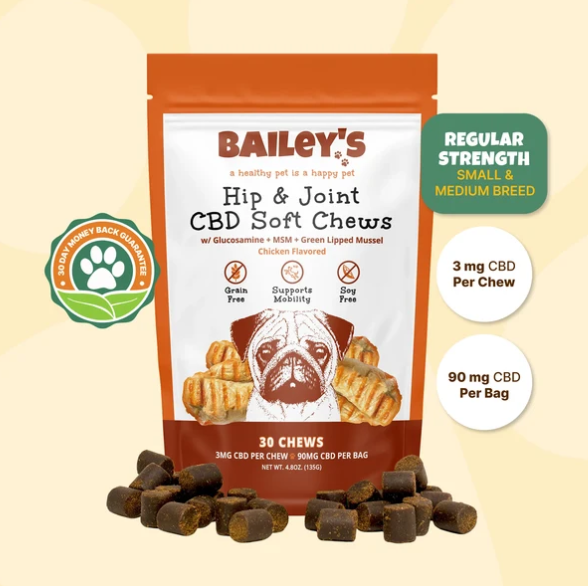
Bailey's Hip & Joint CBD Oil for Dogs is a product in the brand's mobility range. Review the current formula, bottle size and suggested use for the exact option being considered. A bottle with more total CBD does not automatically deliver more CBD in the same volume, so compare the concentration directly.
When a chew may be convenient
Soft chews may fit a dog that readily accepts their texture and flavor. They also make it important to review the entire formula rather than the CBD number alone. Joint chews can contain other ingredients that overlap with a dog's existing supplements.
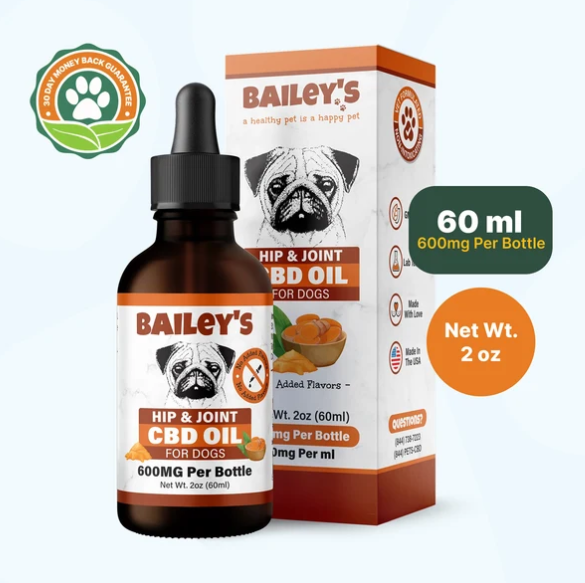
Bailey's Hip & Joint CBD Soft Chews offer another format to compare. Check the strength, CBD per chew and current ingredient panel. If chewing, appetite or dietary restrictions complicate use, discuss a different format instead of assuming any soft chew will be suitable.
Do not stack an oil and a chew simply because both are marketed for mobility. Combining them may duplicate CBD or other ingredients. Keep one complete list of what the dog receives so your veterinarian can assess the total plan.

How should you compare joint-support ingredients?
Products may mention glucosamine, MSM, green-lipped mussel, omega fatty acids, CBD or combinations of these. Their presence on a label does not make the products equivalent. Ingredient identity, amount, formulation and evidence all matter, and a blend does not automatically inherit every claim made about its individual ingredients.
Use a side-by-side label review:
- What exactly is included? Read the ingredient panel rather than relying on the product name.
- How much is supplied? Look for amounts per serving where available.
- What is already in the care plan? Note duplication with other chews, oils, diets or supplements.
- What evidence applies? Distinguish general ingredient research from a trial of that finished product.
- What is the practical goal? Identify the observation you will use to judge the plan.
Bailey's Omega Hemp CBD Soft Chews provide a separate option to review alongside the Hip & Joint range. The product name is a starting point for comparison, not proof that it supplies a particular therapeutic omega-fatty-acid amount. Use the current label and your veterinarian's advice to decide whether its composition adds something useful.
For example, if your dog already receives a joint chew containing glucosamine and MSM, write those ingredients beside the Hip & Joint Soft Chews panel. If the dog receives an omega supplement, place that label beside the Omega Hemp chews. This turns a vague concern about “too many supplements” into a specific comparison your veterinarian can assess.
Do not assume that total omega content is the same as a stated amount of EPA and DHA. Likewise, an ingredient's presence is different from a therapeutic amount for a diagnosed condition. Bailey's separate mobility oil, joint-chew and omega-chew options make it possible to choose a format deliberately instead of adding every available product.
How much CBD should a senior dog get?
There is no universal senior-dog CBD dose. Body weight is relevant, but the dog's health, medications, formulation and treatment goal also matter. A dose used in a study should not be copied directly into home use, and age is not a reason to increase an amount automatically.
Before deciding on a serving, identify:
- The exact product and strength.
- CBD content per milliliter or chew.
- Every added ingredient.
- Current medicines and supplements.
- The veterinarian's plan for administration and reassessment.
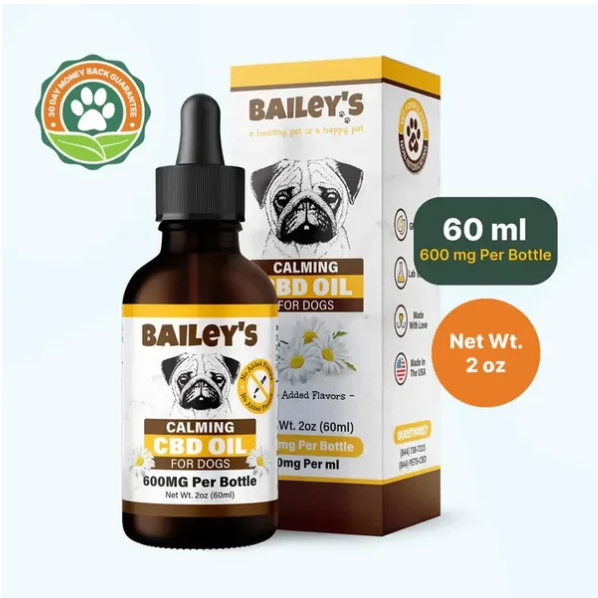
Avoid confusing total bottle content with the amount in a single serving. If the label is unclear, ask the manufacturer and veterinary team to clarify it before use. A measuring problem is easier to prevent than to interpret after a dog has received an uncertain amount.
Can CBD be used with other medications or supplements?
That decision needs an individualized veterinary review. Older dogs may have several health conditions or products in their routine, and CBD can complicate drug handling and monitoring. A general statement that two products are “natural” does not establish that their combination is appropriate.
Make a complete list, including products that are easy to overlook:
- Prescription and occasional-use medicines.
- Joint, calming and sleep-related supplements.
- Oils, chews and treats with active ingredients.
- Recent changes in product strength or serving.
Ask whether any monitoring is needed and what signs should lead you to withhold the product and call. If your dog takes prescribed pain medication, do not discontinue it or add CBD without discussing the plan. A study allowing particular stable medications under controlled conditions is not blanket permission to combine them at home.
The FDA's cannabis and CBD guidance explains that cannabis products are not approved for animals. That is an important distinction from a manufacturer's description of veterinary input during formulation.

How do you evaluate product testing?
Look for a certificate of analysis that can be matched to the product and, ideally, its batch. Check CBD and THC results, the units used and which contaminant panels were included. A potency test alone does not tell you that every relevant contaminant was assessed.
Bailey's maintains a public lab-results page. Use it to find the report for the product being considered, and request help if the name, strength or batch is unclear. A laboratory report helps establish what a tested sample contained; it does not diagnose your dog's mobility problem or determine the right dose.
Keep the original packaging and a photograph of the label. This makes it easier to compare a later purchase, especially if the brand changes its packaging, strength options or formula.
A simple mobility record to share with your veterinarian
Choose two or three ordinary activities before changing the routine. Use the same walking route when practical, observe a familiar rise from bed and note willingness to use a necessary step. Make a weekly comparison using similar conditions rather than judging from the best or worst moment of one day.
Record a few details consistently:
- What activity you observed and whether the dog completed it comfortably.
- How long stiffness or hesitation lasted.
- Appetite, sleep and any digestive or alertness changes.
- The exact product, serving and time if a CBD trial was agreed.
- Other changes, such as flooring, exercise, weather or medication.
Avoid introducing several optional supplements at once unless the veterinarian directs that approach. Multiple simultaneous changes make it harder to know what helped or caused a problem. A short video from the same angle can also be useful when it is safe and does not require making the dog repeat a painful movement.
Agree on a reassessment point before beginning. If the dog is not improving, worsening or experiencing adverse effects, contact the veterinary team rather than continuing automatically. The aim is a care plan that supports the dog's actual daily life, whether the next step involves a product, a home adjustment or further treatment.
Copy this short record into a notebook or phone note:
| Date and time | Ordinary activity | What happened | Product or other changes |
|---|---|---|---|
| Before the trial | Rise from usual bed | Record attempts, hesitation and assistance needed | Record current medicines, diet and home setup |
| Daily observation | Same walking route | Record comfortable distance, pace and stopping points | Product name, measured serving and administration time |
| Weekly comparison | Repeat the same observations | Better, unchanged or worse, with a concrete example | Note weather, flooring, exercise or medication changes |
The record is for communication, not a diagnostic score. A short description such as “needed help at the back step on three mornings” is more useful than an unexplained rating. Do not wait for the weekly comparison if the dog worsens or develops a concerning new sign.
Frequently asked questions
Giving a dog CBD every night should have a clear purpose and a veterinarian-agreed plan. An older dog that paces or cannot settle may be experiencing pain, needing to toilet or showing another health change. CBD should not be used to make that pattern less visible without investigating it. Discuss the exact product, duration, medication list and signs to monitor before making it a routine.
Weight alone is not enough to recommend an amount. A 70-pound dog may have medical conditions or medications that change the decision, and different oils and chews contain different CBD concentrations. Bring the precise label to your veterinarian. Do not convert a study dose or another dog's serving into instructions for your own pet.
CBD is not an established treatment for sundowning in dogs, evening confusion or canine cognitive dysfunction. A change in nighttime behavior needs veterinary assessment because several problems can look similar. Keep a record of timing, pacing, sleep, toileting and other changes. Ask about an appropriate care plan rather than treating every unsettled evening as a reason for a calming product.
Neither gabapentin nor CBD is universally better for dogs; they are not interchangeable treatments. Your veterinarian may prescribe gabapentin for a specific problem, while CBD products have variable formulations and a different evidence base. The diagnosis, goals and dog's other medications determine the appropriate plan. Do not replace or combine a prescribed medicine with CBD without consulting the treating veterinarian.
To help a dog with dementia calm down, ask your veterinarian to assess the current signs and review the existing treatment plan. A dog with a cognitive-dysfunction diagnosis can also develop pain, illness or another reason for restlessness. Describe when the behavior occurs and whether anything has changed. Do not add a CBD or sleep product without reviewing the ingredients and possible medication overlap with the veterinary team.