Do Dental Powders for Dogs Actually Work?
Published on September 22, 2026
Sponsored content: This article was created in partnership with PetLabCo.®. VetStreet’s veterinary author independently reviewed the current product information and the published evidence discussed below. Vetstreet may earn a commission if you purchase through links in this article.
Written by Athena Gaffud, DVM. Last reviewed September 14, 2026.
Dental Powders for Dogs promise a cleaner mouth and fresher breath from one scoop sprinkled over dinner, which sounds too easy to be true. The question “does dental powder for dogs work” deserves a real answer, not a marketing line, so this guide walks through the mechanism first, then the evidence, then the practical decision.
Key Takeaways
- The short answer: Well-formulated dental powders can support a cleaner mouth and fresher breath when used daily, but they work chemically and biologically, not mechanically, so they complement brushing rather than replace it.
- The mechanism comes first: The three active classes that matter are oral probiotics (to balance mouth bacteria), sodium hexametaphosphate (to interfere with plaque mineralizing into tartar), and brown algae (a seaweed ingredient studied for plaque and calculus in dogs).
- The evidence: PetLabCo.® reports a 28-day study in which ProBright® Advanced reduced hydrogen sulfide, a common bad-breath compound, by 40%, and a 90-day plaque study in which daily users had a plaque index score 25% lower than the control group. Both are brand-reported, and individual results may vary.
- The limits: No powder dissolves hardened tartar, cleans below the gumline, or substitutes for a veterinary dental exam. Brushing remains the home-care standard.
- Safety: Dental powder is generally well tolerated in healthy dogs 12 weeks and older when the label is followed. Give it with food, and ask your veterinarian first if your dog has a known health condition, is pregnant, or takes medication.
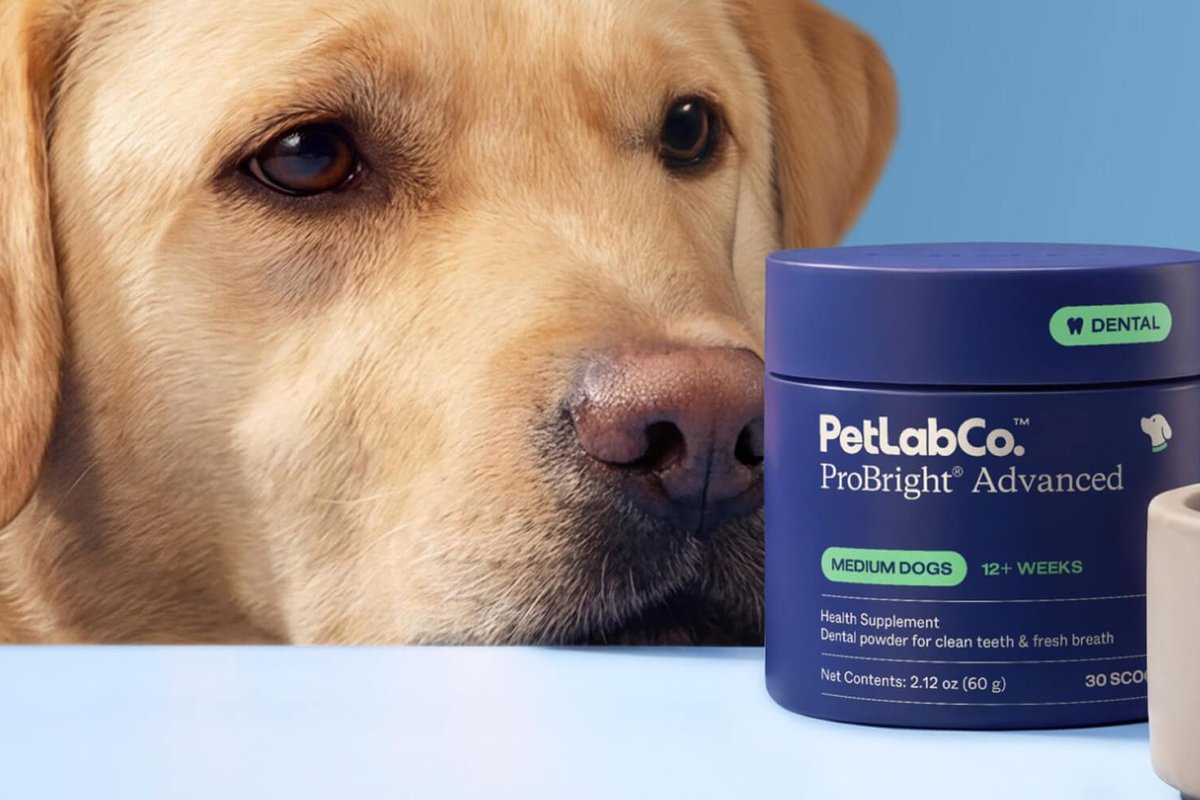
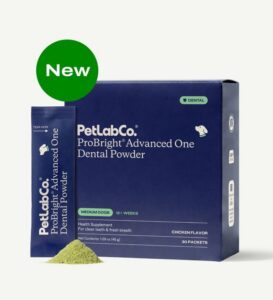
- Format matters for consistency: ProBright® Advanced comes as a weight-matched tub with a scoop; ProBright® Advanced One delivers the same formula in 30 pre-measured daily packets.
- Veterinary guidance: Ask your veterinarian for a mouth check before starting any dental supplement, especially if your dog has never had one.
The format is the same one VetStreet uses for any “do they work” question. We name the active ingredient classes and explain what each is supposed to do before any claim is made. We then look at the two brand-reported clinical studies behind PetLabCo.® ProBright® Advanced, compare powder with brushing, water additives, and chews, cover safety, and finish with a verdict you can act on.
The short answer
Yes, with a caveat. Dental powders for dogs can help support cleaner teeth and fresher breath when given every day, because their active ingredients interfere with plaque mineralization and help balance oral bacteria. They do not remove existing tartar, they do not brush the teeth, and they work best alongside brushing and regular veterinary dental care.
That is the honest version of “does dental powder for dogs really work.” A powder is a supplement, and supplements support normal function. They are not designed to diagnose, treat, cure, or prevent dental disease, and no responsible manufacturer claims otherwise.
The reason the question keeps coming up on forums, including the “does dental powder work for dogs reddit” threads, is that owners see two very different kinds of results. Dogs with mild, early plaque often show visibly cleaner-looking teeth and better breath within a few months. Dogs with heavy brown calculus do not, because a powder cannot touch mineralized tartar below the gumline. The practical framing looks like this:
- Expect support, not a fix: A powder can help slow new plaque and freshen breath as part of a daily routine.
- Expect it to be gradual: Brand-reported studies measure change at 28 and 90 days, not days or weeks.
- Expect it to be suitable when used as labeled: “Is dental powder safe for dogs” is a fair question, and the answer for healthy dogs 12 weeks and older is generally yes, with the cautions covered later in this guide.
- Expect brushing to still matter: The American Animal Hospital Association (AAHA) home-care guidance lists daily brushing as the most effective thing an owner can do at home.
The rest of this article explains why those expectations are the right ones.
How dental powders for dogs are supposed to work
Every dog dental powder is a meal topper. It goes on the food, gets eaten, and then acts either in the mouth during the meal or through the body after digestion. Understanding which ingredient does what is the only way to judge whether a given dental powder for dogs is worth buying, whether it is a natural dental powder for dogs built on seaweed, a postbiotic dental powder for dogs, or a probiotic formula like the one examined here.
Does a seaweed-based dental powder really work for dogs? Yes, it can work in the sense that matters: daily use of Ascophyllum nodosum brown algae has been associated with less plaque and calculus accumulation in controlled canine studies, and brown algae is one of the three active classes in PetLabCo.® ProBright® Advanced. What such a powder cannot do is lift off tartar that has already mineralized, and it cannot substitute for brushing or a professional cleaning. A dog with heavy calculus needs a veterinary cleaning first, after which a daily powder helps maintain the result.
The sections below name each active class, explain what it is supposed to do, and then apply that checklist to the dental powder for dogs reviews and label claims you will meet while shopping.
Plaque, tartar, and why chemistry matters
Plaque is a soft film of bacteria, saliva proteins, and food debris that starts forming on a dog’s teeth within hours of a meal. If it is not removed, minerals in saliva harden it into tartar, also called calculus, within a few days. The Merck Veterinary Manual describes this progression as the starting point of periodontal disease, which is one of the most common conditions veterinarians see in adult dogs.
Brushing removes plaque mechanically. A powder cannot do that. What a powder can do is change the chemistry and biology of the mouth so that:
- Less plaque mineralizes into tartar in the first place.
- The bacterial population shifts toward species that produce fewer odor compounds.
- The overall oral environment supports healthier gums.
The three active classes that do the work
The formulas worth considering rely on one or more of these ingredient classes. Using PetLabCo.®’s full ingredient breakdown for ProBright® Advanced as the working example, here is what each is meant to do.
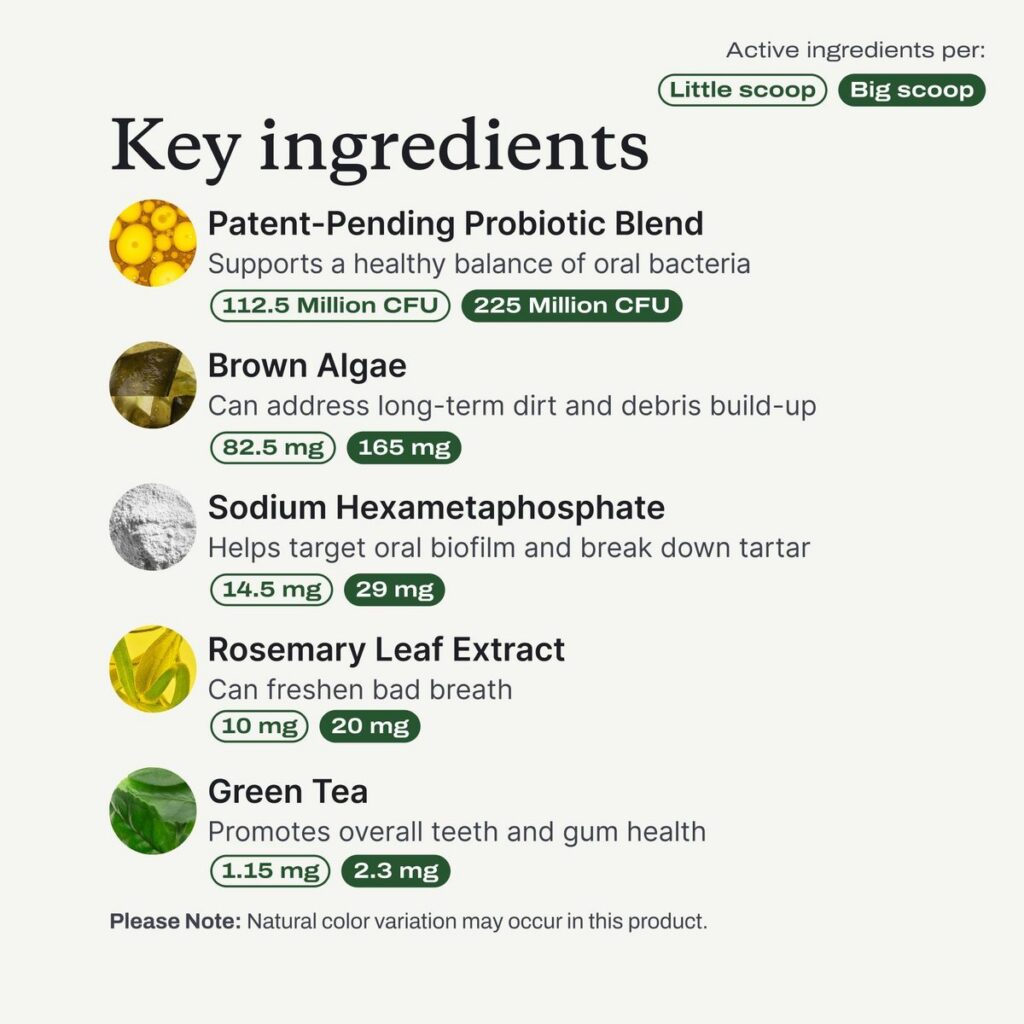
- Oral probiotics (balancing oral bacteria): ProBright® Advanced carries a patent-pending proprietary blend of Pediococcus pentosaceus and Lactiplantibacillus plantarum, at 112.5 million to 1.2 billion CFU per serving depending on dog size. These are oral strains, not gut strains. The intended mechanism is competitive: helpful bacteria delivered with each meal occupy space on the teeth and gums, supporting a normal balance of oral bacteria and helping crowd out the sulfur-producing organisms behind bad breath.
- Sodium hexametaphosphate (targeting tartar mineralization): This is a mineral compound, a polyphosphate, that binds calcium in saliva. When calcium is tied up, plaque has a harder time hardening into calculus. It is the same ingredient class used in some dental diets and treats for exactly this reason. ProBright® Advanced supplies 14.5 mg to 125 mg per serving. It targets new tartar formation; it does not dissolve tartar that is already on the tooth.
- Brown algae, Ascophyllum nodosum (the seaweed ingredient): This is the “seaweed dental powder for dogs” people search for. Brown algae works after ingestion rather than by scrubbing, and peer-reviewed canine studies have reported reduced plaque and calculus accumulation with daily supplementation. ProBright® Advanced supplies 82.5 mg to 1,510 mg per serving. Because seaweed naturally contains iodine, this is also the ingredient that drives the thyroid caution on the label.
Two supporting botanicals round out the formula: rosemary leaf extract (10 mg to 79.67 mg) and decaffeinated green tea (1.15 mg to 9.3 mg). Both are included for antioxidant support and breath freshness rather than as the primary mechanism.
Reading the label wherever you shop
The mechanism above is the checklist. Whether you are searching “dental powder for dogs amazon” or shopping for dental powder for dogs at a local store, the label questions are identical:
- Which of the three active classes are present, and are the amounts disclosed per serving?
- Are serving sizes matched to body weight, or is it one scoop for every dog?
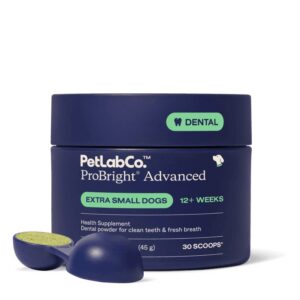
- Is the product made for dogs, or marketed as a dental powder for dogs and cats? ProBright® Advanced is formulated for dogs only, and PetLabCo.® does not recommend it for cats.
- Is the product labeled as probiotic (live organisms) or postbiotic (heat-treated organisms or their by-products)? A postbiotic dental powder for dogs is a different mechanism and should be judged on its own evidence.
- Are the dental powder for dogs reviews you are reading about breath and appearance, or about measured plaque?
A “natural dental powder for dogs” is not automatically the best natural dental powder for dogs. Brown algae, rosemary, and green tea are natural ingredients, but what makes a powder useful is a disclosed amount, a weight-based serving, and evidence.
Why DIY and homemade dental powder falls short
Recipes for diy dog dental powder or homemade dental powder for dogs usually combine kelp, parsley, and baking soda. The problem is not that the ingredients are dangerous in small amounts; it is that nothing is measured. Kelp iodine content varies widely between batches, there is no probiotic strain, no polyphosphate, and no way to know the serving a 6-pound dog should get versus an 80-pound dog. A commercial powder with a disclosed panel solves exactly that problem.
What the clinical evidence shows
This is where most dental powder articles get vague. VetStreet’s standard is simple: name the study, the duration, the outcome measured, and the limits, and link the source rather than paraphrasing it into something bigger than it is.
PetLabCo.® reports two clinical studies of ProBright® Advanced, both summarized on the company’s clinical study breakdown page.
- The 28-day study (bad-breath compound): A 28-day clinical study found ProBright® Advanced significantly reduced hydrogen sulfide, one of the most common compounds that produces bad breath, by 40%. Hydrogen sulfide is a volatile sulfur compound produced when oral bacteria break down proteins, so a lower level is a meaningful signal that the probiotic and botanical mechanism is doing what it is designed to do.
- The 90-day plaque study (plaque index): In a 90-day clinical study, dogs taking ProBright® Advanced daily had a plaque index score that was 25% lower than the control group. That statement is attributed to Dr. Jan Bellows, a board-certified veterinary dentist and consultant to PetLabCo.®. A plaque index measures soft plaque coverage on the tooth surface, which is the stage sodium hexametaphosphate and brown algae are meant to influence.
Both studies are brand-reported, and PetLabCo.® itself notes that individual results may vary.
What the studies measured, and what they did not:
- They measured one odor compound at 28 days and a plaque index at 90 days. Those are the right endpoints for a supplement whose job is supporting fresher breath and a cleaner mouth.
- They did not measure calculus removal, gum pocket depth, or periodontal disease outcomes, so the powder should not be described as treating gum disease or removing tartar.
- The presence of a control group is a strength. The full study reports were not available for independent review at the time of writing, so sample size, blinding, and baseline dental status could not be checked by VetStreet.
- The evidence limit is therefore clear: these results support daily use as part of a home-care routine. They do not replace veterinary care, and a dog with existing dental disease needs an examination before a supplement is the answer.
Read that way, the two studies are genuinely useful. They are more than most dental powders offer, and they line up with the mechanism: breath compound first (bacteria balance, 28 days), plaque second (mineralization control, 90 days).
Dental powder versus brushing, water additives, and chews
No single format does everything, which is why the honest comparison includes brushing as the standard rather than as a competitor. The question in the “dog dental powder vs water additive” searches is really about mechanism and compliance, so the table below compares both.
| Format | How it works | What it can and cannot do | Best fit |
|---|---|---|---|
| Daily brushing (the standard) | Mechanical removal of plaque with a dog toothpaste | Removes soft plaque from reachable surfaces; cannot remove hardened tartar or reach below the gumline | Every dog that tolerates it; AAHA calls daily brushing the most effective home care |
| Dental powder (ProBright® Advanced as the current label example) | Probiotics balance oral bacteria; sodium hexametaphosphate targets tartar mineralization; brown algae acts after ingestion | Supports fresher breath and less new plaque with daily serving; cannot scrub teeth or dissolve existing calculus | Dogs that resist brushing, owners who want one scoop on food; adds to brushing rather than replacing it |
| Water additive | Chemical or enzymatic agents in drinking water | Reaches the whole mouth passively; dose depends on how much the dog drinks; cannot brush or remove tartar | Multi-dog homes or dogs that will not accept powder on food |
| Dental chews and sticks | Abrasion from chewing, sometimes with added actives | Helps scrape some surfaces while chewing; hard chews can fracture teeth; adds calories | Dogs that chew thoroughly and need a treat-based routine |
| Professional cleaning under anesthesia | Ultrasonic scaling above and below the gumline, with dental X-rays | The only method that removes hardened tartar and treats disease below the gumline | Any dog with visible calculus, red gums, or bad breath that does not improve |
The Veterinary Oral Health Council (VOHC) reviews manufacturer data and grants its seal to products that meet its plaque or tartar control standard. The council publishes its list of vohc approved products for dog owners as a PDF table on its site (the “vohc approved products for dogs pdf” most searches are looking for), and it is the best independent check for vohc approved dental chews for dogs, diets, water additives, and gels. The list is voluntary, so absence does not mean a product is ineffective, and dental powders are lightly represented compared with chews and diets. PetLabCo.® does not present ProBright® Advanced as VOHC Accepted; its case rests on the two brand-reported clinical studies above instead.
What is the best natural way to clean my dog’s teeth? The best natural way to clean a dog’s teeth is daily brushing with a dog-safe toothpaste, because it removes plaque mechanically before it can mineralize, and no ingredient does that job better than friction. Layer on a natural-ingredient daily support such as a seaweed and probiotic powder, and offer an appropriately sized chew that the dog actually chews rather than swallows. Skip home remedies that rely on hard bones, antlers, or abrasive pastes, since those fracture teeth more often than they clean them. Anything already hardened into brown calculus needs a professional cleaning; natural methods keep a clean mouth clean, they do not reverse buildup.
Building the routine
For an owner trying to build a routine, the sensible stack is:
- A dental chew or dental diet where the dog tolerates it
- Daily brushing where possible, since it is the only home method that removes plaque mechanically
- A daily powder for the days brushing does not happen and for the bacterial balance brushing does not address
- A professional cleaning whenever calculus, red gums, or persistent odor is present, before home care is expected to hold the line
Side effects and safety
Dog dental powder side effects are uncommon in healthy dogs when the label is followed, which is one reason powders are popular with owners who cannot brush. Safety still deserves a specific answer, because “is dental powder safe for dogs,” “vet approved dental powder for dogs,” and “vet recommended dog dental powder” are among the most common searches in this category.
What are the side effects of dog dental powder? The most common side effect of dog dental powder is mild digestive upset, such as softer stool or a skipped meal, usually in the first few days while a dog adjusts to a new flavor on the food. That is why the ProBright® Advanced label directs owners to give the powder during or after the meal rather than on an empty stomach. Less commonly, a dog with a sensitivity to an ingredient such as chicken liver flavor, brewer’s yeast, or seaweed may show itching or an appetite change. Serious reactions are rare, and stopping the product resolves most concerns. Any dog that vomits repeatedly, develops diarrhea that persists, or seems unwell should stop the powder and be seen by a veterinarian.
One more expectation to set: there is no consumer reports best dog dental powder ranking to lean on, because independent consumer-testing organizations do not run canine dental trials, and the VOHC program above is voluntary and lightly populated with powders. The practical substitute is the same checklist a veterinarian uses: a disclosed active panel with amounts per serving, weight-based label directions, a controlled study with a stated duration and endpoint, and a label that tells you plainly who should not use the product.
Current label directions and cautions for the featured products
ProBright® Advanced and ProBright® Advanced One share the same active formula and the same label cautions:
- Intended for dogs and puppies 12 weeks and older; not formulated for cats.
- Administer during or after the animal has eaten to reduce the incidence of gastrointestinal upset.
- An examination from a veterinarian is recommended prior to using the product.
- Use with caution in animals with hyperthyroid disease, because brown algae contains naturally occurring iodine.
- Safe use in pregnant animals or animals intended for breeding has not been proven.
- If the animal’s condition worsens or does not improve, stop administration and consult your veterinarian.
- Give at mealtime and do not add to water. Keep out of reach of children and animals, and store in a cool, dry place with the tub or carton resealed.
Who should ask a veterinarian first
The label cautions translate into a short list of dogs that need a conversation before the first scoop:
- Dogs with thyroid disease or on thyroid medication
- Dogs taking any daily medication, so timing with a new supplement can be planned
- Dogs on a veterinary elimination diet, since a flavored powder can interfere with the trial
- Pregnant, nursing, or breeding dogs
- Dogs with changes to tooth or gum color or texture, which need checking by a veterinarian rather than a supplement
VOHC approved, vet recommended, and what those words mean
There is no VOHC approved dental powder for dogs from PetLabCo.®, and the brand does not claim one. “Vet recommended dental powder for dogs” is a different kind of claim: ProBright® Advanced was formulated with a board-certified veterinary dentist, PetLabCo.® states that the company is NASC certified and third-party tests for purity and potency, and the product was voted Dog Dental Care Product of the Year in the 2024, 2025, and 2026 Pet Innovation Awards. Those are quality and formulation signals rather than a regulatory approval, and they are the right things to look for when a search for a vet recommended dental powder for dogs turns up a page of marketing claims.
How long dental powder takes to work
How long does it take for dog dental powder to work? Roughly one to three months of daily use, and the two brand-reported ProBright® Advanced studies are the best available timeline: a measurable reduction in a bad-breath compound at 28 days, and a lower plaque index score than the control group at 90 days. Breath tends to change first because the probiotic and botanical mechanism acts on bacteria at every meal, while a visible difference in plaque coverage takes longer because it depends on slowing new buildup over many weeks. Individual results may vary with the dog’s diet, starting dental condition, and how consistently the powder is given.
A realistic expectation by stage:
- Days 1 to 7: The dog gets used to the flavor on food. Nothing visible changes yet.
- Weeks 2 to 4: Breath is the first thing many owners notice, which matches the 28-day study endpoint.
- Weeks 4 to 12: Teeth that were lightly filmed begin to look cleaner as less new plaque mineralizes, in line with the 90-day plaque study.
- Beyond 90 days: Support continues only while daily use continues. Plaque returns within days once any home care stops.
Two things shorten the wait. Start after a professional cleaning if the dog already has calculus, because the powder can then help maintain a clean surface instead of fighting buildup it cannot remove. And give it every day; a skipped week resets the bacterial balance the probiotics are meant to support.
Do vets recommend dental powder?
Do vets recommend dental powder for dogs? Yes, as an addition to a home-care routine, not as its foundation. Most veterinarians, including AAHA in its dental home-care guidance, put daily brushing first because it is the only home method that physically removes plaque. Where a dog will not tolerate a brush, or an owner cannot manage it daily, a powder with disclosed actives and evidence is a reasonable next step, and many practices are comfortable with that trade-off because a consistent something beats an inconsistent ideal. The recommendation always comes with two conditions: the mouth should be examined before starting, and any dog with existing tartar or changes to gum color or texture needs a cleaning first.
What a veterinarian looks for when judging a specific powder:
- Named active ingredients with amounts: A proprietary blend with no numbers is a red flag; a panel that lists CFU and milligrams per serving is not.
- Weight-based servings: A Chihuahua and a Labrador should not get the same scoop.
- Evidence beyond testimonials: Controlled studies with a stated duration and endpoint, as PetLabCo.® reports for ProBright® Advanced.
- Honest labeling: Support language, a recommendation to see a veterinarian first, and clear cautions.
That is why the product examined here appears in this guide. It meets the checklist, and it is positioned by its own manufacturer as something that does not replace tooth-brushing or professional cleanings.
Our verdict: which dental powder to choose
The dental powder to choose is the one your dog will eat every day, with active ingredients you can verify, from a brand that shows its evidence. For most owners reading this, that points to a probiotic and seaweed formula with sodium hexametaphosphate, and the two PetLabCo.® ProBright® options are the ones VetStreet examined most closely for this guide.
If your question is “what is the best dental powder for dogs,” VetStreet keeps its ranked list of the best dental powder for dogs in a separate roundup that compares the leading options on plaque control, realistic tartar removal expectations (no powder qualifies as a tartar removal best dental powder for dogs, because none dissolves calculus), ingredient transparency, and value, and it updates the picks as labels change. That roundup also weighs the best dental powder for dogs reviews and the best dental powder for dogs reddit threads against measured evidence. Use it when deciding between several powders; use this guide to understand what any of them can deliver.
PetLabCo.® offers its ProBright® dental powder in two products that share one formula. The difference is packaging, and that difference is about consistency, not strength, so the choice comes down to how your household serves a daily meal.
PetLabCo.® ProBright® dental powder for dogs: the two formats
| Detail | ProBright® Advanced (tub) | ProBright® Advanced One (packets) |
|---|---|---|
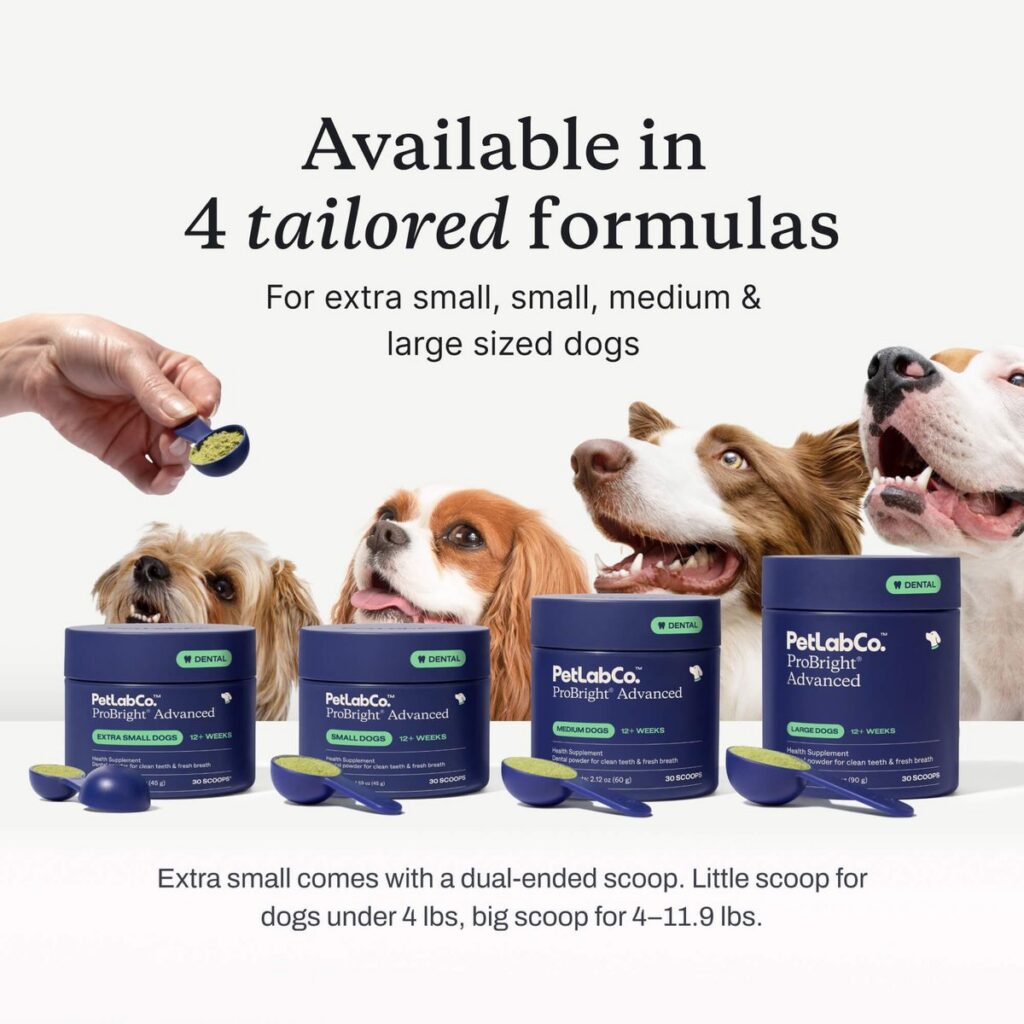
| Format | Weight-matched tub with scoop; four tub sizes | Carton of 30 individually sealed, pre-measured daily packets |
| Active ingredients | Proprietary probiotic blend, brown algae, sodium hexametaphosphate, rosemary leaf extract, decaffeinated green tea | Same active formula and amounts by weight band |
| Serving by dog weight | Under 4 lb: 1 small scoop; 4-11.9 lb: 1 big scoop (extra-small tub); 12-24.9 lb, 25-75 lb, over 75 lb: 1 scoop from the matching tub | Under 4 lb: half a packet; every other weight band: 1 packet from the matching carton |
| Age | Dogs 12 weeks and older | Dogs 12 weeks and older |
| Flavor and inactive ingredients | Hydrolyzed chicken liver flavor, calcium bentonite, dried brewer’s yeast, spinach powder | Same |
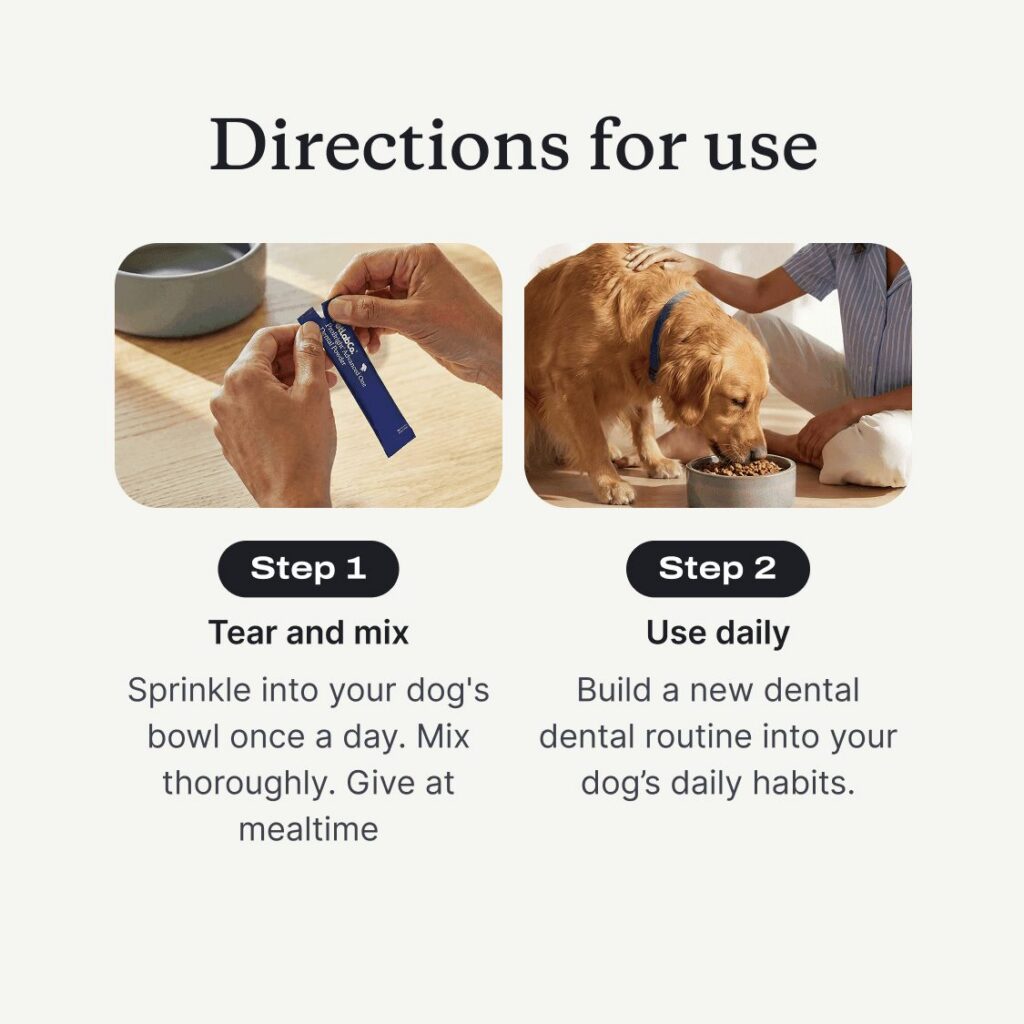
| How to give | Once daily at mealtime on food; do not add to water | Tear open and sprinkle once daily at mealtime; do not add to water |
| Evidence | 28-day study and 90-day plaque study, brand-reported | Same formula studies apply; no separate packet study |
| Price checked September 14, 2026 | $36.19 one-time, $28.95 with subscription on the official site | $38.69 one-time, $30.95 with subscription on the official site |
Prices, promotions, and formulas can change. Check the current product listing and label directions before buying.
Choose the ProBright® Advanced tub when one dog eats at home, the correct scoop is easy to keep with the tub, and the lower price matters. Choose ProBright® Advanced One when consistency is the problem to solve: travel, boarding, a dog sitter, or several dogs in different weight bands. Owners of dogs under 4 pounds should note that the One format still requires splitting a packet in half.
For readers who want a deeper look at either product, Petful’s sister-site coverage includes a full ProBright® Advanced review and a separate ProBright® Advanced One review that weighs the packet format against the tub. The probright dental powder for dogs reviews on the official site skew toward breath and appearance, which is consistent with the study endpoints; treat them as owner experience, not as measured evidence.
The bottom line
Dental powders for dogs actually work for the job they are designed to do: supporting fresher breath and helping slow new plaque when given daily. The mechanism is sound, the ProBright® Advanced evidence is specific and bounded, and the safety profile is favorable for healthy dogs 12 weeks and older. Pair the powder with brushing when you can, book a dental exam before you start, and browse PetLabCo.®’s dental collection for the format that fits your routine, whether that is the tub or the daily packets of ProBright® Advanced One.
Frequently Asked Questions
Nothing dissolves plaque on dogs’ teeth naturally once it has hardened into tartar; nothing dissolves hardened tartar except professional scaling. Soft plaque is a different story, because daily mechanical and additive control disrupts it: brushing physically removes it, and ingredients such as sodium hexametaphosphate and brown algae help keep new plaque from hardening. Probiotic strains support a bacterial balance that produces fewer odor compounds. The natural approach that works is daily prevention on a professionally cleaned mouth, not a remedy that claims to melt calculus.
It is never too late to start brushing a dog’s teeth, but the order matters: start after a dental exam, because existing disease needs cleaning first. Brushing over tartar and inflamed gums is painful and does not remove calculus, so an older dog with buildup usually needs a professional cleaning under anesthesia, then a brushing routine to maintain the result. Introduce the brush gradually with a dog toothpaste, a few teeth at a time, and add a daily powder for the bacterial support brushing does not provide.
It is not okay to scrape plaque off a dog’s teeth at home. Tartar removal is done by scaling under anesthesia, where the veterinarian can clean below the gumline, take dental X-rays, and polish the enamel afterward. Scraping an awake dog carries real enamel and gum injury risk, leaves scratches that attract new plaque faster, and misses the disease under the gums that causes tooth loss. Anesthesia-free scaling has the same limits. Spend the money on a proper cleaning and a daily routine instead.
If you have never cleaned your dog’s teeth, book a dental exam first so your veterinarian can grade the teeth, check for gum disease, and say whether a professional cleaning is needed before home care begins. Then start a daily routine afterward: brushing a few teeth at a time with a dog toothpaste, a daily powder such as ProBright® Advanced on the evening meal for bacterial balance and plaque support, and an appropriately sized chew if the dog enjoys one. Consistency beats perfection, and starting late beats not starting.
Dental powder is safe for puppies 12 weeks and older when the label is followed: ProBright® Advanced and ProBright® Advanced One are both labeled for that age, so a puppy past it can generally start once a veterinarian has checked the mouth. Follow the size-based scoop or packet for the puppy’s current weight, and move up a size as the puppy grows rather than estimating. Give the powder with food to limit stomach upset. Teething puppies may have temporary bad breath, which resolves on its own.
No, dental powder should not go in water instead of food. Powder goes on food, and both ProBright® Advanced labels state plainly not to add it to water. The probiotic strains and botanicals are designed to contact the teeth during a meal in a measured serving, which cannot be controlled in a water bowl. Water additives are a separate format with their own formulation, dosed by how much a dog drinks rather than by body weight. If your dog refuses powder on food, choose a water additive or chew.
Sources
- American Animal Hospital Association. AAHA Dental Care Guidelines: Home Care. Accessed September 14, 2026.
- Veterinary Oral Health Council. VOHC Accepted Products. Accessed September 14, 2026.
- Merck Veterinary Manual. Dentistry in Dogs and Cats. Accessed September 14, 2026.
- American Kennel Club. Dog Health: Expert Advice. Accessed September 14, 2026.
- Gawor J, et al. Effects of Edible Treats Containing Ascophyllum nodosum on the Oral Health of Dogs: A Double-Blind, Randomized, Placebo-Controlled Single-Center Study. Frontiers in Veterinary Science. 2018;5:168.
- PetLabCo.® ProBright® Advanced and ProBright® Advanced One official product pages, ingredient breakdown, and clinical study page, linked in the article above. Accessed September 14, 2026.
PetLabCo.® products are not intended to diagnose, treat, cure, or prevent any disease. Consult your veterinarian before starting supplements, especially if your dog has a health condition, takes medication, is pregnant or nursing, or has persistent symptoms.