Grain-Free Dog Food: What the Science Says
Published on July 19, 2026
When shoppers reach for grain free dog food, they are usually acting on a simple belief: that skipping wheat, corn, and rice makes a diet cleaner, more “natural,” and gentler on a dog’s stomach. It is one of the most successful marketing stories in pet nutrition. It is also one of the most misunderstood. Over the past several years, the conversation around grain-free dog food has shifted from allergy relief to a much bigger question about heart health, prompted by a U.S. Food and Drug Administration (FDA) investigation that is still open today.
This guide walks through what “grain-free” actually means, what the FDA and peer-reviewed research have found about the possible link to a heart condition called dilated cardiomyopathy (DCM), which dogs might genuinely benefit from a grain-free recipe, and how to choose any diet safely. The goal is not to sell you on a category. It is to help you and your veterinarian make an evidence-based choice for your individual dog.
All featured products are chosen at the discretion of the author. However, Vetstreet may make a small affiliate commission if you click through and make a purchase.
Key Takeaways
- Grain-free does not mean carb-free. Most grain-free recipes simply swap grains for peas, lentils, chickpeas, and potatoes, so the total carbohydrate load is often similar.
- True grain allergy in dogs is rare. The most common food allergens are animal proteins like beef, dairy, and chicken, not grains.
- The FDA investigation into diet and DCM remains open and unresolved. No single ingredient has been proven to cause DCM, and a direct cause-and-effect link has not been established.
- Many veterinarians favor grain-inclusive diets while the science is unsettled, especially for breeds already predisposed to heart disease.
- Formulation matters more than the grain-free label. A complete and balanced diet from a company with veterinary nutrition oversight is the safer starting point.
- Any diet change for a dog with a heart murmur or diagnosed heart condition should happen under veterinary guidance.
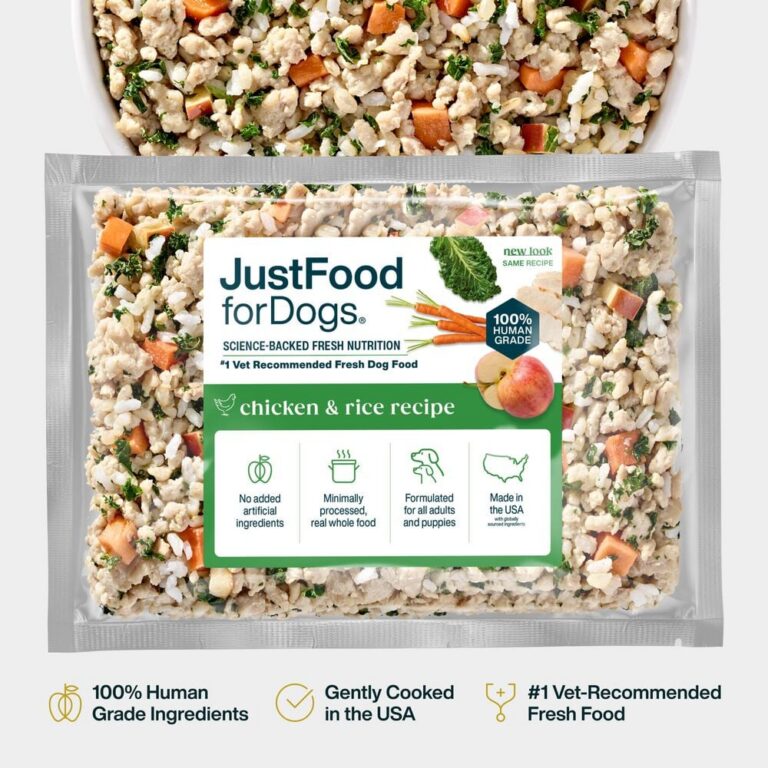
Vetstreet may earn a commission when you click through to JustFoodForDogs, at no extra cost to you.
What Does It Mean When a Dog Food Is Grain-Free?
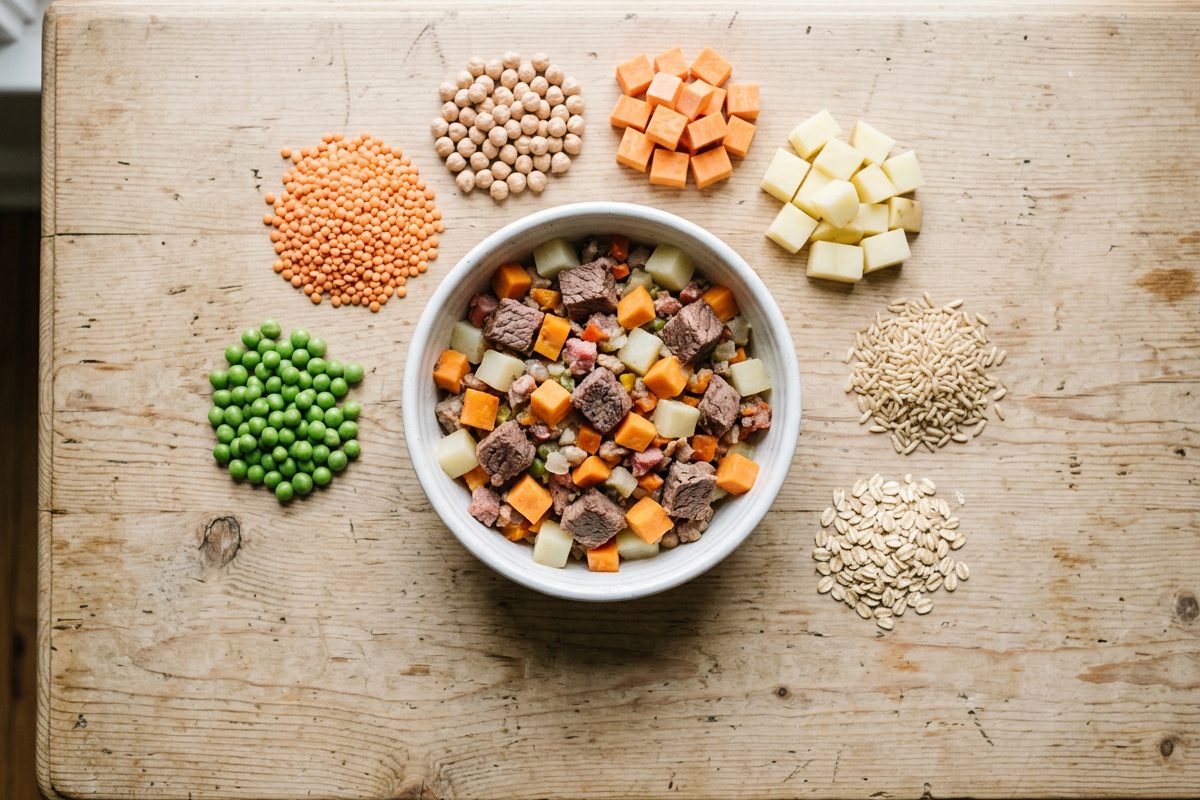
A grain-free dog food is exactly what it sounds like: a recipe formulated without cereal grains. That means no wheat, corn, rice, barley, oats, sorghum, or rye. Because dogs still need an energy source to bind kibble and fuel their day, those grains are replaced with alternative carbohydrates, most commonly potatoes, sweet potatoes, peas, lentils, chickpeas, and other legumes (collectively called pulses).
This is the single most important point to understand: grain-free is not low-carbohydrate. A grain-free kibble can contain just as much starch as a grain-inclusive one, sometimes more. The difference is the source of that starch, not the amount. Marketing language like “ancestral,” “biologically appropriate,” or “what wolves eat” tends to blur this distinction, but from a nutritional standpoint, a pea is simply standing in for a grain of rice.
It is also worth separating two ideas that often get bundled together. “Grain-free” refers only to the absence of grains. “Limited-ingredient” or “novel-protein” diets, which are sometimes used to identify or manage food sensitivities, are a different concept entirely. A food can be grain-free and still contain a long list of ingredients, and a grain-inclusive food can be very simple.
The FDA and DCM Investigation: What We Know So Far
The reason grain-free became a health headline rather than just a shopping preference comes down to a July 2018 alert from the FDA. The agency reported it was investigating a possible association between certain diets, many of them grain-free and rich in peas, lentils, and other legumes, and reports of dilated cardiomyopathy in dogs, including breeds not typically genetically prone to the condition.
DCM is a serious disease in which the heart muscle weakens and enlarges, reducing its ability to pump blood effectively. In some breeds, such as Doberman Pinschers and Great Danes, DCM has a well-established genetic basis. What caught researchers’ attention was a pattern of cases in breeds like Golden Retrievers, where diet appeared to be a common thread.
What the FDA Actually Reported
By June 2019, the FDA had received reports involving hundreds of dogs and published a list of diet brands most frequently named in those reports. The overwhelming majority were labeled grain-free. Importantly, the agency was careful about its wording. It described a potential association, not a proven cause. The FDA has repeatedly stated that the relationship is complex, likely involves multiple factors, and has not been reduced to a single ingredient or a simple mechanism.
The FDA has not recalled these foods, and it has not told owners to stop feeding grain-free diets outright. Its guidance has consistently pointed owners back to their veterinarians. The investigation remains open, and the agency has said it will provide updates as meaningful scientific findings emerge. You can review the agency’s own summary on the FDA investigation page.
What the Peer-Reviewed Science Says
Beyond the regulatory reports, a body of veterinary research has looked at the diet-and-heart question directly. Five peer-reviewed studies, plus one early research abstract, help frame what is currently understood:
- A widely cited 2018 overview in the Journal of the American Veterinary Medical Association (Freeman and colleagues) laid out what was known about diet-associated DCM and why grain-free, legume-heavy, and “boutique” or exotic-protein diets deserved a closer look.
- A 2018 study in PLOS ONE (Kaplan and colleagues) examined taurine deficiency and DCM in Golden Retrievers eating certain commercial diets, and found that some affected dogs improved when their diet was changed and taurine was supplemented under veterinary care.
- A 2019 paper in the Journal of Veterinary Cardiology (Adin and colleagues) reported that the echocardiographic picture of DCM differed depending on diet type, adding weight to the idea that food plays a role in at least some cases.
- A 2022 study in the same journal (Walker and colleagues) followed dogs with DCM and congestive heart failure and looked at how diet change related to their clinical outcomes over time.
- A 2025 review published through the National Library of Medicine (PubMed Central) synthesized the accumulated literature, underscoring that the evidence points to an association worth taking seriously while a definitive mechanism is still being worked out.
Rounding out that picture, an early research abstract from a university cardiology group, presented before some of the peer-reviewed work above was published, first flagged the taurine-and-diet signal in Golden Retrievers that later studies expanded on. Taken together, this research supports caution and continued study. It does not, at this point, prove that grain-free food causes heart disease in the average dog. That distinction is the heart of the whole debate.
Vetstreet may earn a commission when you click through to JustFoodForDogs, at no extra cost to you.
Grain-Free vs. Grain-Inclusive: A Quick Comparison
For most owners, the practical question is not “is grain-free evil” but “which category fits my dog.” The table below lays out how the two approaches compare on the factors that actually matter.
| Factor | Grain-Free | Grain-Inclusive |
|---|---|---|
| Carbohydrate source | Potatoes, peas, lentils, chickpeas, sweet potato | Rice, corn, barley, oats, whole wheat |
| Total carbohydrate level | Often similar to grain-inclusive, not automatically lower | Comparable; varies widely by recipe |
| DCM investigation status | Over-represented in FDA case reports; association unproven | Not implicated in the FDA reports to the same degree |
| Relevance to food allergies | Helpful only if a grain sensitivity is actually diagnosed | Fine for the vast majority of dogs |
| Best suited for | Dogs with a veterinarian-confirmed grain intolerance | Most healthy dogs, including many at-risk breeds |
| Nutritional bottom line | Can be complete and balanced if well formulated | Can be complete and balanced if well formulated |
Notice that the deciding lines are not “grain good, grain bad.” They are formulation quality and your individual dog’s diagnosed needs. A thoughtfully built grain-free recipe and a thoughtfully built grain-inclusive recipe can both be excellent. A poorly formulated version of either can fall short.
Why Some Veterinarians Are Cautious About Grain-Free
If grains are not common allergens and grain-free is not inherently unhealthy, why do so many veterinarians steer clients away from it? The caution comes down to a few overlapping reasons.
The open DCM question. While the association is unproven, the pattern in the FDA reports was strong enough that many veterinary cardiologists prefer to err on the side of caution, particularly for breeds already at higher heart-disease risk. Choosing a grain-inclusive diet while the science is unsettled is a low-cost way to sidestep an unresolved question.
A benefit that often is not there. The marketing promise of grain-free is that it is healthier or more natural. For the average dog, there is no strong evidence that removing grains improves health, energy, coat, or digestion. When a product carries a theoretical risk and no demonstrated benefit for most dogs, the risk-to-reward math tilts against it.
The “boutique, exotic, grain-free” pattern. Veterinary nutritionists often note that many of the diets named in the investigation shared more than just the absence of grains. They also tended to come from smaller brands using unusual protein sources and legume-heavy formulas, sometimes without the deep nutrition-science and feeding-trial backing that established, research-driven companies invest in. Formulation oversight, not the grain question alone, is a big part of the concern.
Ingredient substitution effects. Heavy reliance on peas, lentils, and other pulses is one of the leading hypotheses researchers are still examining. Because these ingredients do double duty as protein and carbohydrate sources, they can change a recipe’s overall nutrient profile in ways that are still being studied.

Vetstreet may earn a commission when you click through to JustFoodForDogs, at no extra cost to you.
Who Might Actually Need Grain-Free Dog Food?
Grain-free is not useless. It simply has a much narrower legitimate use than the shelf space it occupies would suggest. The dogs who genuinely benefit are those with a diagnosed intolerance or allergy to a specific grain, which is far less common than most owners assume.
Food allergies in dogs are real, but they are typically driven by animal proteins. Beef, dairy, chicken, and egg consistently top the lists of confirmed canine food allergens in the veterinary literature. Wheat and other grains appear far lower down. In other words, most dogs switched to grain-free “for allergies” were never allergic to grain in the first place, and the switch is more likely to resolve nothing or to accidentally change the protein source at the same time.
The reliable way to identify a food sensitivity is not guesswork at the pet store. It is a properly conducted elimination diet trial supervised by your veterinarian, in which one carefully chosen diet is fed exclusively for several weeks and suspected ingredients are reintroduced one at a time. If a grain genuinely turns out to be the trigger, then a grain-free recipe has a clear and appropriate role. That decision should come from a diagnosis, not a hunch.
Vetstreet may earn a commission when you click through to JustFoodForDogs, at no extra cost to you.
Diet and Heart Health: Feeding a Dog With a Murmur
Because the grain-free story is now tied to heart health, owners of dogs with heart murmurs often ask what they should feed. The most important thing to understand is that a heart murmur is a sign, not a diagnosis. It is a sound the heart makes, and it can range from completely harmless to a marker of underlying disease. What it means for diet depends entirely on what, if anything, is causing it.
There is no special “heart murmur food” on the shelf that resolves the murmur itself. What veterinary nutrition experts recommend is a complete and balanced diet, formulated to meet AAFCO nutrient profiles, produced by a company that employs qualified nutritionists and stands behind its recipes with research. For dogs being managed for a diagnosed heart condition, veterinarians may also discuss appropriate sodium levels, adequate protein, and nutrients like taurine, all of which can help support cardiovascular health as part of a broader care plan.
Given the open DCM investigation, many cardiologists currently steer heart patients and at-risk breeds toward well-established grain-inclusive diets rather than legume-heavy grain-free ones. That is a precautionary stance, not a proven prescription. If your dog has a murmur or any diagnosed heart issue, the single best step is to see your vet before changing food. Diet decisions for these dogs belong under veterinary guidance, ideally with input from a veterinary cardiologist or nutritionist.
How to Choose Any Dog Food Safely
Whether you land on grain-free or grain-inclusive, the questions that separate a trustworthy diet from a risky one are the same. Veterinary nutrition experts, including the World Small Animal Veterinary Association (WSAVA), suggest looking past the front-of-bag claims and asking:
- Does the company employ a qualified nutritionist? Look for a full-time veterinary nutritionist (a board-certified specialist) or a PhD in animal nutrition on staff, not just a consultant.
- Who formulates the recipes, and do they run feeding trials? Diets tested through AAFCO feeding trials, not just formulated on paper, carry an extra layer of real-world validation.
- Does the food meet AAFCO nutrient profiles for your dog’s life stage? The label should state that the food is complete and balanced and formulated to meet AAFCO nutrient profiles. Note that this is a formulation standard, not a government “approval.”
- Can the company give you specifics? A quick call or email asking for the calorie content and nutrient details of a recipe is a fair test. Research-driven brands answer readily.
- Is the choice matched to your individual dog? Life stage, breed risk factors, body condition, and any diagnosed conditions all matter more than a marketing label.
A grain-free bag that passes every one of these checks can be a fine choice for the right dog. A grain-free bag that fails them is exactly the profile the investigation raised questions about. The label on the front is far less informative than the answers to these questions.
Where Balanced Fresh Food Fits In
One reason the grain-free trend took hold is that many owners were, quite reasonably, looking for food that felt more wholesome and less processed. Fresh, whole-food diets speak to that same instinct without forcing an owner into the grain-free-versus-DCM debate at all.
Within that broader lineup, JFFD Beef & Russet Potato is the grain-free recipe to consider for active or underweight adult dogs that need a calorie-dense option. It offers the whole-food approach some owners are seeking without making grain-free the default for every dog. Because DCM research continues, match any grain-free choice to the individual dog with veterinary input.
The point is not that fresh food is a magic answer, and it is not a substitute for a veterinary conversation about your dog’s specific needs. “Grain-free” and “high quality” were never the same thing, and grain-inclusive food is not automatically risk-free. A balanced, grain-inclusive fresh diet can deliver the whole-food experience many owners want without relying on a grain-free label. Because formulation, ingredient proportions, nutrient availability, genetics, and other factors may all matter, a diet like JustFoodForDogs is one option to discuss with your veterinarian while the DCM research continues.
Frequently Asked Questions
Not necessarily. For most dogs there is no proven advantage to grain-free food, and grains are a normal, digestible source of nutrients and energy. Grain-free diets have a clear role for the small number of dogs with a veterinarian-diagnosed grain sensitivity, but they are not a healthier default for the general dog population. Because grain-free recipes are over-represented in the FDA’s DCM reports, many veterinarians suggest a well-formulated grain-inclusive diet unless there is a specific reason to go grain-free. The right answer depends on your individual dog, so it is worth discussing with your vet.
Many veterinarians hesitate to recommend grain-free dog food for three main reasons. First, grain-free and legume-heavy diets are the ones most frequently named in the FDA’s ongoing investigation into diet-associated dilated cardiomyopathy, and while the link is unproven, the pattern is enough to prompt caution. Second, grains are not a common allergen for dogs, so removing them rarely delivers the health benefit that marketing implies. Third, several diets in the investigation came from brands with less nutrition-science and feeding-trial backing. When there is a theoretical risk and little demonstrated benefit, many vets simply prefer a proven grain-inclusive option.
A grain-free dog food is formulated without any cereal grains, meaning no wheat, corn, rice, barley, oats, or similar ingredients. To provide energy and hold the food together, those grains are replaced with other carbohydrate sources such as potatoes, sweet potatoes, peas, lentils, and chickpeas. Grain-free does not mean carbohydrate-free or low-carb. In many cases the total carbohydrate content is similar to a grain-inclusive food; only the source has changed.
There is no single food that is specifically good for heart murmurs, because a murmur is a sign rather than a diagnosis and its significance varies widely. What veterinary experts recommend is a complete and balanced diet, formulated to meet AAFCO nutrient profiles, from a company with qualified nutritionists and a research track record. For dogs being managed for a diagnosed heart condition, a veterinarian may also guide choices around sodium, protein, and taurine, which can help support heart health as part of an overall care plan. Because the DCM question is still open, many vets favor established grain-inclusive diets for these dogs. Always see your vet before changing the diet of a dog with a murmur.
The reservation many veterinarians have about grain-free is less about grains themselves and more about the wider pattern the category represents. Grain-free foods dominate the diets linked to reports in the FDA’s DCM investigation, so caution feels prudent while the science is unresolved. On top of that, grain-free is largely a marketing-driven trend rather than an evidence-driven one, since grains are rarely the cause of a dog’s problems, and some grain-free products rely heavily on peas and lentils or come from brands without deep nutrition oversight. In short, vets tend to see a lot of perceived risk and very little proven upside for the average dog.
The genuinely dangerous foods for dogs are not commercial diets at all, whether grain-free or grain-inclusive. The most harmful items are toxic human foods: chocolate, xylitol (a sweetener found in sugar-free gum and many products), grapes and raisins, onions and garlic, alcohol, and macadamia nuts, all of which can make a dog seriously ill. Among regular dog foods, the least healthy option is any diet that is not complete and balanced or that comes from a company without proper nutrition oversight, regardless of whether it contains grains. If your dog eats a known toxic food, contact your veterinarian or an animal poison hotline right away.
For the average dog, no. There is no strong evidence that a grain-free diet is healthier than a well-formulated grain-inclusive one, and grains contribute useful nutrients, fiber, and energy rather than acting as filler. The exception is the individual dog with a diagnosed grain intolerance, for whom a grain-free recipe is appropriate. For everyone else, grain-free is a description of one ingredient choice, not a marker of quality. Diet quality is driven by proper formulation, nutrition oversight, and a good match to your specific dog, which is a conversation to have with your veterinarian.