Best Dog Food With Grains: Fresh and Dry Options Compared
Published on October 20, 2026
Compare two JustFoodForDogs fresh meals with two real dry foods using life-stage labels, named grains, equal-calorie portions, storage requirements, and a practical daily-cost worksheet.
This article is sponsored by JustFoodForDogs.
The best dog food with grains is a complete recipe that suits your dog’s life stage, calorie needs, ingredient requirements, and daily routine. Rice, oats, or millet can help identify a grain-inclusive food, but the grain list alone cannot tell you whether that food is the right choice.
This comparison looks at two fresh options from JustFoodForDogs and two dry options from ORIJEN and ACANA. The meaningful differences include puppy eligibility, calories per gram, storage, and the amount you would serve. This is a comparison of manufacturer information and feeding considerations. We did not conduct hands-on feeding tests.
What makes a good dog food with grains?
Start with the whole food rather than the grain on the front of the package. A good dog food with grain should provide appropriate complete nutrition, have a clear nutritional adequacy statement, and fit the dog’s feeding needs. It should also be practical to store, measure, and use consistently in your household.
The FDA’s explanation of complete and balanced pet food describes the importance of the nutritional adequacy statement. Check that statement on the exact recipe. Foods from one brand can have different life-stage designations, even when their names sound similar.
Key Takeaways
- Check the exact recipe’s life stage before comparing formats.
- Compare equal calories, not equal scoops.
- Grain-inclusive describes ingredients, not storage.
- A complete recipe and a manageable feeding routine matter more than a grain-based ranking.
For this guide, “best” means a useful fit for a particular feeding situation. A fresh-frozen food may suit someone who has freezer space and plans meals ahead. An unopened shelf-stable fresh food may suit an adult dog’s household that wants a different storage routine. Dry food offers another approach to measuring, carrying, and storing meals.
Our selection criteria are:
- Life-stage suitability: Whether the exact recipe is intended for adult maintenance, growth, or all life stages.
- Named grains: The actual grain ingredients, rather than a broad claim about wholesome ingredients.
- Energy density: Calories per kilogram, gram, or stated measuring cup.
- Format and storage: What the food requires before and after opening.
- Practical feeding fit: Whether you can measure and use the food correctly.
- Individual suitability: Whether the recipe respects an established ingredient restriction or veterinary feeding plan.
A healthy dog food with grain is not automatically the food with the longest ingredient list or the greatest number of grains. Similarly, a food does not become nutritionally poor because it uses familiar rice instead of a less familiar grain. The relevant question is what the completed recipe supplies when fed in an appropriate amount.
Quality dog food also needs usable information. If you cannot determine the recipe’s calorie density, adequacy statement, or storage requirements, you cannot make a reliable serving comparison. A readable label can therefore be more useful to the decision than a photograph of ingredients arranged beside the package. Vetstreet’s guide to dog food labels and nutrition explains the distinction.
Decide what you need the new food to do
Before comparing bags and packages, write down why you are considering a change. Perhaps you want a fresh texture, a food that includes grains, a smaller daily serving by weight, or a format that is easier for a pet sitter to handle. Naming that goal helps you compare relevant features without expecting one product to solve unrelated problems.
Keep any existing medical feeding plan separate from a general shopping preference. A prescription diet, supervised food trial, or specific nutrient restriction requires a different selection process. None of the four foods below is being presented as treatment for a disease simply because it contains grains.
A useful short description might be: “Adult dog, no identified ingredient restrictions, measured meals, limited freezer space.” Another household might write: “Growing puppy, large expected adult size, freezer space available, several family members feeding.” Those households could reasonably choose different products from the same comparison.
Four grain-inclusive foods: two fresh options and two dry options
The four foods below give you a real fresh-versus-dry comparison. The JustFoodForDogs selections are fresh meal formats. The ORIJEN and ACANA selections are dry foods. Neither JustFoodForDogs product is described here as kibble or canned food.

| Recipe | Format | Named grains | Nutritional adequacy | Calories per kilogram | Storage consideration | Practical fit |
|---|---|---|---|---|---|---|
| JustFoodForDogs Chicken & Rice | Fresh Frozen | Long-grain white rice and long-grain brown rice | All life stages, including growth of large dogs expected to reach 70 pounds or more | 1,530 | Frozen storage, then refrigeration after thawing | Households seeking a fresh grain-inclusive recipe with growth eligibility |
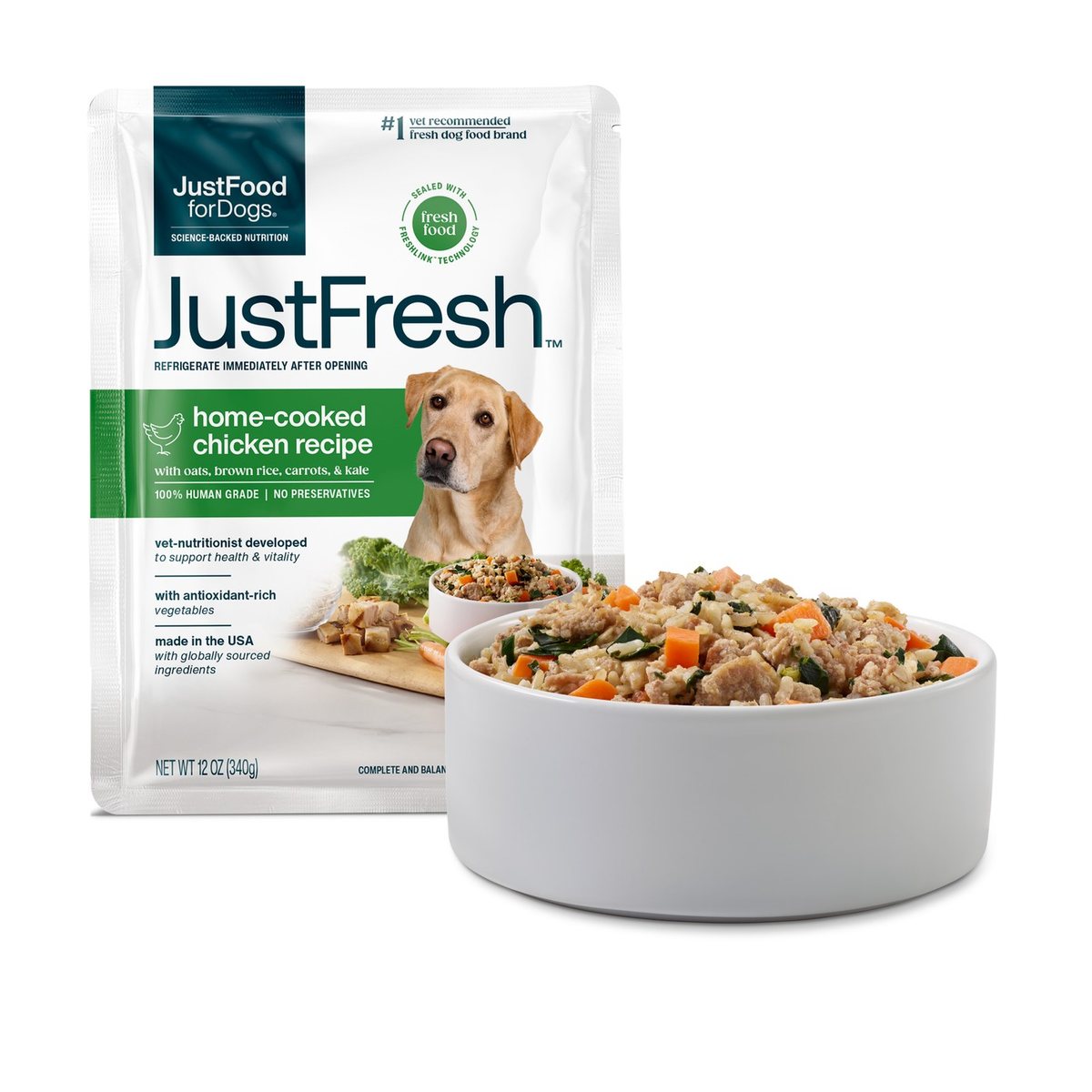
| JustFoodForDogs JustFresh Home-Cooked Chicken | Shelf-stable before opening | Oats and long-grain brown rice | Adult maintenance | 1,254 | Refrigerate after opening and use within 3 days | Adult-dog households that prefer unopened pantry storage |
| ORIJEN Amazing Grains Original | Dry | Oat groats, millet, and whole oats | All life stages, including growth of large dogs expected to reach 70 pounds or more | 3,920 | Follow the dry-food package’s storage instructions | Households comfortable measuring a relatively energy-dense dry ration |
| ACANA Wholesome Grains Free-Run Poultry & Grains Recipe | Dry | Oat groats, whole sorghum, whole millet, and whole oats | All life stages, including growth of large dogs expected to reach 70 pounds or more | 3,370 | Follow the dry-food package’s storage instructions | Households comparing a dry option with a different calorie density |
These calorie values describe the foods as sold. The fresh foods contain more moisture, so their calories per gram are lower than those of the two dry foods. That is a serving calculation, not proof that one format provides better nutrition.
Use the table to narrow the field, then read the individual pick. The product name matters: a different recipe, product line, or regional version can have different ingredients and nutritional information. The dry products here are the current U.S. recipes identified by their full names.
Fresh grain-inclusive choices from JustFoodForDogs
If you are looking for wet dog food with grain, distinguish fresh-frozen meals, shelf-stable fresh meals, and canned foods before comparing storage. They can all contain moisture and grains while requiring different handling. A soft appearance does not mean two products are packaged or preserved in the same way.
The two JustFoodForDogs choices below provide a practical comparison within fresh feeding. Chicken & Rice requires freezer and refrigerator planning. JustFresh Home-Cooked Chicken can be stored unopened according to its shelf-stable instructions, but it needs refrigeration after opening.
Neither product is a can. If your specific goal is canned dog food with grain, use the same adequacy, calorie, and ingredient checks on the canned recipe you are considering. These fresh options illustrate alternatives; they are not mislabeled substitutes for a canned-food comparison.
JustFoodForDogs Chicken & Rice
- Useful fit: a fresh-frozen grain-inclusive recipe with growth and adult-feeding eligibility.
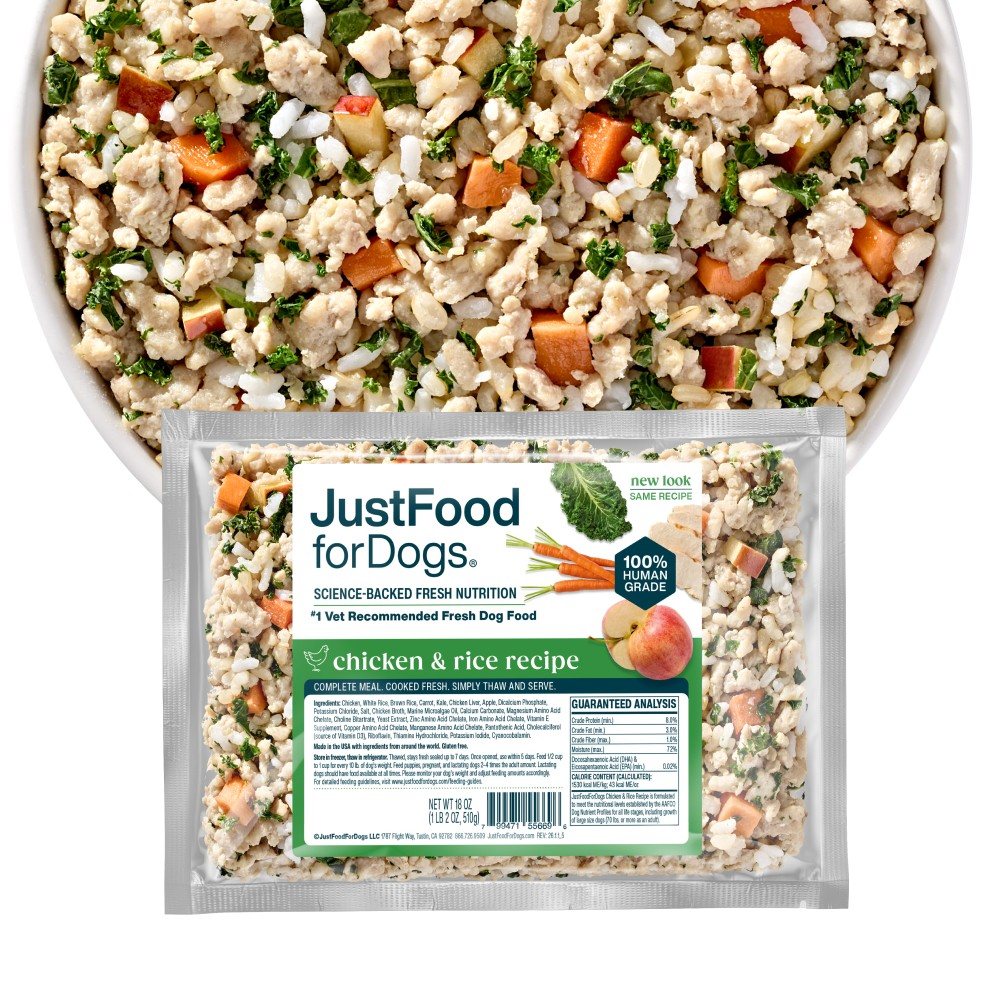
This recipe contains long-grain white rice and long-grain brown rice alongside chicken and other ingredients. Its current nutritional adequacy statement says it is formulated to meet AAFCO nutrient profiles for all life stages, including growth of large dogs expected to reach 70 pounds or more as adults.
That growth statement is a meaningful distinction from the adult-maintenance JustFresh recipe below. Do not assume that two chicken-based foods from the same company have the same puppy eligibility. For a household buying food for a growing dog, the exact adequacy statement is more useful than the shared brand name.
The current energy density is 1,530 calories per kilogram, equivalent to 1.53 calories per gram. The label also lists approximately 43 calories per ounce. Use one consistent set of units when calculating meals rather than alternating between ounces, grams, and an unmeasured scoop.
- Grains: Long-grain white rice and long-grain brown rice.
- Format: Fresh Frozen.
- Life stage: All life stages, including large-dog growth.
- Energy density: 1.53 calories per gram.
- Routine to plan: Frozen storage, refrigerator thawing, and use of the opened remainder within its instructions.
A useful way to evaluate this choice is to work backward from the daily portion. Determine how many grams your dog would receive, then compare that amount with the package size and available refrigerator space. A product that suits the dog nutritionally also needs to fit the pace at which your household uses it.
The JustFoodForDogs FAQ gives non-fish fresh-frozen meals up to seven refrigerated days sealed in the original package after thawing and five days after opening. Its fresh-frozen freezer period is up to 18 months. Follow the package directions and retain the date information when portioning.
Fit thawing into meal preparation
For someone already preparing measured meals, this can be a straightforward routine: move the next package to the refrigerator, serve a weighed portion, and put the untouched remainder back promptly. Someone who frequently forgets to thaw food may prefer a different format, even if the recipe itself is suitable.
Do not treat a fresh-frozen package as shelf-stable because another JustFoodForDogs line can be stored unopened in a pantry. This specific Chicken & Rice product needs its own storage conditions from the time you receive it.
JustFoodForDogs JustFresh Home-Cooked Chicken
- Useful fit: a grain-inclusive adult-maintenance meal with unopened shelf-stable storage.
JustFresh Home-Cooked Chicken contains oats and long-grain brown rice. Its current nutritional adequacy statement is for adult maintenance. It should not be selected as a growing puppy’s complete diet simply because the Fresh Frozen Chicken & Rice recipe has an all-life-stages statement.
The recipe supplies 1,254 calories per kilogram, or 1.254 calories per gram. The label’s approximate ounce value is 36 calories. Its lower calories per gram than Fresh Frozen Chicken & Rice mean that an equal-calorie serving weighs more. That difference is useful for portioning, but it does not establish which texture an individual dog will prefer.
- Grains: Oats and long-grain brown rice.
- Format: Shelf-stable before opening.
- Life stage: Adult maintenance.
- Energy density: 1.254 calories per gram.
- Routine to plan: Pantry storage while unopened, then refrigeration and prompt use after opening.
The brand gives unopened JustFresh a shelf life of up to two years from manufacture. That is not two years from the day you buy it, and it is not the opened-package allowance. Once opened, refrigerate the food and use it within three days.
Match storage to the product line
Fresh Frozen Chicken & Rice requires frozen storage before thawing. JustFresh Chicken can be stored unopened according to its shelf-stable directions. Both require appropriate handling after opening.
JustFresh may be convenient for a household that wants an unopened reserve without using freezer space. It can also simplify planning when someone else feeds the dog, because there is no thawing step before opening. The tradeoff is that you still need to finish or appropriately manage the opened package within its short refrigerated window.
Before choosing the largest package available, compare its contents with your dog’s actual daily amount. A small adult dog receiving part of its calories from another suitable complete food may use JustFresh more slowly than a dog eating it as the entire ration. Package size and feeding role therefore belong in the same decision.
Recalculate when changing recipes
The grain ingredients do not make JustFresh nutritionally interchangeable with the fresh-frozen recipe. It has its own formulation, calorie density, and adequacy statement. If you switch between them, recalculate the serving instead of carrying over the same gram amount.
For an adult dog with a suitable feeding plan, the strongest practical reason to consider this pick is the unopened storage format. Choose it because the complete product and routine fit, not because shelf stability implies it can remain in an opened bowl indefinitely.
Dry grain-inclusive choices for a different feeding routine
The best dry dog food with grain for a particular household should meet the same core requirements as a fresh food: appropriate life-stage nutrition, suitable ingredients, and an amount the owner can measure accurately. Dry food changes the handling routine and energy density, rather than removing the need to evaluate the whole recipe.
The two dry choices below contain different grain combinations and supply different calories per gram and per cup. Both current U.S. adequacy statements include all life stages and large-dog growth. That shared designation does not mean their serving sizes are identical.
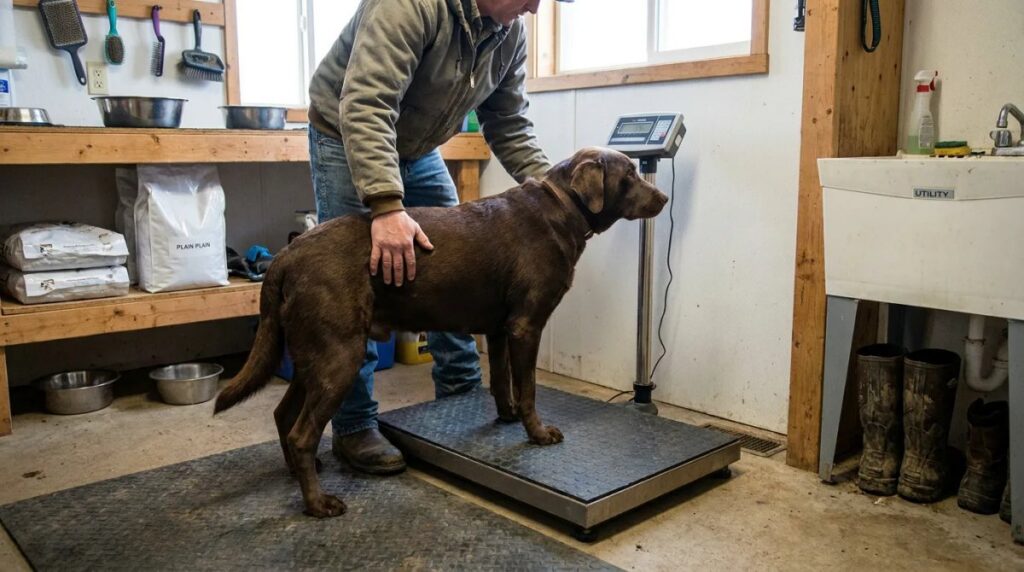
Dry food can be practical for measured training rewards, travel, or households that prefer not to thaw meals. Those are real conveniences. They do not mean the food can be stored carelessly, that an open bag lasts indefinitely, or that a cup from one formula can be substituted directly for a cup of another.
ORIJEN Amazing Grains Original
- Useful fit: an energy-dense dry option for owners who will measure its portion carefully.
The U.S. ORIJEN Amazing Grains Original recipe includes oat groats, millet, and whole oats. Its stated nutritional adequacy covers all life stages, including growth of large dogs expected to reach 70 pounds or more as adults.
Its listed calorie content is 3,920 calories per kilogram and 490 calories per cup. That converts to 3.92 calories per gram. Compared with the two fresh foods in this guide, a much smaller weight supplies the same calories.
This can be useful when an owner wants to carry a measured ration or use part of the daily dry food during training. It also makes casual overpouring consequential: a small additional weight of an energy-dense food contributes more calories than the same additional weight of a lower-density food.
- Grains: Oat groats, millet, and whole oats.
- Format: Dry.
- Life stage: All life stages, including large-dog growth.
- Energy density: 3.92 calories per gram.
- Listed cup value: 490 calories.
- Routine to plan: Consistent weighing or careful use of the recipe’s own cup information.
The guaranteed analysis lists minimum crude protein of 38% and minimum crude fat of 18%, with maximum crude fiber of 4% and maximum moisture of 12%. These are label guarantees, not an independent laboratory measurement of the portion in your bowl.
Do not compare the 38% protein figure directly with the fresh foods’ as-fed protein percentages and conclude that the dry food is automatically superior. Moisture differs substantially between formats. Even a moisture-adjusted comparison would not, by itself, establish protein quality, digestibility, or suitability for a particular dog.
Measure the compact daily ration
A useful application is to convert the dog’s established calorie allowance into grams, then check whether that portion is easy for the household to measure. If several people feed the dog, write down the gram amount rather than leaving the instruction as “a small scoop.”
The 490-calorie cup value is specific to this product’s stated measuring convention. A standard eight-ounce measuring cup describes volume; it does not mean the kibble inside weighs eight ounces. A kitchen scale avoids that particular confusion.
This pick is worth comparing when dry-food convenience and a relatively compact ration matter. It is not a default recommendation for every active dog or puppy. The individual dog’s intake, body condition, and feeding needs still determine whether it fits.
ACANA Wholesome Grains Free-Run Poultry & Grains Recipe
- Useful fit: a second dry option with a different grain mix and lower calorie density than the ORIJEN recipe above.
The current U.S. product name is ACANA Wholesome Grains Free-Run Poultry & Grains Recipe. Its named grains include oat groats, whole sorghum, whole millet, and whole oats. Use this exact product identity when checking the label rather than assuming a similarly named regional formula is identical.
The U.S. nutritional adequacy statement covers all life stages, including growth of large dogs expected to reach 70 pounds or more. Its listed energy content is 3,370 calories per kilogram, or 3.37 calories per gram, with 371 calories per cup.
That is lower in calories per gram than ORIJEN Amazing Grains Original, but higher than either fresh recipe in this comparison. An equal-calorie portion will therefore weigh more than the ORIJEN portion and less than the fresh-food portions.
- Grains: Oat groats, whole sorghum, whole millet, and whole oats.
- Format: Dry.
- Life stage: All life stages, including large-dog growth.
- Energy density: 3.37 calories per gram.
- Listed cup value: 371 calories.
- Routine to plan: A measured dry ration based on this recipe’s own calorie content.
Its guaranteed analysis lists minimum crude protein of 27% and minimum crude fat of 17%, with maximum crude fiber of 6% and maximum moisture of 12%. Those figures describe the manufacturer’s guarantees. They do not supply a measured carbohydrate value, a digestibility result, or a prediction of how an individual dog will respond.
The contrast with ORIJEN is useful because it shows why “dry grain-inclusive food” is not a single calorie category. Two bags can both include grains and support the same life stage while requiring different weights and cup amounts for an equal-calorie meal.
For example, an owner moving between these two dry recipes should not keep the same cup amount without recalculating. The stated 490 and 371 calories per cup are materially different. The equal-calorie worksheet below turns that label difference into a serving comparison.
Check the full formula for ingredient restrictions
ACANA’s poultry-based product name also matters for ingredient exclusions. A grain-inclusive label does not make this a poultry-free option. If a veterinarian has identified an ingredient restriction, use the complete ingredient list and the manufacturer’s information for the exact formula.
This choice can suit an owner who wants a dry routine and is comparing a less calorie-dense option than the ORIJEN food listed here. It should not be presented as a weight-loss treatment or as a universal low-calorie food. The useful claim is the specific, label-supported comparison between these recipes.
Read guaranteed analysis without turning it into a score
Guaranteed analysis can help you understand a label, but it is not a complete ranking system. Fresh and dry foods have different moisture contents, and the listed protein and fat values are typically minima while moisture and fiber are maxima.
Tufts’ explanation of guaranteed analysis explains those limits. A dry-matter calculation can help account for water, but using guaranteed minimum and maximum values produces an estimate rather than a measured analysis.
Label percentages have limits
A guaranteed minimum is not an exact laboratory result. Moisture-adjusted percentages do not establish digestibility, ingredient quality, or the best food for an individual dog.
For a practical comparison, keep nutrient interpretation separate from serving arithmetic. Calories per gram tell you how much food supplies a calorie allowance. The adequacy statement tells you the intended life stage. Neither requires declaring one food superior because a single percentage is higher.
Compare portions and daily cost on equal calories
The most useful rule across these formats is to compare equal calories, not equal scoops. A scoop measures volume, and a gram measures weight. Neither is a calorie unit. You need the exact recipe’s calorie density to connect the serving with the feeding plan.
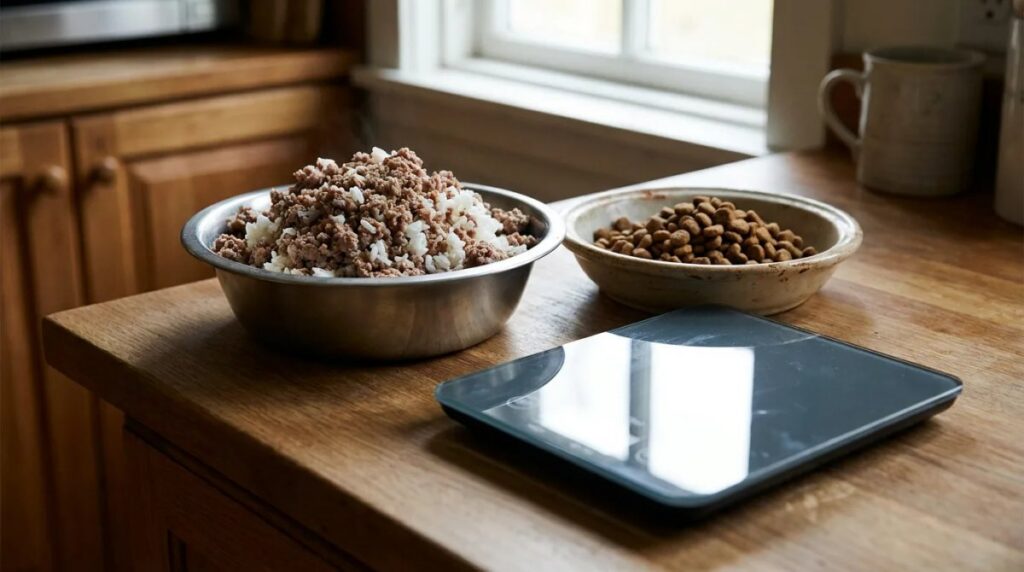
Start with an appropriate daily calorie allowance for your dog. That allowance may come from an established veterinary plan or a feeding estimate that is adjusted to the dog’s body condition and weight trend. The calculation below compares foods; it does not determine the right calorie target for every dog.
Convert the manufacturer’s calories per kilogram into calories per gram by dividing by 1,000. Then divide the calories assigned to that food by its calories per gram.
- Calories per gram = calories per kilogram ÷ 1,000.
- Grams to serve = calories allocated to the recipe ÷ calories per gram.
- Grams per meal = daily grams ÷ the number of equal meals.
- If meals are unequal, assign the planned share to each rather than adding an extra portion.
A hypothetical 400-calorie comparison
Suppose 400 calories are allocated to one of these foods. This is an illustrative allowance, not a recommendation for a particular breed, body weight, or life stage.
For Chicken & Rice, divide 400 by 1.53. The result is approximately 261 grams. For JustFresh Chicken, divide 400 by 1.254, which gives approximately 319 grams. The same calories require different weights because the recipes have different energy densities.
For ORIJEN, 400 divided by 3.92 gives approximately 102 grams. For ACANA, 400 divided by 3.37 gives approximately 119 grams. The smaller dry portions are not evidence that the dog is receiving fewer calories.
| Recipe | Calories per gram | Approximate weight for a hypothetical 400 calories | Storage format remains |
|---|---|---|---|
| JustFoodForDogs Chicken & Rice | 1.53 | 261 g | Fresh Frozen, then refrigerated after thawing |
| JustFoodForDogs JustFresh Home-Cooked Chicken | 1.254 | 319 g | Shelf-stable unopened, refrigerated after opening |
| ORIJEN Amazing Grains Original | 3.92 | 102 g | Dry, stored according to its package |
| ACANA Wholesome Grains Free-Run Poultry & Grains Recipe | 3.37 | 119 g | Dry, stored according to its package |
Rounding is appropriate for a household comparison, but keep the method consistent. If you are following a medical feeding plan, use the precision and adjustments your veterinary team specifies. Do not replace that plan with a hypothetical number from a shopping article.
The table also shows why bowl appearance can mislead. A larger fresh-food portion may look more generous while supplying the same calories as a smaller dry portion. That observation does not tell you which food an individual dog finds more satisfying, easier to eat, or more appealing.
Keep extras inside the daily total
If the dog also receives noncomplete treats, table food, or toppers, those calories belong in the same daily plan. The AAHA nutrition guidelines identify excessive extras as a nutritional risk. A common ceiling is no more than 10% of daily calories from noncomplete extras combined.
That is one shared allowance, not separate allowances for training treats, dental chews, and food from the table. Some dogs need a stricter plan. A dog on a supervised elimination diet, for example, cannot use a calorie calculation to justify an otherwise excluded treat.
- List the extras the dog actually receives.
- Read their calorie information where available.
- Subtract those calories before calculating the complete-food portion.
- Keep a household record if several people give rewards.
- Revisit the plan when the type or amount of extras changes.
Using a portion of the dog’s suitable complete food as rewards can simplify accounting when the format works for training. It still needs to come from the measured daily ration. Dry food may be easier to carry, while fresh food requires appropriate handling.
Calculate cost per day from the package you will buy
Price per bag or package is not enough to compare daily feeding cost. A heavier food with more moisture can have a lower price per pound while providing fewer calories per pound. A smaller package can cost less at checkout but more per day.
Use a current price for the exact package size and purchase arrangement you intend to use. A one-time introductory discount and a recurring price answer different budgeting questions. Shipping, taxes, and delivery frequency can also matter to the amount your household actually pays.
The calculation is:
- Package calories = package weight in grams × calories per gram.
- Cost per calorie = package price ÷ package calories.
- Daily food cost = cost per calorie × calories allocated to that food each day.
- Expected feeding days = package calories ÷ daily calories allocated to that food.
| Worksheet input | What to enter |
|---|---|
| Exact recipe and package | Full product name and size |
| Current price | The amount for the purchase arrangement you intend to use |
| Package weight | Convert the net food weight to grams |
| Calories per gram | Use the current recipe’s label |
| Total package calories | Weight in grams × calories per gram |
| Daily calorie allocation | The amount assigned to this food |
| Calculated daily cost | Price ÷ package calories × daily allocation |
Current prices were not verified for this comparison, so there is no supported cheapest-to-most-expensive ranking here. The worksheet lets you use the actual price in front of you rather than a stale promotion.
A purely hypothetical example shows the arithmetic. If a package costs $24 and contains 4,800 calories, its cost is half a cent per calorie. At an allocation of 400 calories per day, the calculated food cost is $2 per day. Those figures are invented to demonstrate the method and do not describe any product above.
Include the food you can actually use
The mathematical cost assumes the package is used appropriately. If an opened fresh package cannot be finished within its instructions, the practical cost of the food eaten may be higher than the simple calculation. Package size and storage therefore belong beside price, rather than being treated as a separate inconvenience.
For a small dog, buying the largest available package is not automatically the most economical choice. Compare the projected feeding days with the opened-food limit before deciding. For dry food, use the manufacturer’s storage and freshness guidance rather than assuming an oversized bag is always the best buy.
A practical purchase checklist is:
- Does the exact recipe fit the dog?
- Can you measure the calculated portion?
- Can you store the unopened supply correctly?
- Can you finish an opened package within its instructions?
- Does the ongoing daily cost fit the household budget?
- Is the same product reliably available through the route you plan to use?
Budget from the ongoing plan
Compare the current recurring price, package calories, and the amount your dog will actually use. A large package or first-order discount does not automatically produce the lowest sustainable daily cost.
Vetstreet’s JustFoodForDogs review provides earlier firsthand brand experience. Use the current recipe labels for today’s product details.
Is dog food with grain good for dogs?
Dog food with grain can be a good choice when the complete recipe suits the individual dog. Grains are ingredients within a formulation. Their presence does not automatically make a food healthy, and their absence does not automatically make it better.
The useful comparison is dog food with grain versus grain-free food at the level of the exact recipes. Vetstreet’s grain-free dog food explainer covers the companion question. Check nutritional adequacy, life stage, calorie density, ingredient suitability, and the manufacturer’s information. A front-label category cannot answer all of those questions.
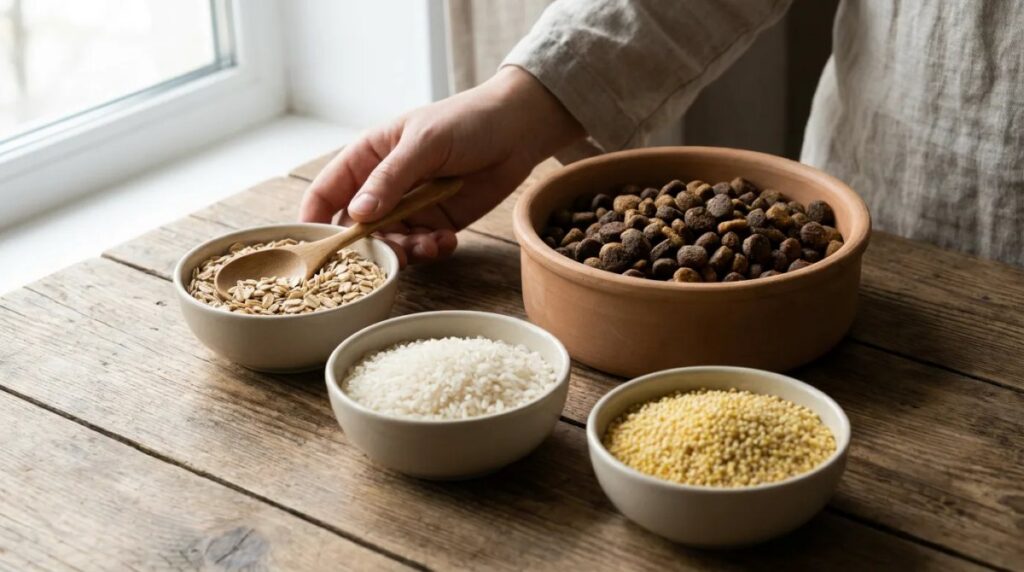
If you are deciding whether to choose dog food with grain or without it, begin with the dog’s needs and the reason for considering a change. A documented ingredient restriction is different from a general preference. So is a recommendation from the veterinarian who knows the dog’s history.
- Grain-inclusive is not the same as nutritionally complete.
- Grain-free is not the same as low-carbohydrate.
- A named grain does not identify the entire nutrient profile.
- A product category does not diagnose an allergy.
- A grain-inclusive label does not guarantee protection against heart disease.
The four products in this guide are not selected because grains are a cure or because one ingredient category should be feared. They are concrete examples that let you compare fresh and dry routines while keeping the nutritional information visible.
Avoid judging the recipe from one ingredient
Owners sometimes ask whether dog food with grain is bad because they have seen rice, oats, or other grains described broadly as fillers. That label does not evaluate the finished diet. The important question is whether the food supplies appropriate nutrition when fed according to a suitable plan.
The opposite shortcut is also unreliable. A food is not automatically the best choice because it lists several whole grains or uses an ingredient you associate with a healthy human breakfast. Dogs eat the formulated food, not the marketing story surrounding one component.
Use ingredient information for the questions it can answer. It can help you identify rice, oats, poultry ingredients, or a specific exclusion. It cannot by itself tell you how digestible the finished recipe is, whether the dog will maintain an appropriate body condition on your chosen portion, or whether one brand is universally better.
Change the question from “Which category wins?” to “Does this recipe fit?”
A practical decision can be narrower than a verdict on all grain-inclusive or grain-free foods. If a dog does well on an appropriate complete diet, the presence of grains alone does not establish a need to change. If the current routine is difficult, identify the specific problem before switching.
For example, needing unopened pantry storage is a format problem. Needing growth nutrition is a life-stage problem. An unexplained reaction is a clinical assessment problem. Those questions lead to different evidence and should not all be answered by choosing or avoiding grains.
After a change, use observations that relate to the actual goal. If you wanted easier portioning, assess whether the measured routine works. If the dog has a medical concern, follow the veterinary plan rather than treating a new grain label as proof that the concern has been resolved.
Choose the right life stage and protein before the grain label
The best dog food with grain for small dogs and large dogs begins with appropriate nutrition for the individual, not a universal grain preference. Size affects the amount served and the practicality of the texture and package. Growth status affects which adequacy statement is appropriate.
Puppies need a growth-appropriate recipe
For puppy dog food with grain, read the actual growth or all-life-stages statement. A food designated only for adult maintenance is not a puppy’s complete diet. This remains true when the product has an appealing fresh texture or shares its main protein with a growth-appropriate recipe.
Among these four choices, Chicken & Rice and both dry recipes have current statements covering all life stages, including growth of large dogs expected to reach 70 pounds or more. JustFresh Home-Cooked Chicken is for adult maintenance.
Large-breed puppy owners should pay particular attention to the large-dog growth wording. “Suitable for adults” and “suitable for growth of large dogs” are different claims. Do not try to correct an unsuitable main diet by adding a supplement without professional formulation.
- Confirm the puppy’s expected adult size.
- Read the adequacy statement on the exact package.
- Use the growth feeding plan rather than an adult’s portion.
- Reassess intake as the puppy grows.
- Keep extras from displacing the complete growth diet.
Small dogs need a usable portion and package
Small breed dog food with grain can come in several formats. A smaller mouth does not automatically require fresh food, and a small-breed label does not eliminate the need to measure calories. Consider what your dog can comfortably pick up and eat, as well as the amount needed each day.
The equal-calorie table can help you compare the practical size of the ration. A lower-calorie-per-gram fresh food creates a larger weight of food for the same calories. A dry food creates a smaller weight. Neither observation alone tells you which will suit a particular small dog.
Package use is especially relevant. If a dog needs only a modest daily amount, check whether an opened fresh package can be used within its refrigerated window. Clear measuring instructions also help prevent a tiny dog from receiving several “small” extras that together represent a substantial share of its day.
Large adults need an individual allowance
For large breed dog food with grain, do not confuse a large-breed growth statement with a command to feed every large adult the same amount. Adult calorie needs still vary with condition, activity, and the individual feeding plan.
A large dog can make a package disappear quickly, but that does not make portion calculation optional. Multiplying an imprecise scoop over several meals can create a meaningful difference in intake. Use the recipe’s energy density and a consistent measuring method.
The WSAVA body-condition chart provides a way to assess body fat using features such as the ribs, waist, and abdominal tuck. Weight trend and veterinary assessment add context; the amount printed on a package is a starting point rather than a permanent rule for every dog.
Senior dogs are not one calorie category
Senior dog food with grain should suit the older dog’s actual condition and needs. Age alone does not tell you whether the dog needs more or fewer calories, a different texture, or a medical diet. Changes in muscle, appetite, mobility, and health can all matter.
If an older dog begins eating less or has trouble managing its food, identify the cause instead of assuming that a softer product solves it. A fresh texture may be easier to present in some situations, but an unexplained change in eating deserves attention.
Keep the current food label and a record of what the dog actually eats when discussing a change with the veterinary team. That makes the conversation more useful than asking only whether the next food should contain grains.
Ingredient exclusions require the whole list
Chicken-free dog food with grain and poultry-free dog food with grain are separate searches from simply finding a grain-inclusive recipe. The four choices in this comparison should not be treated as a shortlist that meets every ingredient exclusion.
Read the complete ingredient list rather than relying on the recipe name or grain claim. If an exclusion is part of a supervised food trial, ask the veterinarian which product characteristics and manufacturer information are required. A casual label comparison is not the same as confirming suitability for a diagnostic diet.
A practical record includes:
- The exact ingredient being avoided.
- Why it is being avoided.
- The complete name of the proposed recipe.
- Its current ingredient list and adequacy statement.
- Any additional manufacturer information requested by the veterinary team.
This keeps the selection focused on the dog’s needs. It also prevents a well-intentioned switch from changing several things at once without a clear reason or a way to assess the result.
Grain-inclusive dog food questions
Veterinarians do not all share one blanket opinion. Concern about some diets has included the investigation of non-hereditary dilated cardiomyopathy, or DCM. The FDA describes a complex issue with potentially interacting factors and reports involving both grain-free and grain-containing foods. It has not established a specific connection that lets owners judge safety from the grain label alone. Discuss the exact recipe and your dog’s history with your veterinarian; adding grain is not a guaranteed prevention strategy.
There is no universally healthiest grain independent of the complete recipe and the dog eating it. Rice, oats, millet, and other grains can appear in formulated foods with different nutrient profiles. Comparing a dog’s complete food is more useful than ranking grains as standalone ingredients. If a specific ingredient must be restricted, follow the individual feeding plan rather than choosing a substitute solely because it sounds more nutritious.
Reasons can include personal preference, marketing messages, prior feeding experiences, or a specific veterinary recommendation. Those reasons are not equivalent. A diagnosed need to avoid an ingredient should guide selection, while a general impression that all grains are unsuitable does not establish that a particular complete food is wrong for the dog. If a food seems associated with a problem, keep a detailed history and seek assessment instead of repeatedly removing broad ingredient categories.
Often, provided both foods are appropriate for the dog’s life stage and feeding plan. Allocate calories to each food instead of adding a full fresh serving to a full dry ration. Calculate the grams of each from its own calorie density, and follow the storage requirements of the mixed meal’s perishable component. Dogs on a prescribed diet or supervised food trial need their veterinary team’s guidance before mixing foods.
No. A grain claim tells you about one ingredient category and does not establish which animal ingredients are present. If chicken or all poultry must be excluded, inspect the full current formula and obtain any manufacturer details your veterinarian needs. Do not substitute a general grain-inclusive product for a prescribed elimination diet simply because its front label emphasizes oats, rice, or another grain.
The FDA’s current DCM questions and answers explain the uncertainty behind diet-related concerns. For the everyday shopping decision, keep the exact recipe, life stage, measured calories, and workable storage routine together.