Fresh Dog Food for Active Dogs: Fueling High-Energy and Working Dogs
Published on November 03, 2026
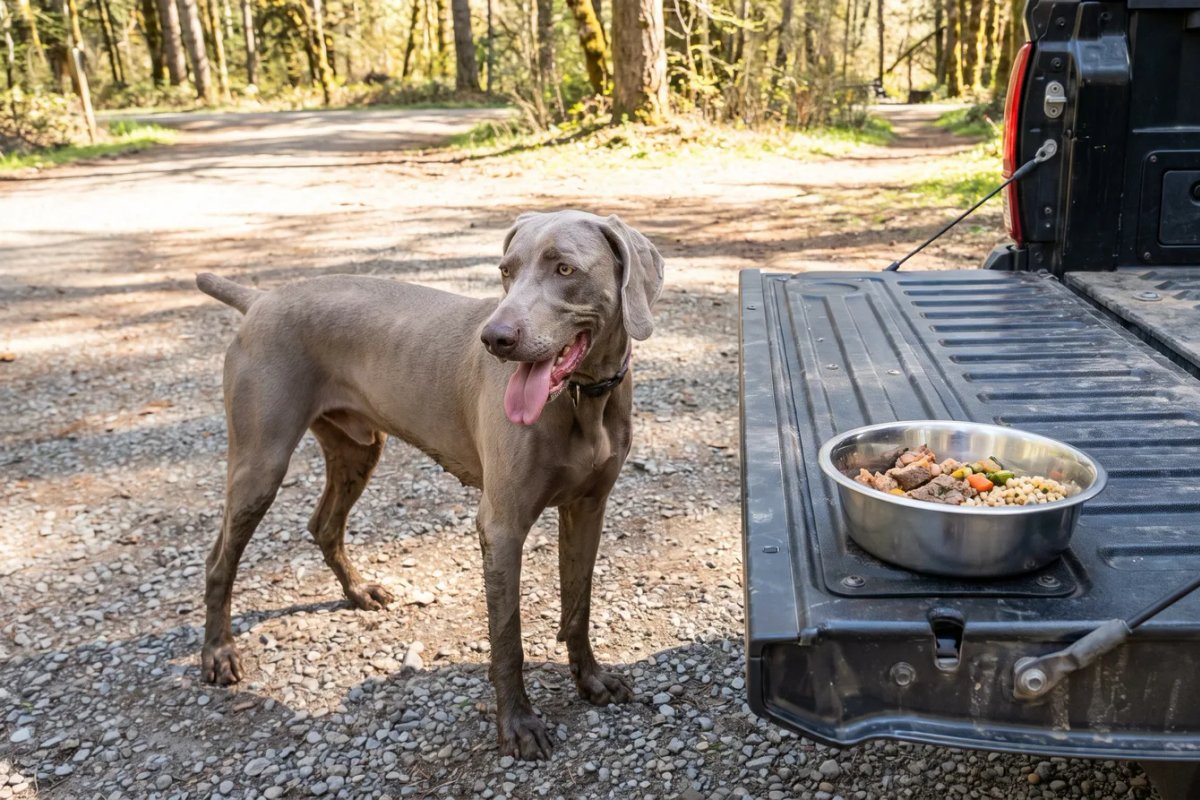
Fresh dog food for active dogs works well when the calories in the bowl match the work the dog is doing. A retriever that hunts every weekend, a border collie that herds all day, and a lab that runs five miles with its owner each morning all burn more energy than a dog that naps on the couch, and that extra energy has to come from somewhere. Fresh food can supply it, as long as you know the calorie density of the recipe and scale the portion with care.
This guide walks through the numbers that matter for high-energy and working dogs: how many calories an active dog needs, how protein and fat fuel exercise and recovery, how to raise portions without guesswork, and when to feed around exercise so you lower the risk of bloat. It uses the published calorie and guaranteed-analysis figures for Get Real, Chewy’s gently cooked fresh dog food, to show how the math works with a real recipe.
This article is sponsored by Get Real, Chewy’s gently cooked fresh dog food line. Vetstreet may earn a commission if you purchase through links in this article.
Key Takeaways
- Fresh food can fuel an active or working dog when calories match workload, so the portion has to grow as the work grows.
- Fat is the main fuel for endurance work, and protein supports muscle repair after hard days.
- Raise portions in small steps of about 10 percent and check body condition every week.
- Meal timing matters: give your dog rest before and after hard exercise to lower bloat risk.
- Switch to a new food gradually over 7 to 10 days, even for a hungry, hard-working dog.
Fresh dog food for active dogs: the quick answer
Is active dog food good for dogs? Yes, for dogs that truly need it. Food chosen for active dogs is simply more calorie dense, and it is good for a dog whose daily exercise burns those calories. For a dog that is less active than its owner thinks, the same food can lead to weight gain, so the label matters less than how well the calories match the dog.
So what is the best dog food for active dogs? A good dog food for active dogs is complete and balanced, offers enough protein and fat to support the work, and is calorie dense enough that the dog does not need an enormous bowl to meet its needs. Fresh food fits that description well. Get Real, for example, is gently cooked then frozen, made with human-grade ingredients and 10 ingredients or less plus vitamins and minerals, and meets AAFCO nutrient profiles for all life stages. Its Get Real Turkey & Cranberry Recipe lists the most calories per pack of the three recipes, which makes it a natural first look for a hard-working dog.
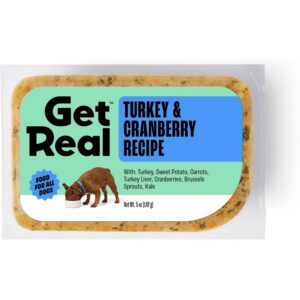
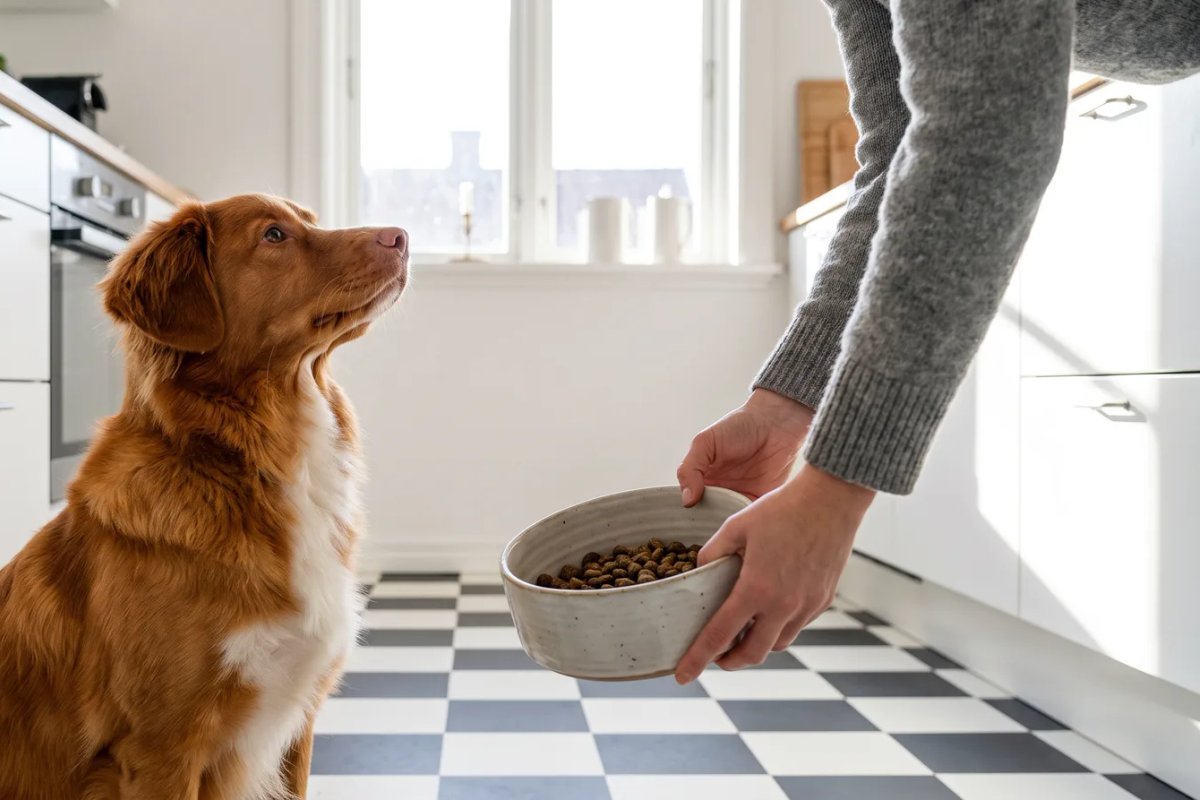
Get Real Turkey & Cranberry Recipe. The Get Real recipe with the most calories listed per pack and the highest printed fat minimum, a sensible starting point for dogs that work or train hard.
Which dogs count as active? The most active dogs are usually the sporting, herding, and working breeds, but activity is about the individual dog and its routine, not only the breed. Some useful reference points:
- Labradors and golden retrievers were bred to retrieve and swim, and they thrive with a job or daily exercise.
- Standard poodles were bred as water retrievers, and they are brainy and often excel at agility.
- Corgis and other herding breeds have real stamina despite short legs.
- Beagles and dachshunds were bred to hunt, although many pet dachshunds lead quieter lives.
- Dobermans and Cane Corsos are powerful working breeds that need regular, structured exercise.
- Greyhounds sprint hard but spend much of the day resting, so most need less endurance fuel than their speed suggests.
- Pugs and other flat-faced breeds cannot safely handle long, hard exercise in heat.
If you want a longer list, the Vetstreet roundup of the most athletic dog breeds goes deeper. Whatever the breed, the right food supplies enough calories for the work, is complete and balanced for the dog’s life stage, and keeps the dog lean.
The principles are the same for small dogs and big ones: match calories to workload, choose a complete and balanced food, and judge the result by your dog’s body condition. Small active dogs, such as a Jack Russell terrier or a miniature poodle, burn a lot of energy for their size, so a calorie-dense food lets them eat enough without overfilling a small stomach. Grain-free is a label choice rather than a performance feature, so focus on calories, protein, and balance first. For a dog that trains most days rather than working all day, a recipe in the middle of the calorie range is often the easiest everyday fit.
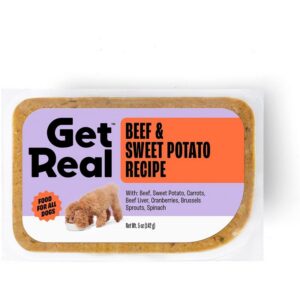
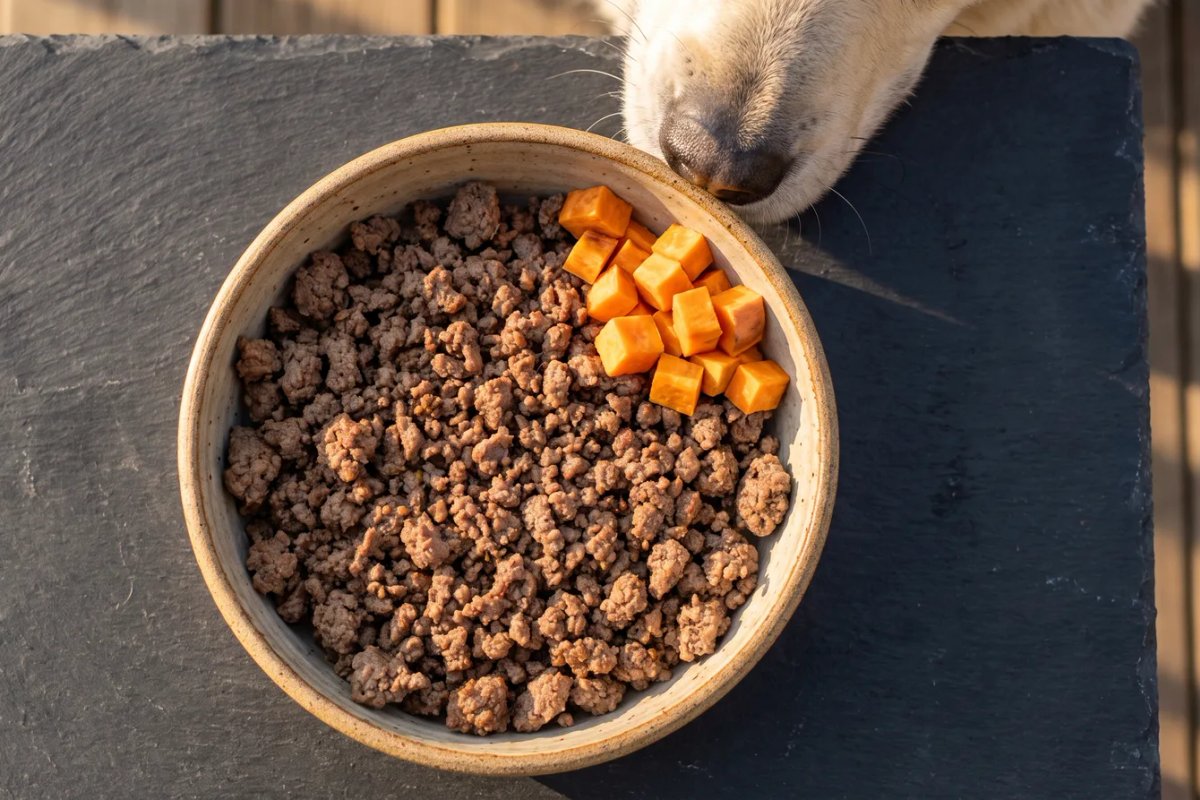
Get Real Beef & Sweet Potato Recipe. Beef and sweet potato in the middle of the Get Real calorie range, a steady everyday option for dogs that train most days.
How many calories does an active dog need?
An active dog needs more calories than a resting dog, and a working dog can need much more. Veterinary nutritionists start with the resting energy requirement, then multiply it to get maintenance calories. According to the Merck Veterinary Manual, the resting energy requirement equals 70 times body weight in kilograms raised to the 0.75 power, and a moderately active neutered adult dog needs roughly 1.6 times that figure for maintenance. The same source notes that an individual dog can need about 30 percent more or less than the calculated amount.
Activity pushes the number up. As a general rule, active dogs can need roughly 1.5 to 2 times their maintenance calories on busy days, and heavy working dogs, such as dogs hunting all day in cold weather or sled dogs in training, can need more still, always adjusted by body condition. Because fat supplies more than twice the energy of protein or carbohydrate per gram, fat is what makes a high-energy diet calorie dense, and it is the main fuel for endurance work.
Here is how that plays out for working and sporting dogs:
- A dog that walks 30 to 60 minutes a day usually does well near its maintenance calories.
- A dog that runs, trains for agility, or plays fetch hard for an hour or more most days often needs a modest increase above maintenance.
- A hunting dog in the field all day, a herding dog working stock, or a search dog on long shifts can need well above maintenance on work days and less on rest days.
- Young active dogs that are still growing need calories for both growth and activity, so their portions should be set with growth in mind.
- Large active dogs burn more total calories but fewer per pound than small dogs, which is why the formula uses body weight to the 0.75 power.
These multipliers are starting points, not prescriptions. Any food still has to be fed in the right amount for the dog, and the only way to know the amount is right is to watch body condition over time. A body condition score, the 1 to 9 scale veterinarians use, is the most reliable check. An ideal score of 4 or 5 means you can easily feel the ribs under a thin layer of fat, see a waist from above, and see a tuck behind the ribs from the side.
Calories on rest days deserve a mention too. Many owners raise the portion when a dog starts training and never bring it back down when the season ends. A dog that hunts hard from fall into winter and then spends the spring at home needs its portion lowered again, or the extra calories turn into extra pounds. Building the habit of adjusting in both directions is what separates a well-fed active dog from an overweight one.
Protein and fat for high-energy and working dogs
What is the best dog food for a working dog? The best dog food for a working dog is complete and balanced, has enough calorie density to meet the workload in a reasonable portion, and supplies plenty of protein from quality animal sources plus enough fat to fuel long effort. Fresh, gently cooked food can meet those criteria when the recipe and portion are chosen with the dog’s work in mind.
Fat is the main fuel for endurance work. Dogs are very good at burning fat during long, steady exercise, and fat packs about 9 kcal per gram compared with about 4 for protein and carbohydrate. That is why a high-calorie food almost always has more fat, and why the fat minimum on a label is one of the first numbers to check for a very active dog.
Protein supports muscle repair and recovery. Every training session causes small amounts of muscle wear, and the body uses dietary protein to rebuild it. A high-protein food makes sense because a working dog that eats more calories should also take in more protein, which happens naturally when you feed more of a complete and balanced food. AAFCO sets a minimum protein level for adult maintenance, and most fresh foods sit well above it once you account for moisture.
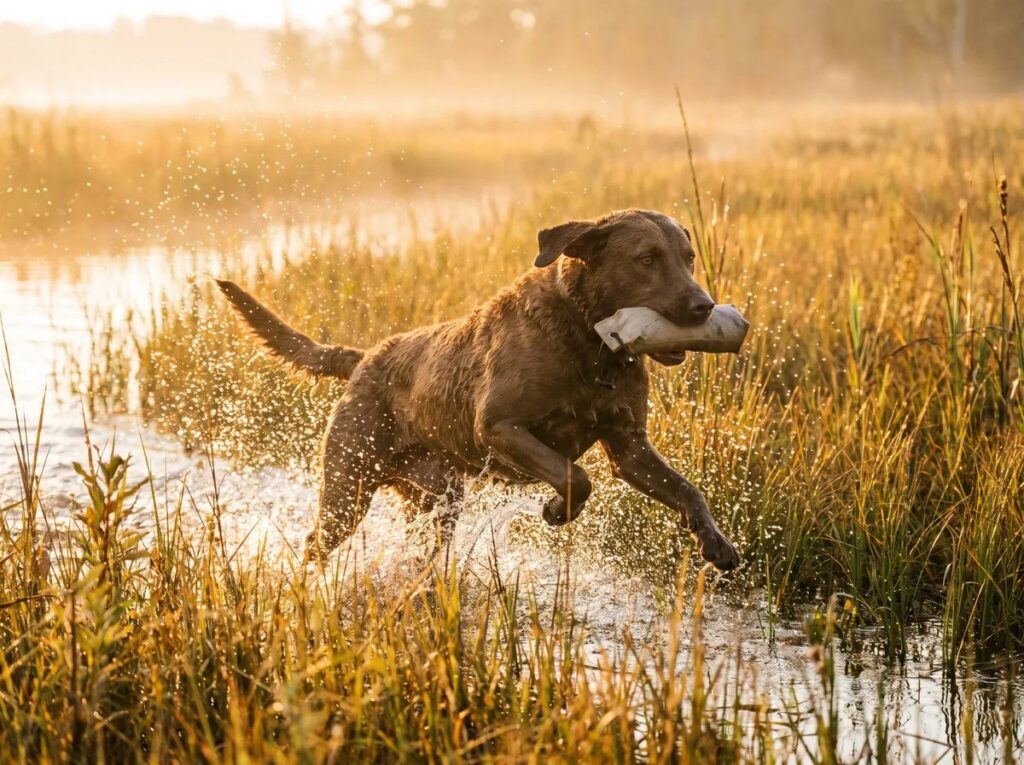
How do you read protein and fat on a fresh food label? Fresh food is about 75 percent moisture, so the guaranteed analysis looks low next to kibble, which is usually around 10 percent moisture. To compare fairly, convert to a dry matter basis by dividing the nutrient percentage by the dry portion of the food. As an illustration only, using guaranteed minimums and maximums rather than actual values: Get Real Chicken & Brussels Sprouts lists at least 10 percent protein and 8.5 percent fat with no more than 75 percent moisture, which converts to roughly 40 percent protein and 34 percent fat on a dry matter basis. Guaranteed analysis figures are label floors and ceilings, so this conversion does not establish the food’s actual nutrient percentages.
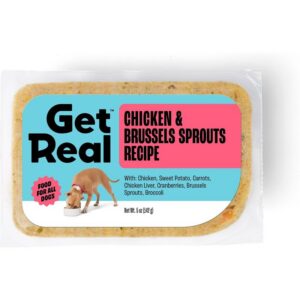
Get Real Chicken & Brussels Sprouts Recipe. Chicken and Brussels sprouts with the fewest calories listed per pack of the three recipes, an easy base for scaling portions up step by step.
When comparing foods for a very active dog:
- Look for named animal proteins, such as chicken, beef, or turkey, near the top of the ingredient list.
- Compare fat minimums on a dry matter basis, not as printed, when comparing fresh food with kibble.
- Choose a food that is complete and balanced for the dog’s life stage, with an AAFCO statement on the label.
- Remember that more protein is not automatically better; the right amount comes from feeding enough of a balanced food.
- Keep treats under about 10 percent of daily calories so they do not dilute the balanced diet.
Owners sometimes notice that a very active dog stays very active after being neutered. That dog still needs fewer calories than an intact dog doing the same work, because neutering lowers energy needs, so check body condition closely in the months after surgery. The portion should be adjusted down if the ribs disappear under a new layer of fat. The Vetstreet guide to keeping your dog at a healthy weight explains how to read the ribs, waist, and tuck.
Comparing Get Real recipes for active dogs
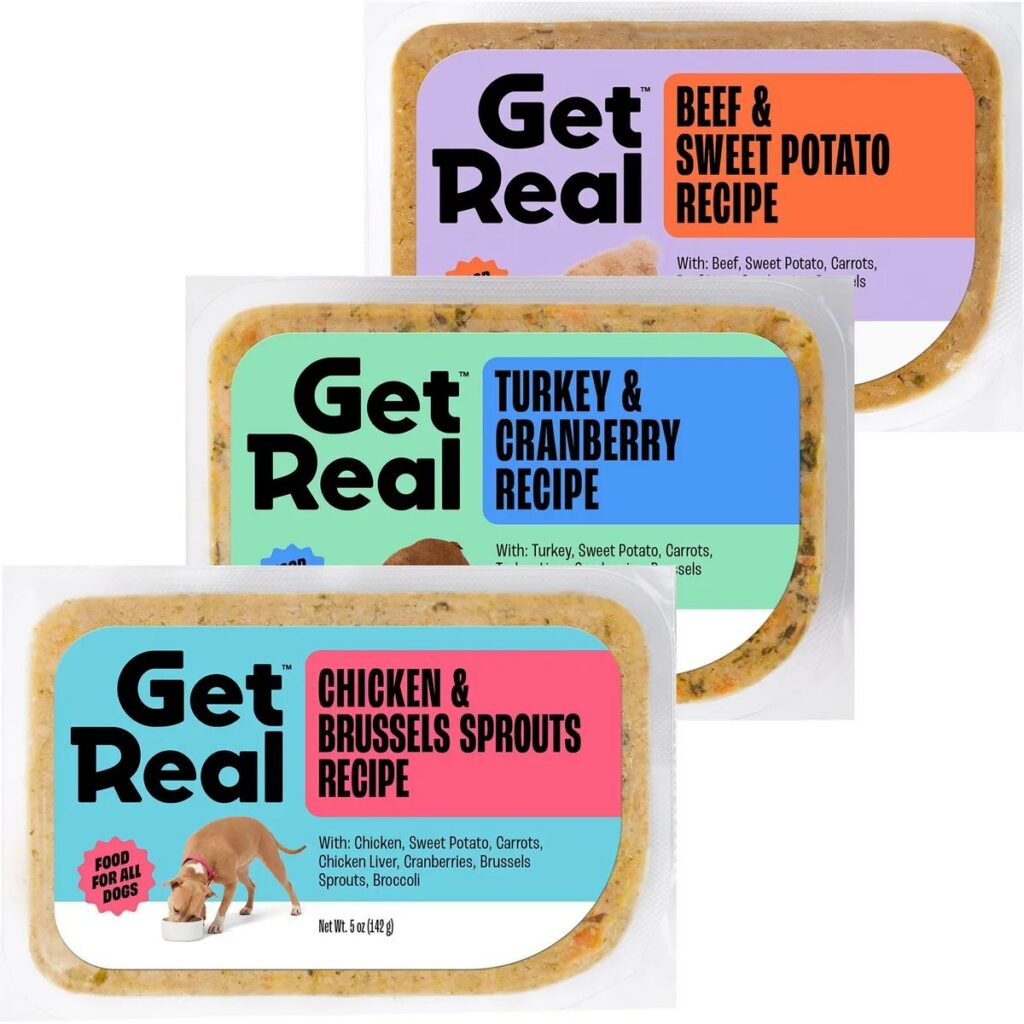
The three Get Real recipes share the same approach, gently cooked then frozen with 10 ingredients or less plus vitamins and minerals, but the calories listed per pack and their printed guarantees differ. For an active dog, the calories per pack are the practical figure for portioning. The table below uses the calories listed on Chewy’s product pages for the 12 oz and 24 oz packs, plus each recipe’s guaranteed protein and fat minimums.
| Recipe | Protein (min) | Fat (min) | kcal per 12 oz pack | kcal per 24 oz pack |
|---|---|---|---|---|
| Turkey & Cranberry | 8% | 10% | 474 | 948 |
| Beef & Sweet Potato | 9% | 7% | 451 | 902 |
| Chicken & Brussels Sprouts | 10% | 8.5% | 428 | 856 |
Here is what the numbers mean for an active dog:
- Turkey & Cranberry lists the most calories per 12 oz pack, 474, and prints the highest fat minimum, 10 percent, which makes it the most calories per pack for hard-working dogs.
- Chicken & Brussels Sprouts lists the fewest calories per 12 oz pack, 428, which suits an active dog that gains weight easily or needs a little more volume in the bowl.
- Beef & Sweet Potato sits between them on calories and offers a rich, beef-forward option; its listed ingredients start with beef, sweet potato, carrots, and beef liver.
The Get Real Beef & Sweet Potato Recipe is a good middle path for a dog that trains most days but is not working stock or hunting all day. Many owners rotate recipes by season, leaning on the more calorie-dense turkey during heavy work and moving to chicken or beef during lighter months.
If you are choosing between proteins for other reasons, such as a dog that does better on one meat, the comparison of chicken vs beef vs turkey for dogs walks through each protein in more depth. Get Real meets AAFCO nutrient profiles for all life stages, including growth of large dogs, so the same recipes can feed a growing young dog and an adult working dog.
Calorie density also affects how full the bowl looks. Because fresh food holds so much water, the same calories take up more space than kibble. That is helpful for a dog that loves to eat, but it can be a challenge for a very hard-working dog with big energy needs. In that case the more calorie-dense recipe, or splitting the day into more meals, keeps each portion comfortable.
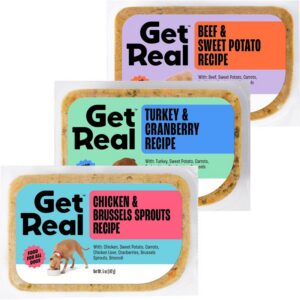
Get Real Sampler Pack, Beef, Chicken & Turkey Gently Cooked Fresh Dog Food, 6 pack bundle (2 of each recipe). Try the Get Real recipes before committing, then build your active dog’s plan around the one it eats best.
How to scale portions up without guesswork
The Get Real online plan sets a starting portion based on your dog’s weight, breed, age, and activity level. That is the right place to begin. From there, the goal is to adjust using your dog’s own response instead of guessing. This routine works for most active dogs:
- Start at the plan amount for at least two weeks and weigh your dog at the start.
- Check body condition weekly: run your hands along the ribs, look for a waist from above, and look for a tuck from the side.
- If your dog is losing weight or the ribs are becoming visible during heavier work, raise the daily portion in 10 percent steps.
- Hold each new amount for a week before deciding on another change.
- Stop increasing when the ribs are easy to feel but not see and your dog’s weight is steady.
- Lower the portion by about 10 percent at a time when the work season ends or the dog’s activity drops.
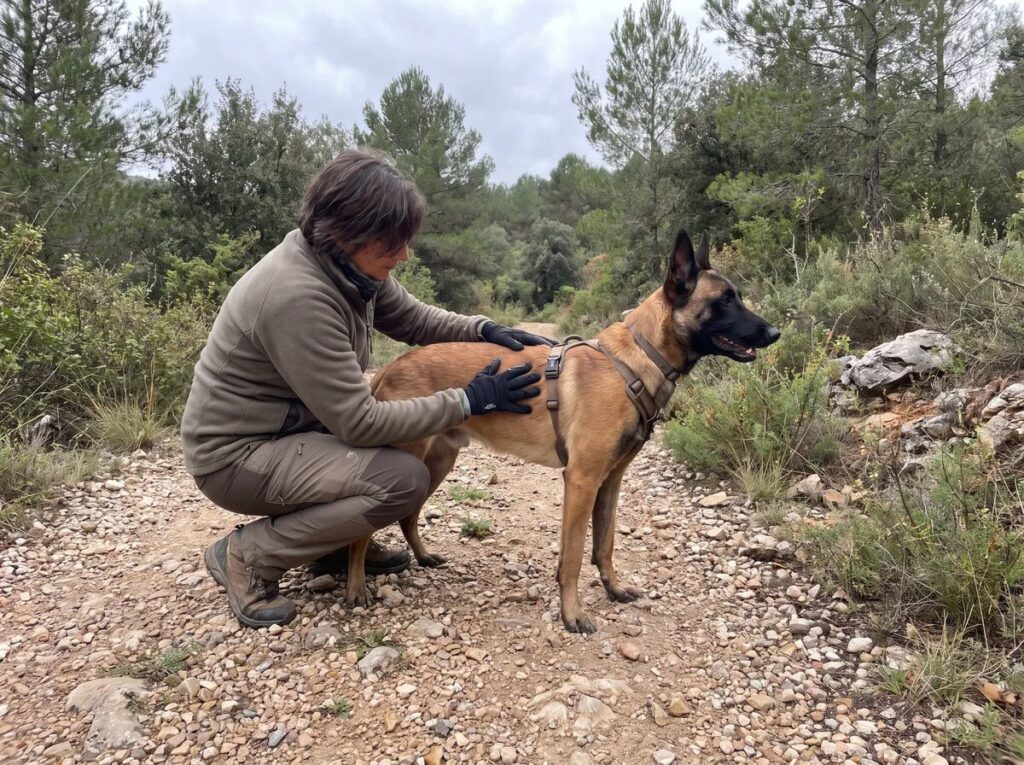
Here is what a 10 percent step looks like in real numbers. Suppose your dog’s plan supplies about 950 kcal a day, roughly one 24 oz pack of Turkey & Cranberry at 948 kcal, and your dog is getting thinner during a busy training month. A 10 percent step adds about 95 kcal a day, which is about one fifth of a 12 oz Turkey pack at 474 kcal. After a week at the new amount, recheck body condition. If the ribs are still too easy to see, take another 10 percent step. Small changes like these are easy to reverse and far safer than doubling a portion overnight.
Why 10 percent steps and not bigger jumps? Large jumps can upset the stomach, and they make it hard to tell how much extra food your dog truly needs. A body condition change takes a week or two to show, so moving in small steps lets you see the effect of each change. Body condition, not the scale alone, is the guide, because a dog that is building muscle can gain weight while looking leaner.
Treats, chews, and training rewards count toward the daily total. A dog that earns dozens of rewards in a training session can take in a surprising number of extra calories. If you train with food, use part of the day’s meal as rewards or choose small, low-calorie treats, and keep all extras to about 10 percent of daily calories.
- Write down the daily amount each time you change it, so you can see the trend over a season.
- Weigh on the same scale at the same time of day.
- Take a side-view photo every two weeks; it often shows a waist change before the scale does.
Meal timing around exercise and work
When you feed matters almost as much as how much you feed. A full stomach during hard exercise is uncomfortable, and in large, deep-chested dogs it is linked to bloat, or gastric dilatation-volvulus (GDV), a life-threatening condition in which the stomach fills with gas and can twist. The Merck Veterinary Manual lists restricting exercise before and after meals and feeding multiple small meals rather than one large meal among the steps that help lower bloat risk, and the American College of Veterinary Surgeons notes that dogs fed a single large meal once daily are at higher risk.
In practice, a simple rule covers most dogs: feed at least an hour before and after hard exercise, and longer for big, deep-chested breeds. A practical schedule for a working or sporting dog looks like this:
- Feed the main meal at least an hour after the dog has cooled down from work, and longer after very hard exercise.
- If the dog works in the morning, give a small meal well before work and the larger meal after recovery.
- Split the daily amount into two or three meals instead of one, especially for large, deep-chested breeds.
- Offer water before, during breaks in, and after work, but avoid letting a hot dog gulp a huge volume at once.
- Keep mealtime calm, and avoid a hard play session right after eating.
Bloat risk after exercise is real for large, deep-chested dogs. Emergency warning signs include a swollen belly, unproductive retching, drooling, restlessness, and weakness; go to an emergency veterinarian right away if you see them.
For a dog that hunts or works all day, spreading food across the day helps too. Small snacks during long breaks, rather than one large meal in the middle of the work, keep energy steady without filling the stomach. On multi-day events, keep the same feeding times as at home where you can, because a familiar routine helps a working dog eat well under stress. For a day in the field, portion thawed food ahead of time and keep it in a cooler at 40 F or below.
The same idea applies to training days at home. If you run with your dog in the morning, feed after the run once the dog has cooled down and caught its breath. If you train in the evening, feed the larger meal earlier in the day and a smaller one later, after the session. Consistent meal timing helps both digestion and appetite.
Hydration, heat, and recovery
Active dogs lose water through panting, and working in heat raises that loss sharply. Fresh food is about 75 percent moisture, so every meal adds water, but that moisture does not replace drinking. Always bring water on outings, offer it often, and watch for signs that your dog is struggling in warm weather. The Vetstreet article on running in hot weather with your dog explains why heat is so dangerous for running dogs.
Recovery is where good nutrition pays off. After hard work, a dog needs water first, then a cool-down, and then a meal once it has settled. These habits support recovery:
- Offer small amounts of water often during and after work rather than one large drink.
- Rest in shade before the post-work meal, and wait until breathing has returned to normal.
- Feed the recovery meal on time, because muscles repair best when protein and calories arrive consistently.
- Plan a lighter day after an unusually hard one, both for exercise and, if the dog is holding weight, for portion size.
- Check paws, joints, and gait after long work days, and rest a dog that is sore.
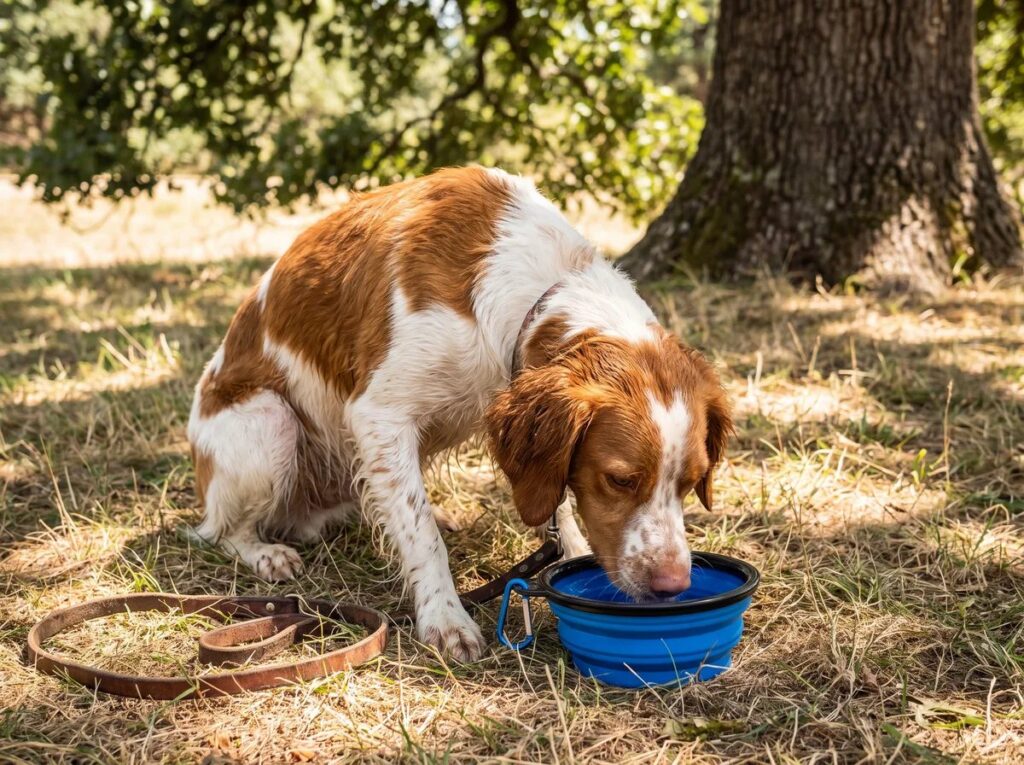
Heat changes calorie needs too. Dogs working in hot weather often eat less, while dogs working in cold weather need more calories to stay warm. Watch body condition through seasonal changes, and adjust portions in the same 10 percent steps. A dog that refuses food after a hot day, or seems weak, wobbly, or confused, may be overheated and needs cooling and veterinary attention.
How to switch an active dog to fresh food
Even a hungry, hard-working dog should change foods gradually. Chewy recommends mixing a small amount of Get Real into the current food and increasing it over 7 to 10 days, or 10 to 14 days for dogs with sensitive stomachs. A gradual transition gives the gut time to adjust and avoids loose stools in the middle of a training season.
A simple 7 to 10 day transition looks like this:
- Days 1 to 3: about one quarter fresh food and three quarters current food.
- Days 4 to 6: about half and half.
- Days 7 to 9: about three quarters fresh food.
- Day 10 onward: fresh food as the full meal, if that is your plan.
Plan the switch for a lighter week if you can, not the week of a big hunt, trial, or race. To keep the change simple, thaw Get Real packs in the refrigerator for 12 to 24 hours (35 to 48 hours for the 24 oz size), use thawed food within 3 to 5 days, and discard any food that has sat at room temperature for more than 2 hours.
If you want to start with the leanest recipe and move up only as needed, the Get Real Chicken & Brussels Sprouts Recipe is a sensible base. Its higher protein and lower calories make it easy to add volume in small steps while you learn your dog’s real needs during the season.
A few Get Real details help with planning around a busy season:
- Get Real can also be fed as a topper or kibble mixer if you want to add fresh food without changing the whole diet; pre-portioned 5 oz mixer packs go on top of kibble, while 12 oz and 24 oz packs suit full meals.
- For a full-meal plan, Chewy ships the second order an extra week later to allow time for the transition.
- Subscriptions can be changed, paused, skipped, or canceled, which helps when a dog’s needs change between seasons.
- Get Real is sold only at Chewy and is available in select markets.
For owners who want to compare recipes before settling, the Get Real Sampler Pack is the simplest way to see which protein your dog prefers, then build the full plan around it. For large working breeds, the Petful guide to fresh dog food for large dogs covers portioning for bigger frames.
Above all, judge success by the dog in front of you. A well-fed active dog has steady energy through the work, recovers well the next day, holds a lean body condition, and has firm stools. If any of those slip, adjust the portion, the timing, or the recipe in small steps.
Related reading: WebVet’s Get Real feeding guide shows how to scale portions for a higher calorie target.
Active dogs and fresh food: frequently asked questions
Frequently asked questions
Fat is the most energy-dense part of a dog’s diet, with more than twice the calories per gram of protein or carbohydrate, so calorie dense recipes with a higher fat level give an active dog the most sustained fuel. The food should still be complete and balanced, and portions should match how much the dog actually works.
Start with a veterinarian check, because low energy can come from illness, pain, weight changes, or age rather than diet. If your dog is healthy, a complete and balanced food fed in the right amount, regular exercise, good sleep, and a lean body condition usually restore energy; changing food alone rarely fixes a medical cause.
There is little evidence that a normal, complete and balanced dog food makes a dog hyper, and the idea is largely a diet myth. Most hyper behavior comes from unmet exercise needs, too little mental work, or training gaps, so a busy dog usually needs more activity and structure rather than a food change.
Yes, a complete and balanced kibble can fuel an active dog. Kibble is calorie dense because it holds little water; fresh food is about 75 percent moisture, and many dogs find fresh food more appealing; either works when the portion matches the workload and body condition stays lean.
Diet alone rarely calms a hyperactive dog, because the issue is usually behavior, not diet. An exercise and training plan, mental enrichment, and a steady routine do far more, and a dog whose activity seems extreme or new should see a veterinarian to rule out a medical cause.