
Best Dog Food for Boxers: Choosing Meals by Age and Activity
Published on October 05, 2026

Find a suitable food for your Boxer by comparing life-stage labels, fresh recipes, calorie density, activity needs, and practical portions for everyday feeding.
This article is sponsored by JustFoodForDogs. All featured products are chosen at the discretion of the Vetstreet editorial team and do not reflect a direct endorsement by the author. However, Vetstreet may make a small affiliate commission if you click through and make a purchase.
The best dog food for Boxers fits the life your dog actually leads. A growing puppy, an adult with a busy exercise routine, and an older companion may need different feeding plans. The breed’s athletic appearance is a useful reminder to consider activity level, but it cannot tell you the right recipe or daily amount on its own.
JustFoodForDogs offers several ways to make that choice concrete: growth-suitable fresh meals, adult recipes with different calorie densities, and an adult option that is shelf-stable before opening. This guide compares four current recipes, then connects those differences to portions, age, activity, and the work of feeding a Boxer every day.
Our recommendations use manufacturer labels and practical feeding considerations. We did not conduct a hands-on feeding trial, and these everyday foods are not presented as treatments or ways to prevent breed-associated diseases.
Choosing food for a Boxer by age and activity
Key takeaway: Match the life-stage statement first. Then consider the amount your individual Boxer needs, whether that amount fits comfortably into meals, and how the food fits your household’s storage and budget.

The Boxer can be an energetic companion, but two dogs of the same breed do not necessarily have the same daily routine. One may accompany its owner on regular outings; another may have shorter walks and quiet days at home. A puppy’s growth adds another consideration that an adult activity label cannot address.
Start with life stage, not the most impressive package claim
Look for the nutritional adequacy statement on the exact food. The FDA’s complete and balanced food guide explains that food for growth and food for adult maintenance serve different life stages. The statement is more useful for this decision than a muscular dog on the package or a large protein number on the front.
An adult-maintenance recipe can be appropriate for an adult Boxer, but that wording does not establish suitability for a puppy. An all-life-stages recipe can be considered for both when the precise growth wording is appropriate and each dog’s serving is calculated individually. The amount is not interchangeable simply because the recipe is shared.
For everyday shopping, make these checks in order:
- Confirm a complete-meal nutritional adequacy statement.
- Match the statement to puppy growth or adult maintenance as appropriate.
- Record the current calories per kilogram or ounce.
- Calculate the food weight for the dog’s individual calorie allowance.
- Compare storage, meal size, daily cost, and availability.
Interpret ingredient and marketing language
If you are searching for a natural dog food for your Boxer, keep that term separate from the nutritional adequacy decision. AAFCO explains natural labeling as a description governed by ingredient and processing definitions. It is not, by itself, a complete feeding plan or proof that a food is ideal for a particular dog.
Use the ingredient list to identify what is present, including the main proteins, grains, oils, and nutrient additions. Then use the adequacy statement and calorie information for their different jobs. A recipe’s complete nutritional result cannot be established by picking the ingredients that sound most appealing to a person.
For grain choices, the shortlist includes grain-containing Chicken & Rice, Turkey & Whole Wheat Macaroni, and JustFresh Chicken, plus grain-free Fish & Sweet Potato. That gives you concrete options to compare without assuming the breed name creates a universal need to include or exclude a grain. Follow any individual veterinary instructions rather than turning a marketing category into a health promise.
What is the best diet for a Boxer dog?
For a Boxer dog’s diet, foods such as chicken and rice or fish and potatoes should come as a fully formulated complete meal, not an improvised ingredient combination. For a healthy adult, the best fit is a complete diet for the appropriate life stage, served in a measured amount that suits the individual dog. Chicken & Rice is our grain-inclusive fresh starting pick; Turkey & Whole Wheat Macaroni offers a more compact adult portion; Fish & Sweet Potato provides a fish-based alternative; and JustFresh Chicken offers unopened pantry convenience.
The selections are useful for different reasons. They are not a promise that one diet will prevent heart disease, bloat, or joint problems. A Boxer with an existing prescribed feeding plan should follow that plan rather than substitute a general shopping recommendation.
Athletic medium-to-large breeds raise similar activity questions; Petful’s Doberman and Cane Corso feeding guides use the same calorie-first approach.
Fresh recipe choices for adult Boxers
| JustFoodForDogs recipe | Practical fit | Current life-stage statement | Calories | Storage format |
|---|---|---|---|---|
| Chicken & Rice | Grain-inclusive fresh meals with puppy eligibility | All life stages, including large-size growth | 1,530 kcal/kg; about 43 kcal/oz | Fresh frozen |
| Turkey & Whole Wheat Macaroni | A more compact adult serving among these picks | Adult maintenance | 1,741 kcal/kg; about 49 kcal/oz | Fresh frozen |
| Fish & Sweet Potato | A fish-based recipe with a larger serving at equal calories | All life stages, including large-size growth | 922 kcal/kg; about 26 kcal/oz | Fresh frozen |
| JustFresh Home-Cooked Chicken | Adult meals without unopened freezer storage | Adult maintenance | 1,254 kcal/kg; about 36 kcal/oz | Shelf-stable before opening |
Chicken & Rice: A versatile grain-inclusive starting point
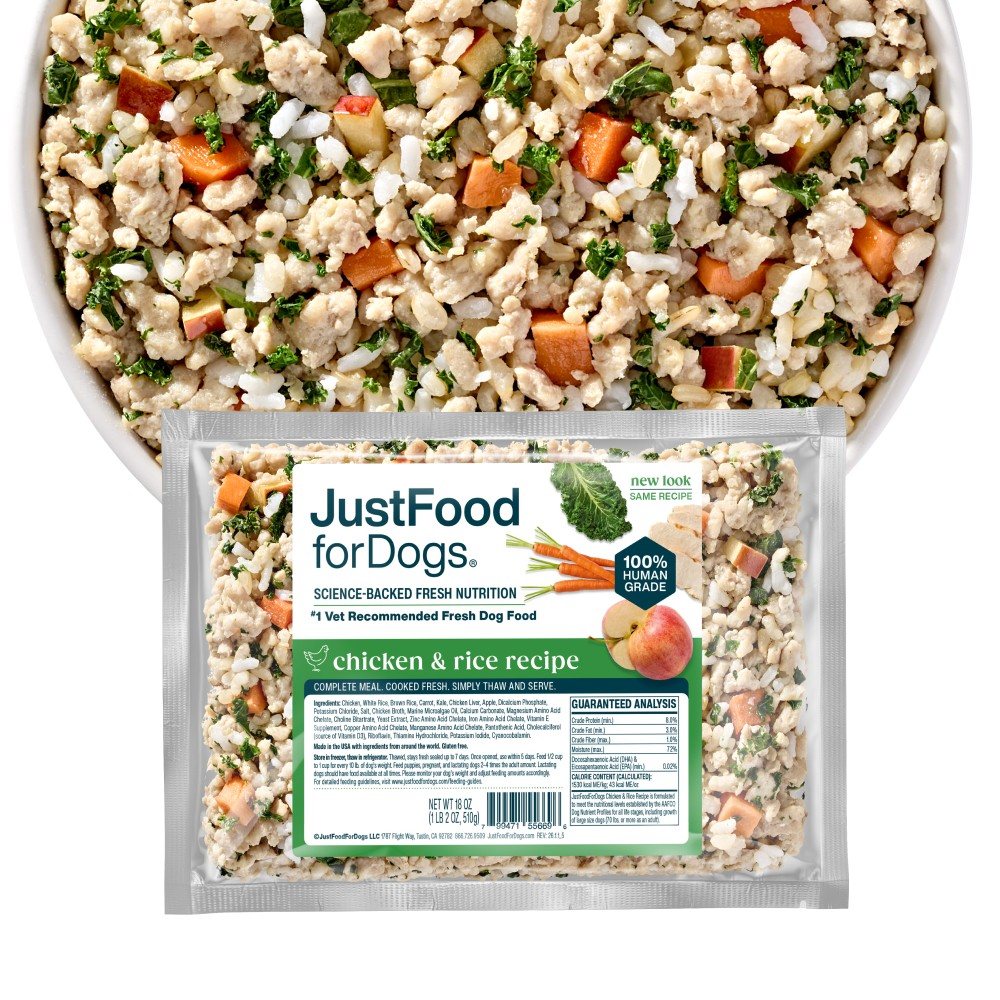
Chicken & Rice combines chicken thighs and liver with white and brown rice, vegetables, fruit, oils, and its nutrient blend. The current nutritional adequacy statement covers all life stages, including growth of large-size dogs. It is therefore relevant to puppy selection as well as adult feeding, with separate amounts for each dog.
The label’s 1,530 kcal/kg equals 1.530 calories per gram. That makes it straightforward to turn a daily calorie allocation into a weighed ration. For an adult Boxer household, a repeatable calculation is useful whether the food forms every meal or replaces part of an existing complete diet.
Why it fits this shortlist:
- Grain-inclusive ingredients in a complete prepared fresh meal.
- Growth eligibility for a household also comparing puppy options.
- A middle-range energy density among these selections.
Practical consideration: Keep a frozen supply and plan thawing according to the package. When another person feeds your Boxer, write down the recipe and daily weight rather than leaving an instruction such as “one full bowl.” Bowl size is not a portion standard.
Chicken & Rice is a useful default comparison when you want a prepared fresh meal without choosing the highest or lowest calorie density on this shortlist. Its flexibility is about eligible life stages and measurable portions, not a claim that every Boxer should eat chicken.
Turkey & Whole Wheat Macaroni: More calories in less food weight
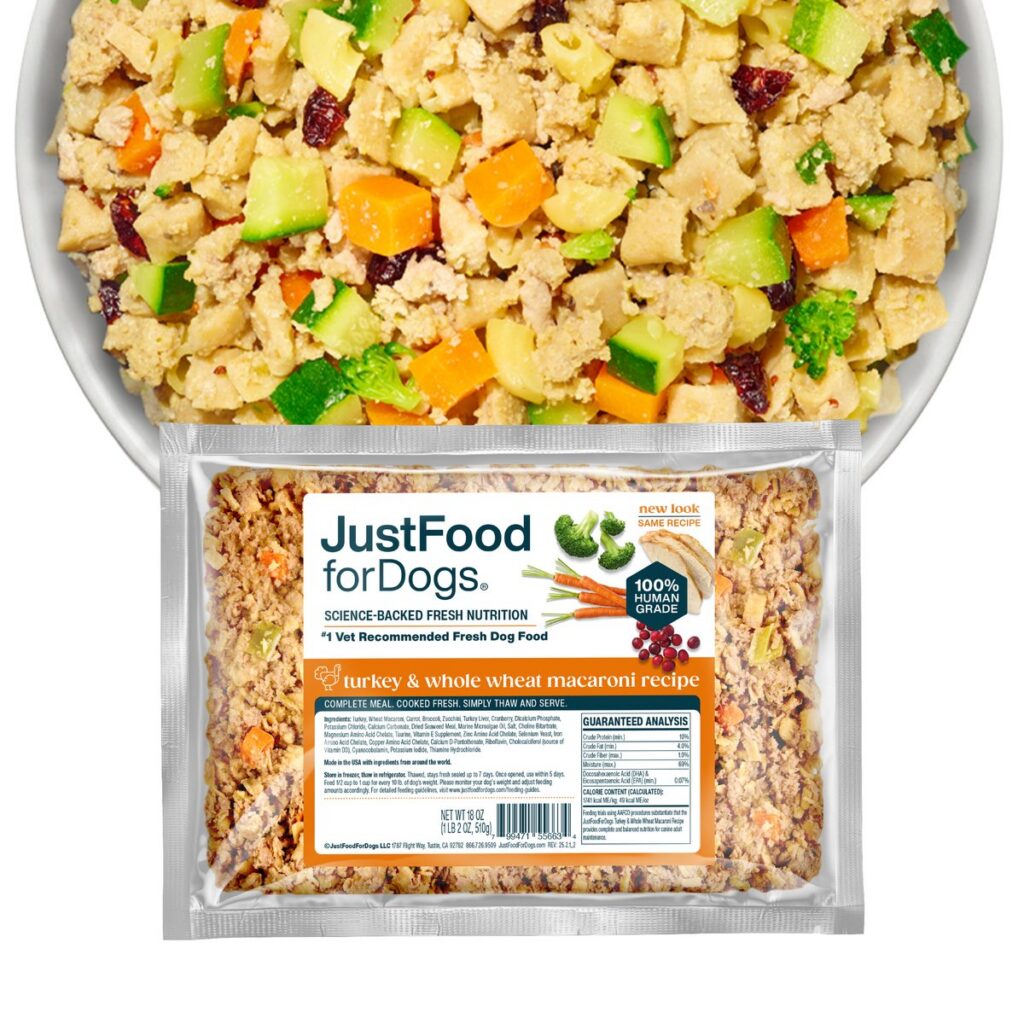
Turkey & Whole Wheat Macaroni is an adult-maintenance recipe containing turkey, liver, whole wheat macaroni, vegetables, cranberries, and a nutrient blend. Its 1,741 kcal/kg, or 1.741 calories per gram, is the highest energy density among these four choices.
For an adult with a larger individual calorie allocation, that can reduce the food weight needed to meet the plan. It is a practical comparison to make if the amount of a less dense recipe becomes cumbersome to divide, store, or carry. Calculate the difference before ordering rather than assuming that all fresh meals require the same volume.
Why it fits this shortlist:
- A turkey-based adult meal with grain-containing ingredients.
- A relatively compact serving at a fixed calorie allocation.
- Useful label information for comparing daily food weight.
Practical consideration: This is an adult-maintenance food, and the macaroni contains wheat. Keep puppy meals separate and review the ingredient list if your dog has specific feeding instructions. A preference for a protein is different from a veterinary elimination-diet requirement.
Turkey & Whole Wheat Macaroni is worth comparing when food weight matters to your adult dog’s routine. Choosing it does not automatically mean feeding more calories; the ration can supply the same calorie allocation in fewer grams.
Fish & Sweet Potato: A fish-based fresh alternative
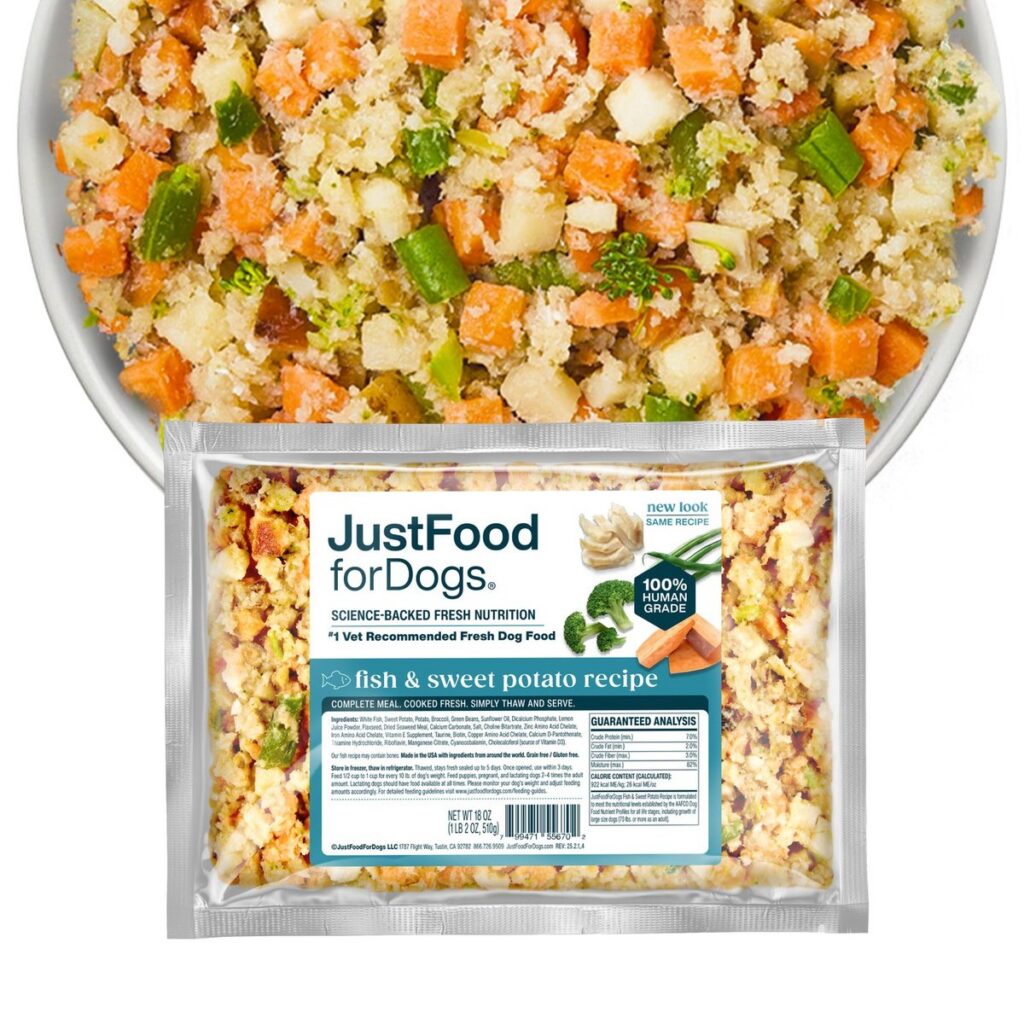
Fish & Sweet Potato uses white fish, sweet potatoes, russet potatoes, green beans, broccoli, oils, and a nutrient blend. Its current all-life-stages statement includes large-size growth. The recipe gives a household a fish-based choice without leaving the complete prepared-meal format.
At 922 kcal/kg, it provides 0.922 calories per gram. This is lower than the other featured recipes, so a fixed calorie allocation requires more food by weight. That difference is useful when estimating how many meals are in an order or planning space for thawed portions.
Why it fits this shortlist:
- A complete fish-based option eligible for growth consideration.
- A distinct ingredient and energy-density profile.
- Straightforward comparison with the more calorie-dense adult turkey recipe.
Practical consideration: Confirm that the required serving can be comfortably managed across the dog’s meals. A lower energy density is not a weight-loss prescription, and a grain-free ingredient list is not evidence of superiority for Boxers. Select the recipe for a relevant individual preference and feeding fit.
This can be a useful alternative for an owner who prefers a fish-based meal and can accommodate the corresponding food weight. Keep that larger daily quantity in mind when comparing package prices with another recipe.
JustFresh Home-Cooked Chicken: An adult pantry option
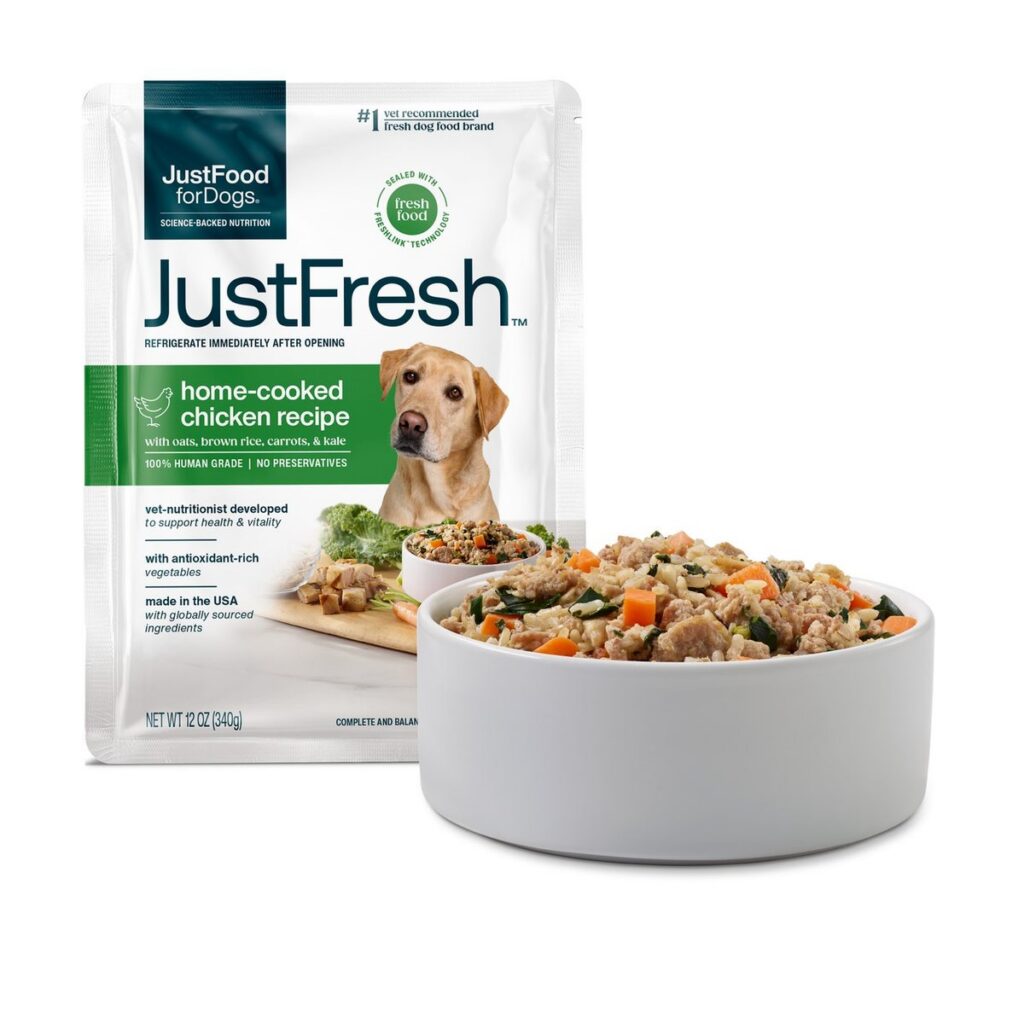
JustFresh Home-Cooked Chicken changes the unopened-storage routine. It is shelf-stable before opening, so you can keep a supply without allocating freezer space. Once opened, it needs refrigeration and use within three days according to current directions.
The current adult-maintenance label lists 1,254 kcal/kg, or 1.254 calories per gram. Ingredients include chicken thighs and liver, oats, brown rice, carrots, and kale. Its adult eligibility is important when the household also has a puppy: pantry convenience does not change the recipe’s life-stage role.
Why it fits this shortlist:
- Complete adult meals with convenient unopened storage.
- No thawing step before opening a pouch.
- A practical alternative when the freezer limits fresh-food planning.
Practical consideration: Plan the opened pouch as well as the unopened order. Calculate how many meals it supplies and whether the remainder can be used within the refrigerated limit. This matters during travel or when a sitter follows a different schedule from yours.
JustFresh can simplify stocking meals for an adult Boxer while keeping portioning precise. It does not eliminate food handling; it shifts the planning from frozen inventory to opened-pouch management.
Feeding Boxer puppies and older dogs
Age changes the selection process even before you compare activity. A growing Boxer needs a growth-suitable diet. An older adult needs a review of the actual feeding routine and individual circumstances, rather than an automatic switch based solely on a birthday.

What’s the best food to feed a Boxer puppy?
Among the featured fresh choices, Chicken & Rice is a practical grain-inclusive starting option and Fish & Sweet Potato is the fish-based alternative. Both current labels identify complete and balanced food covering the growth life stage, including growth of large-size dogs. Turkey & Whole Wheat Macaroni and JustFresh Chicken are adult-maintenance selections rather than the puppy’s complete growth meal.
Expected adult size belongs in the label check. If the puppy is expected to reach 70 pounds or more, the large-size growth wording is relevant. Vetstreet’s large-breed puppy food guide provides further selection context. A puppy becoming physically large does not make an adult-maintenance diet appropriate before growth is complete.
Record the puppy’s current weight, exact recipe, and feeding directions when reviewing amounts with the veterinary team. Puppy servings change during development, and a portion that worked earlier should not become permanent simply because the bowl is still emptied.
Make the puppy schedule separate from the adult schedule
Young puppies generally need more frequent feeding opportunities than adults. The AKC’s feeding-frequency guidance describes small meals through the early months and commonly three to four daily puppy feedings. Follow individual advice on the schedule and divide the daily total accordingly.
In a mixed-age home, distinguish the puppy’s ration from the adult’s. Use separate bowls and clear instructions, and observe each dog rather than assuming both ate the amount you put down. A puppy taking food from an adult’s dish can make the growth plan difficult to track.
Keep treat accounting separate for each dog as well. Training may create many small opportunities to offer food, and those contributions belong in the puppy’s plan. Ask your veterinary team about an appropriate allowance instead of treating every training reward as nutritionally invisible.
Older Boxers: Review the current dog

A senior Boxer may have a different routine from the dog you fed several years ago. Review what happens now: activity, appetite, body condition, eating comfort, and any individual veterinary instructions. Those observations are more useful than assuming every older dog needs the same calorie reduction or a softer food.
The adult-maintenance choices here can be compared for an older adult whose needs fit them. Growth-inclusive recipes can also be considered with the appropriate serving. The life-stage wording is one part of the decision; it does not tell you the correct amount or override a prescribed feeding plan.
Vetstreet’s senior dog food guide explores the wider category. For a routine checkup, bring the exact food label and the measured daily amount, including extras. That gives any feeding discussion a clear starting point.
Boxer owners comparing other short-muzzled breeds can also read WebVet’s Boston Terrier feeding guide, and Petful’s guide to Great Danes for giant-breed portions.
Everyday portions, dry food, and meal routines

Food weight is the link between the recipe decision and the daily feeding routine. Start with the individual’s calorie allocation, subtract any calories reserved for extras where appropriate, and calculate the main-food amount from the selected label. A breed-wide cup count cannot do that accurately across different foods.
Describe activity in useful terms
“Active” means different things in different households. A dog that plays enthusiastically for a few minutes is not necessarily following the same routine as a dog participating in sustained training or other regular work. Describe the activities that actually happen rather than choosing a food around an aspirational schedule.
A simple record can include the usual walks, play or training sessions, rest days, and food received during those activities. You do not need to turn every outing into an estimated calorie burn. The purpose is to give your veterinarian an accurate picture when reviewing the dog’s food intake and body condition.
Changes deserve attention too. A quieter season, a different caregiver, or a new daily routine can change the relationship between meals and activity. Keep the current food amount visible so any adjustment starts from what the dog actually receives. Avoid changing recipes and portions simultaneously without tracking either one.
Bring an ordinary-week record
For a useful week-long observation, note the routine on ordinary weekdays as well as the busiest day. Include who provided food during training and whether the dog received an extra meal away from home. A weekend adventure can be memorable without representing the amount of activity that happens the rest of the time.
Take that record to a feeding discussion when you notice a body-condition change. It helps distinguish a real routine change from an impression that a Boxer must always need an athletic dog’s ration. The goal is a plan that fits the individual dog, not a score for how active the household ought to be.
Calorie density is a practical feature
A more calorie-dense food supplies a given amount of energy in less food weight. That can make a difference when a dog’s individual feeding plan calls for a larger daily calorie allocation. It may affect meal size and the amount you store, carry, and purchase.
It does not follow that every active Boxer needs the highest-density recipe. If an adult eats an appropriate portion comfortably and maintains the body condition recommended by the veterinary team, a different formula may not be necessary. Compare the actual serving before assuming an athlete-style marketing phrase will improve the diet.
In the four foods below, Turkey & Whole Wheat Macaroni is the most calorie-dense, while Fish & Sweet Potato is the least. Chicken & Rice and JustFresh Chicken fall between them. That provides useful options for different feeding routines without assigning one recipe to an entire breed.
Compare the same calorie allocation
The following table assumes 1,000 calories per day allocated to main food. It is a hypothetical comparison, not a prescribed intake for a Boxer. The aim is to show what calorie density changes when the calorie allocation stays the same.
| Recipe | Calories per gram | Grams for the illustrative 1,000-calorie day | Approximate grams per meal if split into two |
|---|---|---|---|
| Chicken & Rice | 1.530 | 654 | 327 |
| Turkey & Whole Wheat Macaroni | 1.741 | 574 | 287 |
| Fish & Sweet Potato | 0.922 | 1,085 | 542 |
| JustFresh Home-Cooked Chicken | 1.254 | 797 | 399 |
For a gram-based plan, divide kcal/kg by 1,000 to obtain calories per gram. Then divide the calories assigned to that food by its calories per gram. Round the result to a practical measuring amount and keep the same units throughout the plan.
At equal calories, the fish recipe requires roughly 511 more grams per day than the adult turkey recipe in this example. That affects meal size and supply planning. It does not prove that one dog should eat more calories, or that a lower-density recipe is a treatment for excess weight.
Two adult routines, one calculation method
Suppose two adult dogs have different individually established main-food allocations: 900 calories for one and 1,500 for the other. These numbers are illustrative, not assigned calorie needs for quiet and active Boxers. They demonstrate that the same recipe can be measured for different daily plans.
At Chicken & Rice’s 1.530 calories per gram, the two daily amounts would be about 588 grams and 980 grams. At Turkey & Whole Wheat Macaroni’s 1.741 calories per gram, they would be about 517 grams and 862 grams. The more calorie-dense recipe changes the food weight, while the separate calorie allocation remains the decision established for each dog.
This is why “feed an active formula” is incomplete advice. You still need to know how much energy the dog should receive, how that translates into meals, and whether the plan is working over time. The WSAVA nutrition resources include body-condition tools that help support veterinary feeding discussions.
Count training rewards before calculating dinner
Food offered during training, walks, and family interactions can add up without looking like a meal. Keep a shared record of the approximate quantity and calories. If part of the main diet can be used appropriately in a training activity, reserving it from the daily ration makes the accounting simpler.
For an arithmetic example, a 1,100-calorie total daily plan with 100 calories allocated to extras leaves 1,000 calories for the main food. Use the remaining 1,000 in the table’s calculation. Serving 1,100 calories of main meals and adding the extras afterward creates a different daily total.
An eager response to food does not establish that the dog needs more. Review the measured intake, body condition, and activity with your veterinarian if you are uncertain. Avoid converting every request for food into another unrecorded snack.
Dry food and mixed meals
A suitable complete dry food can be a practical option for a Boxer. Evaluate life stage, calories, texture, and serving instructions on that exact recipe. JustFoodForDogs does not make kibble, so these fresh selections are alternatives or possible components of a mixed plan, not dry JFFD products.
If you want both formats, allocate part of the main-food calories to each. For the illustrative 1,000-calorie main-food day, an equal calorie split gives 500 to fresh and 500 to dry. Chicken & Rice would supply its half in about 327 grams. The dry portion must be calculated from the other food’s own label.
Equal calories do not mean equal bowl volume. Do not add the fresh half to the full old dry ration. Write the quantities for both foods, confirm that both fit the life stage, and follow the transition instructions as the new food is introduced.
Compare canned and fresh handling
Canned wet food is another format to assess using the same nutritional adequacy and calorie checks. A sealed can may be convenient to store, but the opened food needs the manufacturer’s specified refrigeration and use period. Pâté and pieces in gravy also have different textures to observe at mealtime.
Fresh frozen food brings freezer and thawing steps. Shelf-stable fresh simplifies unopened storage but still requires the correct handling after opening. These are practical distinctions, not proof that canned food or fresh food is inherently more nutritious.
When comparing a can with a pouch, check calories per container and net weight. A package that looks like one meal may provide more or less than the dog’s actual allocation. Calculate portions before deciding how many cans or pouches belong in an order.
Budget by feeding days
Use the amount your Boxer actually needs to compare food cost. Divide the total order price by its food weight, then multiply by daily food weight. Compare equivalent purchase terms and include applicable shipping rather than comparing a first-order discount with another food’s ongoing price.
For a current example, regular prices observed on September 28, 2026 were $153.99 for fourteen 18-ounce Chicken & Rice packs and $167.99 for fourteen 18-ounce Fish & Sweet Potato packs. Each order contains 252 ounces. At the illustrative 1,000-food-calorie allocation, using rounded label values of 43 and 26 kcal/oz, daily costs are approximately $14.21 and $25.64 respectively, before tax and shipping.
Prices can change. This is a comparison between selected fresh recipes, not a claim to identify the market’s cheapest dog food. It shows why equal-weight orders supply different numbers of days when their calorie densities differ.
Budget for a mixed meal
For mixed feeding, calculate the daily cost of each component and add them. Half of the example’s main-food calories from Chicken & Rice would cost about $7.11 at that observed regular price; the dry portion’s cost depends on its own package and serving. This lets you assess a fresh-food routine without assuming that every meal must use the same format.
Calculate how long an order lasts
Daily food weight also tells you when to reorder. For the illustrative 1,000-food-calorie day, Chicken & Rice requires about 23.3 ounces using its rounded ounce label. A 252-ounce order would therefore cover approximately 10.8 days. Fish & Sweet Potato requires about 38.5 ounces, so the same total order weight covers approximately 6.6 days.
This is a separate question from whether a package is affordable at checkout. An order that covers fewer days needs a different replenishment schedule and storage plan. If two dogs use the same recipe, add their individually calculated daily weights before dividing the order weight by daily use.
Plan a reorder around the supply you will actually use, allowing for the delivery information shown when you buy. Do not assume all recipes, pack sizes, or addresses have identical delivery conditions. Keep a practical supply of the established suitable food while introducing a new routine so a delayed order does not force an improvised replacement.
Storage, reordering, and shared care
Estimate how many days an order covers before it arrives. Compare the frozen pack dimensions with actual freezer space, and arrange thawing according to the package instructions. For JustFresh, consider both unopened storage and the three-day refrigerated period after opening.
A caregiver’s instructions should identify:
- The complete recipe name and intended dog.
- The daily food total and amount at each meal.
- Food or treats already reserved for training.
- Which opened container to use first.
- The applicable storage and use-period instructions.
This is especially helpful when two Boxers have different activity routines or life-stage needs. The same food bag or pouch can otherwise lead to an assumption that the same scoop works for both. Measuring and identifying each dog’s ration prevents that confusion.
Turning the plan into a meal
Place an empty clean bowl on the kitchen scale and reset it to zero. Add the amount allocated to that meal, then return unused perishable food to the storage specified on the package. Note the opened date where every caregiver can see it. These steps make the calculation repeatable rather than leaving it as a number in a shopping note.
For a mixed meal, weigh each component according to its own daily allocation. If one component is given at breakfast and the other at dinner, the same total still applies. Avoid keeping two separate instructions that each describe a full day’s ration without explaining the split.
When the dog leaves food, distinguish the amount served from the amount eaten. Recording an approximate leftover weight is more useful than describing the bowl as “mostly finished.” Repeated leftovers or appetite changes can then be discussed with the actual recipe and intake in view.
Compare protein percentages on the same moisture basis
An athletic-looking Boxer can make a high protein percentage sound especially persuasive. Before comparing a dry food with a moist meal, account for water. A percentage printed on a moist-food label describes food containing that water; it is not directly comparable with the same percentage on a much drier food. The Pet Food Institute’s guaranteed-analysis guide explains why a dry-matter comparison is useful.
For a hypothetical example, imagine a fresh food labeled 8% minimum protein and 70% maximum moisture. Its estimated dry matter is 100 minus 70, or 30%. Dividing 8 by 30 and multiplying by 100 gives about 26.7% protein on a dry-matter basis. A hypothetical dry food with 25% minimum protein and 10% maximum moisture gives 25 divided by 90 times 100, or about 27.8%. The apparently large 8-versus-25 gap has become much smaller when water is accounted for.
These are invented label examples to demonstrate the calculation, not guaranteed analyses for the featured JustFoodForDogs recipes. Minimum protein and maximum moisture figures also make this an approximate comparison rather than an exact laboratory result. Ask the manufacturer for typical nutrient analysis if you need a more precise comparison of particular foods. Use that calculation for its limited purpose:
- It puts two protein percentages on a comparable moisture basis.
- It does not tell you how many calories your Boxer should receive.
- It does not measure protein digestibility or establish the adequacy of every nutrient.
- A higher result does not automatically make a recipe more suitable for an active dog.
Return to the complete life-stage statement and the individual feeding plan after comparing the figures. If both foods meet the appropriate requirements, calorie density, ingredient preference, meal size, storage, and cost can help select between them. You do not need to choose the largest protein number simply because the dog is a Boxer.
Review a changed feeding plan
Bring current weight, body-condition observations, actual intake, treats, and ordinary activity to a feeding review. If you change recipes, retain both labels and follow the transition directions; equal weights can supply different calories. Update the household’s current recipe and meal amounts once the change is complete so a caregiver does not use an obsolete portion.
Persistent appetite changes, difficulty eating, vomiting, or diarrhea need veterinary attention. They do not establish that a particular protein is wrong for the entire breed. A clear record gives the veterinary team something specific to assess and keeps a shopping decision separate from a medical concern.
Related breed feeding guides from our sister sites: Best Dog Food for Dobermans (Petful), Best Dog Food for Cane Corsos (Petful), Best Dog Food for Boston Terriers (WebVet).
Frequently Asked Questions
Chicken & Rice and Fish & Sweet Potato have all-life-stages statements including large-size growth. Turkey & Whole Wheat Macaroni and JustFresh Chicken are adult-maintenance options. Choose the growth-appropriate recipe first, then establish the individual puppy’s amount and schedule with the veterinary team.
Use calories rather than bowl volume. Divide the assigned fresh-food calories by that recipe’s calorie density and do the same for the dry share. The two calculated portions form one meal plan; a full dry serving plus a full fresh serving would double-count the intended meal.
No. Actual activity, individual calorie needs, body condition, and the amount a dog comfortably eats determine whether a more calorie-dense recipe is useful. Turkey & Whole Wheat Macaroni offers more calories per gram than the other featured foods, but an adult doing well on an appropriate portion of another complete recipe does not automatically need to change.
JustFoodForDogs offers one-time purchase options, so a subscription is not required. Calculate the daily portion and storage needs before choosing an order. Compare the current one-time and recurring purchase terms if both interest you, and separate an introductory promotion from the ongoing food budget.
Calculate each dog’s portion separately and supervise meals so one does not finish the other’s ration. Shared recipe eligibility does not mean shared calorie requirements. In a puppy-and-adult household, confirm the puppy’s growth suitability first and keep any adult-maintenance recipe assigned to the adult.