Best Dog Food for Rottweilers: Puppy and Adult Options
Published on October 05, 2026

Compare fresh food options for Rottweiler puppies and adults, with large-breed growth checks, measured portions, calorie guidance, and realistic feeding costs.
This article is sponsored by JustFoodForDogs. All featured products are chosen at the discretion of the Vetstreet editorial team and do not reflect a direct endorsement by the author. However, Vetstreet may make a small affiliate commission if you click through and make a purchase.
The best dog food for Rottweilers starts with a distinction that can be easy to miss: a large puppy is still a puppy. The food’s life-stage statement matters more than how substantial the dog already looks. Once that requirement is clear, calorie density, portion size, storage, and daily cost help you compare suitable meals.
JustFoodForDogs offers both growth-suitable fresh recipes and adult-maintenance options. Below, we compare four choices, identify which belong on a puppy shortlist, and show how to translate their labels into realistic amounts. The recommendations use current manufacturer information and practical feeding considerations, not a hands-on feeding trial or a promise of faster growth.
Choosing a food for a Rottweiler
The nutritional adequacy statement refers to AAFCO nutrient profiles or feeding trials, rather than a breed-specific marketing claim. Check the stated life stage on the exact recipe.
Key takeaway: For a puppy, verify growth suitability, including the large-size growth statement where applicable. For an adult, compare complete recipes by individual calorie needs and the amount of food your household can reliably store and serve.

Read the adequacy statement before the breed claim
The nutritional adequacy statement identifies the life stage for which a food is complete and balanced. The FDA’s explanation distinguishes growth from adult maintenance. A bag showing a large adult dog, or a recipe promoted for muscular breeds, does not replace that statement.
For an adult Rottweiler, a suitable adult-maintenance or appropriate all-life-stages food can be considered alongside the dog’s individual needs. A puppy requires growth suitability. When expected adult weight is 70 pounds or more, check the precise large-size growth wording instead of relying on the phrase “all life stages” without reading the rest.
Use five questions to narrow the choice:
- Is this a complete everyday meal rather than a topper or treat?
- Does the exact life-stage statement fit the dog who will eat it?
- How many calories are in a gram or ounce?
- How much food does the individual feeding plan require?
- Can the household maintain the storage, handling, and purchase routine?
What is the best food to feed a Rottweiler?
Chicken & Rice is our starting dog food pick for Rottweilers wanting a grain-inclusive fresh meal because its current label covers growth as well as adult feeding. Fish & Sweet Potato is the fish-based alternative with the same broad life-stage eligibility. Adults can also be considered for the more calorie-dense Turkey & Whole Wheat Macaroni or the unopened pantry convenience of JustFresh Chicken.
These recommendations describe different useful fits, not a universal winner for every Rottweiler. A quieter adult, a more active adult, and a growing puppy need their own portions. Follow any existing veterinary feeding instructions rather than replacing a prescribed plan with an everyday buying guide.
Assess the individual, not an idealized breed picture
Record the dog’s actual age, body weight, usual activity, and food intake when reviewing a diet. Your veterinary team can help assess body condition and whether the current portion remains appropriate. The WSAVA nutrition resources include tools that support those discussions.
Avoid choosing food to chase a particular body size or appearance. A recipe’s role is to meet the dog’s nutritional needs, not guarantee growth speed, exceptional muscle, or protection from joint disease. Calorie density is useful for portion planning, but it should not become a reason to feed an unneeded surplus.
The same principle applies when a large dog asks for more food. Appetite and enthusiasm are observations, not a calorie calculation. Account for meals, training rewards, and food from other caregivers before deciding that the main ration is too small.
Guardian breeds with comparable growth and portion questions include Cane Corsos, Dobermans, and Great Danes; Petful’s breed feeding guides cover each.
Fresh meals for adult Rottweilers
This comparison keeps life-stage eligibility beside the calorie information so an adult selection does not accidentally become a puppy recommendation.
| JustFoodForDogs recipe | Practical reason to compare it | Current life-stage statement | Calories per kilogram | Storage |
|---|---|---|---|---|
| Chicken & Rice | Grain-inclusive fresh meals with growth eligibility | All life stages, including large-size growth | 1,530 | Fresh frozen |
| Fish & Sweet Potato | A fish-based recipe with a larger serving at equal calories | All life stages, including large-size growth | 922 | Fresh frozen |
| Turkey & Whole Wheat Macaroni | More calories in less food weight among these picks | Adult maintenance | 1,741 | Fresh frozen |
| JustFresh Home-Cooked Chicken | Adult meals that do not need unopened freezer storage | Adult maintenance | 1,254 | Shelf-stable before opening |
Chicken & Rice: A grain-inclusive fresh foundation
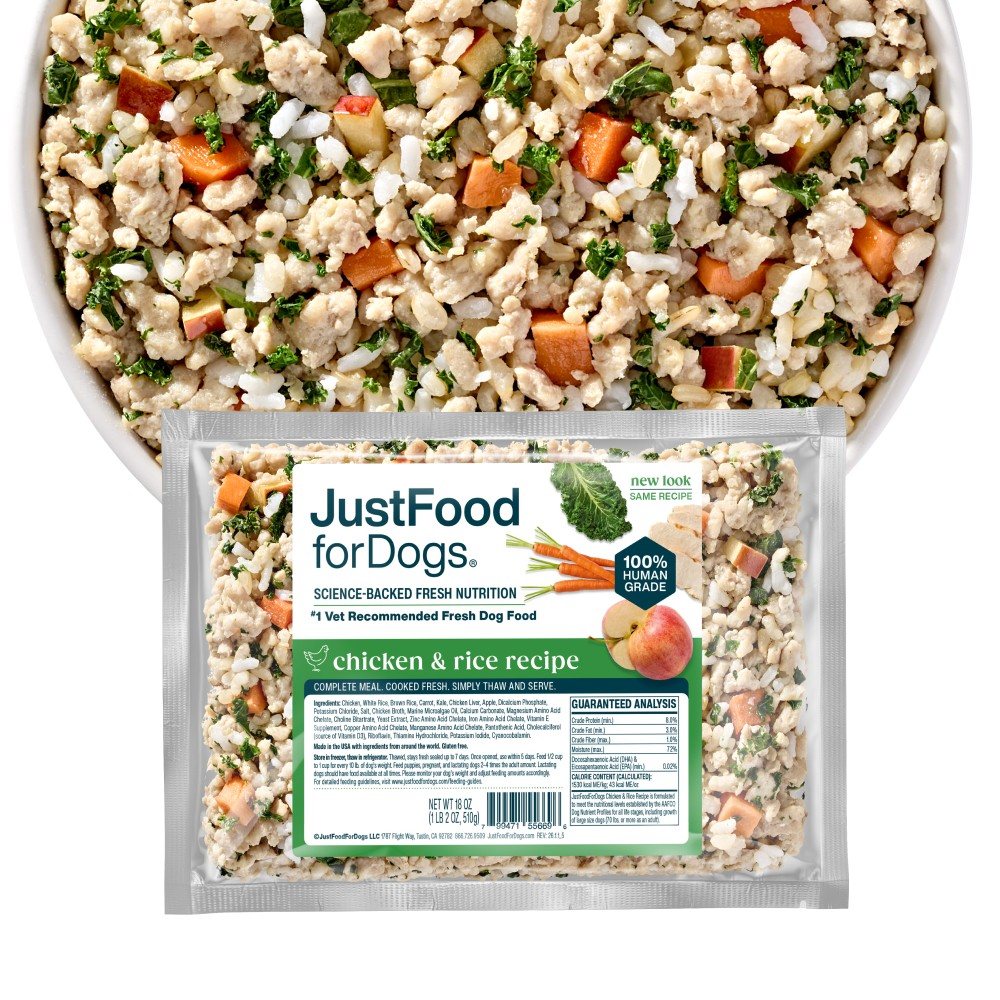
Chicken & Rice contains chicken thighs and liver, white and brown rice, vegetables, fruit, oils, and its nutrient blend. Its current all-life-stages statement includes growth of large-size dogs. It can therefore be compared for a Rottweiler puppy as well as an adult, with the appropriate individual serving.
At 1.530 calories per gram, the recipe sits between the turkey and fish selections in energy density. That provides a useful starting point for an owner comparing complete fresh meals. The exact daily weight follows the dog’s feeding plan rather than a standard scoop or bowl size.
What makes it useful:
- A complete grain-inclusive recipe with large-size growth eligibility.
- Published calorie information for weighing puppy or adult portions.
- A prepared fresh option for households comfortable with freezer storage.
What to plan: Calculate how many days an order will cover and make space before delivery. Follow the package’s thawing and storage instructions. If a puppy and adult share the recipe, write the two portions separately so another caregiver does not assume equal meals.
Chicken & Rice is a practical first comparison when you want a fresh recipe with flexibility across life stages. That flexibility does not remove the need to reassess amounts as a puppy grows or an adult’s routine changes.
Fish & Sweet Potato: A growth-suitable fish choice
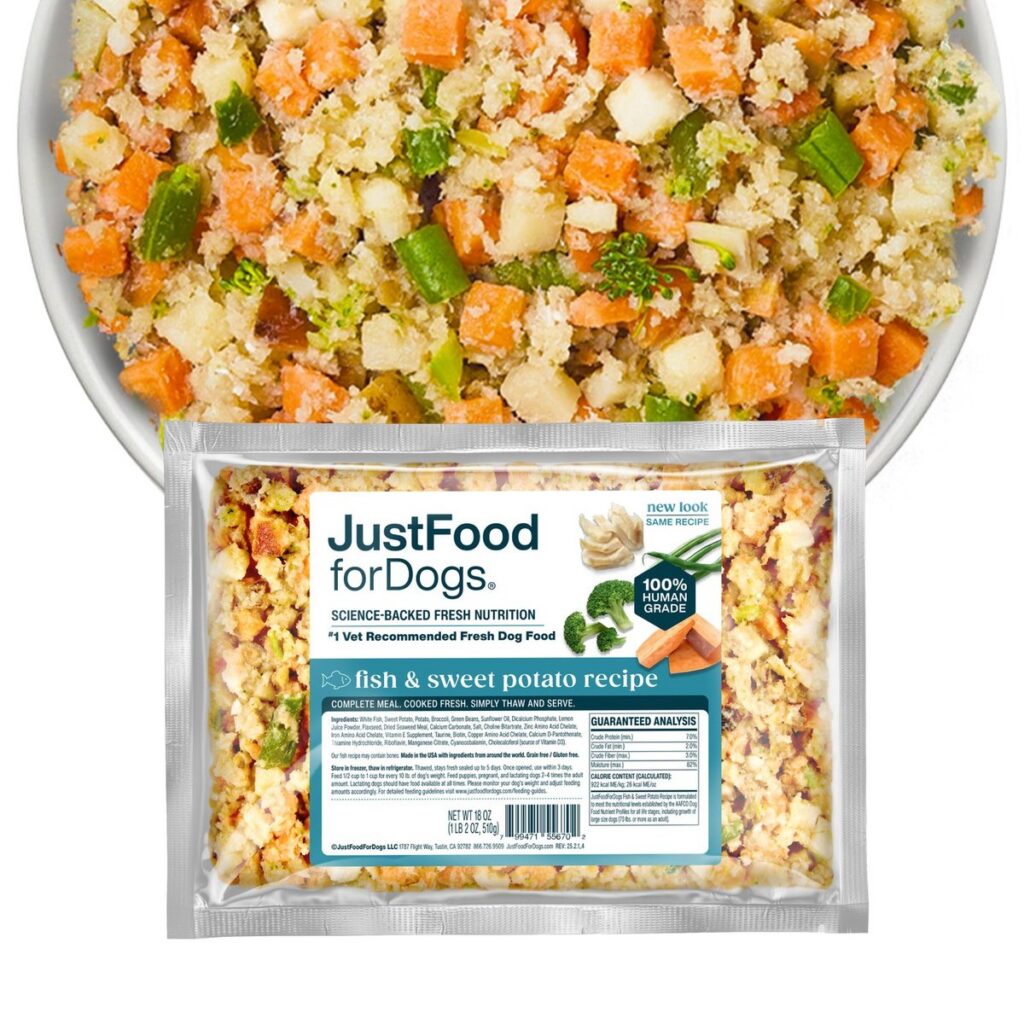
Fish & Sweet Potato combines white fish with sweet potatoes, russet potatoes, green beans, broccoli, oils, and a nutrient blend. Its current all-life-stages statement also includes growth of large-size dogs. It offers a fish-based alternative within the prepared fresh range.
The label lists 922 kcal/kg, equivalent to 0.922 calories per gram. For the same calorie allocation, you will serve more of this food by weight than Chicken & Rice or Turkey & Whole Wheat Macaroni. That affects bowl portions, shopping frequency, and the amount stored in the refrigerator or freezer.
What makes it useful:
- A complete fish-based meal eligible for large-size growth consideration.
- A different main protein from the chicken and turkey choices.
- Clear calorie information for comparing the actual serving requirement.
What to plan: Make sure the daily food weight can be divided into manageable meals. Use the new recipe’s calories if you switch from another food; keeping the same ounces will not preserve the same energy intake. The recipe is grain-free, which is an ingredient description rather than a claim that all Rottweilers need to avoid grains.
For a household that prefers a fish-based recipe and can accommodate its larger equal-calorie portion, this is a concrete fresh option. An ingredient preference is different from a veterinary allergy plan, which requires individualized guidance.
Turkey & Whole Wheat Macaroni: A compact adult portion
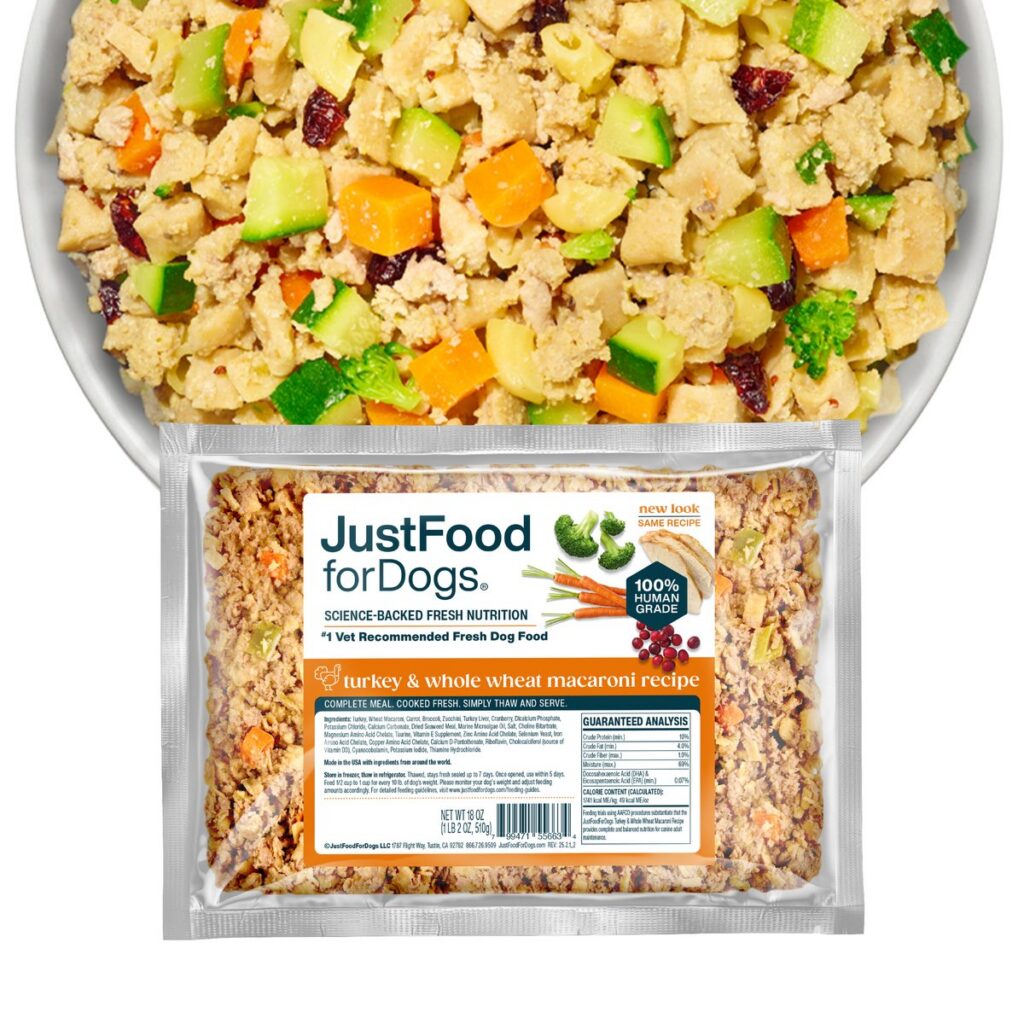
Turkey & Whole Wheat Macaroni is an adult-maintenance recipe containing turkey, liver, whole wheat macaroni, vegetables, cranberries, and a nutrient blend. Its 1.741 calories per gram is the highest energy density among these four choices.
For an adult Rottweiler with an individually established calorie plan, this can mean less food weight at the same calorie allocation. It is worth comparing when the required amount of a lower-density food is difficult to portion, store, or transport. A more concentrated meal does not mean the dog should receive more total calories.
What makes it useful:
- A turkey-based complete meal for adult maintenance.
- A comparatively compact serving within this shortlist.
- Grain-containing ingredients for owners choosing that type of recipe.
What to plan: This food contains wheat and is an adult selection. Do not use its adult-maintenance statement as a puppy-growth claim. In a mixed-age household, label storage and feeding instructions clearly so each dog receives the intended recipe.
JustFresh Home-Cooked Chicken: Adult pantry convenience
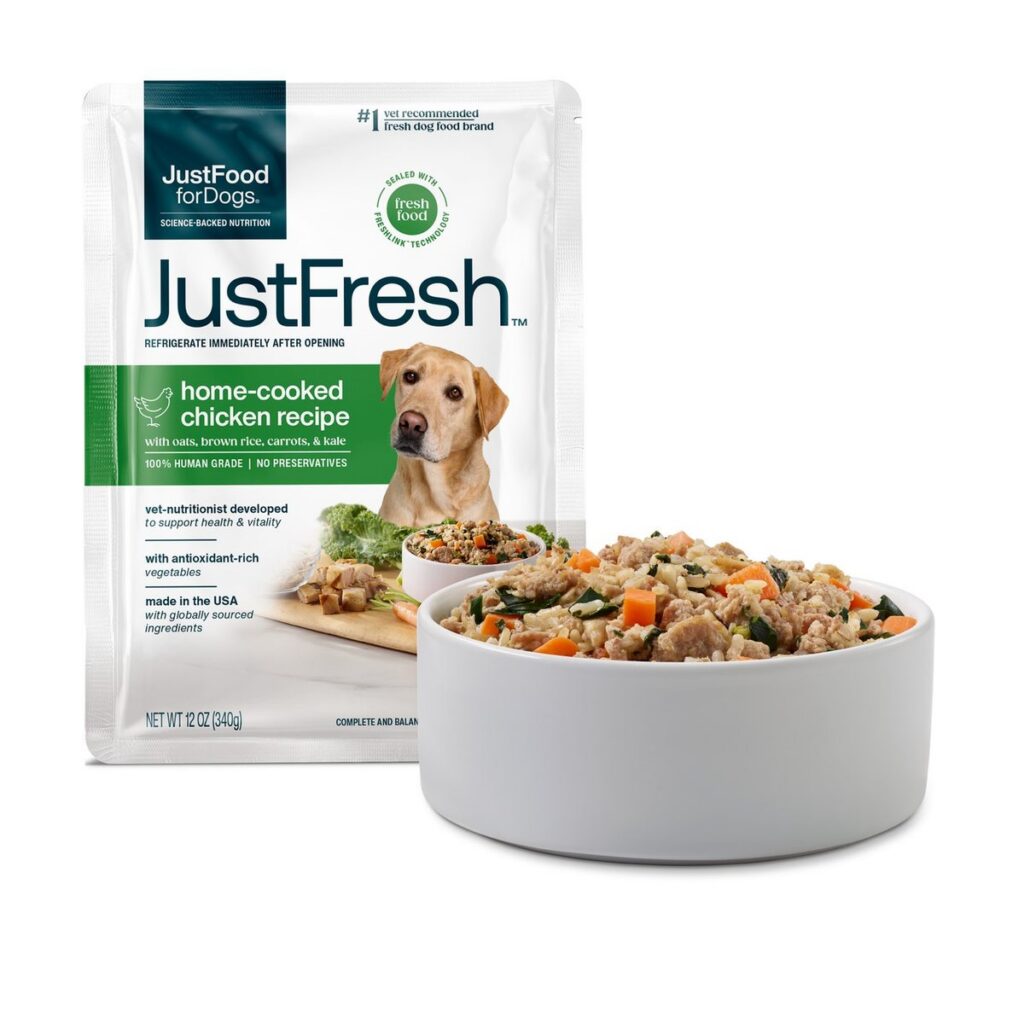
JustFresh Home-Cooked Chicken is shelf-stable before opening and formulated for adult maintenance. Its current label lists 1,254 kcal/kg, or 1.254 calories per gram. The recipe includes chicken thighs and liver, oats, brown rice, carrots, and kale.
For an adult Rottweiler household, its main practical advantage is unopened storage without freezer space. That can help when frozen-food capacity limits how much you can keep on hand or when another caregiver needs a straightforward unopened supply.
What makes it useful:
- Complete adult meals without a pre-opening thawing step.
- Convenient unopened pantry storage.
- A distinct format to compare alongside the fresh frozen choices.
What to plan: After opening, refrigerate and use within three days. Calculate how many pouches the daily ration requires and how any remainder will be stored. Shelf-stable before opening does not mean opened food can be left at room temperature throughout the day.
Rottweiler puppy growth and life-stage labels

What is the best food for a Rottweiler puppy?
For the fresh options in this guide, start by comparing Chicken & Rice and Fish & Sweet Potato. Their current nutritional adequacy statements identify complete and balanced nutrition for all life stages, including growth of large-size dogs. Chicken provides the more calorie-dense serving of the two; Fish offers a fish-based alternative with more food weight at equal calories.
Choose the growth-suitable recipe first and establish the portion separately. A puppy’s current size does not make an adult-maintenance food appropriate, and feeding more of an adult recipe does not change its intended life stage. The label distinction is the essential filter before flavor or storage preference.
Vetstreet’s large-breed puppy food guide provides broader context. Use it alongside the exact product label and your veterinarian’s guidance for the individual puppy. This article keeps Rottweiler puppy and adult choices together so the differences are visible in one place.
Read the whole growth statement
The important distinction is whether the statement includes or excludes growth of large-size dogs. Do not stop reading after seeing the words “all life stages.” A label’s qualification can change whether it belongs on your puppy shortlist, even when the front of the package looks suitable for a large dog.
The current Chicken & Rice and Fish & Sweet Potato statements explicitly include large-size growth. This is the basis for including them here. It is not an inference from the ingredients, the softness of the meal, or a general statement about the brand. If the package you receive differs from the information you used to shop, ask the manufacturer to clarify the exact product before carrying over the old feeding plan.
What to record as a puppy grows
Keep the current body weight, food name, daily amount, meal schedule, and treats in one simple record. Review the plan during routine veterinary care and update it as development changes the puppy’s needs. An old feeding calculation should not become permanent simply because the puppy still finishes the meal.
Bring the actual label or a clear photograph when asking about portions. “Fresh chicken food” is too vague when products with similar names have different calorie densities and life-stage statements. Note whether your amount is a daily total or a single meal so the advice can be interpreted correctly.
Useful questions for a feeding review include:
- Does this exact adequacy statement fit expected adult size?
- Is the daily amount appropriate for current growth and body condition?
- How should the ration be split between meals at this age?
- What allowance should be used for training rewards?
- When should the next portion or life-stage review happen?
Avoid shortcuts based on size
Do not use an adult dog’s ration as a puppy feeding chart simply because the dogs currently weigh a similar amount. Growth and maintenance are different contexts. Likewise, a bigger bowl does not establish a bigger nutritional requirement.
Avoid adding ingredients or supplements to a complete growth diet without specific guidance. The intended meal already has a formulation; unplanned additions change the overall diet. A larger future adult size is not a reason to improvise a growth supplement routine or chase faster development.
In a home with multiple dogs, supervise meals and keep the puppy’s food identifiable. If one dog moves between bowls, the amount offered is no longer the same as the amount each dog receives. A clear meal routine makes the feeding record more meaningful.
Large-size growth wording also matters for Bernese Mountain Dog and Great Pyrenees puppies, as Petful’s guides explain.
Dry-food choices, portions, and daily cost
A complete dry food can be an appropriate format when the actual recipe fits the dog’s life stage and individual plan. Check the calories and the dog’s ability to manage the kibble. JustFoodForDogs does not make dry kibble, so the fresh choices above should not be confused with a ranked list of dry products.
Fresh, dry, and canned meals bring different storage and portioning routines. A dry bag may be easy to measure and transport; a canned meal requires the correct opened-food handling; fresh frozen food needs thawing; and JustFresh offers adult pantry convenience before opening. The best routine is one you can follow consistently.
A large-dog portion comparison
The following adult comparison assumes 1,400 calories per day allocated to the main food. Turkey & Whole Wheat Macaroni and JustFresh Chicken are adult-maintenance foods; the separate puppy section identifies the growth-suitable selections. It is an arithmetic example, not a recommendation for a Rottweiler of a certain weight or age. Your dog’s actual calorie allocation must be established separately.
| Recipe | Calories per gram | Grams for the illustrative 1,400-calorie day | Approximate grams per meal if divided into two |
|---|---|---|---|
| Chicken & Rice | 1.530 | 915 | 458 |
| Fish & Sweet Potato | 0.922 | 1,518 | 759 |
| Turkey & Whole Wheat Macaroni | 1.741 | 804 | 402 |
| JustFresh Home-Cooked Chicken | 1.254 | 1,116 | 558 |
The calculation is food calories divided by calories per gram. Divide a kcal/kg label value by 1,000 to get calories per gram. A scale then makes the resulting weight easier to repeat than a bowl filled by appearance.
The difference between roughly 804 and 1,518 grams is substantial even though the calorie allocation is the same. It helps explain why pack weight and package price cannot be interpreted in isolation. You need to know how much of the exact food the dog would use each day.
Use one calorie unit consistently
Labels may provide both calories per kilogram and calories per ounce, with the ounce figure rounded. For a plan measured in grams, use kcal/kg divided by 1,000 throughout. For an ounce-based illustration, use the stated kcal/oz. Small differences between the two calculations can reflect rounding rather than a change in the food.
For example, JustFresh Chicken’s current label lists 1,254 kcal/kg and 36 kcal/oz. A gram calculation should use 1.254 calories per gram rather than converting the rounded ounce value back into grams. Record the method you used so another caregiver can reproduce the same practical portion.
The decimal places help explain the calculation; they do not guarantee an exact biological calorie need. The dog’s individual feeding plan and response still need review. Measuring consistently is more useful than treating a mathematically precise portion as permanently correct.
Make a weighed ration easy to repeat
Choose a scale that can hold the bowl and the intended food weight within its stated capacity. Put the empty bowl on the scale, reset to zero, and add the food allocated to that meal. If the day’s food is divided in advance, label the portions clearly so nobody mistakes one meal for the whole daily amount.
For large servings, record leftovers as well as food offered. A bowl that looks nearly empty can still contain enough to affect your estimate of intake over several days. You do not need to turn each meal into a complicated measurement exercise, but a repeatable method gives a feeding discussion a better starting point than “about a bowl.”
Wash the serving utensils and bowl after use, and follow the exact product’s directions for unused food. Keep the label or instructions available where meals are prepared. Another caregiver should be able to follow the same routine without guessing which unit or portion size you meant.
Keep the main-food allowance separate from extras
If an individual plan allocates some calories to treats or other extras, subtract them before calculating main meals. For example, a hypothetical total of 1,500 calories with 100 reserved for extras leaves 1,400 for the food calculation. Those figures demonstrate the method; they are not a breed-wide feeding prescription.
Record rewards given by family members and during training. Small portions offered many times can become a meaningful part of the day. Treats are not automatically complete nutrition, and they should not quietly replace most of the balanced main diet.
When several people help, leave the daily food total and meal split together. One person should not serve the full day’s fresh ration while another also gives an unchanged full dry-food allowance. The written plan should make the combined amount clear.
Combine fresh and dry by calories
For an illustrative adult mixed plan, divide the 1,400 main-food calories equally between fresh and dry. The fresh half is 700 calories. Chicken & Rice supplies that in approximately 458 grams; the dry portion depends on the other product’s label.
Do not use equal cups or equal weights as a shortcut for equal calories. Both foods must suit the dog’s life stage, and their combined contribution should fit the established daily plan. Introduce changes according to the food’s directions and any individualized advice.
If the two foods are served at separate meals, the same calculation applies. Record the daily amount of each and which meal contains it. That prevents an accidental second ration when someone interprets the fresh dinner as an addition to a full day’s dry food.
Compare realistic daily food costs
If you prefer a grain-free recipe for your adult Rottweiler, Fish & Sweet Potato is the featured option to compare. Its lower calorie density means buying more food weight for the same energy allowance than grain-inclusive Chicken & Rice. Check the resulting daily cost rather than assuming that either a grain-free label or a cheaper package identifies the better value.
Regular prices observed September 28, 2026 were $153.99 for fourteen 18-ounce Chicken & Rice packs and $167.99 for fourteen 18-ounce Fish & Sweet Potato packs. Each order contains 252 ounces. Using rounded label values of 43 and 26 kcal/oz, the illustrative 1,400-food-calorie day costs about $19.90 for Chicken & Rice or $35.90 for Fish & Sweet Potato, before tax and shipping.
These are comparisons between selected fresh recipes, not promises of current checkout totals or the cheapest dog food available. Prices may change. The examples show why the recipe’s calorie density belongs in a budget decision alongside its price. To calculate your own daily cost:
- Divide the order price by total food weight in the same unit you use for portions.
- Multiply by the daily amount of that exact recipe.
- Add applicable delivery costs when comparing orders.
- Compare equivalent regular purchase terms, separating introductory offers.
- Include the cost of any other complete food used in a mixed plan.
Compare a first order with an ongoing routine
A first order can answer whether the selected recipe and handling routine work in your household. Before buying a large supply, calculate the expected feeding days, the freezer or pantry space, and the opened-food requirements. A larger order is useful only if you can store it and use it as directed.
Check the exact recipe and pack size at checkout. Similar chicken-based products can have different life-stage statements and storage instructions. Keep the product name and format in your reorder notes so a family member does not select an adult-maintenance pantry product when the intended purchase was a growth-suitable frozen recipe.
Once the routine works, use the dog’s current daily portion to choose a reorder interval. Revisit that interval when a puppy grows, another dog joins the household, or a mixed-feeding split changes. The order frequency follows actual use; it should not become an independent reason to serve more food or stretch a supply with unmeasured extras.
Plan the supply, not just the next bowl
At the illustrative 1,400-calorie allocation, Chicken & Rice uses about 32.6 ounces daily, while Fish & Sweet Potato uses about 53.8 ounces. A 252-ounce order therefore covers approximately 7.7 or 4.7 days respectively. That changes how frequently you would need another order.
Check freezer capacity before choosing a quantity. Follow the package’s thawing instructions and identify the food that should be used next. With JustFresh, unopened pantry storage simplifies one part of the routine, but opened food still needs its three-day refrigerated plan.
For travel or a sitter, provide exact recipe and portion instructions. Include storage directions and opened dates rather than assuming all fresh products have the same use period. If more than one dog is being cared for, label portions by dog as well as recipe.
Changing recipes without losing the feeding plan
When switching, save the old label and calculate the intended portion of the new food before the old supply runs out. Follow the manufacturer’s transition directions and any individual veterinary advice. A gradual change still needs calorie awareness because the two foods may provide different energy in the same weight.
Keep other extras consistent while assessing the change. If meals, treats, and household scraps all change together, it becomes harder to describe what the dog ate or what differed. Record meaningful appetite or stool changes and seek veterinary advice for persistent problems instead of repeatedly replacing foods without a clear plan.
When the transition is finished, replace the old feeding note with the current recipe, daily total, and meal split. Include the opened-storage directions for that product. This is a simple way to prevent a well-intentioned caregiver from using the right food with the wrong serving or handling instructions.
Older Rottweilers and changing routines
Reassess an older dog’s meals around current body condition, activity, eating comfort, and veterinary instructions. The food and portion that worked in a younger adult routine may need review, but age alone does not identify one universally suitable senior recipe.
The adult-maintenance choices here are everyday options for an older adult when they fit the individual’s needs. Vetstreet’s senior dog food guide provides additional context. A prescribed diet should not be replaced with a general selection from this article.
Keep unsafe household foods out of the plan at every age. Vetstreet’s guide to foods not to share with dogs covers important exclusions. Being a large dog does not make an unsafe ingredient appropriate.
Related breed feeding guides from our sister sites: Best Dog Food for Cane Corsos (Petful), Best Dog Food for Dobermans (Petful), Best Dog Food for Great Danes (Petful).
Frequently Asked Questions
They may share a recipe whose adequacy statement meets both needs, such as the growth-suitable Chicken & Rice or Fish & Sweet Potato discussed here. Give each dog a separate calculated portion. Adult-maintenance Turkey & Whole Wheat Macaroni and JustFresh Chicken should not be substituted into the puppy’s main diet.
Compare the same calorie allocation. Turkey & Whole Wheat Macaroni provides 49 kcal/oz for adults, while Fish & Sweet Potato provides 26 kcal/oz, so the fish serving weighs more for equal calories. Use that difference to assess meal handling and storage, not to infer that the larger bowl provides better nutrition.
Adult Rottweilers commonly eat two meals a day, while young Rottweiler puppies generally need more frequent meals. The AKC’s feeding-frequency guidance describes three to four puppy feedings during the early months. Follow the individual’s meal schedule and divide the daily amount rather than multiplying it by the number of meals.
The current label covers all life stages, including large-size growth, so it can be considered for both. Their portions still need separate calculations, and meals should be managed so each dog receives the intended amount. An adult-only recipe elsewhere in the brand’s range does not inherit that growth eligibility.
The breed name alone does not establish a need to avoid grains. This shortlist includes grain-containing meals and grain-free Fish & Sweet Potato. Compare complete nutrition, life-stage suitability, and the exact ingredients alongside any individual veterinary instructions. Grain-free is not a guarantee of greater quality or a treatment for a suspected food allergy.