
Best Dog Food for Beagles: Puppy and Adult Options
Published on October 05, 2026

Explore JustFoodForDogs meals for Beagle puppies and adults, then build a practical daily plan for complete food, training rewards, portions, storage, and cost.
This article is sponsored by JustFoodForDogs. All featured products are chosen at the discretion of the Vetstreet editorial team and do not reflect a direct endorsement by the author. However, Vetstreet may make a small affiliate commission if you click through and make a purchase.
The best dog food for Beagles combines complete nutrition for the dog’s life stage with a feeding routine the whole household can follow. For a puppy, that begins with a food suitable for growth. For an adult, it also means counting the food used during walks, scent games, and training when you plan the day’s meals.
JustFoodForDogs offers several useful fresh options. Chicken & Rice is a practical starting choice for a grain-inclusive meal that covers puppies and adults. Fish & Sweet Potato provides a fish-based alternative, while Turkey & Whole Wheat Macaroni and JustFresh Home-Cooked Chicken offer different conveniences for adult dogs. Comparing their calories makes it possible to choose a recipe and serve it deliberately.
Choosing a complete food for a Beagle
Our starting recommendation is JustFoodForDogs Chicken & Rice for a complete fresh meal with grains and life-stage flexibility. Choose Fish & Sweet Potato when you prefer a fish-based recipe. Adult Beagles also have the option of Turkey & Whole Wheat Macaroni, which supplies more calories per ounce, or JustFresh Chicken, which can stay in the pantry until opened.
These selections are based on current manufacturer information, nutritional adequacy statements, calorie density, and everyday serving requirements. They are not the results of a hands-on feeding trial. The aim is to help you choose between real meals using information that affects your dog’s bowl and your household routine.
There is no need to find a package that specifically names Beagles. Start with the exact recipe’s feeding purpose. The FDA’s explanation of complete and balanced pet food describes how nutrient profiles or feeding trials using AAFCO procedures support that statement. An adult-maintenance food and a food suitable for growth serve different needs.
Key Takeaways
- Choose a complete food for the correct life stage, reserve the day’s training rewards, and calculate meals from the calories that remain. A full-day plan is more useful than judging the size of a bowl.
Read the statement that answers the feeding question
The nutritional adequacy statement tells you whether a product can function as the main diet for the life stage you need. Check that statement on the particular recipe, even if you recognize the brand. A company may make complete meals, adult-only foods, treats, and products intended for supplemental feeding. Brand familiarity does not make those products interchangeable.
Next, find the calorie information and a unit you can measure. Calories per kilogram support weighing food in grams; calories per ounce support an ounce-based serving calculation. A spoonful or half a pouch has meaning only when you know its weight and the calories in that weight. This becomes especially useful when different family members feed the same dog.
Keep the ingredient list in the decision, too, but use it to answer a specific question. You might prefer a grain-inclusive chicken recipe, want a fish-based option, or need to avoid buying a recipe that contains wheat. Reading the whole list gives a more accurate picture than choosing from the protein named on the front of the package.

Match food shopping to your household
Vetstreet’s Beagle breed profile is a useful starting point for understanding the dog beyond the food bowl. For shopping purposes, make the description more specific: a growing puppy, a mature companion, a senior with an established feeding plan, or an adult with regular days of sustained activity. Those distinctions are more useful than assuming one serving suits the breed.
A busy household may value a recipe everyone can portion from one written instruction. Someone with limited freezer space may appreciate an unopened shelf-stable option for an adult. A person who practices recall throughout the day may need a clear place to record training food. Choosing a routine you can maintain helps make the recipe’s nutritional information useful in practice.
Before ordering, collect these details in one place:
- The dog’s life stage and current feeding instructions.
- The calorie information for the proposed food and for rewards already used.
- The actual storage space available before and after opening.
- The number of people who give meals, treats, chews, or food-filled toys.
If you do not yet have an appropriate daily calorie target, ask your veterinarian for one based on the individual dog. The worked examples below show how to use a target once established. They are arithmetic examples, not feeding amounts prescribed for every Beagle of a particular age or weight.
Food-motivated breeds raise the same treat-budget questions; Petful’s Corgi and Dachshund feeding guides and WebVet’s Pug guide cover them.
Fresh meal options for adult Beagles
These four JustFoodForDogs recipes offer different combinations of ingredients, calorie density, and storage convenience. The puppy eligibility column also helps households with a growing Beagle identify which choices to discuss first. Check the current package when ordering because formulations, package sizes, and instructions can change.
| Fresh food | Best practical fit | Published calories per ounce | Life-stage fit |
|---|---|---|---|
| Chicken & Rice | Grain-inclusive starting choice | 43 | All life stages |
| Turkey & Whole Wheat Macaroni | More calories in a smaller food weight | 49 | Adult maintenance |
| Fish & Sweet Potato | Fish-based fresh alternative | 26 | All life stages |
| JustFresh Home-Cooked Chicken | Pantry storage before opening | 36 | Adult maintenance |
The calorie differences are useful shopping information. They do not rank nutritional quality. A smaller serving can contain the same calories as a larger serving of another recipe. Once you know the dog’s main-food allowance, you can compare what each choice would mean for portioning, storage, and cost.
Use ingredient preferences to narrow the shortlist
If your first preference is a grain-inclusive meal, Chicken & Rice, Turkey & Whole Wheat Macaroni, and JustFresh Chicken provide different grain combinations. White and brown rice, whole wheat macaroni, and oats with brown rice are not identical ingredient choices. Read the complete current list before selecting the combination you want, particularly if you have specific feeding instructions to follow.
If you prefer fish as the named main animal ingredient, Fish & Sweet Potato offers that clear distinction. It also changes the calorie calculation substantially. Ingredient preference and serving convenience can therefore point in different directions: the fish option may be the ingredient match, while requiring more food weight and storage capacity for the same calorie allowance.
Choose the feature that matters to your household, then check the remaining requirements. That sequence makes a positive recommendation practical: the preferred recipe still needs the correct life-stage statement, a measurable portion, and a storage routine you can follow.
Chicken & Rice: A grain-inclusive starting choice
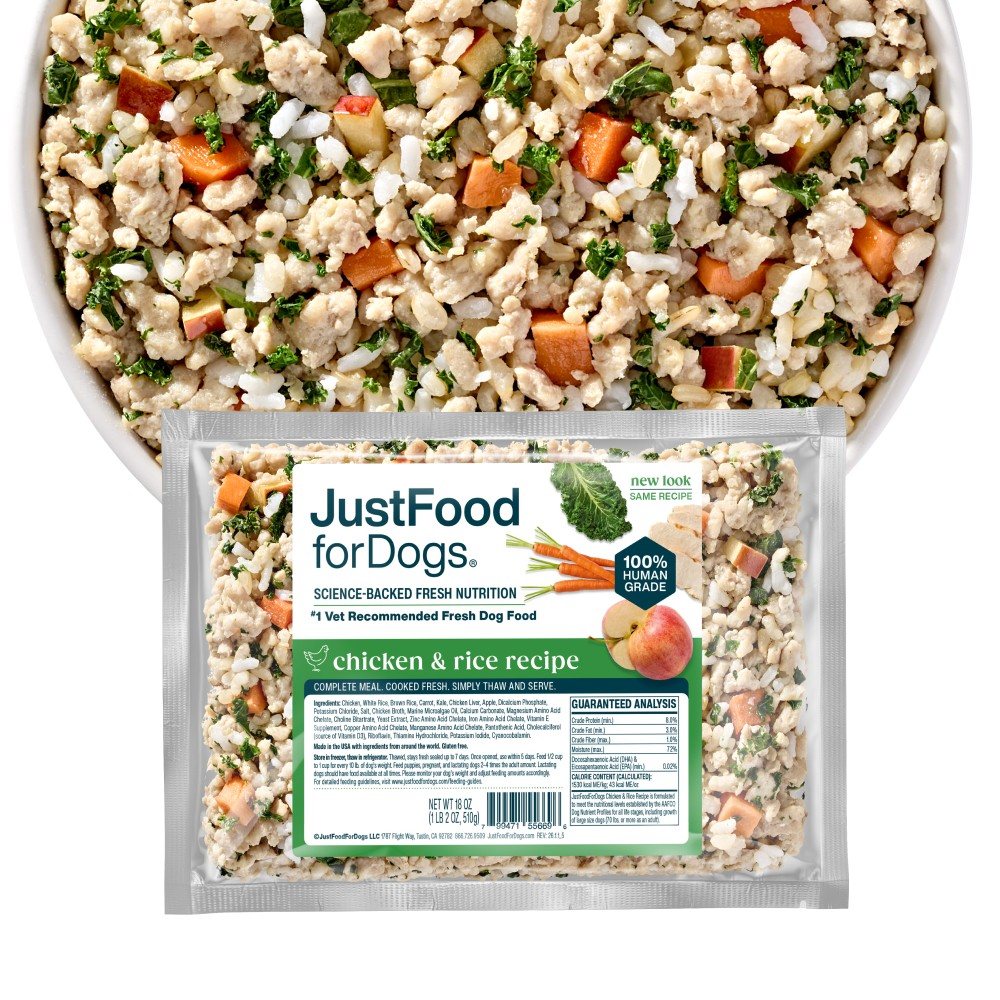
JustFoodForDogs Chicken & Rice is a useful first recipe to consider when you want a complete fresh meal with grains. Its ingredient list includes chicken thighs and liver, white and brown rice, kale, carrots, and apples. The recognizable ingredients sit within a formulated recipe rather than a simple combination of meat and a carbohydrate.
The manufacturer’s current product information lists 1,530 calories per kilogram, or about 43 calories per ounce. Its nutritional adequacy statement covers all life stages, including growth. That makes the recipe relevant both to a puppy-food discussion and to an adult Beagle’s meal plan, with the actual amount adjusted for the individual dog.
For an adult receiving an illustrative 500 calories from the main food, the ounce-based calculation produces about 11.6 ounces per day. This is useful when checking whether an order fits your freezer and when deciding how much to thaw for the next serving period. It does not establish that 500 calories is the right allowance for your own dog.
- Why consider it: A complete chicken-and-rice recipe with a clear life-stage statement.
- Portioning advantage: Published calories support gram or ounce calculations.
- Household fit: A straightforward starting point for a fresh-feeding routine that can be written down and repeated.
For reward-heavy training days, the same portioning clarity helps you keep meals and extras in one plan. You can calculate the main-food amount after reserving the day’s rewards, rather than filling the usual bowl and treating training food as invisible. If you use some of the complete meal itself as a reward, set that portion aside before serving the rest.
Chicken & Rice also gives you a clear ingredient reference when comparing other recipes. If a fish-based meal interests you later, you can compare calories and ingredients directly rather than assuming the same scoop will work. Save the current calorie figure with your feeding instructions so the next person serving dinner does not need to reconstruct the calculation.
Turkey & Whole Wheat Macaroni: More calories per ounce for adults
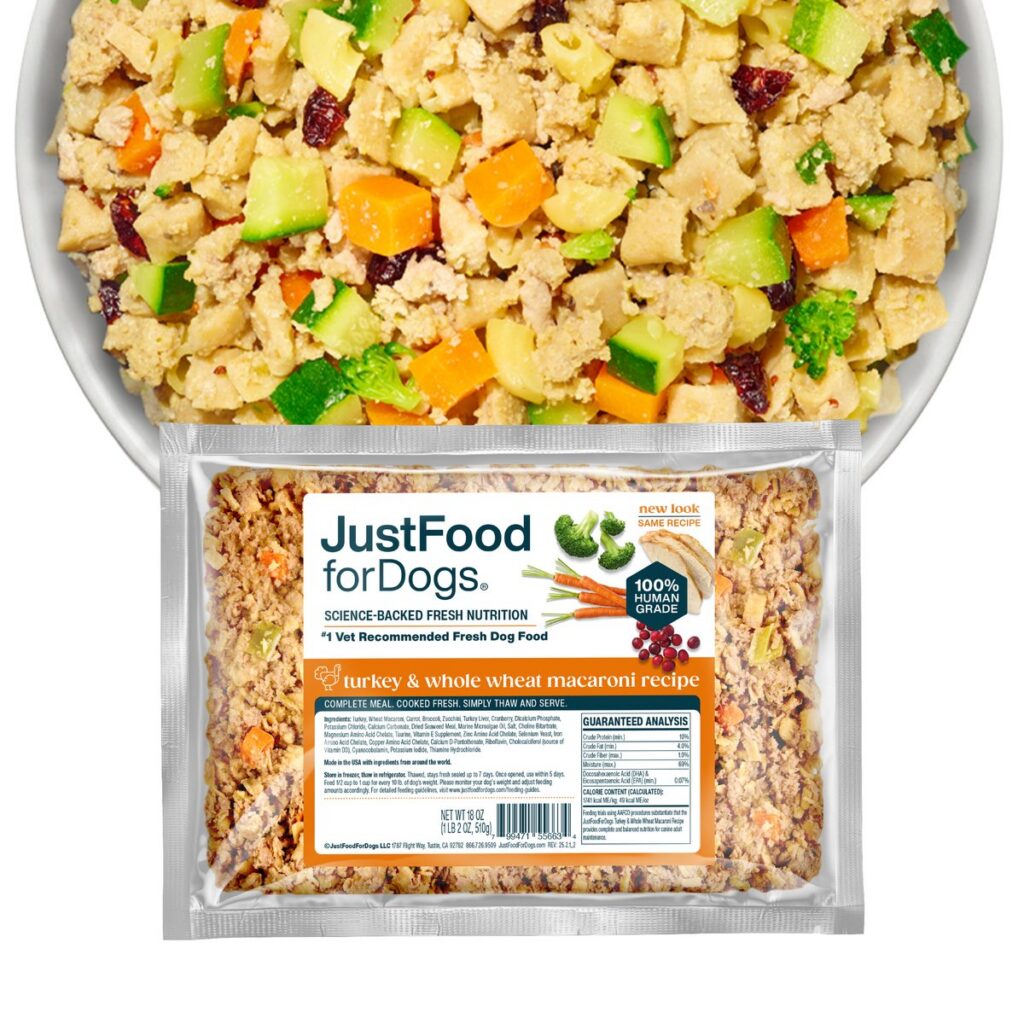
Turkey & Whole Wheat Macaroni is the most calorie-dense of the four recipes compared here. The manufacturer lists 1,741 calories per kilogram, or about 49 calories per ounce. An adult Beagle can receive the same planned calories from a smaller food weight than with the other options in this guide.
The recipe contains turkey and turkey liver, whole wheat macaroni, broccoli, zucchini, carrots, and cranberries. The wheat is an important ingredient detail for anyone comparing grain choices. Its adult-maintenance statement is supported by feeding trials using AAFCO procedures, according to the manufacturer’s product page.
An illustrative 500-calorie main-food allowance works out to about 10.2 ounces per day using the published ounce figure. The practical benefit is compactness, which may matter when you organize portions for an adult dog’s sitter or plan refrigerator space. It does not mean you should choose the recipe simply because a Beagle is active or has a strong interest in food.
- Why consider it: An adult fresh recipe with turkey and grains.
- Portioning advantage: The smallest food weight at the same calorie allowance among these four choices.
- Life-stage boundary: Choose a growth-appropriate food for puppies instead of assuming all recipes from the brand cover growth.
This recipe can be especially easy to compare when a household is choosing between chicken and turkey meals for an adult. Start with the desired ingredient combination, then calculate the amount each would require. A modest-looking serving of the turkey recipe may be entirely consistent with the plan, even if another recipe would create a fuller bowl.
Measure that serving before adding anything else. If you use a food-filled toy, its portion can come from the daily measured amount when the toy and food are suitable for that use. Counting food before it is divided between a bowl and an activity helps prevent a second, unrecorded serving from appearing during the afternoon.

Fish & Sweet Potato: A fish-based fresh alternative
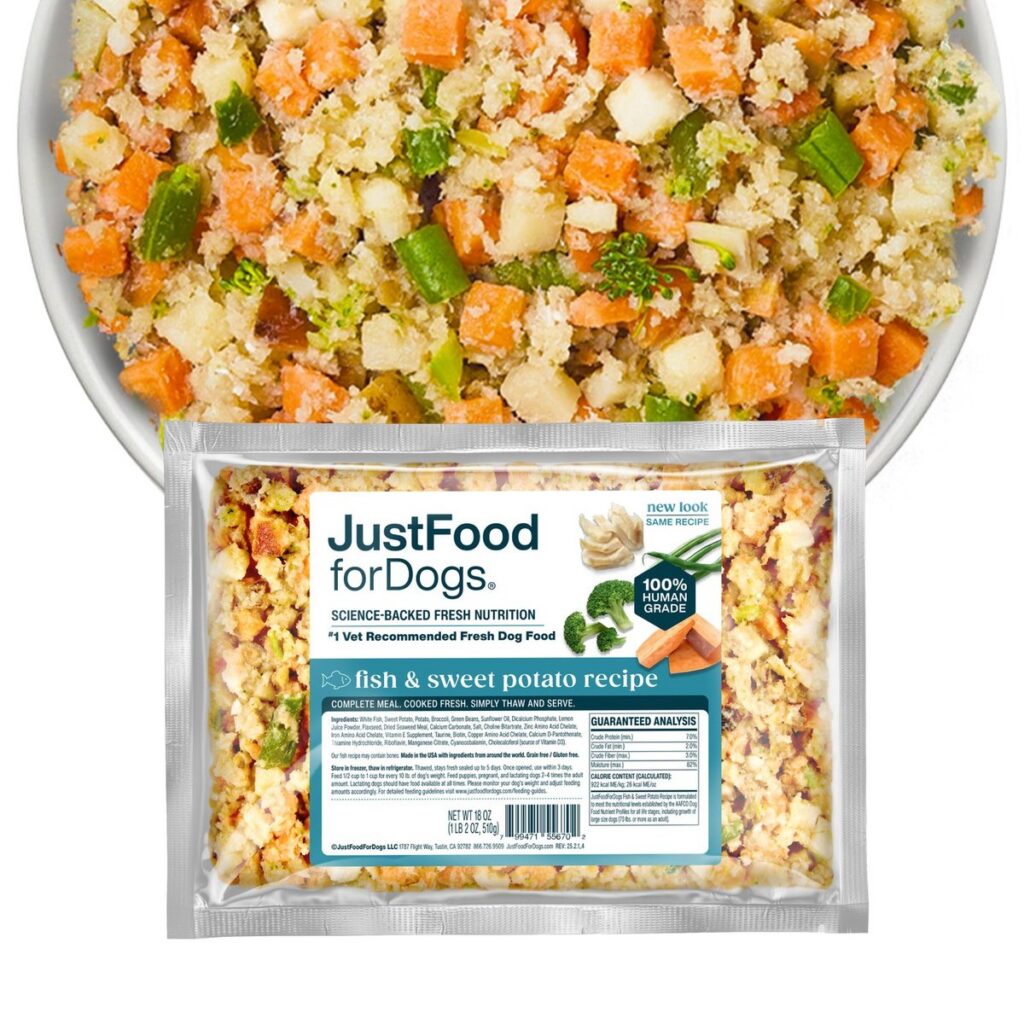
Fish & Sweet Potato gives owners a distinctly different ingredient combination. Its recipe includes whitefish, sweet and russet potatoes, green beans, broccoli, and oils. The current formula is grain-free; that describes its ingredients, rather than establishing an advantage for every Beagle.
The official product information lists 922 calories per kilogram, or about 26 calories per ounce, with an all-life-stages nutritional adequacy statement. It therefore belongs on the shortlist for both puppies and adults when its ingredients and practical requirements fit the household.
At an illustrative 500 calories from the main food, the calculation produces about 19.2 ounces daily. That is substantially more food by weight than the turkey or chicken options at the same calorie amount. The difference matters for shopping and portion preparation: a package will supply fewer days at a fixed calorie allowance if each day requires more ounces.
- Why consider it: A complete fish-based meal with a different ingredient mix.
- Portioning distinction: More food weight at the same calorie allowance than the other recipes here.
- Planning priority: Check refrigerator and freezer capacity against the actual amount you will use.
If your adult Beagle already eats another complete food and you want to include this recipe, decide the calorie share before adding it. For example, a 100-calorie share is about 3.8 ounces using the published calorie figure. That share replaces 100 calories of the existing complete food; it is not an extra topping on top of a full allowance.
Do not interpret the larger portion as proof that it keeps every dog satisfied longer. A dog’s response to meals is individual, and bowl volume is only one part of the routine. The measurable advantage here is transparency: you can see the exact ingredient combination, life-stage eligibility, and amount required for the calories in your plan.
JustFresh Home-Cooked Chicken: Pantry convenience for adult meals
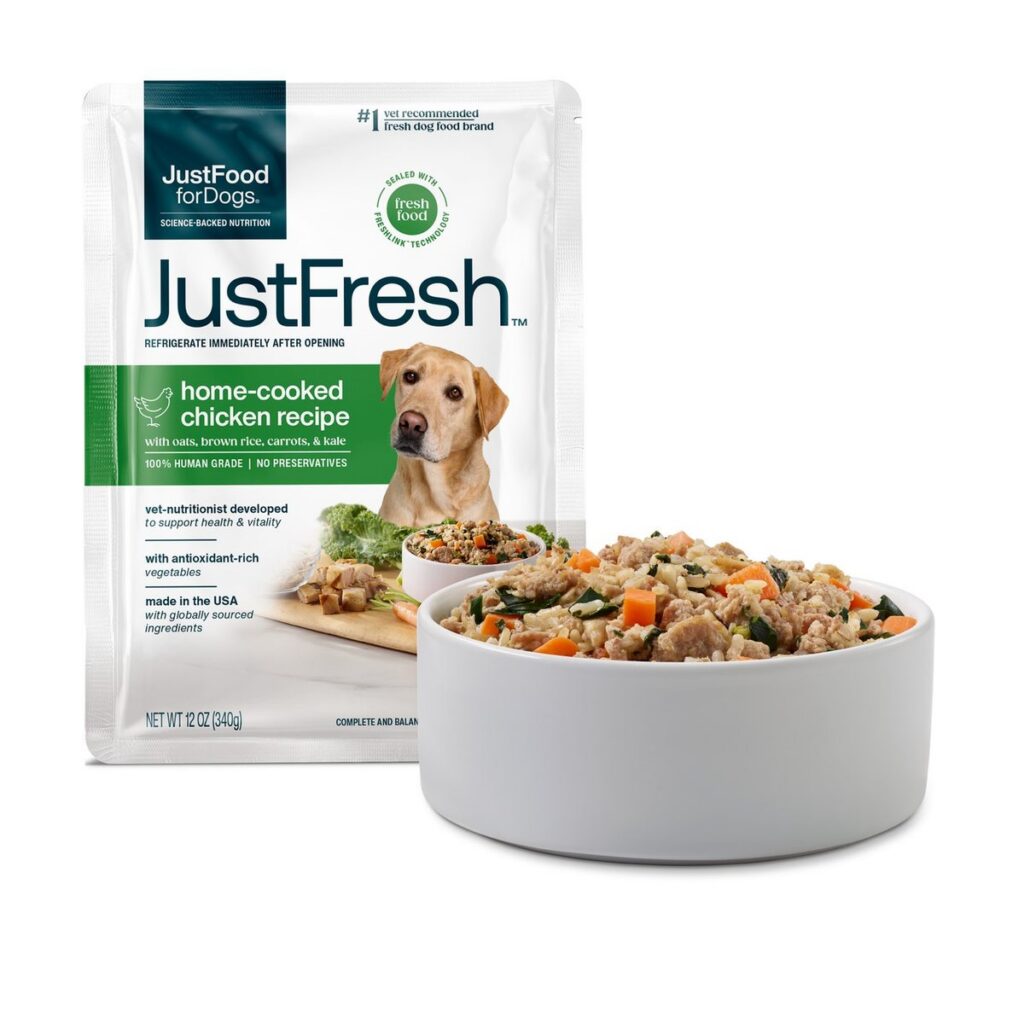
JustFresh Home-Cooked Chicken offers a useful storage distinction: the unopened product is shelf-stable. For an adult Beagle’s household, that can make it easier to keep a planned supply without allocating all of it to the freezer. It is also a practical option to evaluate when a sitter needs a clearly identified meal.
The recipe includes chicken and liver, oats, brown rice, carrots, kale, oils, potato starch, and a nutrient blend. The manufacturer’s product information identifies it as an adult-maintenance food and lists 1,254 calories per kilogram, or about 36 calories per ounce.
The convenience changes after opening: refrigerate the food and use it within three days, following the current package instructions. An opened pouch is not a shelf-stable travel meal. If you are taking opened food away from home, the plan needs to include appropriate cold storage rather than just a space in the car.
- Why consider it: Complete adult meals with unopened pantry storage.
- Portioning reference: An illustrative 500 calories requires about 13.9 ounces.
- Serving priority: Match the amount opened to the amount you can use within the stated refrigerated period.
For a multi-person household, write the opening date and the daily measured amount where the feeder will see them. That small step connects the storage instructions with the actual meal plan. It is particularly helpful if only part of a pouch is used at a time or if a sitter takes over halfway through an opened package.
JustFresh can also provide continuity when freezer space is temporarily tight. The useful comparison is between complete adult recipes and their serving requirements, not simply fresh versus convenient. If you change from another food, follow transition guidance appropriate to your dog and recalculate the portion from the new recipe’s calories rather than reusing the old food weight.
Beagle puppy and senior food decisions
A food decision begins again when the life-stage requirement changes. Puppy nutrition, adult maintenance, and the feeding plan for an older individual are related, but they are not interchangeable labels. Use the dog’s current stage to narrow the choices, then consider ingredients, calories, and the routine that will deliver the food consistently.
Start Beagle puppies with growth-appropriate nutrition
For a puppy, look for a complete food whose nutritional adequacy statement includes growth or all life stages. Chicken & Rice and Fish & Sweet Potato meet that life-stage requirement in their current formulations. Turkey & Whole Wheat Macaroni and JustFresh Chicken are adult-maintenance choices, so they should not replace the puppy’s growth diet as the main meal.
The word chicken alone cannot answer the puppy question. A complete growth-appropriate chicken recipe is different from plain cooked chicken or an adult-maintenance chicken meal. The nutrient formulation and life-stage statement are the deciding information, even when two products look similar or come from the same company.
Vetstreet’s guide to puppy food provides broader shopping context. When comparing a current puppy food with a fresh option, put both adequacy statements and calorie figures side by side. That makes the conversation about a specific replacement instead of an assumption that fresher-looking ingredients automatically settle the nutritional question.

Plan several feeding opportunities as the puppy grows
Young puppies generally need smaller, more frequent meals than mature adults. The AKC’s puppy-feeding guidance describes a common progression from four meals for young puppies to three during the three-to-six-month period, then two as they mature. Confirm the timing and amount for your individual puppy with your veterinarian.
Frequency and total intake are separate parts of the plan. Splitting a daily food allowance into three meals does not mean serving the old two-meal portion three times. Start with the current daily amount, then divide it across the schedule. If training rewards come from the complete puppy food, set them aside from that same measured total.
Record changes as the puppy grows. A meal amount calculated weeks earlier may no longer match the puppy’s current needs. Bring a clear record of the recipe, amount, extras, and current growth information to routine veterinary visits so the feeding discussion is based on what is actually being served.
- Keep the food’s life-stage statement with your notes.
- Record the total daily amount before splitting meals.
- Include rewards used for house training, handling practice, and recall.
- Revisit the amount as the puppy grows instead of treating the first calculation as permanent.
Training can make food accounting harder because rewards arrive in tiny pieces throughout the day. Their size does not make them nutritionally invisible. A practical approach is to portion the day’s planned training food before the first session and ask everyone in the household to use that shared supply, rather than carrying separate unrecorded bags.
Move to adult feeding deliberately
The move out of puppy feeding is a useful time to review the whole routine. Ask when your dog should change feeding plans based on development, rather than switching merely because a bag has run out. If an all-life-stages recipe remains suitable, the change may involve the amount and schedule rather than necessarily buying a different food.
Adult-maintenance recipes also become options once the dog is ready for adult feeding. Turkey & Whole Wheat Macaroni may appeal for its ingredient combination and smaller portion weight at a given calorie amount. JustFresh Chicken may appeal because of unopened pantry storage. Choose the feature that solves an actual household need.
During the change, update the written instructions for every feeder. Note the new recipe if there is one, the new calorie information, the total daily amount, and how it is divided. An outdated instruction on the refrigerator can otherwise keep the puppy’s old routine going after the food itself has changed.
Compare an active adult with a household companion
A hunting Beagle and a household Beagle may be able to eat the same complete adult recipe while needing different daily amounts. The activity label does not determine the answer on its own. How often the dog works, how long the sessions last, and the individual’s condition and feeding response all matter when setting a practical plan.
Describe a real week rather than the dog’s most demanding day. A weekend of sustained activity and several quieter weekdays is different from regular daily work. Record changes to routine and discuss the calorie plan with your veterinarian, especially when the dog’s workload changes substantially. Do not increase every day’s food indefinitely because one outing was unusually long.
For day-to-day organization, separate the established daily allowance from where the food will be served. Some can be reserved for appropriate training, with the remainder divided between meals. On an active day, use the feeding plan you have established for that situation rather than guessing from enthusiasm at the food bowl.
Choose food for the individual senior
An older Beagle’s food decision should start with current needs and the existing veterinary feeding plan. Age alone does not tell you a specific protein level, calorie amount, or texture to choose. A senior who remains comfortable with the current complete food may need a different discussion from one whose appetite, ability to eat, or daily routine has changed.
Vetstreet’s senior dog food guide offers broader context for comparing options. For this fresh-food shortlist, use the same concrete information as you would for another adult: adult suitability, ingredients, calorie density, and practical serving needs. Bring any new eating difficulty or unexplained change to your veterinarian rather than treating a new recipe as the solution.
A moist complete meal may be convenient to portion and serve, but the word fresh does not prove that it addresses a senior dog’s individual needs. The useful question is whether a specific complete recipe fits the feeding plan and can be offered consistently. Clear calorie information helps you compare options without making the serving amount depend on appearance.

Keep a feeding handoff simple
A Beagle’s feeding note should identify the recipe, daily amount, meal schedule, and reserved reward supply. The reward line is especially useful in homes where walks, training, and visitors all involve food. Keep the note with the day’s supply so a second caregiver can see what has already been used.
For a medium-to-large comparison, see Petful on feeding Dobermans and Great Pyrenees.
Food formats, training rewards, and daily portions
The most useful Beagle feeding plan accounts for the full day before the first bowl is served. Meals, training pieces, chews, food used in toys, and snacks from another family member all belong in the same picture. Start with an appropriate calorie target, then assign the calories to their intended uses.
Distinguish appetite from a portion calculation
A dog’s interest in another bite does not tell you how many calories were in the last meal. Before increasing food because the bowl was emptied quickly, check the serving against the written plan. Confirm that the correct recipe and unit were used, and ask whether someone else has already supplied rewards or another meal.
This is especially useful after switching between recipes with different calorie densities. A smaller food weight may look surprising even when it supplies the planned calories. Conversely, a visibly larger portion does not necessarily contain more calories. Returning to the label calculation gives you a concrete starting point for evaluating what changed.
Watch the individual dog’s overall feeding response and discuss unexplained changes with your veterinarian. A routine adjustment should be based on the dog and the established plan, rather than on an assumption that every request for food requires a larger serving. Keeping a brief record of amounts and extras makes that conversation more useful.
Fresh, dry, and wet describe formats, not a complete decision
A fresh meal can be the main diet when it is complete and balanced for the correct life stage. Dry and canned foods can also be complete diets. The first comparison is nutritional adequacy; the next is the calorie and storage information that lets you serve a consistent amount. Texture or moisture alone does not establish which food is best for every dog.
For owners comparing wet food for Beagles, the four fresh options above offer moist meals with specific practical differences. Chicken & Rice includes grains, Fish & Sweet Potato offers fish and potatoes, Turkey & Whole Wheat Macaroni is more calorie-dense, and unopened JustFresh Chicken simplifies pantry storage. Those are useful distinctions you can check against your own preferences and space.
If you combine complete foods, count each one’s calorie contribution. The goal is not to make the bowl look half fresh and half dry. Equal volumes can supply very different amounts of energy, and equal food weights do not necessarily divide the calories equally either. Decide on the calorie split, then calculate each food’s amount from its own label.
Why protein percentages need context
Moisture affects the percentages shown on pet-food labels. A fresh recipe and a dry food may display different protein percentages partly because they contain different amounts of water. Comparing those numbers directly can therefore give a misleading impression of the difference between the foods.
The FDA’s pet-food guidance explains dry-matter comparison: divide the listed nutrient percentage by the percentage of dry matter, then multiply by 100. Dry matter is 100 minus the moisture percentage. That calculation puts the two foods on a more comparable basis for the particular nutrient.
It still does not identify an overall winner by itself. Nutritional adequacy, the complete formulation, the dog’s life stage, and the amount eaten remain relevant. Use the analysis to ask better questions about a recipe, rather than turning one percentage into a claim that every Beagle needs the highest number available.
Build a full-day food budget
Here is an illustrative adult plan using a total allowance of 550 calories per day. This number is chosen to demonstrate the arithmetic; it is not a recommendation for an average Beagle. Suppose the dog’s established plan reserves 50 calories for suitable rewards and other extras. That leaves 500 calories for the main complete food.
The calculation is simple: 550 total calories minus 50 calories in planned extras equals 500 calories from meals. Calculate the main-food portion from that remaining amount. If the reward plan changes, update the meal calculation rather than automatically keeping the same meal and adding more extras.
Keeping extras a small part of the total protects the role of the complete diet. WSAVA’s nutrition resources provide practical tools for discussing treats and overall intake with your veterinary team. The allowable extras for an individual dog may be more restricted by an established feeding plan, so use that plan when it applies.
Training budget: Set aside the day’s planned reward supply before training starts. Tell every feeder whether it comes from the complete-food portion or from a separate extras allowance. Count it once, in the correct place.
The distinction between those two sources matters. Food removed from a measured daily portion of complete food is still part of that portion. A separate treat is an extra with its own calorie information. Subtracting a reserved meal portion twice would undercount food; forgetting a separate treat would overcount what remains available for meals.
Turn the same allowance into four different portions
The table below uses the same 500-calorie main-food allowance for each recipe. It uses the manufacturer’s rounded calories-per-ounce figures, so small differences from gram-based calculations are expected. Pick one unit for your routine and use the matching calorie figure consistently.
| Recipe | Calculation for 500 main-food calories | Approximate daily amount | Approximate amount per meal if divided in two |
|---|---|---|---|
| Chicken & Rice | 500 ÷ 43 calories per ounce | 11.6 ounces | 5.8 ounces |
| Turkey & Whole Wheat Macaroni | 500 ÷ 49 | 10.2 ounces | 5.1 ounces |
| Fish & Sweet Potato | 500 ÷ 26 | 19.2 ounces | 9.6 ounces |
| JustFresh Home-Cooked Chicken | 500 ÷ 36 | 13.9 ounces | 6.9 ounces |
These are alternative ways to supply the example allowance, not four servings to combine. They show why a familiar bowl size or an old recipe’s scoop is not a reliable transfer method. Fish & Sweet Potato requires almost twice the food weight of Turkey & Whole Wheat Macaroni for the same example calories.
The meal column also assumes two equal meals. If the dog’s established schedule uses a different division, apply that division to the daily total. The serving schedule can change where the food appears during the day without changing the total calories assigned to the main food.
Use a scale without mixing up units
For the example’s 500 food calories, Chicken & Rice at 1.53 kcal/g requires about 327 grams daily. Zero the empty bowl, then weigh the food. A two-meal schedule would use about 163 grams per meal; write the unit and meal frequency on the feeding note.
Make reward calories visible
A hypothetical two-calorie treat contributes 40 calories when you use 20 pieces. Breaking each piece into four gives 80 small rewards with the same 40 calories. This can provide more reinforcement opportunities within the planned allowance. Use the actual treat’s calorie information and pieces appropriate for your dog; reward count alone does not measure intake.
Two ways to organize the same training day
Using the same illustrative 550-calorie day, reserve 50 calories for separate treats and 500 for Chicken & Rice. The fresh portion is about 327 grams. If 33 grams of that portion will be served during a feeding activity, leave about 294 grams for bowls. Moving food from a bowl to an activity changes where it is eaten, not the daily allowance. Moist food still needs appropriate cold storage and clean handling; a separate dry reward may be more practical outdoors.
- The meal record shows the portion remaining for bowls.
- The activity portion is identified as already counted complete food.
- The separate reward container retains its own planned allowance.

Coordinate rewards across the household
For a Beagle attending training class, pack rewards from the day’s reserved allowance before leaving home. Use the same supply for walks and visitors rather than giving each person a separate allowance. A labeled container makes the remaining supply visible without requiring everyone to repeat the calculation.
Combine fresh and dry food by calories
Suppose you want half of the example’s 500 main-food calories to come from Chicken & Rice, with the other half from an appropriate complete dry food. The fresh share is 250 calories divided by 43 calories per ounce, or about 5.8 ounces per day.
For illustration, imagine the dry-food label says 400 calories per cup. Its 250-calorie share would be 0.625 cup. That calorie density is hypothetical, so replace it with the figure on your own food. If the dry label also supplies calories per kilogram, a gram-based calculation may be more convenient for your measuring routine.
The result is one combined 500-calorie main-food allowance, with the separate 50-calorie extras allowance still unchanged. It is not a full dry-food portion plus a fresh addition. If you divide the mixture into two meals, divide both daily components so the feeder knows how much of each belongs in each serving.
Compare complete fresh recipes the same way
For a 500-calorie main-food plan split equally between two fresh recipes, use about 5.8 ounces of Chicken & Rice and 9.6 ounces of Fish & Sweet Potato. This is an optional calorie split, not a reason to rotate foods or a requirement for Beagles. For a puppy, both main-diet components must fit the growth plan.
Recalculate when the food changes
A change of recipe requires a new food weight even if the calorie allowance stays the same. During the transition, calculate each recipe’s assigned share separately and record the step being served. If the dog develops a feeding problem, use that record when contacting the veterinarian instead of repeatedly changing foods.
Budget from daily use, not just package price
At the regular prices observed on September 28, 2026, the official Chicken & Rice listing showed $153.99 for 14 packs of 18 ounces, or 252 ounces total. Fish & Sweet Potato showed $167.99 for the same package count and size. These are observed listed regular prices, excluding tax and shipping; promotions and current prices may differ.
Using the 500-calorie main-food example, Chicken & Rice costs about $7.11 per day and Fish & Sweet Potato about $12.82 per day. The difference follows from both the listed price and the amount required to supply the same calories. A comparison based only on the price of the bundle would miss much of that practical difference.
| Example using listed regular prices | Chicken & Rice | Fish & Sweet Potato |
|---|---|---|
| Bundle quantity | 252 ounces | 252 ounces |
| Observed regular bundle price | $153.99 | $167.99 |
| Main-food calorie allowance used | 500 calories daily | 500 calories daily |
| Approximate daily cost | $7.11 | $12.82 |
| Approximate seven-day cost | $49.74 | $89.74 |
| Approximate days supplied by one bundle | 21.7 days | 13.1 days |
The weekly figures use unrounded calculations, which can differ slightly from multiplying a rounded daily figure by seven. Treats and any second food are additional costs. Recalculate with the current checkout information and your dog’s established amount before using the example as a shopping budget.
If half the main-food calories come from Chicken & Rice in the mixed plan above, its fresh portion costs about $3.55 per day at that observed regular price. Add the cost of the actual dry-food portion and rewards to compare the whole day. This gives you a meaningful mixed-feeding budget without pretending the second food is free.
Plan opening, storage, and replenishment together
Choose the recipe around the amount your Beagle actually uses. Fresh Frozen requires a thawing routine; adult JustFresh Chicken offers unopened pantry storage but a three-day opened-use window. Before buying a larger pack, check that its contents can be used within the exact product’s handling directions.
Check the first order against a real week
After the first week, compare food used with the calculated order estimate and check whether the reward allowance was followed. If the difference comes from unmeasured additions, correct the routine before changing the recipe. If the dog’s intake or weight changes unexpectedly, review the individual plan with the veterinarian.
Keep food safety separate from food preferences
Foods people enjoy are not automatically appropriate rewards for a dog. Vetstreet’s guide to foods you should never share with your dog covers this broader safety question. Chocolate, grapes and raisins, onions, and products containing xylitol are examples that should stay out of the reward supply.
Keep the approved training food in a clearly identified place, especially when children or visitors may offer snacks. If a dog may have eaten something hazardous, contact a veterinarian or animal poison service promptly rather than trying to solve the problem with a different meal. The shopping choices in this guide are for routine feeding decisions.
What the research adds to a Beagle food decision
JustFoodForDogs offers more than a list of ingredients to compare. Its published research and recipe-level labels give owners specific evidence to examine alongside the practical feeding choices above. For a Beagle owner, one particularly relevant study actually used adult Beagles, although that does not establish a unique nutritional requirement for the breed or a universal winning food.
A published study that included adult Beagles
A 2021 University of Illinois study compared four diets in 12 healthy adult Beagles, using repeated 28-day feeding periods. Two diets were JustFoodForDogs Beef & Russet Potato and Chicken & White Rice; the others were a fresh roasted food and an extruded dry food. The investigators measured nutrient digestibility, fecal output and other laboratory outcomes.
The two JFFD foods were highly digestible and produced less fecal output than the tested extruded food. That is useful, product-specific evidence behind the fresh-food discussion. It does not prove that every current recipe produces the same result, that every kibble performs alike, or that a puppy or dog with a medical condition would respond identically. The study evaluated the foods supplied for that experiment, not every product now sold under the brand.
Match the evidence to the product you are buying
Use three separate questions when reading a recommendation: Was a named food studied? What did the study measure? Does the current product label fit this dog’s life stage? A favorable answer to the first question cannot replace the other two. This approach lets you recognize JFFD’s research investment while choosing on facts that actually apply to the bag, carton, or pouch in your order.
JFFD publishes feeding-trial certificates for readers who want to inspect its testing documentation. Match the recipe name and intended feeding purpose rather than transferring a finding across an entire brand. Research, nutritional adequacy, and your dog’s practical feeding response answer related but different questions. Together they are more informative than a package photograph or a broad claim that one processing method is always best.
Distinguish nutritional adequacy from an endorsement
The FDA explains two routes for complete-and-balanced statements: meeting the relevant nutrient profile or substantiating adequacy through feeding trials conducted under AAFCO procedures. The statement also identifies the intended life stage. These are specific label claims, not a survey declaring which food all veterinarians recommend and not a guarantee of a particular outcome for one Beagle.
For this shortlist, the decision remains straightforward. A Beagle puppy needs the growth eligibility discussed for Chicken & Rice or Fish & Sweet Potato. An adult can also compare Turkey & Whole Wheat Macaroni or JustFresh Chicken for the particular serving and storage advantages described above. Keep the evidence attached to the exact recipe and use the current label when an older study or certificate uses an earlier product name.
Ask questions that can change the buying decision
The WSAVA nutrition toolkit helps owners evaluate a manufacturer’s nutritional expertise, formulation, quality control, and research. Use those topics to request information you can act on. For example, if you need a puppy meal, ask for the exact nutritional adequacy statement. If you are comparing a dietary restriction, provide the veterinarian’s actual requirement and ask for the complete formulation information needed to assess it.
For a healthy adult Beagle, a useful comparison record contains the recipe’s intended life stage, the source supporting any research claim, and the practical reason it fits your routine. Keep unanswered questions specific. Asking which exact product and study support a claim produces a more useful response than asking whether a brand is simply good or bad. Retain the manufacturer’s response with the current label for your next veterinary nutrition discussion.
Choose for your own Beagle
This guide’s recommendations combine those label and research checks with the serving comparisons, storage requirements, and training-food accounting already explained. Chicken & Rice is a useful fresh starting point because its growth suitability, grain-inclusive recipe, and calorie information answer concrete owner needs. The other JFFD selections address different protein, food-weight, or unopened-storage preferences. None requires an invented hands-on trial or a claim that every Beagle needs the same meal.
Related breed feeding guides from our sister sites: Best Dog Food for Corgis (Petful), Best Dog Food for Dachshunds (Petful), Best Dog Food for Pugs (WebVet).
Frequently Asked Questions
Chicken & Rice and Fish & Sweet Potato carry the growth suitability discussed here. Turkey & Whole Wheat Macaroni and JustFresh Chicken are adult-maintenance foods. Start with a growth-appropriate recipe and a puppy-specific feeding plan; do not select only by protein name or an adult Beagle’s serving.
Yes. Calculate the fresh meal from the calories remaining after the planned reward allowance. At the illustrative 550-calorie total used here, 50 calories of separate rewards leave 500 calories for the complete food. The example teaches accounting and is not a calorie prescription for every Beagle.
Yes. Their calories belong in the full day’s plan. A separate treat uses part of the extras allowance, while a reward taken from an already measured complete-food portion remains part of that portion. Setting the day’s supply aside in advance makes the distinction clear and helps multiple people avoid giving the same allowance twice.
They may be able to share a complete recipe appropriate for their life stages while receiving different amounts. Base the feeding plan on the individual dog and actual workload. Record meaningful changes in activity and review the amount with your veterinarian instead of assuming the word hunting identifies one fixed portion or food requirement.
Not necessarily. Topper describes how a product is served, while the nutritional adequacy statement describes its feeding purpose. A complete food can be served as part of a meal, but a product intended only for supplemental or intermittent feeding should not replace the complete diet. Check the exact product’s statement and count its calories in the daily plan.