
Best Dog Food for Maltese Dogs: Small Portions, Complete Nutrition
Published on October 05, 2026

Compare complete meals for Maltese puppies and adults, with guidance on soft textures, small portions, fresh-food storage, and fitting meals into a daily routine.
This article is sponsored by JustFoodForDogs. All featured products are chosen at the discretion of the Vetstreet editorial team and do not reflect a direct endorsement by the author. However, Vetstreet may make a small affiliate commission if you click through and make a purchase.
The best dog food for Maltese dogs should make a small portion nutritionally complete. A soft meal can be convenient for a little mouth, but texture alone does not tell you whether the food supports a puppy’s growth, an adult’s maintenance needs, or a sensible daily serving. The label and the amount in the bowl both matter.
JustFoodForDogs provides several useful choices for Maltese owners, from fresh frozen recipes suitable for growing puppies to adult meals that can stay in the pantry until opened. Below, we compare four recipes by their published nutrition and handling information, then work through portions in grams and opened-pack use. These recommendations are based on label research, not a hands-on feeding trial.
Choosing a complete food for a Maltese
The nutritional adequacy statement refers to AAFCO nutrient profiles or feeding trials, rather than a breed-specific marketing claim. Check the stated life stage on the exact recipe.
Key Takeaways
- Start with a complete and balanced food for your dog’s life stage. Then compare calorie density, comfortable meal texture, and how much of an opened package your dog can finish within its storage window.
A Maltese may eat only a modest amount by weight, so every spoonful deserves careful measurement. Breed alone does not establish a daily calorie target. Your dog’s age, size, activity, body condition, and individual health determine the starting plan, with the food’s directions and your veterinarian helping you adjust it.
The FDA’s complete and balanced guidance explains the nutritional adequacy statement. Look for growth or all-life-stages suitability for puppies, and appropriate maintenance or all-life-stages suitability for adults. A product described as a topper or intended only for intermittent or supplemental feeding should not become the entire diet just because the dog enjoys it.
What makes one recipe a better fit?
Chicken & Rice is a useful starting comparison if you want a grain-inclusive fresh recipe that can suit a puppy or an adult. Fish & Sweet Potato offers a different protein and a larger food weight for the same calories. Turkey & Whole Wheat Macaroni supplies the most calories per gram among these four options, while JustFresh Chicken simplifies unopened storage for adult meals.
There is no established number-one healthiest food for every Maltese. For Maltese owners comparing dog food brands, these life-stage, calorie, and handling differences are more useful than an unsupported universal ranking. Choose the recipe that meets the dog’s nutritional requirements and fits the household’s portioning routine. Vetstreet’s small-breed dog food guide offers broader context, while the general dog food guide covers a wider range of buying options.
Use this shortlist of label checks before comparing package sizes:
- Confirm the nutritional adequacy statement and intended life stage.
- Find calories per kilogram, gram, ounce, or package.
- Read the full ingredient list when an ingredient matters to your choice.
- Check unopened storage and the separate directions after opening.
- Compare how many measured daily portions the package actually provides.
Closely related small breeds appear in Petful’s guides to feeding Maltipoos, Toy Poodles, and Dachshunds.
Fresh and soft meal options for small mouths
These JustFoodForDogs recipes offer different calorie densities and storage arrangements. The best practical fit depends on which combination makes complete meals easiest to serve consistently.
| Recipe | Practical fit | Current life-stage suitability | Calories per kilogram | Unopened storage |
|---|---|---|---|---|
| Chicken & Rice | Grain-inclusive fresh meals for puppies or adults | All life stages, including large-size growth | 1,530 | Frozen |
| Fish & Sweet Potato | Fish-based meals with fewer calories per gram | All life stages, including large-size growth | 922 | Frozen |
| Turkey & Whole Wheat Macaroni | More calories in a smaller adult serving among these picks | Adult maintenance | 1,741 | Frozen |
| JustFresh Home-Cooked Chicken | Adult meals with unopened pantry convenience | Adult maintenance | 1,254 | Shelf-stable |

Chicken & Rice: A versatile fresh starting point
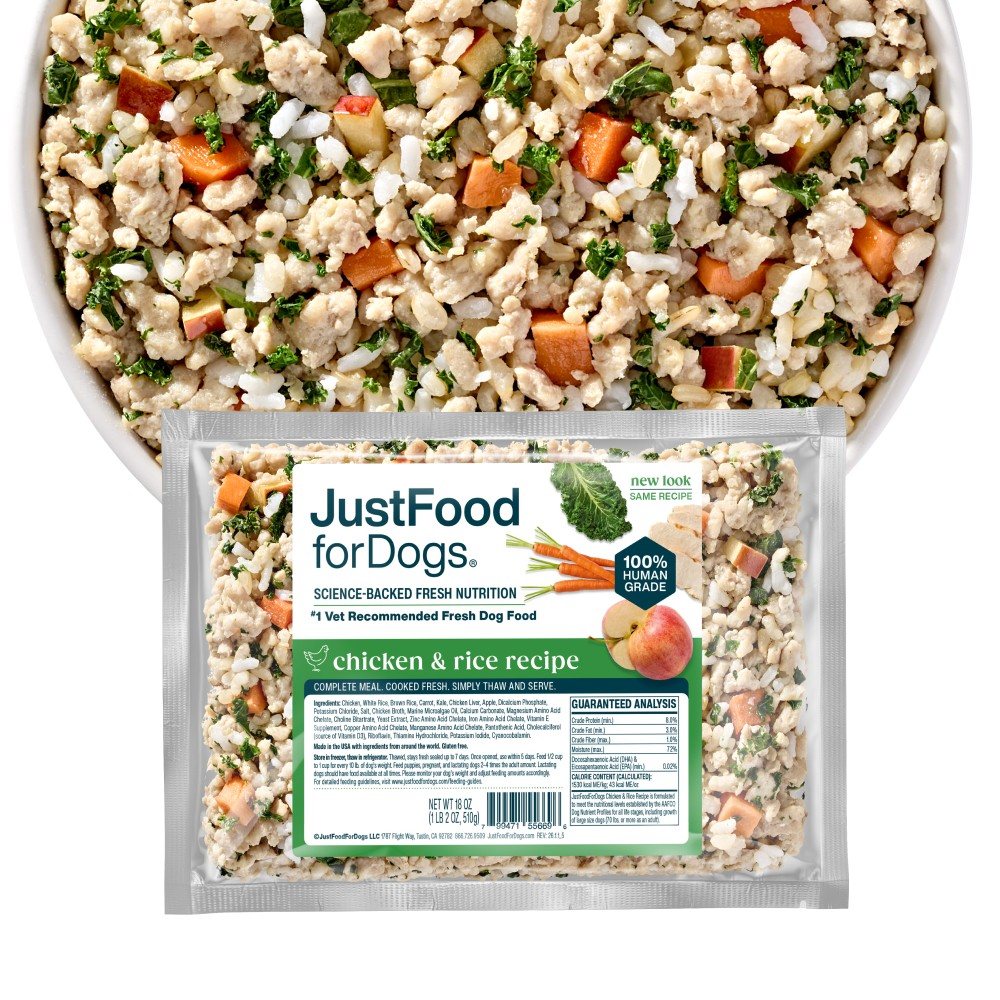
Chicken & Rice combines chicken thighs and liver with white and brown rice, vegetables, fruit, oils, and a nutrient blend. Its current all-life-stages statement includes growth, making it a useful option to compare for both Maltese puppies and adults. Each dog still needs a separately calculated portion.
At 1.530 calories per gram, a hypothetical 200-calorie daily food allowance would equal about 131 grams. That is a calculation example, not a recommended allowance for every Maltese. The recipe’s energy density provides a middle ground between the lighter Fish & Sweet Potato and the more concentrated Turkey & Whole Wheat Macaroni.
Why it belongs on the shortlist: Owners can choose a grain-inclusive fresh meal and use the same clearly labeled recipe through different life stages when it remains appropriate for the individual dog. Freezer space, thawing, and refrigerated handling are part of the routine, so plan the next portion before the current supply runs out.
Fish & Sweet Potato: A fish-based fresh alternative
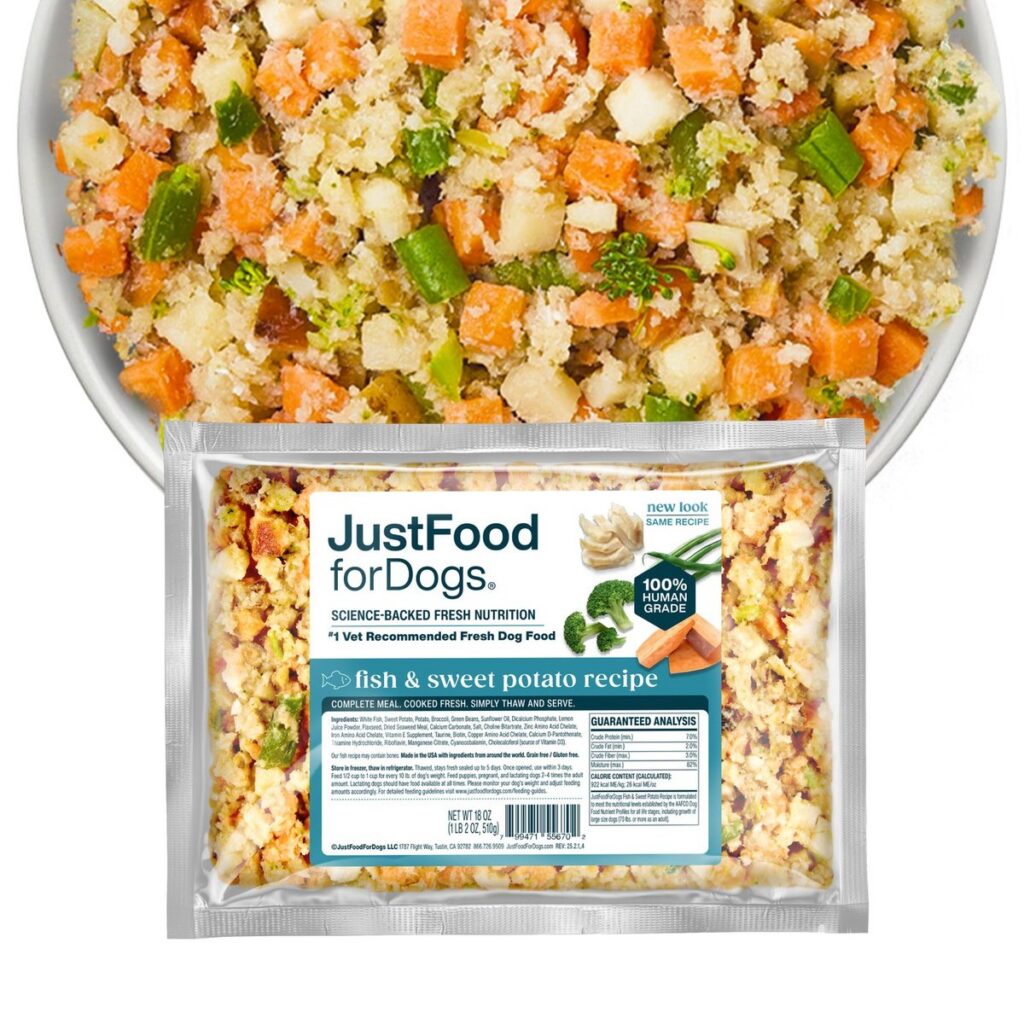
Fish & Sweet Potato includes whitefish, sweet potatoes, russet potatoes, green beans, broccoli, oils, and a nutrient blend. Its current label supports all life stages, including growth. For a Maltese owner who prefers a fish-based recipe, it offers a complete fresh choice with clear calorie information.
At 0.922 calories per gram, the same illustrative 200 calories takes about 217 grams. That is substantially more food by weight than the Chicken & Rice example. Compare that amount with the dog’s existing meals and the number of feedings in the day rather than assuming that any small pack equals one small-dog serving.
Why it belongs on the shortlist: Its protein and ingredient combination offers a distinct choice within the brand. The recipe is grain-free, but that description does not make it automatically better for Maltese dogs or establish a treatment benefit. Select it for its actual formulation and suitability, and keep the individual calorie target unchanged when comparing portions.
Turkey & Whole Wheat Macaroni: A concentrated adult meal
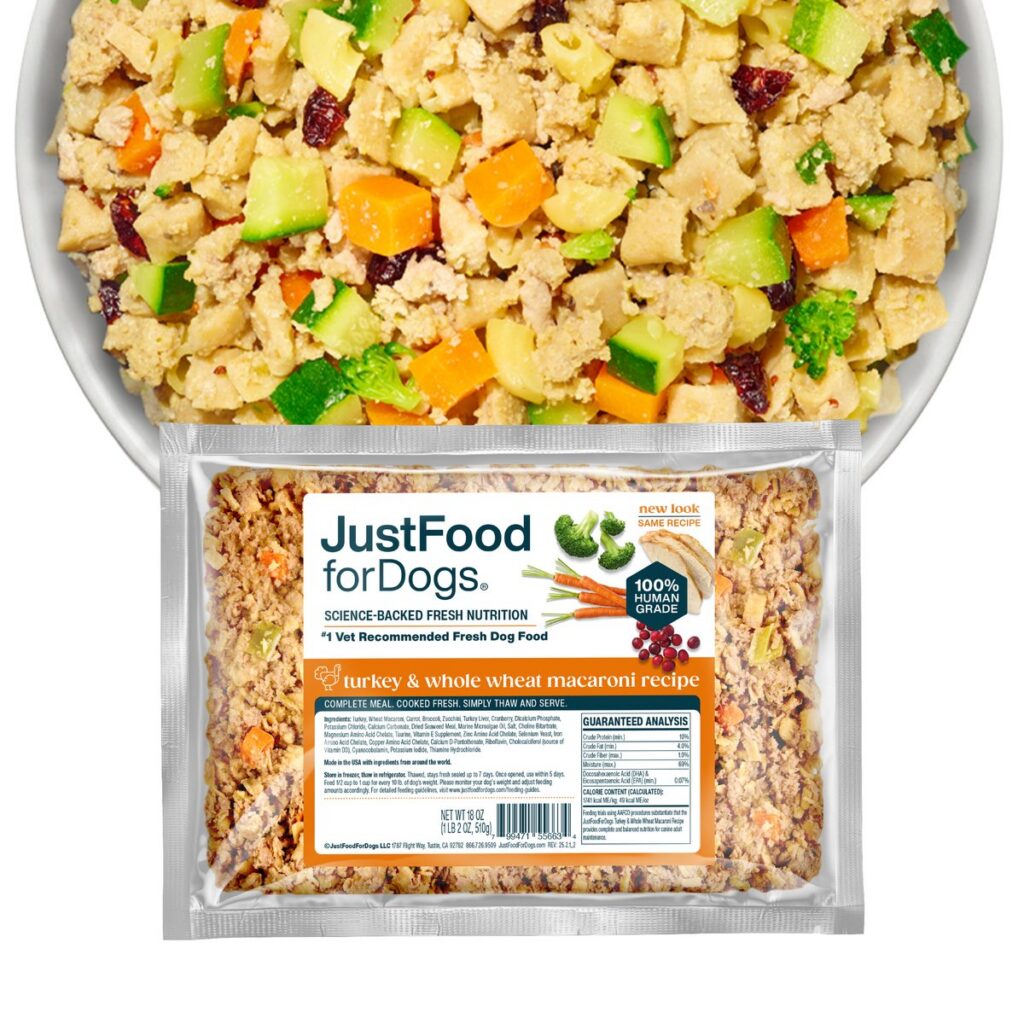
Turkey & Whole Wheat Macaroni combines turkey and liver with whole wheat macaroni, vegetables, cranberries, oils, and a nutrient blend. This recipe’s current nutritional statement is for adult maintenance. It should therefore be compared as an adult Maltese option, not substituted into a puppy plan on the strength of the brand name.
Its 1.741 calories per gram means about 115 grams supplies the illustrative 200 calories. Among these four recipes, it gives the most energy in the least food weight. That can be useful when an adult dog’s measured daily ration needs to fit into compact meals without enlarging the serving merely to match another recipe’s appearance.
Why it belongs on the shortlist: The turkey-based recipe gives adult households a distinct grain-inclusive choice. It contains wheat, which belongs in the ingredient comparison if you are following a specific veterinary recommendation. Energy density also makes a scale especially helpful: a spoonful added casually carries more calories than the same weight of the fish recipe.
JustFresh Home-Cooked Chicken: Unopened pantry convenience
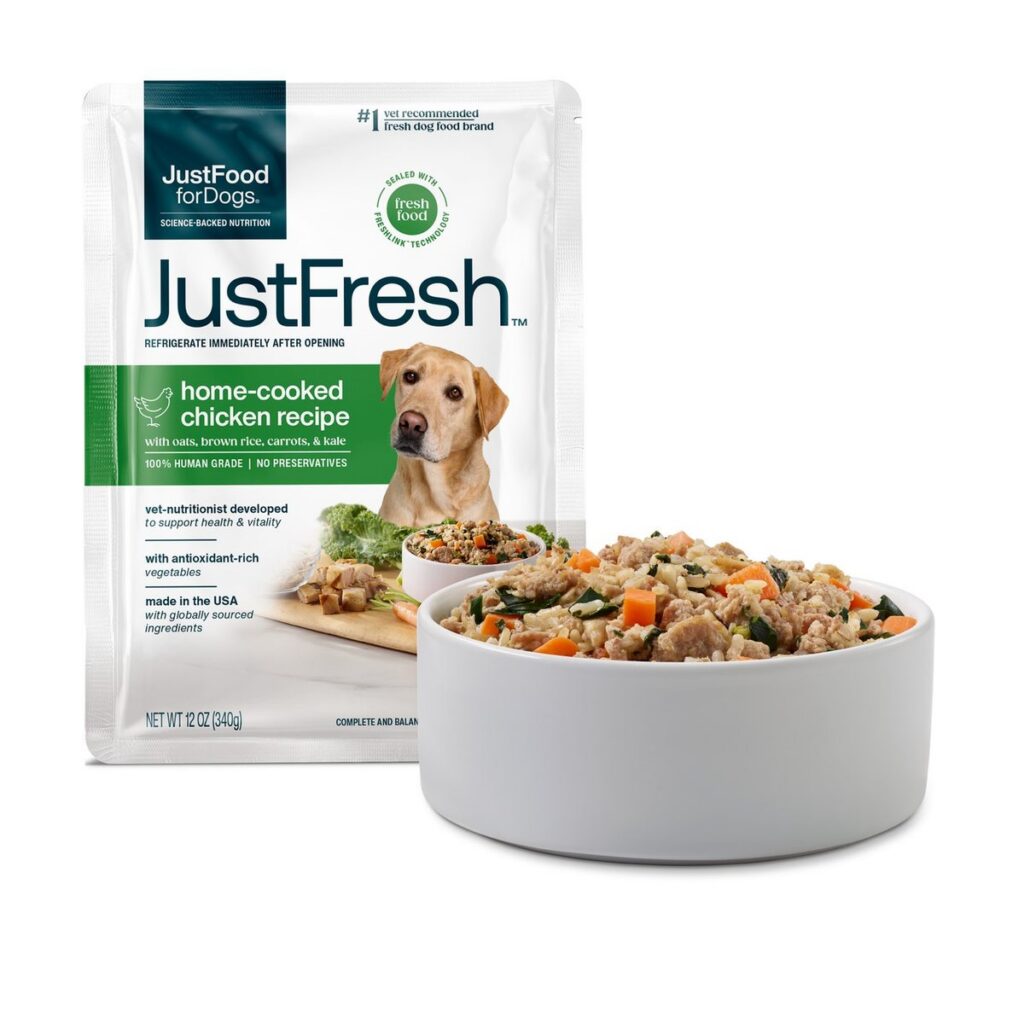
JustFresh Home-Cooked Chicken includes chicken and liver, oats, brown rice, carrots, kale, oils, and a nutrient blend. Its current label is for adult maintenance. The unopened package is shelf-stable, so owners can keep an adult meal supply without reserving freezer space for every portion.
At 1.254 calories per gram, a hypothetical 200 calories is about 159 grams. After opening, the current directions require refrigeration and use within three days. This distinction is particularly useful for a small dog: pantry convenience describes the sealed package, while the remaining food still needs a refrigerator and a dated opening record.
Why it belongs on the shortlist: It combines a soft, ready-to-serve meal with flexible unopened storage. Before buying a larger supply, divide the package’s total calories by the dog’s planned daily amount from this food. That tells you whether one opened package fits the three-day window without changing the dog’s ration to finish it.
Maltese puppies, adults, and senior food choices

A Maltese puppy needs a growth-suitable food even if an adult meal looks equally soft or comes in a convenient pouch. Among the featured recipes, Chicken & Rice and Fish & Sweet Potato have current all-life-stages statements that include growth. Turkey & Whole Wheat Macaroni and JustFresh Chicken are adult-maintenance choices.
For a very small puppy, the amount and frequency of meals deserve a clear plan before the food arrives. The AKC’s small-breed puppy guidance explains why toy and small puppies require particular attention to nutrition and regular feeding. Ask the breeder and veterinarian about the established routine, then make planned adjustments rather than suddenly consolidating meals.
Build the puppy plan from the complete day
Start by identifying the daily amount of the exact recipe, then divide it into the advised number of meals. The daily figure comes first. If a puppy’s plan changes from four meals to three as it matures, that does not by itself mean the daily food amount should increase or decrease.
Record training rewards, chews, and any other calories alongside the main meals. Tiny rewards can still matter to a tiny dog. One useful approach is to ask which portion of the complete daily food can be reserved for supervised reward feeding, so training does not automatically add an uncounted second food budget.
The AKC’s feeding-frequency overview describes more frequent meals for puppies and commonly two meals for adults. An individual young Maltese may need a more specific schedule. Persistent missed meals or a puppy that seems unwell calls for veterinary advice rather than repeated flavor changes.
Moving from puppy to adult feeding
During the puppy-to-adult transition, ask when the individual dog should change its feeding plan rather than using package size as the trigger. You may keep an appropriate all-life-stages recipe while adjusting the amount, or select an adult-maintenance recipe with a new calculation. The nutritional decision and the portion decision should be made together.
Adult and older Maltese dogs
For an adult, compare the maintained body condition and actual daily activity with the current portion. An active day does not automatically justify doubling dinner, and a quiet afternoon does not establish a new calorie target. Look for a consistent trend over time and adjust the measured plan with appropriate guidance.
A senior Maltese also needs an individual assessment. Age alone does not tell you to choose the lowest-calorie recipe, and a softer food is not a diagnosis or treatment for dental problems. If chewing behavior changes, discuss the cause while choosing an appropriate meal texture. Vetstreet’s senior dog food guide provides broader older-dog buying context.
Keep these life-stage decisions separate:
- Puppy: Growth suitability, a reliable meal schedule, and regular review as the dog grows.
- Adult: Complete maintenance nutrition, measured portions, and a routine that fits daily life.
- Senior: An individualized plan based on current condition and comfort, with life-stage and recipe checks still in place.
For small flat-faced dogs, WebVet covers Pugs and Boston Terriers with the same portion-first approach.
Small portions, opened packs, and dry-food alternatives
For this worked example, assume a veterinarian has established 200 calories per day from the main food for one particular adult dog. This is an arithmetic example, not a Maltese feeding recommendation. We use the manufacturers’ calories per kilogram because those figures convert directly to calories per gram.
Divide calories per kilogram by 1,000. Then divide the planned calories by calories per gram. For Chicken & Rice, that is 200 ÷ 1.530 = about 131 grams per day. With two equal meals, the result is about 65 grams per meal, allowing for rounding across the complete day.
| Recipe | Calories per gram | Approximate food for 200 calories daily | Approximate amount per meal if split in two |
|---|---|---|---|
| Chicken & Rice | 1.530 | 131 g | 65 g |
| Fish & Sweet Potato | 0.922 | 217 g | 108 g |
| Turkey & Whole Wheat Macaroni | 1.741 | 115 g | 57 g |
| JustFresh Chicken | 1.254 | 159 g | 80 g |
Make a small measurement repeatable
Put the empty feeding dish on a kitchen scale, press tare, and add the calculated food weight. Use the same unit each time. A portion in grams avoids translating a soft food into a guessed fraction of a cup, and it makes it easier for another caregiver to repeat the serving accurately.
If the dog receives additional foods, keep the total calorie plan intact. Suppose the agreed daily total is 220 calories, including 20 calories of planned extras. The main food allowance is then 200 calories. Adding the 20 calories to an already complete 220-calorie main meal would exceed that plan.
For a small dog, serving precision is useful even when the bowl looks nearly empty. A measured amount can be nutritionally appropriate despite looking modest to a person. Conversely, topping up the bowl because it looks sparse can quietly change the daily intake. Follow the calculation and the dog’s monitored condition together.
Match package life to the actual feeding plan
For opened-pack use, calculate package calories ÷ calories fed from that package each day. A hypothetical 600-calorie package would last three days at 200 calories daily. At 100 calories daily in a mixed-feeding plan, the same package would last six days, which would exceed a three-day refrigerated window.
That example explains why package size matters independently of the meal portion. Do not increase a dog’s serving to avoid leftovers. Choose a suitable pack size, follow the actual product’s handling directions, and ask the manufacturer about approved storage options if your planned use extends beyond the labeled window.

Label the opening date and keep the food refrigerated as directed between meals. A sealed pantry meal and an opened pantry meal are different storage situations. Serve the measured portion in a clean dish; leaving the entire package in a feeding area does not convert it into a safe all-day ration.
Compare daily cost on equal calories
At the regular prices checked September 28, 2026, a 14-pack of 18-ounce Chicken & Rice packages was $153.99, and the equivalent Fish & Sweet Potato bundle was $167.99. Using their displayed 43 and 26 calories per ounce, respectively, a 200-calorie day works out to approximately $2.84 for Chicken & Rice or $5.13 for Fish & Sweet Potato before tax and shipping.
These are food-only comparisons at one illustrative calorie level, not a quote for your dog or a promise of future pricing. Package offers and prices can change. The useful comparison is the cost of an equal amount of energy: a slightly different bundle price can produce a much larger difference in daily cost when the recipes have different calorie densities.
For mixed feeding, calculate the cost of the actual calories assigned to each food. If half of a 200-calorie main-food allowance comes from Chicken & Rice, use the cost of 100 calories of that recipe and add the cost of 100 calories from the other complete food. Include the potential cost of unused leftovers when selecting package size.
Dry food and mixed meals
Dry food can offer convenient unopened storage and compact servings. Look for complete and balanced nutrition for the right life stage, clearly stated calories, and a size and shape your dog can handle comfortably. A small-breed label may help narrow the comparison, but the complete formulation and measured serving remain the deciding factors.
To combine dry and fresh food, divide the calorie allowance between them first. For example, 100 calories from Chicken & Rice equals about 65 grams. If a hypothetical dry food contains 4 calories per gram, another 100 calories equals 25 grams. Together, those amounts provide the example’s 200 calories; a full dry serving plus the fresh portion would not.
Use the exact dry food’s calorie information rather than that illustrative figure. Introduce a planned change according to the manufacturers’ directions and the dog’s individual needs, and keep notes on appetite and tolerance. Frequent unplanned additions make it harder to know which food and quantity the dog is actually receiving.
Test the routine before buying a larger supply
Write down the chosen recipe, daily grams, meal times, and opening date for the first package. Then check what happens during an ordinary day: whether the prepared portion is accessible in the dish, whether leftovers are managed promptly, and whether every caregiver follows the same amount. These observations help identify a practical mismatch without assuming the dog needs an entirely different food.
A shallow dish may make a soft meal easier for a small muzzle to reach, but watch the individual dog instead of choosing by bowl marketing. The dog should be able to approach comfortably and reach the food without a difficult angle. If long facial hair repeatedly reaches the meal, discuss a practical grooming routine and keep the feeding area clean; the food itself does not need to change because of a hairstyle.
Use a short record rather than relying on memory:
- Recipe name and its calories per gram.
- Planned daily grams and the amount allocated to each meal.
- Calories reserved for rewards or other foods.
- Package opening date and labeled refrigerated limit.
- Amount served, amount left, and any meaningful change in eating behavior.
If someone else feeds the dog, a written gram amount is clearer than “a small scoop.” Two people can interpret that phrase very differently. A measured daily container can also help coordinate households, provided it follows the recipe’s storage instructions and everyone understands how much has already been served.
Compare two recipes without changing two variables at once
Suppose an adult Maltese currently receives the illustrative 200-calorie amount of Chicken & Rice. Switching to Turkey & Whole Wheat Macaroni while keeping the same 131-gram food weight would provide about 228 calories, rather than 200. Switching to Fish & Sweet Potato at that weight would provide only about 121 calories. The bowl could look similarly full while the energy intake changes substantially.
That is why a recipe change starts with a calorie calculation, followed by the recommended transition plan. It is also why you should not copy a friend’s Maltese portion: the friend’s dog may eat a different formula, receive different extras, or have a different individual requirement. Recheck the current label even when the package name looks familiar.
Once the routine is established, review the planned amount whenever the food, life stage, or sustained activity pattern changes. Record the reason for an adjustment so the household can follow it consistently. A clear plan makes fresh feeding manageable for a very small dog while preserving the central goal: appropriate complete nutrition in a portion that suits that individual.
Food safety and veterinary boundaries
Maltese dogs should not receive unsafe table scraps simply because the pieces are small. Chocolate, grapes and raisins, onion-containing foods, and products containing xylitol are examples of foods to keep out of the feeding routine. Vetstreet’s guide to foods not to share with dogs explains the broader safety considerations.
Plain home-cooked meat is also not interchangeable with a complete prepared recipe. The nutrient formulation matters, not just whether recognizable ingredients appear in the bowl. If you want to prepare the entire diet at home, seek a properly formulated recipe and follow its ingredients and quantities rather than improvising a meat-and-rice menu.
Avoid treating food shopping as a way to diagnose a new symptom. A change in appetite, difficulty eating, or a visible change around the eyes deserves an individual assessment. Choose an everyday food for supported nutrition and practical fit; claims that one recipe universally fixes a Maltese’s appearance or health go beyond that evidence.
Related breed feeding guides from our sister sites: Best Dog Food for Maltipoos (Petful), Best Dog Food for Poodles (Petful), Best Dog Food for Corgis (Petful).
Frequently Asked Questions
JustFresh Home-Cooked Chicken is an adult-maintenance recipe. For a puppy, compare the growth-suitable Chicken & Rice or Fish & Sweet Potato instead and check the current package statement. A soft texture or chicken ingredient does not by itself establish growth suitability.
Check how many days one opened pack would last at the dog’s measured serving and compare that with the product’s storage limit. JustFresh Chicken’s opened limit is three days. A large bundle may offer convenient inventory, but the individual pack must still fit safe daily use.
A good wet or soft food is complete and balanced for the dog’s life stage and easy to portion correctly. Among these JFFD choices, Chicken & Rice offers a grain-inclusive fresh starting point for puppies or adults, while JustFresh Chicken offers adult pantry convenience before opening. Fresh cooked food and canned food are different formats; compare their actual labels instead of assuming that every soft meal has the same nutritional suitability.
No. A pouch is a package, not a feeding prescription. Compare its total calories with the individual calorie target, calculate the portion in grams, and divide the daily amount across meals. Then check whether the remaining food can be used within the product’s refrigerated storage window. A smaller dog or a mixed-feeding plan may use a package more slowly than its size suggests.
No. A food change has no guaranteed effect on tear staining, and a white coat does not establish a need for a particular protein or grain-free recipe. Persistent or changing staining, especially with irritation or discomfort, warrants veterinary assessment. Select the food for appropriate nutrition and individual suitability rather than buying it as a cosmetic treatment.