
Best Dog Food for Huskies: Choosing Meals for Their Activity Level
Published on October 05, 2026

Compare JustFoodForDogs meals for Husky puppies and adults, then match the exact recipe’s portion, storage, and daily cost to your individual dog’s routine.
This article is sponsored by JustFoodForDogs. All featured products are chosen at the discretion of the Vetstreet editorial team and do not reflect a direct endorsement by the author. However, Vetstreet may make a small affiliate commission if you click through and make a purchase.
The best dog food for Huskies is a complete meal that fits the individual dog’s life stage and daily routine. A household companion who enjoys walks does not automatically need the same food amount as a dog doing sustained physical work. Start with nutritional adequacy, then use the recipe’s calories to plan an appropriate serving.
JustFoodForDogs offers fresh recipes with clear life-stage and calorie information, making those comparisons practical. Chicken & Rice and Fish & Sweet Potato are options for growth and adulthood; Turkey & Whole Wheat Macaroni and JustFresh Home-Cooked Chicken are adult-maintenance choices. Their different calorie densities and storage requirements give owners useful ways to match food to everyday life.
Choose Husky food for the dog you actually have
Chicken & Rice is our practical starting choice for a grain-inclusive fresh meal, with an all-life-stages statement and published calories for portion planning. Fish & Sweet Potato offers a fish-based alternative. For adults, Turkey & Whole Wheat Macaroni supplies more calories per ounce than the other recipes compared here, while JustFresh Chicken offers unopened pantry convenience.
These recommendations come from current manufacturer labels and practical feeding requirements, rather than a hands-on feeding trial. They help answer which food to consider without assuming a universal healthiest recipe or one protein that every Husky prefers. A suitable complete moist meal can be a useful choice even when the package does not say Siberian Husky.
The nutritional adequacy statement is the first label detail to check. The FDA explains complete and balanced pet food in terms of nutrient profiles or feeding trials using AAFCO procedures. The life stage in that statement matters: adult maintenance and growth are different feeding purposes.
Key Takeaways
- Choose complete and balanced nutrition for the correct life stage, then calculate the portion and compare storage needs. Your Husky’s actual routine matters more than an athletic breed image.
Vetstreet’s Siberian Husky profile provides broader breed context. For food shopping, write down the dog’s current age, weight, usual activity, and existing feeding instructions. Descriptions such as very active or always hungry are less useful than knowing what happens during an ordinary week and how much food is actually served.
Use three questions to narrow the options:
- Does the exact recipe cover the dog’s life stage?
- Can you measure the daily amount from its calorie information?
- Can your household follow its storage and serving instructions consistently?
Compare the information behind the name
The healthiest-looking package is not necessarily the most informative one. Look for the nutritional adequacy statement, calories in a usable unit, a complete ingredient list, and a way to contact the manufacturer. These details let you ask specific questions about the meal instead of relying on broad terms such as natural or premium.
A useful product inquiry names the exact recipe and the dog’s life stage. For example, ask whether the formula is appropriate for growth, where its current calorie declaration is listed, or which instructions apply after thawing. Those questions produce information you can use when choosing and serving the food. A general claim that a brand makes high-quality meals does not resolve those product-level details.
For an owner choosing food for an Alaskan Husky, the same label-first process applies: use the individual dog’s growth status, body condition, and actual work rather than transferring a serving from a Siberian Husky example. A shared type of name does not identify one universal daily ration. This guide’s worked numbers show a calculation method, not a standard feeding allowance for every dog called a Husky.

Working and cold-climate breeds with similar activity swings include Great Pyrenees and Bernese Mountain Dogs; Petful’s feeding guides for both apply the same household-record method.
Fresh recipe options for Huskies
The JustFoodForDogs recipes below offer distinct feeding routines. Compare calorie density alongside life stage and format, since equal-looking portions can provide different amounts of energy. Each product has its own label; a shared brand name does not make the servings interchangeable.
| Recipe | Useful fit | Life stage | Calories per ounce | Storage consideration |
|---|---|---|---|---|
| Chicken & Rice | Grain-inclusive fresh meals for puppies and adults | All life stages | 43 | Fresh Frozen; plan freezer space and thawing |
| Turkey & Whole Wheat Macaroni | A more calorie-dense adult fresh meal | Adult maintenance | 49 | Fresh Frozen; contains wheat |
| Fish & Sweet Potato | A fish-based recipe with a larger serving weight per calorie | All life stages | 26 | Fresh Frozen; compare daily food weight before ordering |
| JustFresh Home-Cooked Chicken | Adult meals with unopened pantry convenience | Adult maintenance | 36 | Refrigerate after opening; use within three days |
Chicken & Rice: a grain-inclusive fresh starting point
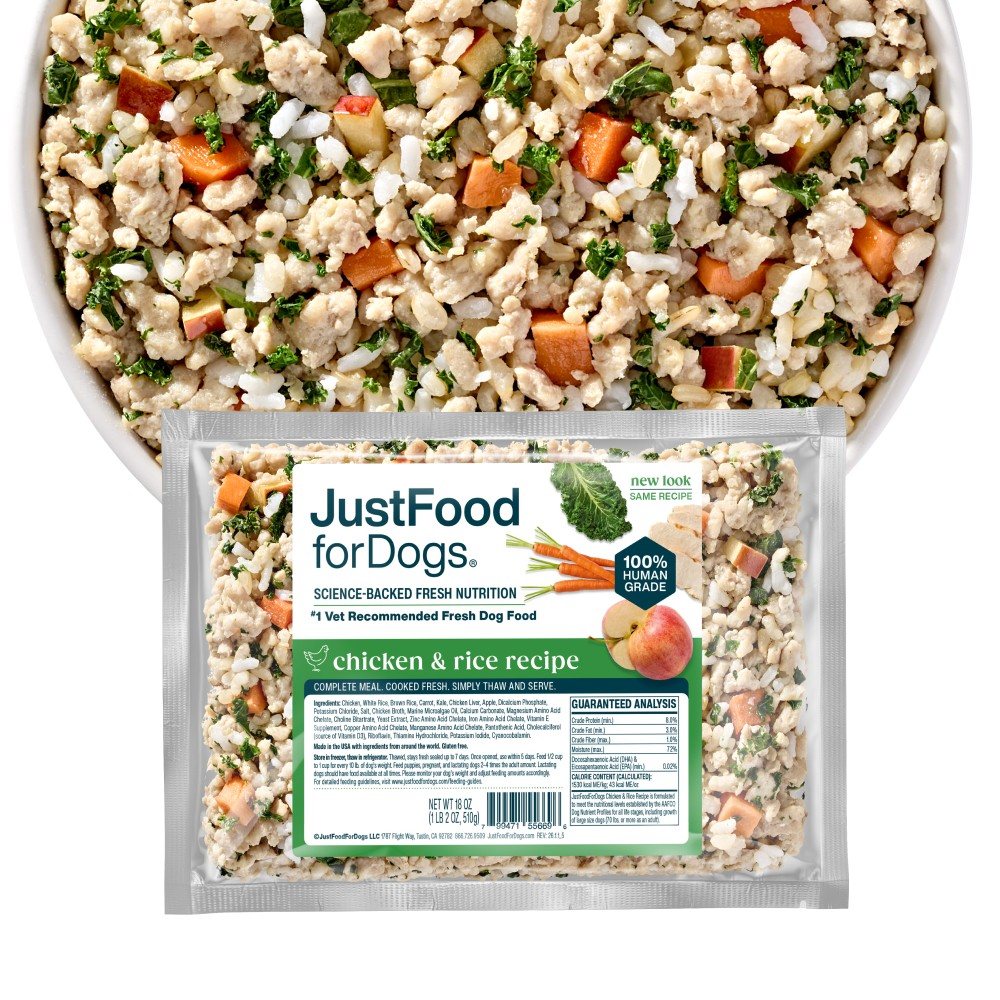
JustFoodForDogs Chicken & Rice combines chicken thighs and liver, white and brown rice, kale, carrots, and apples with the other ingredients needed for its formulation. The current manufacturer page lists all-life-stage suitability, including growth of large-size dogs, and 1,530 calories per kilogram.
For a Husky owner, its useful features are the growth-inclusive label, grain-containing recipe, and straightforward portion information. At the rounded 43 calories per ounce, you can calculate the weight that supplies an individual food-calorie allowance. That is more dependable than copying a cup amount from a food with a different energy density.
- Consider it for: A grain-inclusive prepared fresh meal for a puppy or adult whose needs fit the recipe.
- Plan for: Frozen inventory, refrigerator thawing, and a separate measured amount for each dog.
An all-life-stages recipe can simplify shopping when a household has dogs of different ages, but it does not make their portions identical. Record the daily amount beside each dog’s name. If you later reassess an adult’s maintenance needs, the same suitable recipe may remain useful with an adjusted serving.
Turkey & Whole Wheat Macaroni: a more calorie-dense adult option
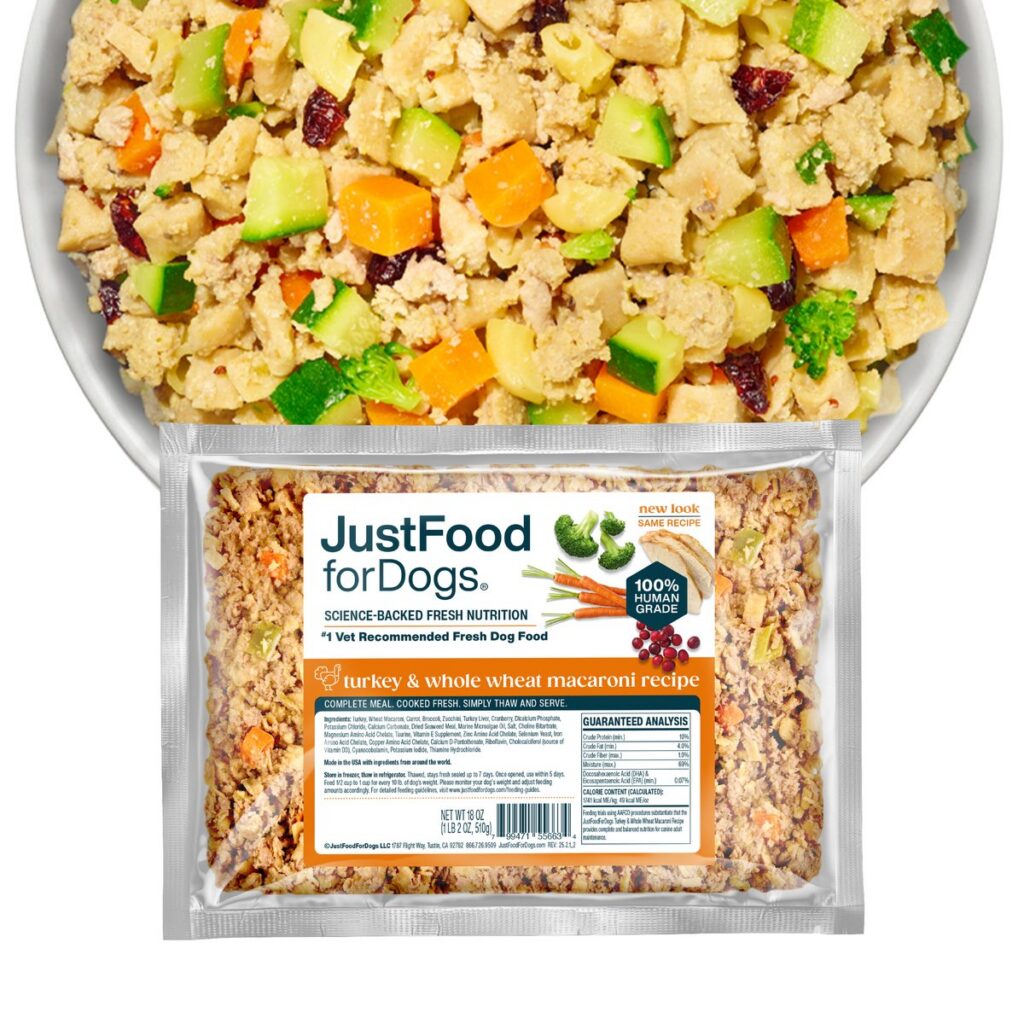
Turkey & Whole Wheat Macaroni supplies about 49 calories per ounce, the highest of these four recipes. That makes it a useful comparison for an adult whose owner wants a smaller fresh-food weight for a given calorie allowance. It does not establish how many calories that particular dog needs.
The manufacturer’s recipe information identifies adult maintenance, established through feeding trials using AAFCO procedures. Ingredients include turkey, turkey liver, whole wheat macaroni, broccoli, zucchini, carrots, and cranberries. The wheat is part of the formula, so this is a grain-containing choice.
- Consider it for: An adult Husky whose owner prefers a turkey-based fresh meal and its calorie density.
- Plan for: The exact adult serving and appropriate frozen storage, rather than copying the ounce amount of another recipe.
This can be a practical option even when the dog is a household companion. Conversely, a dog doing substantial work still needs an individualized feeding assessment. The useful product distinction is energy per ounce; an athletic breed label is not permission to serve a larger amount without checking the total.
Fish & Sweet Potato: a fish-based fresh alternative
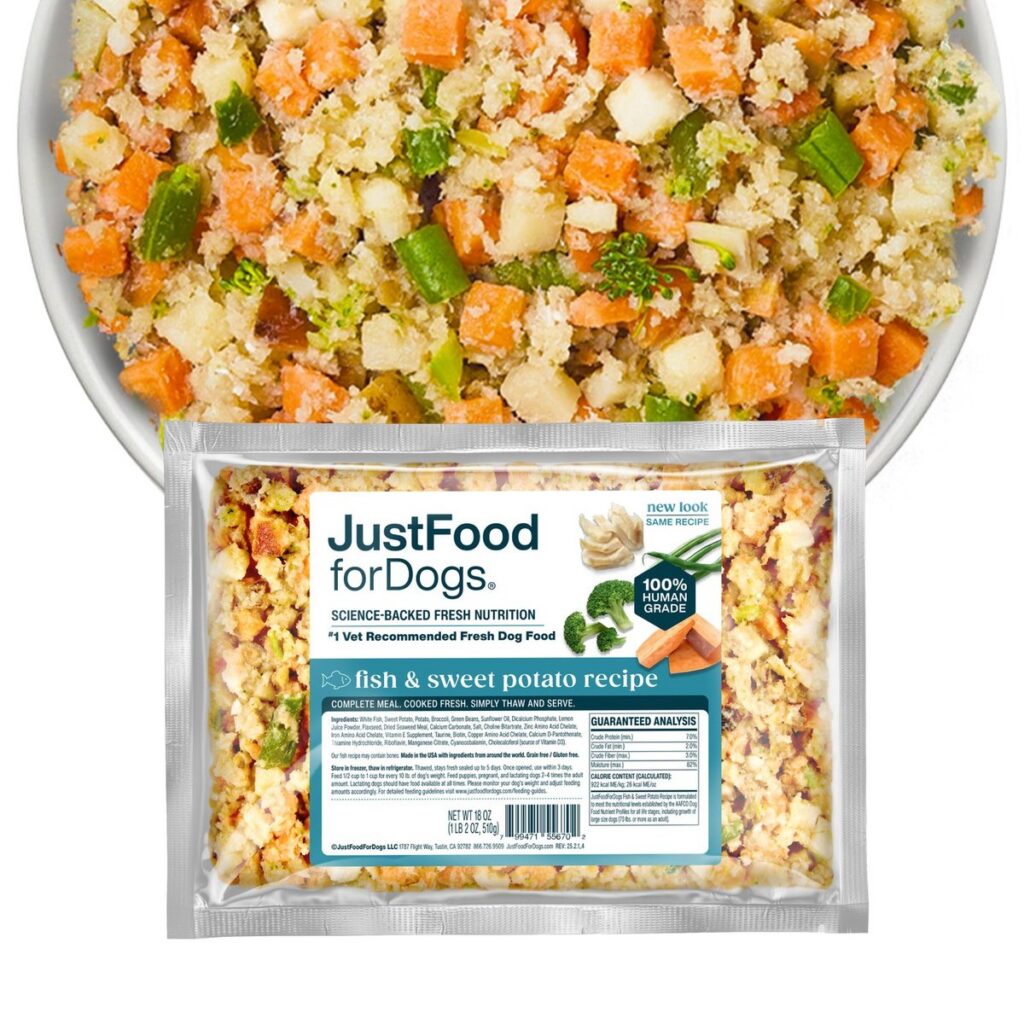
Fish & Sweet Potato provides another all-life-stage choice. Its current ingredients include white fish, sweet potatoes, russet potatoes, green beans, and broccoli. The label lists 922 calories per kilogram, or approximately 26 calories per ounce.
For the same calorie allocation, a dog needs more ounces of this food than of the chicken or turkey recipes. That makes the comparison particularly useful before you decide how much food to order. Consider the daily weight, how much will be thawed at once, and how quickly your household uses a package.
- Consider it for: A complete fish-based fresh meal with growth-inclusive suitability.
- Plan for: The larger serving weight associated with its lower calorie density.
Grain-free describes this recipe’s ingredients; it does not establish an advantage for every Husky. Its place here is as a clearly identified fish-based option with useful portion information. If your dog has an existing individualized feeding plan, compare the full product information with those instructions before making a change.
JustFresh Home-Cooked Chicken: convenient adult pantry storage
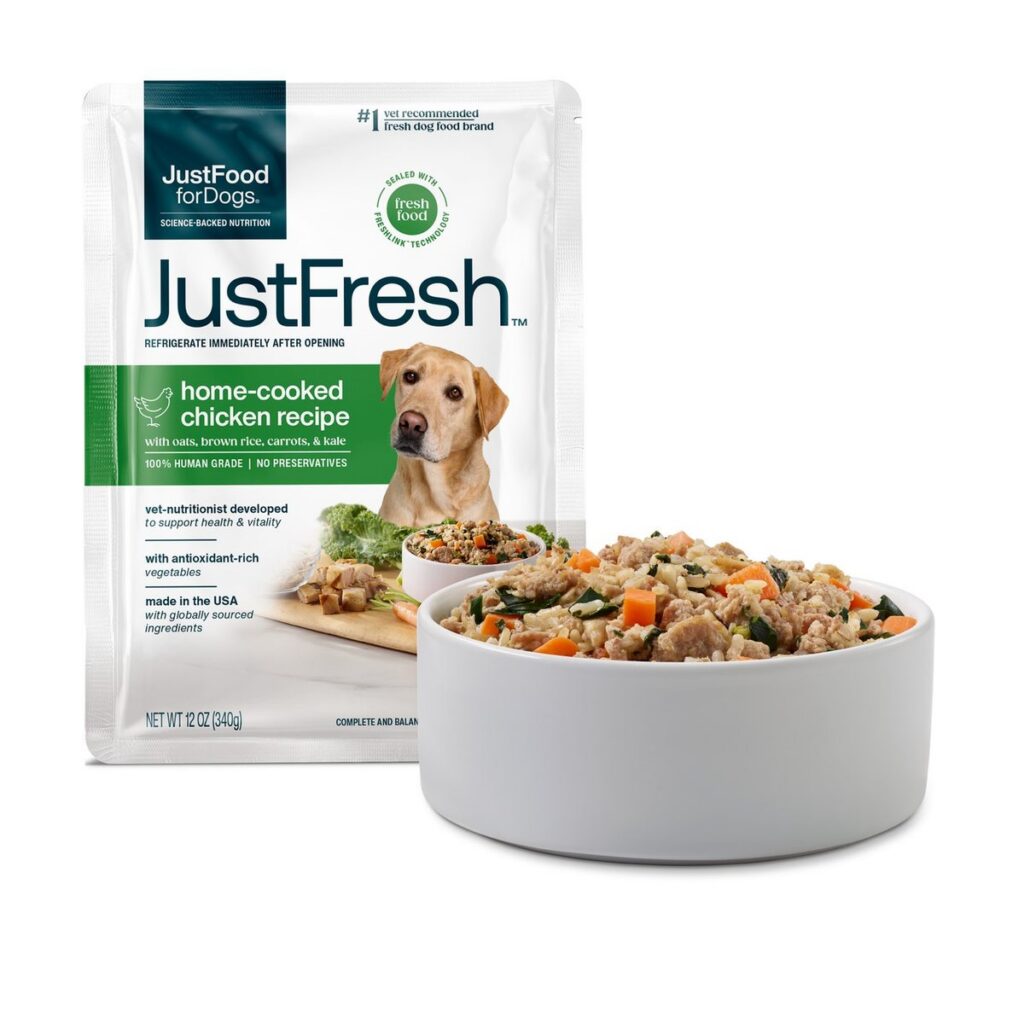
JustFresh Home-Cooked Chicken offers an adult-maintenance meal that is shelf-stable before opening. Unopened pantry storage can be useful when freezer space is limited or when a caregiver needs an easily organized food supply. After opening, refrigerate the food and use it within three days.
The current JustFresh Chicken information lists 1,254 calories per kilogram and 36 calories per ounce. Ingredients include chicken thighs and liver, oats, brown rice, carrots, and kale. Its calorie density differs from Chicken & Rice Fresh Frozen, so use the JustFresh label when working out the portion.
- Consider it for: Adult feeding when unopened pantry convenience fits the household.
- Plan for: Refrigerated storage and timely use of the opened pouch, including when you are away from home.
For an adult Husky traveling with its owner, unopened storage may simplify the food supply, but the opened-food routine still needs planning. A trip without reliable refrigeration is a different situation from a trip with an accessible refrigerator. Choose the format around the conditions you can actually provide.
Husky puppies, adults, and older dogs
A Husky puppy needs a complete food suitable for growth. Chicken & Rice and Fish & Sweet Potato meet that first selection requirement through their all-life-stages statements. Turkey & Whole Wheat Macaroni and JustFresh Chicken are adult-maintenance products, so keep the exact recipe’s feeding purpose visible when shopping.

Puppy food amounts need review as the dog develops. Keep the current weight, recipe name, daily amount, and meal schedule together. If the puppy’s feeding directions change, update the instructions everyone in the household uses. A recipe remaining suitable does not mean the serving should stay fixed throughout growth.
Start with the puppy’s established routine
When a puppy joins your household, ask for the exact food and current feeding instructions. That gives you a clear starting record and helps you plan any change. Vetstreet’s puppy food guide offers broader selection context; the label on the actual recipe still determines its suitability.
Discuss the appropriate meal frequency with your veterinary team, then divide the daily amount across those meals. More frequent meals should not accidentally become several full daily allowances. Write down whether a number means food for one meal or food for the whole day, especially when different people handle breakfast and dinner.
Review the adult’s actual food intake
For an adult, record both the main meals and extras. A training reward, a food-filled toy, and food used to give medication can all contribute calories. If one person measures meals and another supplies treats, bring those records together before deciding the dog needs a different amount of main food.
Use the recipe’s current calories when changing products. Switching from a 26-calorie-per-ounce recipe to a 49-calorie-per-ounce recipe while keeping the same food weight changes the calorie total substantially. That is why a serving plan should name the exact food rather than simply say one bowl of fresh food.
Reassess older dogs individually
An older Husky may need a review of its portions, food texture, and routine. Age alone does not establish that every dog needs the same lower-calorie food or a new protein. Consider body condition, appetite, activity, and existing veterinary instructions together.
Vetstreet’s senior dog food guide explores older-dog choices in more detail. For ordinary shopping, the useful question is whether the current complete food and measured amount still fit. Unexpected weight or appetite changes deserve assessment, rather than assuming a different flavor will solve them.
Separate recipe changes from serving changes
An adult Husky moving to a quieter routine may still do well with the same suitable recipe, but the amount deserves review. A puppy reaching adulthood may also remain on an appropriate all-life-stages food while its feeding instructions change. Neither situation automatically requires switching protein, format, and brand together.
Think about what you are trying to change before shopping:
- A different daily amount: Recalculate the serving for the same recipe using the revised individual allowance.
- A different protein ingredient: Compare the entire alternative recipe, including life stage and calories.
- A different storage routine: Compare frozen and unopened shelf-stable formats, then check opened-food handling.
- A different texture: Observe whether the selected complete food is comfortable for the dog to eat.
This makes the shopping decision more focused. If freezer space is the obstacle, an adult shelf-stable option addresses that practical need directly. If the food amount is the issue, a different package format does not by itself establish a different calorie allowance. Keeping the purpose clear also helps a veterinarian or manufacturer answer your question accurately.
For other high-drive breeds, see Petful’s guides to feeding Dobermans and Great Danes.
Household pets, active dogs, and practical meal budgets
A household companion and a dog doing sustained work can have different feeding needs even when both are called Huskies. Describe the actual routine before assigning an activity label: ordinary walks, play sessions, training, and sustained physical work are different inputs. A working-dog workload should be assessed as such, rather than inferred from the dog’s appearance.
The WSAVA nutrition resources provide body-condition tools that can support a feeding discussion with your veterinary team. Combine those observations with measured intake and weight records. No fixed fraction of another breed’s serving tells you what your individual Husky should receive.
Make an ordinary-week record
For several typical days, note the meals actually served, the extras given, and the usual activity. A short entry such as a morning walk, afternoon training, and evening play is more informative than simply checking a high-energy box. Record rest days as well as busy ones, so the feeding discussion reflects the pattern that repeats.
Keep observed intake separate from food offered. If you measure a serving but some remains, a record that treats the whole amount as eaten can misrepresent the routine. Likewise, if several family members supply rewards, one person’s treat count may miss part of the day. The goal is a usable picture of the current feeding pattern, not a perfect diary forever.
Count rewards in their labeled units
Read the calorie unit on rewards, too. A label might give calories per piece, per ounce, or per package. Ten small pieces cannot be counted accurately from an ounce-based number unless you also know their combined weight. If you break one treat into several training rewards, its total calories are divided between those pieces; cutting it does not create additional calories or remove the need to count the original treat.
For a packaged reward without usable calorie information, ask the manufacturer for that detail before relying on it in a precise feeding calculation. Knowing the main meal’s calories is only part of the accounting when extras appear throughout the day. Once a regular reward and quantity are established, keep that information with the meal note so everyone uses the same basis.
Use that record when the routine changes:
- Bring the current label and the recent daily food amount.
- Describe the sustained change in activity rather than one unusual outing.
- Include weight and body-condition observations from the same period.
- Ask whether the existing calorie allowance still fits before choosing a new amount.
This is especially useful when the owner’s schedule becomes busier or quieter. A food calculator may ask about activity, but its answer depends on the information entered. An honest description of actual days gives a better starting point than selecting the most athletic category because the dog is a Husky.
Convert an individual allowance into food weight
Here is a worked example using 1,000 calories per day from the main food. This is an arithmetic assumption, not a Husky calorie recommendation. It could represent a hypothetical total allowance of 1,100 calories with 100 allocated to extras; the appropriate total for a real dog must be established separately.
| Recipe | Label calories per ounce | Ounces supplying the illustrative 1,000 food calories | Practical difference |
|---|---|---|---|
| Chicken & Rice | 43 | About 23.3 | Grain-inclusive fresh meal |
| Turkey & Whole Wheat Macaroni | 49 | About 20.4 | Smallest serving weight of these four at equal calories; adult only |
| Fish & Sweet Potato | 26 | About 38.5 | Largest serving weight of these four at equal calories |
| JustFresh Home-Cooked Chicken | 36 | About 27.8 | Adult pantry format before opening |
Divide food calories by calories per ounce to obtain daily ounces. If you prefer grams, use the package’s calories per kilogram divided by 1,000 to obtain calories per gram. Keep the calculation in one unit; small differences between ounce and gram answers can reflect rounded label values.
For example, Chicken & Rice’s 1,530 calories per kilogram becomes 1.53 calories per gram. The same illustrative 1,000 food calories would therefore equal about 654 grams per day. If divided into two equal meals, that is about 327 grams at each meal. Use the gram calculation throughout rather than converting a rounded ounce answer back into grams.

The example shows a useful tradeoff: the fish recipe supplies the same assumed calories in about 18 more ounces than the turkey recipe. An owner can use that difference to compare bowl portions, storage, and food supply. It is not proof that one recipe is healthier or that a larger-looking meal provides more energy.
Compare current daily costs on equal terms
On September 28, 2026, the manufacturer listed regular prices of $153.99 for fourteen 18-ounce packs of Chicken & Rice and $167.99 for fourteen 18-ounce packs of Fish & Sweet Potato. Each order contains 252 ounces. Those prices are a dated comparison point, not a guaranteed checkout total.
Using the illustrative 1,000-food-calorie amount, the chicken recipe costs approximately $14.21 per day, while the fish recipe costs approximately $25.64 per day, before tax and shipping. The calculation uses the displayed regular price divided by 252 ounces, multiplied by the recipe’s calculated daily ounces. Prices and promotions may change.
This is why cost per package is only the beginning. The fish recipe’s lower calorie density means more food weight is required for the same calories. Chicken & Rice is the lower daily-cost option within this specific pair, while Fish & Sweet Potato offers a different protein and portion weight. Compare the attributes that matter to your household.
A measured fresh-and-dry combination
A mixed plan can include a complete fresh meal while preserving part of an established dry-food routine. Decide the calorie allocation first. JustFoodForDogs does not make dry kibble, so check the separate dry product’s life-stage statement and calorie information before combining it with an appropriate fresh recipe.
For example, allocate half of the hypothetical 1,000 food calories to Chicken & Rice. Its 500-calorie share is about 11.6 ounces, costing approximately $7.11 at the observed regular price. The remaining 500 calories come from the other complete food, calculated using its own label.
If that separate dry food hypothetically supplied 360 calories per cup, its 500-calorie share would be about 1.39 cups. That number describes an example label, not a recommended kibble or serving for every Husky. Add the two components’ costs to compare the full day’s budget, and keep any separately allocated extras within the overall plan.
Plan the order around actual use
At the illustrative Chicken & Rice amount, a 252-ounce order provides about 10.8 days of main meals. If only half the food calories come from that recipe, the same order lasts approximately twice as long. That changes your purchasing rhythm without changing the product’s thawing or opened-food instructions.
Keep the planning steps separate:
- Calculate the daily amount of each recipe.
- Work out how many days the purchased quantity covers.
- Check freezer or pantry capacity for the unopened supply.
- Follow the exact instructions for thawed or opened food.
When a trip, work schedule, or caregiver arrangement changes, review the handling plan as well as the amount. An unopened shelf-stable food can offer convenience, but opened JustFresh still needs refrigeration and use within three days. A frozen food can fit easily when there is enough space and someone remembers to thaw the next meals.
Make serving instructions usable for someone else
Leave one concise feeding note beside the food. Name the exact recipe, specify grams or ounces, identify the daily total and meal split, and state where the extras allowance is kept. If two dogs use the same recipe, separate their instructions by name instead of asking a caregiver to judge portions from their relative sizes.
For mixed feeding, list both components. “Half fresh” is ambiguous because it could mean half the bowl, half the weight, or half the calories. A note giving the calculated quantity of each food is easier to follow. Include the opened-food instructions as well, particularly if the caregiver is familiar with kibble but new to refrigerated meals.
Before leaving, check the note against an actual meal preparation. Can another person find the correct package, identify the measuring unit, and serve the intended amount without guessing? That small practical check connects the careful label comparison with what will happen in the kitchen. It also makes it easier to keep a settled routine consistent during travel or a change in work hours.
Keep food changes understandable
Introduce a new recipe according to its transition directions and your dog’s individual guidance. Keeping the old and new labels available helps you calculate how calories shift as one food replaces the other. Equal weights of different foods do not necessarily make an equal-calorie transition.
Avoid changing the recipe, several treats, and the measuring method at the same time. A stable record makes it easier to understand what your dog is actually receiving. If the dog already has a prescribed feeding plan, follow that plan instead of substituting an everyday buying-guide recommendation.
Foods and feeding shortcuts to avoid
A fresh cooked meal is different from a raw diet. Huskies do not universally need uncooked meat, and raw feeding introduces separate handling questions. The FDA’s raw pet-food guidance explains microbial risks to pets and people. Choose a complete food for its verified suitability rather than assuming raw is a breed requirement.
Keep unsafe household foods out of reach. Vetstreet’s guide to foods not to share with dogs covers that separate safety topic. Treats and scraps also should not become the main diet simply because a dog enjoys them; their feeding purpose may differ from a complete meal.
Related breed feeding guides from our sister sites: Best Dog Food for Great Pyrenees (Petful), Best Dog Food for Bernese Mountain Dogs (Petful), Best Dog Food for Dobermans (Petful).
Frequently Asked Questions
Chicken & Rice and Fish & Sweet Potato are the growth-suitable choices in this comparison. Turkey & Whole Wheat Macaroni and JustFresh Chicken are adult-maintenance meals. A Husky’s active appearance does not make an adult recipe suitable during growth; check the exact statement first.
Hold the dog’s food-calorie allowance constant, calculate the required weight of each recipe, and multiply by its current regular price per ounce. Include the dry-food share if feeding a mixture. A fish recipe’s larger serving weight can change daily cost and storage even when package sizes match.
What a Siberian Husky loves to eat varies by dog; there is no single favorite food shared by the breed. Individual preference may involve texture or protein ingredients, but the choice still needs to be a complete meal for the dog’s life stage. Chicken & Rice, Fish & Sweet Potato, and the adult turkey recipe provide different prepared options to compare. Observe what your dog accepts without presenting preference as proof that one food is nutritionally superior.
No. Match feeding to the actual workload, life stage, and body condition, rather than the breed’s association with sled work. A household companion may have a very different routine from a dog doing sustained work. If that workload changes, review the calorie allowance and measured serving with your veterinary team. Choosing a more calorie-dense recipe and increasing total calories are separate decisions.
No. The printed protein percentage does not independently show life-stage suitability, calorie density, or the practical portion. Moisture content also affects comparisons between fresh and dry foods. The FDA explains that widely different moisture levels require a dry-matter comparison. Read the complete nutritional adequacy and feeding information rather than selecting whichever package displays the highest-looking percentage.