
Best Dog Food for Pomeranians: Puppy and Adult Options
Published on October 05, 2026

Compare puppy and adult food options for Pomeranians, including fresh meals, with guidance on small servings, texture, storage, and the cost of daily feeding.
This article is sponsored by JustFoodForDogs. All featured products are chosen at the discretion of the Vetstreet editorial team and do not reflect a direct endorsement by the author. However, Vetstreet may make a small affiliate commission if you click through and make a purchase.
The best dog food for Pomeranians makes a small serving count. It should provide complete nutrition for the dog’s life stage, fit comfortably into mealtimes, and come with calorie information that helps you measure consistently. A Pomeranian puppy and an adult may both fit in your lap, but their food requirements are not interchangeable.
JustFoodForDogs offers several practical choices, including growth-suitable fresh recipes and adult meals with different calorie densities and storage needs. We compared the current labels and handling requirements of four options below. These are use-case selections based on published information, not the results of a hands-on feeding trial.
Choosing a complete food for a Pomeranian
The nutritional adequacy statement refers to AAFCO nutrient profiles or feeding trials, rather than a breed-specific marketing claim. Check the stated life stage on the exact recipe.
Key Takeaways
- Choose the right life stage first, then compare calories per gram, texture, and storage. For a tiny serving, weighing food is more repeatable than estimating a fraction of a scoop.
The Pomeranian is a small companion, but the breed name does not identify an exact daily calorie requirement. Age, actual body size, activity, body condition, and the recipe all belong in the feeding plan. Start with the food’s directions and discuss the individual dog’s needs with your veterinarian.
The FDA’s complete and balanced food guidance explains the importance of the nutritional adequacy statement. For a growing puppy, look for growth or all-life-stages suitability. For an adult, an appropriate adult-maintenance food is also an option. A soft texture or small package does not establish either one.
What is the best food for Pomeranians?
For complete and balanced nutrition, match the life stage first. Chicken & Rice is our starting fresh pick for owners seeking a grain-inclusive recipe that can suit puppy or adult feeding with individual portions. Fish & Sweet Potato offers a fish-based alternative. For adults, Turkey & Whole Wheat Macaroni provides a more calorie-dense choice, while JustFresh Chicken offers unopened pantry convenience.
That is a shortlist based on meaningful differences rather than a claim that all Pomeranians need one protein or format. Vetstreet’s small-breed food guide and broader dog food guide provide context when comparing other options.
Other toy and small breeds share the small-serving math in this guide; see Petful on Maltipoos, Dachshunds, and Toy Poodles.
Fresh recipes and soft meal options
| JustFoodForDogs recipe | Best practical fit | Current life-stage statement | Calories per kilogram | Storage |
|---|---|---|---|---|
| Chicken & Rice | Grain-inclusive fresh meals for puppies or adults | All life stages, including large-size growth | 1,530 | Fresh frozen |
| Fish & Sweet Potato | A fish-based fresh choice | All life stages, including large-size growth | 922 | Fresh frozen |
| Turkey & Whole Wheat Macaroni | More calories in a smaller adult serving among these picks | Adult maintenance | 1,741 | Fresh frozen |
| JustFresh Home-Cooked Chicken | Adult meals without unopened freezer storage | Adult maintenance | 1,254 | Shelf-stable before opening |
Chicken & Rice: A grain-inclusive puppy and adult option
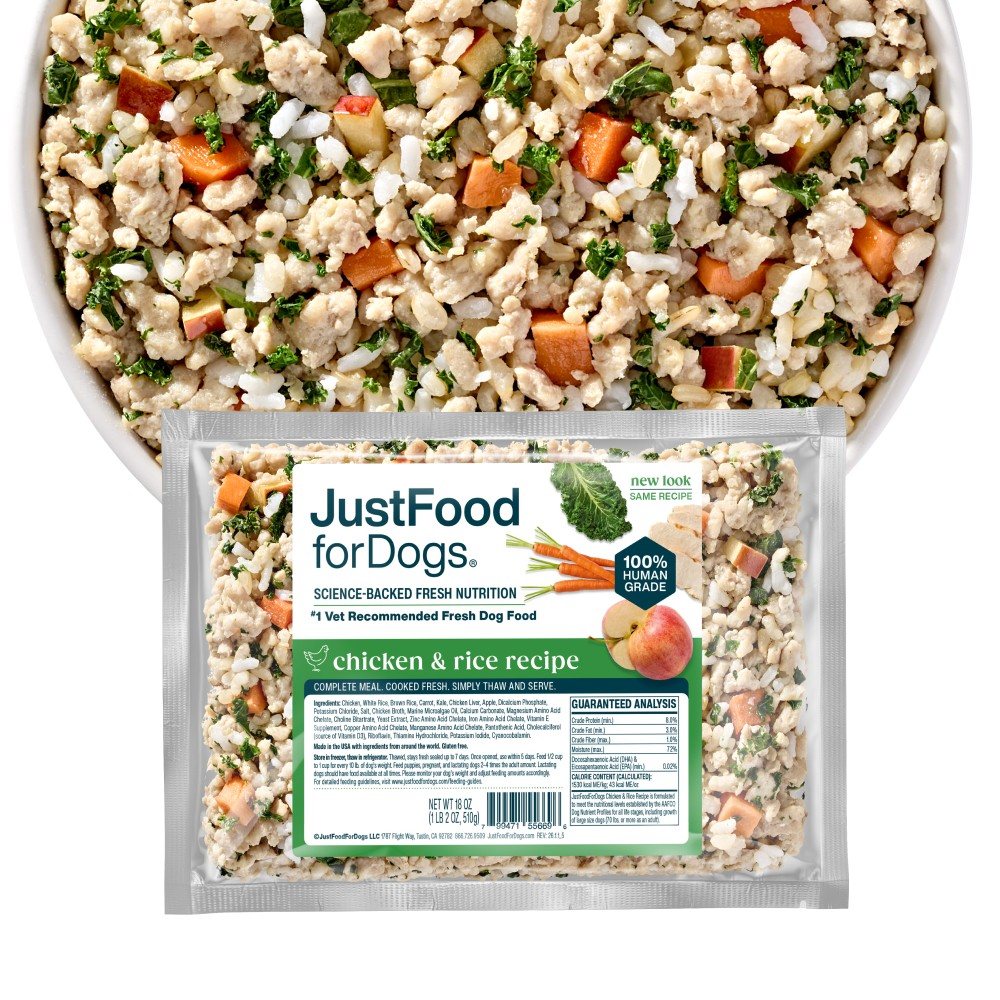
Chicken & Rice combines chicken thighs and liver with white and brown rice, vegetables, fruit, oils, and a nutrient blend. Its current all-life-stages statement includes growth. That makes it a useful comparison for a Pomeranian puppy as well as an adult whose serving is calculated separately.
At 1.530 calories per gram, the recipe provides more energy in the same food weight than Fish & Sweet Potato. For a small dog, this helps you compare manageable meals instead of treating similarly sized packages as equal supplies.
- Choose it for: Growth eligibility and a grain-inclusive fresh meal.
- Plan for: Freezer space, thawing, and a measured daily portion.
This is a practical starting point when the household wants prepared fresh food and can maintain a frozen-food routine. The puppy and adult portions should be written separately even if both dogs eat the same recipe.
Fish & Sweet Potato: A fish-based alternative
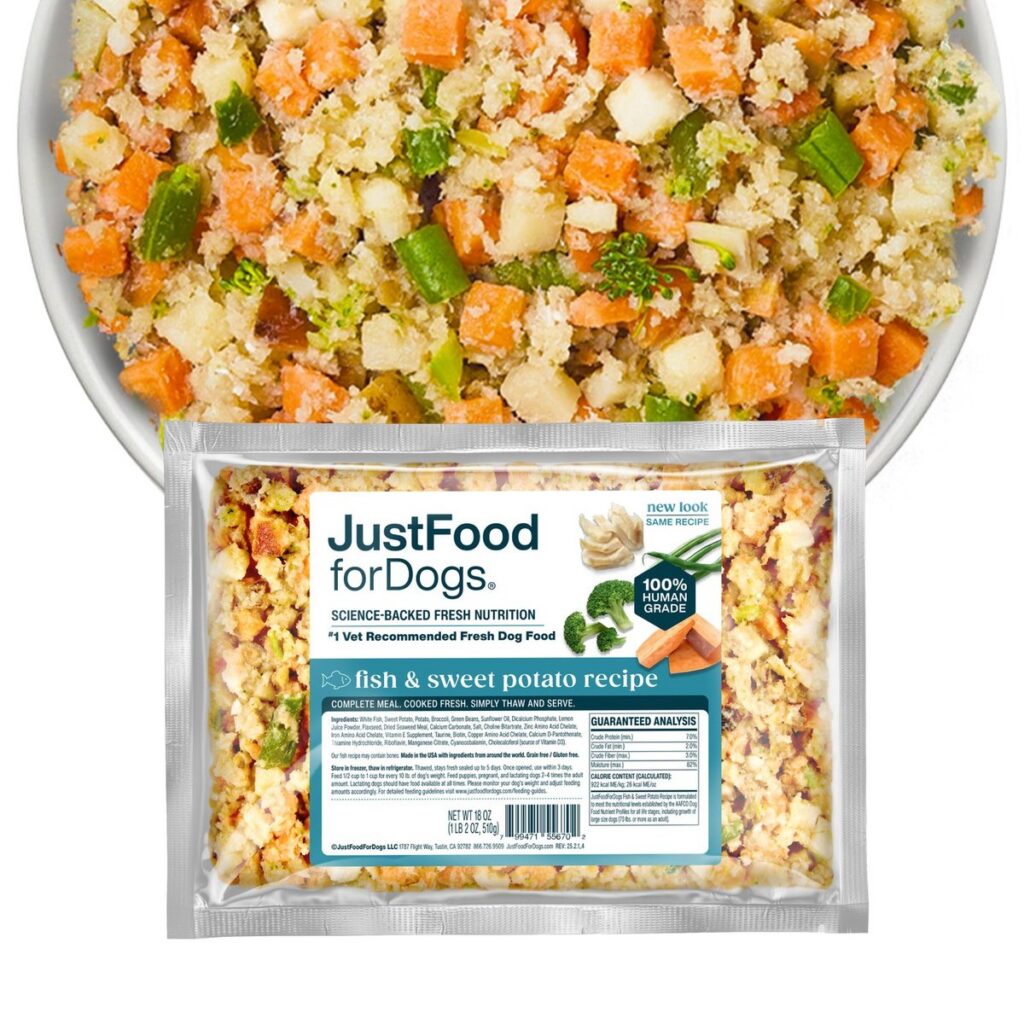
Fish & Sweet Potato combines white fish, sweet potatoes, russet potatoes, green beans, broccoli, oils, and a nutrient blend. Its growth-inclusive statement makes it another puppy-eligible choice. At 0.922 calories per gram, it requires more food by weight than Chicken & Rice for the same calorie allocation.
That difference deserves attention when a small dog eats small meals. Calculate the actual daily weight before ordering, then consider how it will be divided and stored. The larger serving is a consequence of calorie density, not evidence of better or worse nutrition.
- Choose it for: A complete fish-based fresh meal.
- Plan for: More grams per equal calorie allowance and frozen storage.
The recipe is grain-free. Treat that as an ingredient description rather than a claim that Pomeranians need to avoid grains or that a recipe will correct an undiagnosed problem.
Turkey & Whole Wheat Macaroni: A compact adult serving
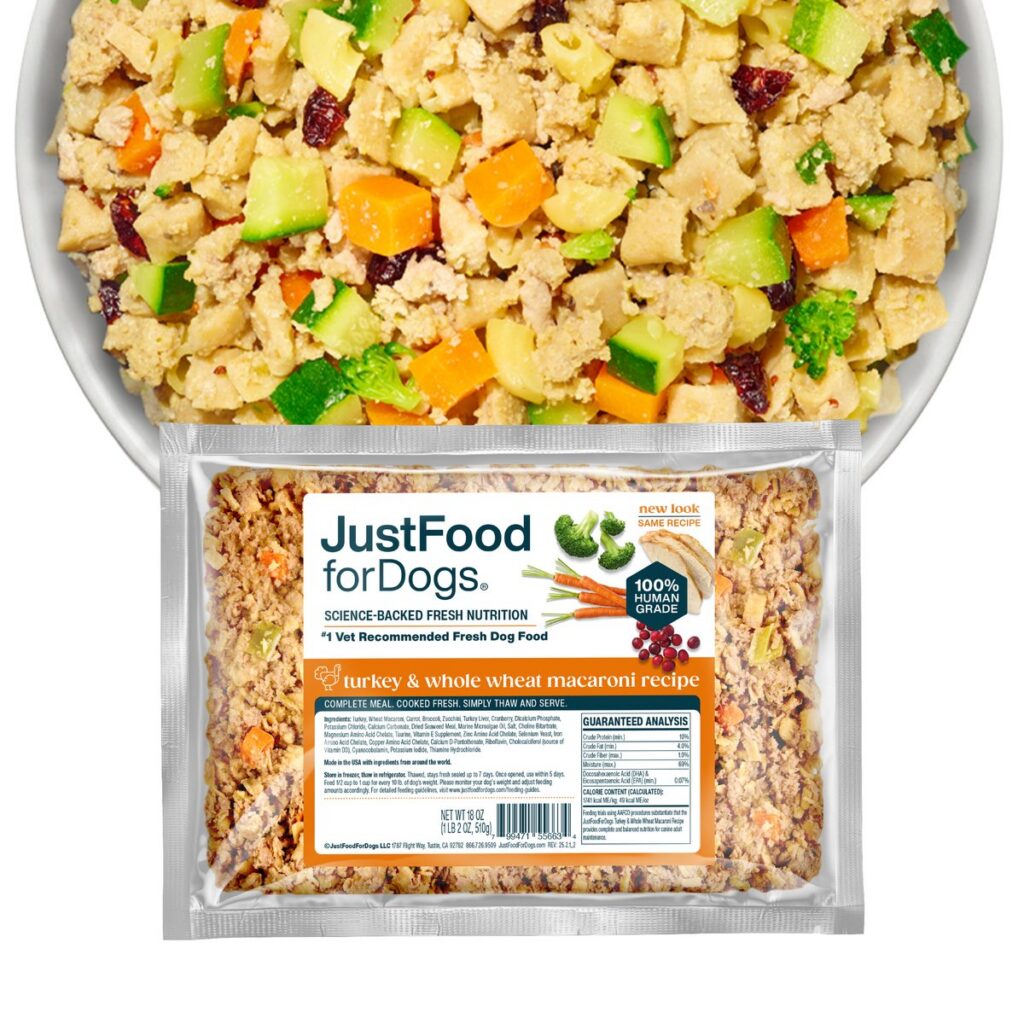
Turkey & Whole Wheat Macaroni is an adult-maintenance recipe containing turkey, liver, whole wheat macaroni, vegetables, cranberries, and its nutrient blend. Its 1.741 calories per gram make it the most calorie-dense of these four selections.
For an adult Pomeranian, that means a smaller weight can provide the same energy as a less dense recipe. It is useful when comparing portion size and the amount of food needed for an order. Consistent weighing matters because a seemingly small extra spoonful still adds calories.
- Choose it for: An adult turkey-based meal with a relatively compact portion.
- Plan for: Adult-only feeding, frozen storage, and a recipe that contains wheat.
JustFresh Home-Cooked Chicken: Pantry convenience for adults
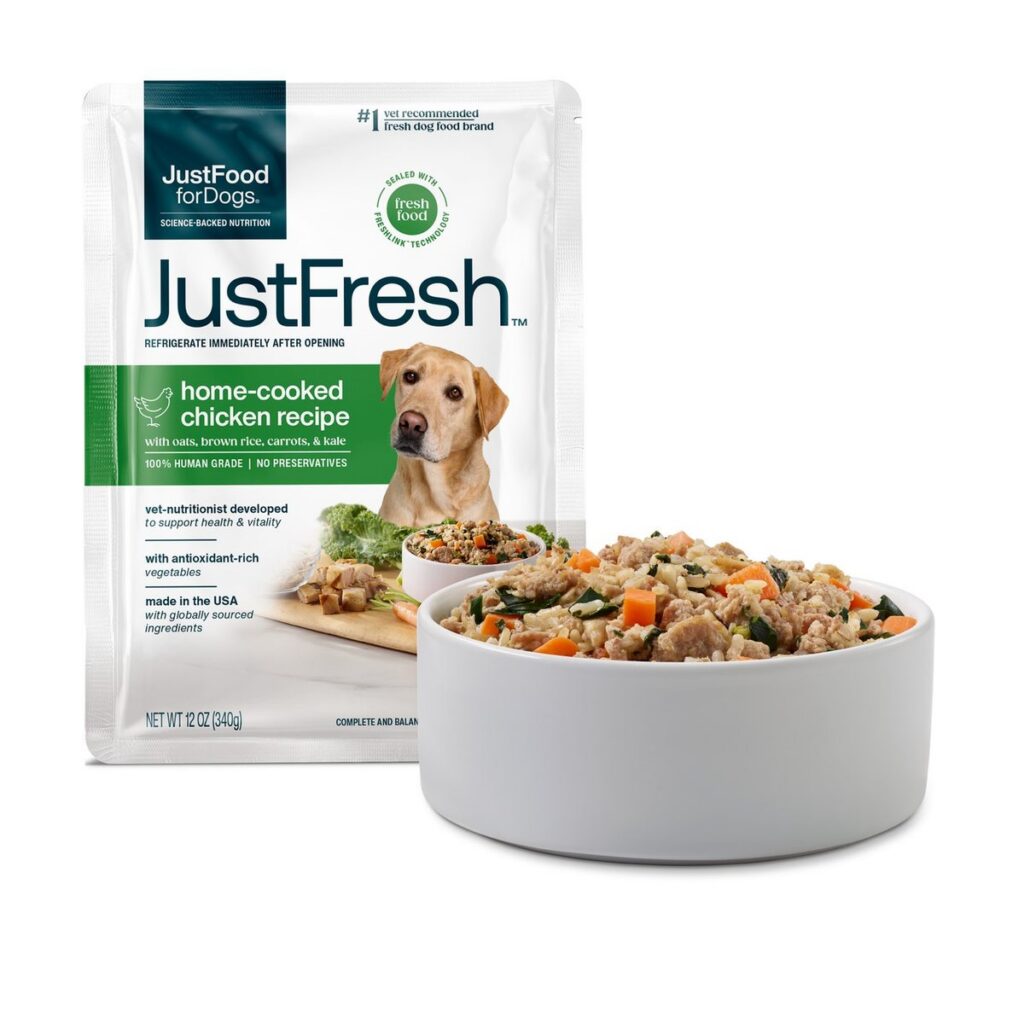
JustFresh Home-Cooked Chicken suits an adult household with limited freezer space. The unopened food is shelf-stable; after opening, refrigerate it and use it within three days. Its current label specifies adult maintenance and 1.254 calories per gram.
The recipe includes chicken thighs and liver, oats, brown rice, carrots, and kale. Its practical advantage is an easier unopened-storage routine, while the opened pouch still needs planning. For a small dog, calculate how much you will use within that three-day period before choosing a purchase size.
- Choose it for: Adult meals with unopened pantry storage.
- Plan for: Refrigeration and timely use once opened.
Puppy, adult, and senior Pomeranian meals

For a puppy, Chicken & Rice and Fish & Sweet Potato are the growth-suitable choices in this comparison. An adult-maintenance food should not become the puppy’s main meal simply because a larger amount can be served. Growth suitability depends on the formulation, not just calories.
For a young Pomeranian, including a three-month-old puppy, use an age-appropriate schedule with the veterinarian’s guidance. The AKC’s toy- and small-breed puppy guidance describes three to four meals divided from the daily ration. Arrange those meals consistently, and reassess amounts as the puppy develops.
An adult can be considered for any of the four recipes when the food fits the individual’s needs. Senior adults may need their portions, texture, and routine reviewed as circumstances change. Vetstreet’s senior dog food guide explores that stage; a birthday alone does not establish one ideal recipe or automatic calorie cut.
For flat-faced small dogs, WebVet’s Pug and Boston Terrier feeding guides add texture and bowl-shape notes.
Small portions, texture, and daily budget
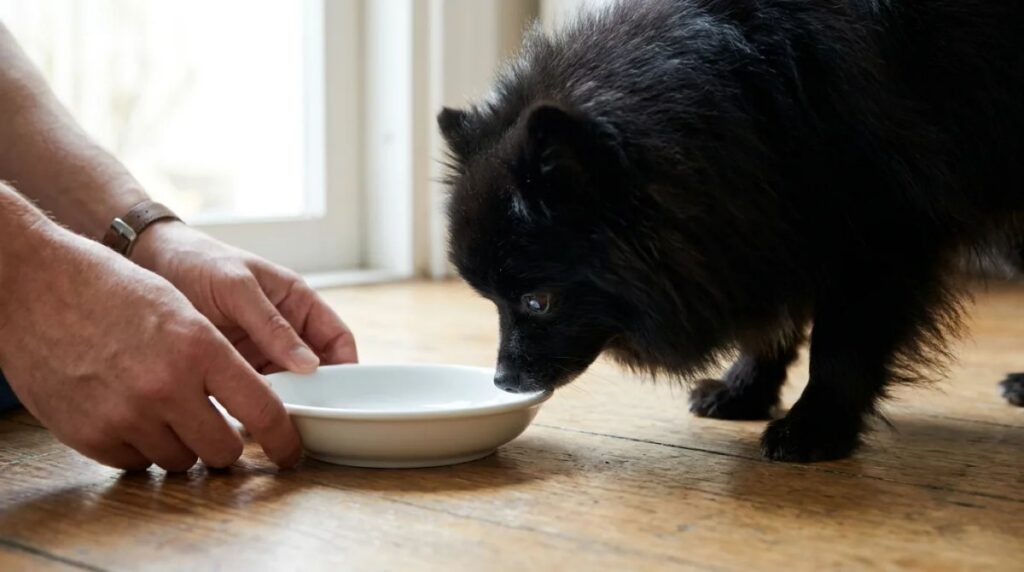
A Pomeranian food chart is useful only when it identifies the food and the basis for its amounts. The adult comparison below assumes 250 calories a day allocated to the main food. Turkey & Whole Wheat Macaroni and JustFresh Chicken are adult-maintenance recipes; use the separate growth-suitable choices for a puppy. This is an arithmetic example, not a recommendation for a Pomeranian’s age, weight, or activity level.
| Recipe | Calories per gram | Grams for the illustrative 250-calorie day | Approximate grams per meal if split into two |
|---|---|---|---|
| Chicken & Rice | 1.530 | 163 | 82 |
| Fish & Sweet Potato | 0.922 | 271 | 136 |
| Turkey & Whole Wheat Macaroni | 1.741 | 144 | 72 |
| JustFresh Home-Cooked Chicken | 1.254 | 199 | 100 |
Divide food calories by calories per gram to find the daily weight. Place the empty dish on the scale and reset it to zero before adding the portion. This avoids including the bowl’s weight and makes the same instructions usable by another caregiver.
Treats and other extras belong in the overall daily plan. If a calorie allowance already includes treats, subtract their contribution before calculating the main meal. For mixed feeding, allocate calories to each complete food and calculate the portions separately instead of simply adding fresh food on top of the original ration.
Keep small servings repeatable
Small serving errors are easier to understand in grams. Ten additional grams of Turkey & Whole Wheat Macaroni supplies about 17 calories; the same extra weight of Fish & Sweet Potato supplies about nine. Neither amount is a reason to panic, but both are real additions when repeated at every meal or by several caregivers.
Make the measuring routine simple enough to follow. Keep the scale beside the preparation area, record the daily total, and specify whether the written amount is per meal or per day. If two people share feeding, a check mark beside each completed meal is more useful than relying on the dog to indicate whether dinner already happened.
Dry food and a fresh-food split
A complete dry food can be suitable for a Pomeranian when its life stage, calories, and texture fit the individual dog. A small-breed label may help narrow the shelf, but still inspect the actual recipe. JustFoodForDogs does not make kibble; its prepared meals offer a different format to compare or incorporate into a measured plan.
For an illustrative adult allocation of 250 main-food calories, putting 125 calories toward Chicken & Rice would use about 82 grams. Calculate the other 125 calories from the selected dry food’s label. Serving half the old dry portion by weight works only if that portion already represented the correct calorie allocation and the food has not changed.
Write both components down and keep their units consistent. A gram-based fresh portion and a cup-based dry portion can be followed, but neither number should be transferred to a different product without recalculating. When changing the split, replace calories rather than adding another meal.
Compare what a day actually costs
The regular prices observed September 28, 2026 were $153.99 for fourteen 18-ounce Chicken & Rice packs and $167.99 for fourteen 18-ounce Fish & Sweet Potato packs. Using the rounded label values of 43 and 26 kcal/oz, the illustrative 250-food-calorie day would cost about $3.55 for Chicken & Rice or $6.41 for Fish & Sweet Potato, excluding tax and shipping.
Prices can change. These figures compare selected fresh recipes at equal calories, not the lowest-cost food on the market. They show why package price alone is incomplete: the less calorie-dense fish recipe supplies fewer days from the same food weight.
Include storage and waste in the budget. An adult Pomeranian eating only a small fresh portion may take longer to use an opened pack than a larger dog would. Choose a quantity you can use within its instructions rather than assuming that the largest package is always the best value.
Plan the order and caregiver instructions
Before ordering, check three practical details: the exact pack size, the amount your dog will use daily, and the available storage space. Divide the order’s total food weight by the daily portion to estimate how long the supply lasts. This also makes it easier to decide whether one-time ordering or a recurring delivery fits your household.
Do the same planning for a sitter or trip. Label the recipe and daily amount clearly, include the opened date, and leave the product’s refrigeration instructions with the food. A pouch that is shelf-stable before opening still needs the specified cold storage afterward. A small dog’s small serving makes that opened-food detail more important, not less.
What if your Pomeranian seems picky?
There is no established favorite food shared by every Pomeranian. Observe whether your dog approaches the bowl, manages the texture, and actually eats the measured meal. Check whether extra treats or food from other people are replacing appetite for dinner.
A complete moist recipe provides a different texture from kibble and can be worth comparing when the dog is otherwise well. Make one planned change at a time, following transition directions. Persistent refusal, sudden appetite changes, or difficulty eating deserve veterinary advice; no food here is presented as a cure for dental disease, allergies, or tear stains.
When you ask for help reviewing the diet, bring the exact recipe name, a label photograph, the current daily weight of food, and a list of treats or extras. Note changes in appetite, activity, or measured body weight rather than simply describing the dog as hungry or picky. Those details help distinguish a shopping preference from a feeding concern and make any portion advice specific to what your dog actually receives. They are also useful when a new caregiver takes over feeding for several days.
Foods to keep out of the bowl
Keep chocolate, grapes and raisins, onions, and products containing xylitol out of the feeding plan. These are unsafe foods for dogs, not alternatives to a complete meal. If your Pomeranian eats a potentially toxic food, contact your veterinarian promptly with the ingredient, estimated amount, and time of exposure. Vetstreet’s guide to foods not to share with dogs covers important exclusions. A small taste is still an exposure, and snacks should not displace a complete main diet.
Homemade Pomeranian meals need a complete formulation
Homemade food for a Pomeranian needs a properly formulated, complete recipe for the correct life stage. It is different from combining meat and vegetables by eye. A puppy needs a formulation suitable for growth; an adult recipe does not become a puppy recipe by increasing its serving. Vetstreet’s guide to homemade pet diets explains the general formulation considerations.
Compare the preparation work before choosing. Can you weigh every ingredient, obtain the exact required supplement, follow cooking instructions, and store the finished food correctly? Replacing ingredients or omitting a supplement changes the formula. For a very small daily serving, careful weighing also helps reproduce the intended proportions across a prepared batch.
Prepared JustFoodForDogs meals shift formulation and cooking to the manufacturer. You choose the appropriate life-stage statement, calculate the portion, and follow the package’s handling directions. Chicken & Rice and Fish & Sweet Potato offer growth-suitable prepared comparisons for a Pomeranian puppy; the adult recipes expand the choices once adult maintenance is appropriate. This is a practical way to serve cooked meals with less preparation work, while retaining a clear nutritional label.
Related breed feeding guides from our sister sites: Best Dog Food for Maltipoos (Petful), Best Dog Food for Poodles (Petful), Best Dog Food for Corgis (Petful).
Frequently Asked Questions
Yes, when the foods suit the same life stage and their calories share one daily allowance. Decide how many calories come from each, then calculate both portions separately. A small fresh serving should replace its assigned calories from the existing food rather than becoming an uncounted extra.
Choose a texture the individual dog can comfortably eat, alongside complete nutrition and appropriate portions. A small breed label does not establish texture preference. Prepared fresh meals offer a moist option, but a new difficulty chewing or eating warrants veterinary attention rather than repeated flavor changes.
For a Pomeranian eating wet food, Chicken & Rice is our grain-inclusive fresh starting pick with a soft texture, with growth suitability for puppy consideration. Fish & Sweet Potato is a fish-based alternative. Adult owners who prefer unopened pantry storage can compare JustFresh Chicken. Match the recipe to life stage and portions rather than choosing by softness alone.
An adult-maintenance statement alone does not establish suitability for a puppy. Look for a growth statement or appropriate all-life-stages wording. In this shortlist, Chicken & Rice and Fish & Sweet Potato qualify for growth; Turkey & Whole Wheat Macaroni and JustFresh Chicken are adult-maintenance choices.
Calculate price per calorie or per gram, then multiply by the actual daily food allowance. Also check how quickly opened food will be used within its refrigerated limit. A large pack’s apparent saving can disappear if much of it cannot be used in time. Compare equivalent purchase terms and include shipping where applicable.