Best Wet Puppy Food: Canned and Fresh Options Compared
Published on October 05, 2026

Choose a complete wet puppy food by comparing canned and fresh formats, growth suitability, calorie density, mixed feeding, and everyday storage needs.
This article is sponsored by JustFoodForDogs. All featured products are chosen at the discretion of the Vetstreet editorial team and do not reflect a direct endorsement by the author. However, Vetstreet may make a small affiliate commission if you click through and make a purchase.
The best wet puppy food gives your growing dog complete nutrition in a texture and portion you can serve consistently. That may mean a canned puppy meal, a prepared fresh recipe, or an eligible shelf-stable meal. What matters first is the food’s growth statement, followed by its calories, serving size, and handling instructions.
JustFoodForDogs offers fresh choices that make those differences easy to compare. Chicken & Rice provides a relatively compact serving among the recipes below; Fish & Sweet Potato offers a fish-based meal; and PantryFresh Chicken & White Rice keeps unopened meals out of the freezer. All three currently carry all-life-stages statements that include large-size growth.
This guide compares those fresh options with Purina Pro Plan Puppy Chicken & Rice Entrée Classic, a complete canned puppy meal, using current manufacturer labels. PantryFresh is a shelf-stable fresh meal, not a canned JFFD product. Our recommendations are label-based analysis, not a hands-on feeding trial.
How to choose a complete wet puppy food
Nutritional adequacy refers to AAFCO nutrient profiles or feeding trials. Confirm growth suitability on the exact recipe, including the large-size growth wording when relevant.
Key takeaway: Read the nutritional adequacy statement before choosing a package or texture. A complete growth-suitable meal can be the foundation of a puppy’s diet. A topper, treat, or adult-maintenance meal has a different role even when it looks just as soft and appetizing.

Check the exact life-stage statement
Puppy nutrition is more specific than finding a food labeled for dogs. According to the FDA’s guide to complete and balanced pet food, the nutritional adequacy statement identifies whether a food meets the relevant nutrient profile or feeding-test criteria. Growth and adult maintenance are different intended uses.
For a puppy’s everyday food, look for growth or all-life-stages suitability. When a puppy is expected to become a large dog, examine the large-size growth wording as well. The relevant label threshold refers to dogs expected to reach 70 pounds or more as adults, not to a puppy’s current weight.
Keep these checks together when shopping:
- Purpose: Is this a complete meal or a supplemental product?
- Life stage: Does the adequacy statement cover puppy growth?
- Expected size: Does the large-size growth wording fit the puppy when relevant?
- Calories: How much energy is in a gram, ounce, or whole container?
- Routine: Can you reliably store, portion, and serve it as directed?
These steps prevent a common mix-up: choosing an adult moist food because the texture looks easy for a puppy to eat. In JustFoodForDogs’ range, adult-maintenance JustFresh Home-Cooked Chicken and Turkey & Whole Wheat Macaroni are different choices from the three growth-suitable recipes featured here. Brand familiarity does not make every recipe interchangeable.
Separate complete meals from toppers
A small pouch may hold a complete meal, or it may contain a food intended only to add flavor. Packaging size does not establish which. Read the feeding-purpose language instead of assuming that anything poured over kibble could safely replace a full meal.
If a product is intended for intermittent or supplemental feeding, use it within an appropriate extras allowance rather than making it the main diet. The complete growth food still needs to provide the puppy’s main nutrition. Keep this distinction especially clear when several family members add a little something to the bowl.
Broader puppy and wet-food comparisons
For a broader view of everyday puppy meal options, use Vetstreet’s puppy food guide. This wet-food comparison focuses on the format, label, and portion decisions that can otherwise get lost in a long list of brands.
For general wet-food shopping beyond the puppy stage, Vetstreet’s wet dog food guide covers that broader category. Keep the growth check specific to your puppy when using any all-dog roundup.
What is the healthiest wet food for puppies?
A useful choice is complete and balanced for growth, suitable for the puppy’s expected adult size, and fed in an amount that supports the individual puppy’s development. No packaging format proves that a food is the healthiest. A canned food can meet growth requirements, and a cooked fresh meal can meet them too.
For the fresh choices here, start with the practical reason for choosing the recipe. Chicken & Rice fits owners seeking a grain-inclusive meal with a relatively compact portion; Fish & Sweet Potato offers a fish-based alternative; PantryFresh suits unopened cupboard storage. Then evaluate how the puppy eats and grows with your veterinarian’s guidance instead of treating “fresh” or “grain-free” as a guaranteed health outcome.
Fresh cooked and shelf-stable puppy meals
The following JustFoodForDogs recipes differ in calories and storage even though each is eligible for growth. That lets you choose for a real household need while keeping complete nutrition at the center of the decision.
| Recipe | Practical reason to compare it | Current growth suitability | Calories | Format |
|---|---|---|---|---|
| Chicken & Rice | More calories in a smaller food weight than the other two picks | All life stages, including large-size growth | 1,530 kcal/kg; about 43 kcal/oz | Fresh frozen |
| Fish & Sweet Potato | A fish-based meal with a larger portion at equal calories | All life stages, including large-size growth | 922 kcal/kg; about 26 kcal/oz | Fresh frozen |
| PantryFresh Chicken & White Rice | Unopened pantry storage without thawing | All life stages, including large-size growth | 1,093 kcal/kg; about 31 kcal/oz | Shelf-stable fresh before opening |

JustFoodForDogs Chicken & Rice: A grain-inclusive fresh starting point
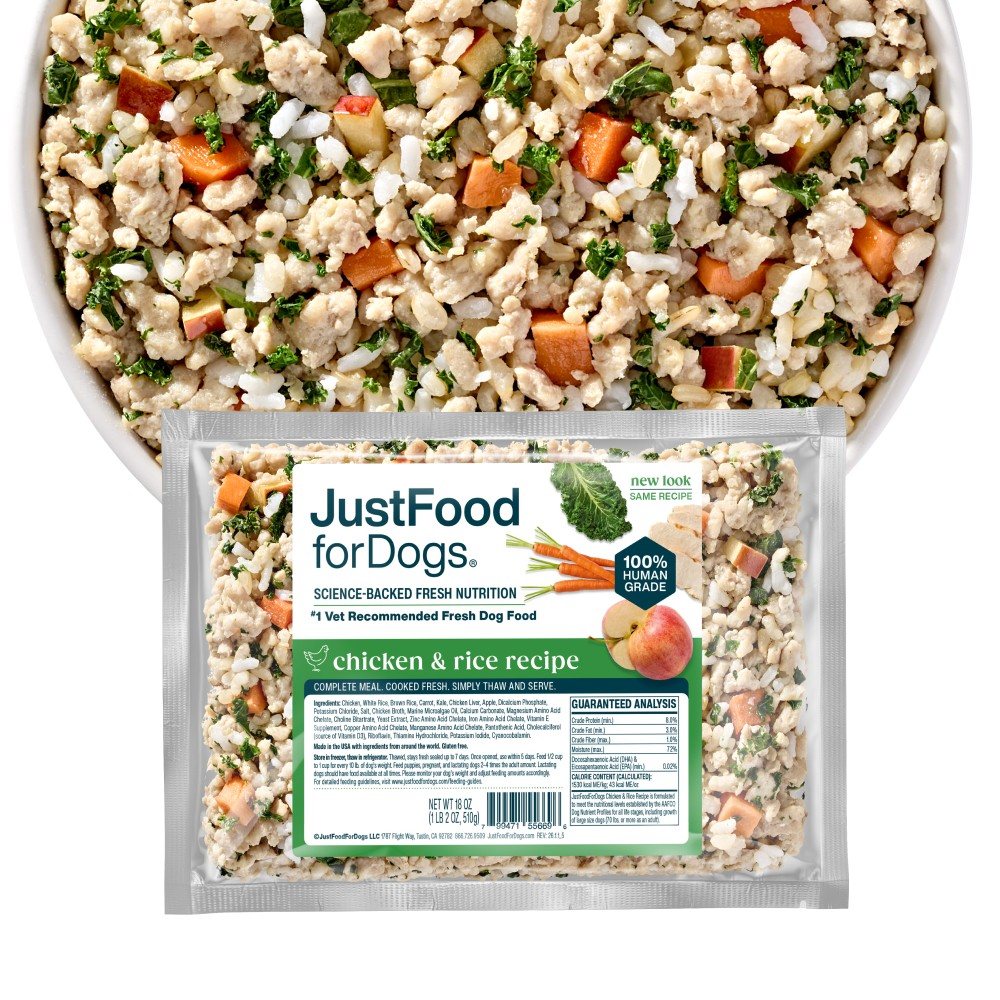
Chicken & Rice brings together chicken thighs and liver, white and brown rice, vegetables, fruit, oils, and its nutrient blend. Its current nutritional adequacy statement covers all life stages, including growth of large-size dogs. That makes it an option to consider for puppies across size categories, with a serving calculated for the individual dog.
At 1,530 kcal/kg, it provides 1.530 calories per gram. This is the most energy-dense of the three featured recipes. For an owner comparing the amount that will fit into several puppy meals, the difference is practical: fewer grams are needed for the same calorie allocation than with Fish & Sweet Potato or PantryFresh Chicken & White Rice.
Why we included it:
- Growth-suitable nutrition in a grain-inclusive fresh recipe.
- A published calorie density that supports precise meal planning.
- A comparatively compact serving within this shortlist.
Best routine fit: A household that can keep a frozen supply and thaw meals on schedule. Weigh the portion after preparing the food according to the package instructions, and divide the daily amount between the planned meals. Having one repeatable measuring method helps when more than one person feeds the puppy.
Chicken & Rice is a useful starting comparison if you are moving from a can to fresh meals and want to understand serving size before ordering. Compare the calories and storage directions of the old and new foods; keeping the old portion by eye does not preserve the same intake.
JustFoodForDogs Fish & Sweet Potato: A fish-based fresh option
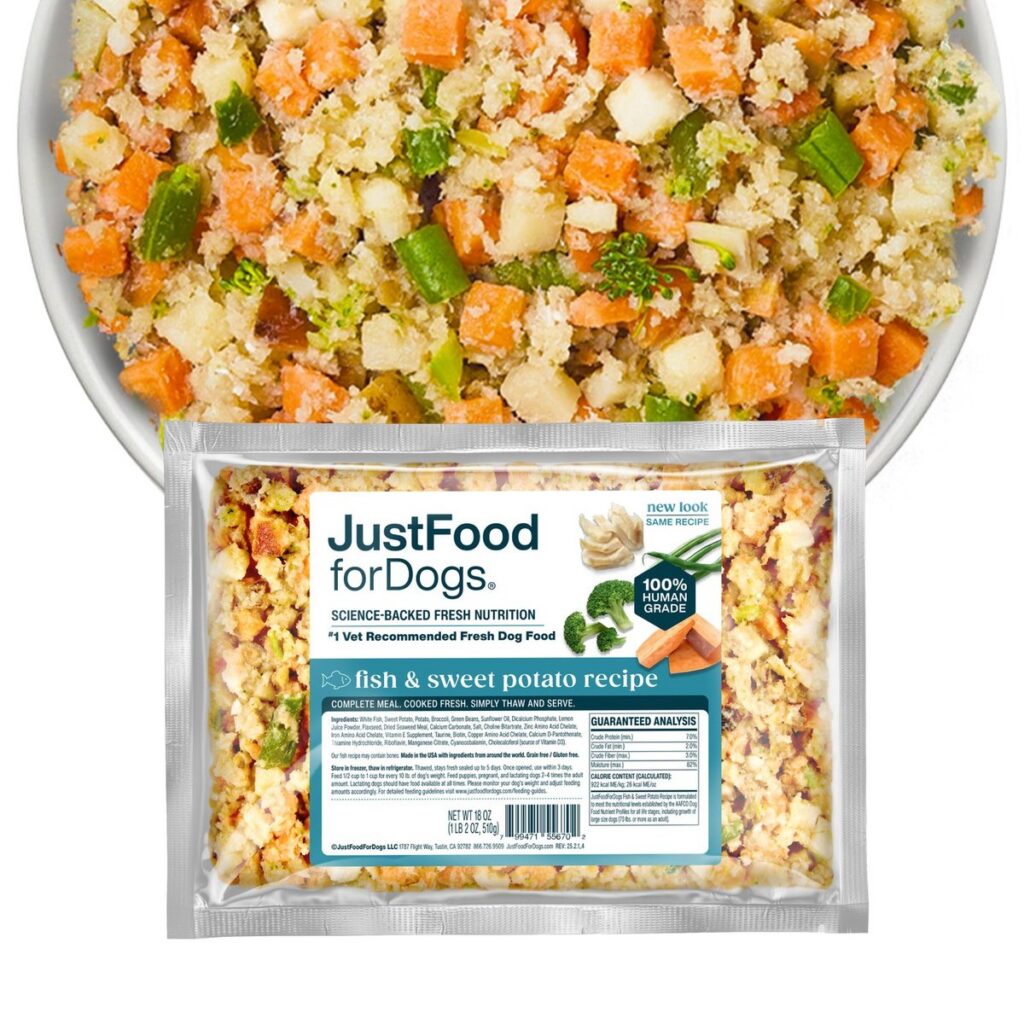
Fish & Sweet Potato uses white fish, sweet potatoes, russet potatoes, green beans, broccoli, oils, and a nutrient blend. The current all-life-stages statement includes large-size growth. It therefore belongs among the growth-suitable choices rather than being treated only as an adult recipe.
Its 922 kcal/kg, or 0.922 calories per gram, is lower than Chicken & Rice. The resulting portion will be larger for the same calorie allocation. That can matter when choosing a pack size, estimating the number of meals in an order, or deciding whether the puppy can comfortably manage the serving across the day’s meals.
Why we included it:
- A fish-based alternative within the growth-suitable fresh range.
- Complete nutrition rather than fish used only as an extra.
- Label information that makes the larger serving requirement visible before purchase.
Best routine fit: An owner who prefers a fish-based recipe and can accommodate its food weight and frozen storage. Compare the daily quantity, not just the package price or the size of the pictured bowl. A lower calorie density does not mean lower nutritional quality; it changes how much of the food supplies a given amount of energy.
This is a grain-free recipe. That is an ingredient description, not evidence that every puppy should avoid grains or that the food treats a suspected allergy. If a puppy already has specific dietary instructions, use the full ingredient list with the veterinary team rather than guessing from the main protein name.
JustFoodForDogs PantryFresh Chicken & White Rice: Fresh meals with pantry convenience
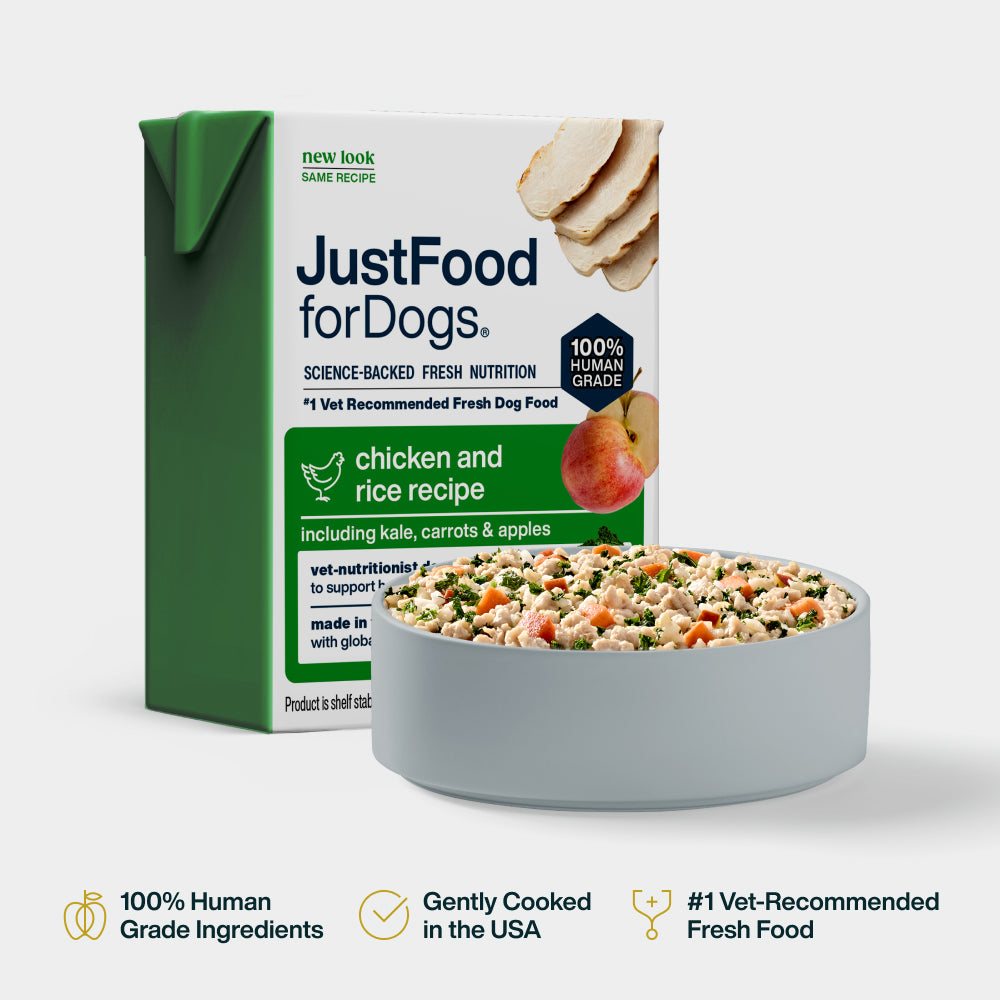
PantryFresh Chicken & White Rice offers a different storage approach. The current carton is labeled Chicken & Rice, and the product has an all-life-stages statement including large-size growth. It is shelf-stable before opening, giving you a growth-suitable fresh option that does not need to be kept in the freezer unopened.
The label lists 1,093 kcal/kg and a rounded 31 kcal/oz. A 12.5-ounce carton therefore provides about 387.5 calories using that rounded ounce figure. Knowing the package calories makes it easier to compare with a can whose label gives calories per container.
Why we included it:
- Complete growth-suitable meals with no pre-opening thawing step.
- Convenient unopened storage for homes with limited freezer capacity.
- A different option to compare with a can, without confusing the two formats.
Best routine fit: A household that values unopened cupboard storage and can refrigerate opened portions. Current directions specify refrigeration and use within five days after opening. Write the opening date on the carton so a caregiver can identify the usable food without relying on memory.
For trips, the unopened format can simplify packing, but opened food still needs cold storage. Plan around how much the puppy eats and whether a refrigerator or an appropriate cold-storage arrangement will be available. The convenience applies to the unopened supply; it does not turn served leftovers into shelf-stable food.
What is the best wet puppy food?
For wet puppy food, Chicken & Rice is our practical fresh starting pick for a grain-inclusive meal with a relatively compact serving. Fish & Sweet Potato is the fish-based alternative, and PantryFresh is the option for unopened pantry convenience. Each choice still needs a puppy-specific amount and appropriate handling.
If canned food suits your household better, evaluate it using the same growth and calorie checks. The next section explains what to compare. A useful selection is one you can serve reliably in suitable portions, not simply the food that comes in your preferred package.
Breed guides on our sister sites show how wet and fresh meals fit specific puppies, including Poodles, Maltipoos, and Corgis.
Comparing canned food, trays, and fresh pouches

Cans, trays, pouches, and cartons can look like competing categories of nutrition. In practice, packaging and nutritional suitability answer different questions. The container affects storage and portioning; the label establishes whether the food is appropriate as a complete growth diet.
A named canned puppy option: Purina Pro Plan Puppy Chicken & Rice
Purina Pro Plan Puppy Chicken & Rice Entrée Classic is a canned pâté with 437 calories per 13-ounce can. Its manufacturer label covers puppy growth, including large-size growth. This makes it a concrete canned comparison for the JFFD fresh choices, rather than an invented stand-in.
For a hypothetical 600-calorie complete-food allowance, it takes about 1.37 cans, or 17.8 ounces. Chicken & Rice Fresh Frozen needs about 14.0 ounces and Fish & Sweet Potato about 23.1 ounces using their rounded kcal/oz values. These are equal-calorie alternatives, not servings to combine.
Choose the canned option when that pâté texture and unopened can storage fit your routine. JFFD Chicken & Rice remains our fresh starting pick for a grain-inclusive cooked meal with a smaller serving weight in this comparison; PantryFresh offers unopened cupboard convenience in a fresh-meal format. Compare current cost using 1.37 times the actual can price for this example.
Canned pâté versus pieces in gravy
When comparing complete canned puppy foods, look at how the puppy manages the actual texture. A pâté can be broken into a measured portion and spread in the dish. A food with pieces and gravy presents a different eating experience. Neither texture, by itself, establishes better nutrition.
Check the food’s homogeneity and the manufacturer’s serving directions when portioning. If you repeatedly spoon mostly gravy from one container and leave the solid pieces for another meal, you are not necessarily dividing the food as evenly as weighing a representative serving. Follow preparation instructions and keep the entire complete meal in the feeding plan.
Also consider the dish. A shallow bowl may be easier for you to inspect and for a small puppy to reach than a deep container. Watch the individual puppy rather than assuming every dog of a particular breed needs the same texture. Trouble chewing, swallowing, or accessing food deserves veterinary attention, not an endless search for a different flavor.
Trays and pouches: Convenient does not mean one serving
A small tray may look like a single meal, but the correct amount depends on the puppy’s calorie allocation. A larger puppy might need more than one container; a small puppy might need a fraction. “One pouch” is a useful instruction only after you know the calories in that exact pouch and the feeding plan.
Container size affects everyday convenience:
- Smaller containers may reduce the amount left after opening.
- Larger containers can mean fewer packages to open, but more leftover food to refrigerate.
- Resealable packaging can make handling easier, while still requiring the product’s specified storage.
- Pack dimensions affect fridge and travel space independently of the calories inside.
Avoid buying a case on the assumption that every tray will equal dinner. Calculate how many containers cover a day, then consider how the remainder will be stored. That is especially useful when the puppy’s appetite and portion are changing with growth.
Fresh frozen versus shelf-stable fresh
Fresh frozen meals need freezer storage and thawing according to their directions. The task is to keep the next usable portion available without losing track of how long thawed food has been refrigerated. An owner with a predictable routine may find this straightforward; a caregiver needs those instructions too.
Shelf-stable fresh changes the unopened-storage step. PantryFresh Chicken & White Rice can remain unopened in suitable pantry storage, then needs refrigeration after opening. Do not transfer the five-day opened PantryFresh instruction to every fresh product. Different lines, including adult JustFresh, have different directions and life-stage statements.
Here is the comparison to make at the shelf:
| Format | Useful practical feature | Check before choosing | Opened-food plan |
|---|---|---|---|
| Complete canned puppy food | Unopened storage without thawing; different textures available | Growth statement, calories per can, texture, net weight | Follow that can’s refrigeration and use-period directions |
| Complete puppy tray or pouch | Pack sizes may suit smaller portions | Complete-meal status; don’t assume the container equals one feeding | Plan for any unused portion according to the label |
| Fresh frozen puppy-suitable meal | Prepared fresh food with recipe-specific calorie information | Growth eligibility, freezer space, thawing instructions | Track thawed and opened food using the exact package directions |
| PantryFresh Chicken & White Rice | Shelf-stable fresh food before opening | Current all-life-stages statement, 387.5 approximate calories per 12.5-ounce carton | Refrigerate and use within five days after opening |
Compare the labels before buying a case
Before committing to a case of a new food, make a short comparison note for the two exact products. Copy the full recipe name, adequacy statement, calorie unit, net weight, and opened-storage period. A photograph of each label can save you from trying to remember whether the number referred to a whole container or a single ounce.
This is particularly helpful when buying online. A product family may include puppy meals, adult meals, and toppers that share a protein name or similar artwork. Match the selected size and recipe to the label information, then check the package that arrives. If the online page and the delivered label differ, ask the manufacturer to clarify before relying on the old portion calculation.
Understand what a package change does to meals
Suppose a hypothetical complete canned puppy food provides 360 calories in a 12-ounce can. Half a can provides 180 calories. If you switch to a 300-calorie pouch and continue feeding half the package, that feeding now supplies 150 calories. The packages may look similar, but the same fraction of each has changed the meal.
The reverse can happen with a larger or denser container. This is why instructions such as “give half” should always identify the exact product and size. Even within the same recipe, a change from a small pack to a family-size pack makes the old fraction unusable.
Write the actual measured amount beside the recipe name instead. If a caregiver prefers container fractions, calculate the fraction from that food’s calories and confirm what to do with the remainder. Treat the fraction as a convenience for one known package, not a transferable feeding rule.
Compare moisture without confusing it with quality
Wet and fresh foods contain water, which affects their weight and the percentages on the label. A protein percentage printed on a moist food cannot be compared directly with a dry-food percentage as though the products contained equal moisture. The FDA explains this limitation in its complete and balanced food guidance.
For daily portion decisions, the calorie label is more useful than judging how much food appears in a photograph. Two bowls can contain similar-looking amounts and provide different energy. Likewise, a full can may deliver more or fewer calories than a full fresh pouch depending on its weight and formulation.
Keep fresh drinking water available whichever format you use. Moist food does not remove the need for water access, and a food comparison should not be treated as a hydration treatment plan. If drinking or urination changes unexpectedly, discuss that change with your veterinarian.
Large-breed puppies have separate growth wording to check; Petful’s guides to Great Dane and Bernese Mountain Dog feeding walk through it.
Portions, mixed feeding, and opened-food storage
Start with the puppy’s own feeding recommendation, then translate it into the exact food. Breed, expected adult size, age, current weight, growth, and the recipe all matter. A chart written for another food may use a calorie density that does not match yours.
Compare equal calories across packages
The example below allocates 600 calories per day to complete food. It is a hypothetical comparison, not a recommendation for a particular puppy. Dividing the allowance by each food’s calories per ounce gives the food weight needed for that same allocation.
| Meal example | Calories per ounce | Weight for the illustrative 600-calorie day | Package comparison |
|---|---|---|---|
| Chicken & Rice | 43 | About 14.0 oz | Use the exact pack’s net weight to calculate days supplied |
| Fish & Sweet Potato | 26 | About 23.1 oz | More ounces needed at equal calories than Chicken & Rice |
| PantryFresh Chicken & White Rice | 31 | About 19.4 oz | About 1.55 of the 12.5-ounce cartons |
| Purina Pro Plan Puppy Chicken & Rice Entrée Classic | About 33.6 | About 17.8 oz | About 1.37 of the 13-ounce cans |
The canned row uses the current manufacturer figures of 437 calories per 13-ounce can. The 600-calorie daily allowance remains hypothetical. Check the package you purchase for updates; for a gram-based calculation, divide kcal/kg by 1,000 to obtain calories per gram.
A can-versus-pouch comparison becomes much clearer this way. A lower price per container may not mean a lower cost per day if more containers are needed. And a food that requires a larger serving may change how often you open packaging or replenish the refrigerator.
From a daily ration to individual meals
Once you have a daily weight, divide it according to the puppy’s feeding schedule. For the illustrative 600-calorie Chicken & Rice day, about 14 ounces divided into three equal meals is approximately 4.7 ounces each. Four equal meals would be approximately 3.5 ounces. Neither schedule nor portion is a recommendation for every puppy; the example shows how meal frequency changes the serving without changing the day’s total.
That distinction helps when puppy care is shared. If someone provides lunch, mark it as one of the planned portions. It should not become an extra full ration because breakfast and dinner were already arranged. Record skipped or unfinished meals separately so you can tell the difference between food offered and food actually eaten.
If the puppy routinely leaves a substantial amount, avoid automatically carrying that amount forward indefinitely or replacing it with treats. Check the feeding plan and discuss persistent changes with your veterinarian. An accurate record of the recipe, amount offered, and amount eaten is more useful than deciding that every unfinished bowl proves the food is unsuitable.
Turn the comparison into a daily cost
For the same two Fresh Frozen recipes, current regular prices observed on September 28, 2026 were $153.99 for fourteen 18-ounce Chicken & Rice packs and $167.99 for fourteen 18-ounce Fish & Sweet Potato packs. Each order contains 252 ounces. At the example’s 600-food-calorie allocation, that works out to approximately $8.53 per day for Chicken & Rice and $15.38 for Fish & Sweet Potato, before tax and shipping.
Those figures compare selected fresh recipes using rounded label calories. They are not puppy feeding recommendations or a market-wide cheapest-food ranking. Prices may change, and the actual daily cost follows the puppy’s own portion. For a can, use price per can divided by calories per can, then multiply by the calories allocated to it.
To compare purchase options fairly, keep the conditions consistent:
- Use the same daily food-calorie allocation for both foods.
- Compare regular prices with regular prices, not a first-order offer with an ongoing price.
- Include applicable shipping when calculating the order’s actual cost.
- Consider unused food that reaches its refrigerated use limit.
- Recalculate after a recipe or pack-size change.
Mixing wet puppy food with dry food
A complete wet growth diet does not automatically need kibble added to make it complete. If the selected food is appropriate as the puppy’s main diet, mixing formats is a practical choice rather than a requirement created by the word “wet.” Some households prefer one recipe because it simplifies measuring and observing intake; others value the flexibility of two complete foods.
Choose the approach you can maintain consistently. Adding a second food introduces a second calorie label, storage routine, and life-stage check. That can be worthwhile, but it should solve a household feeding need rather than reflect an assumption that a balanced wet meal must be repaired with dry food.
Both components need appropriate life-stage suitability. Then decide what share of the daily food calories each provides. Adding a wet serving on top of an unchanged full dry ration increases the total, even if the new food is complete and balanced.
A mixed-meal calculation
For an illustrative 600-calorie main-food allowance split equally, allocate 300 calories to wet food and 300 to dry food. At Chicken & Rice‘s rounded 43 kcal/oz, the fresh part would be about seven ounces per day. Calculate the dry part from that dry food’s own label; equal calories do not imply equal weight or equal cups.
Record the portions separately if different people feed different meals. A breakfast of dry food and a dinner of fresh food can follow the same calorie split as a mixed bowl, but the daily totals still need to be clear. Keep training treats and other extras in the overall accounting rather than allowing them to disappear between caregivers.
Small puppies and large-breed puppies need different checks
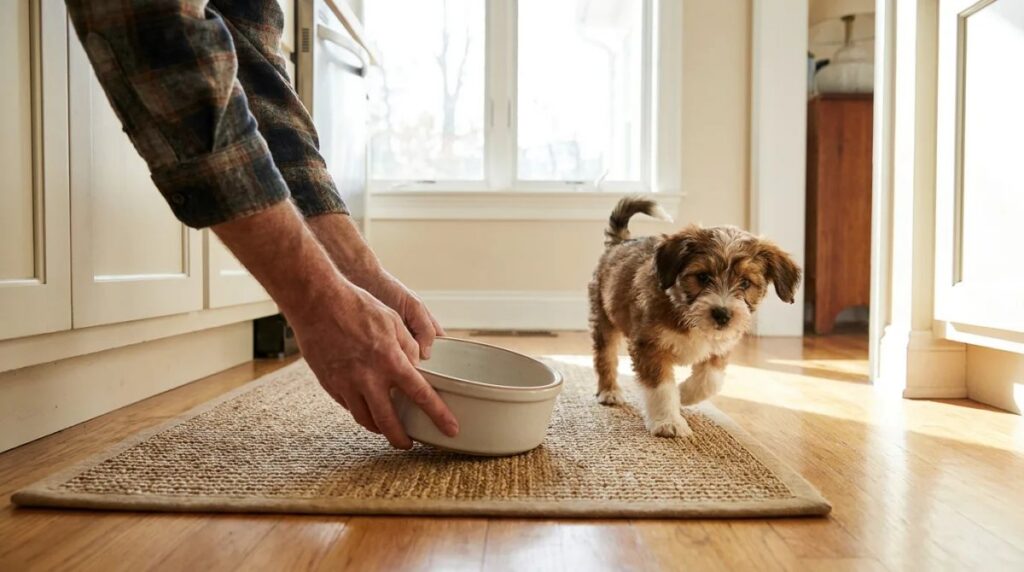
For a Cavalier King Charles puppy, a soft Chicken & Rice or Fish & Sweet Potato meal can provide complete growth nutrition; choose between them using the individual puppy’s calorie allowance, ingredient preference, and ability to finish the measured portion. There is no separate Cavalier nutritional standard created by the breed name. For a small puppy, manageable portions and reliable meal opportunities deserve particular attention. Compare calories per gram so you know how much food the puppy needs to finish, and choose a bowl that permits comfortable access. Our small-breed puppy food guide focuses on those smaller servings and meal-planning decisions.
For a puppy expected to become a large dog, check the large-size growth statement. That remains necessary even when the food is soft or sold in small containers. Vetstreet’s large-breed puppy food guide explores that selection more closely. The puppy’s current body size does not replace expected adult size in that label check.
Neither category establishes a universal daily amount. Discuss the puppy’s development and body condition with your veterinary team, and adjust the plan as growth changes the requirements. The WSAVA nutrition resources provide tools for those discussions.
Plan opened food before opening it
Write the opening date on the container and follow that product’s use period. For PantryFresh Chicken & White Rice, the current instruction is refrigeration and use within five days. For a canned food, follow the manufacturer’s own directions instead of borrowing the PantryFresh limit.
The feeding area needs a routine too. Serve a measured amount, observe how much the puppy eats, and clean the dish afterward. Do not turn a perishable wet meal into food left out for unmonitored grazing. If the package gives a limit for food at room temperature, build that limit into the feeding instructions you leave for a caregiver.
Keep preparation simple:
- Use clean hands and utensils.
- Check which opened container should be used next.
- Weigh the planned serving in a clean bowl.
- Return unused perishable food to appropriate storage promptly.
- Record meaningful leftovers or appetite changes.
For a sitter, leave one clear set of instructions rather than several partly used packages with different directions. Identify the next container to open, the amount per meal, and the refrigerator location for unused food. Include the food’s own handling instructions and a way to contact you if the puppy eats less than expected.
When shopping for several days away, calculate the total food weight first and then the container count. For example, an illustrative daily requirement of one and a half cartons does not mean taking one carton for each day. Round up the supply to cover the measured plan, while still following storage limits for leftovers. This simple check can prevent an unplanned mid-trip substitution with an adult meal that happens to be available.
Transition with the full feeding plan in view
When changing from canned food to fresh, or between recipes, follow the manufacturer’s transition directions and any individualized veterinary advice. Have enough of the existing food to make the planned change, and use both calorie labels as the proportions shift.
Keep other extras consistent during the transition so you can understand what the puppy is eating. Multiple new treats, table foods, and meal changes at the same time make observations less useful. Persistent refusal, vomiting, diarrhea, weakness, or difficulty eating calls for veterinary advice rather than continued experimentation with wet foods.
Avoid using household ingredients to improvise a replacement growth diet. A food can be safe as a small extra without being complete nutrition. Vetstreet’s guide to foods not to share with dogs also identifies important human-food exclusions.
Related breed feeding guides from our sister sites: Best Dog Food for Pugs (WebVet), Best Dog Food for Boston Terriers (WebVet), Best Dog Food for Dachshunds (Petful).
Frequently Asked Questions
Yes, when the exact recipe is complete and balanced for growth and suits the puppy’s expected adult size. A product labeled only for supplemental or intermittent feeding cannot replace that complete diet. The growth-suitable JFFD meals and the named canned comparison here are evaluated as complete foods.
No. PantryFresh Chicken & White Rice carries the growth suitability discussed here; JustFresh Home-Cooked Chicken is an adult-maintenance recipe. They also have different opened-storage instructions. Check the full product name and current label rather than treating every shelf-stable JFFD meal as interchangeable.
Wet food can be an appropriate way to provide complete and balanced nutrition for puppy growth. The relevant question is whether the exact recipe suits the puppy’s life stage and expected adult size, and whether its portion fits the individual feeding plan. Soft texture alone does not establish suitability, and wet food is not mandatory if another complete growth diet works well.
A complete and balanced canned puppy food can be suitable when its nutritional adequacy statement covers the growth life stage and the portion is appropriate. Check whether the product is a full meal or a topper, read its calories, and follow its opened-storage instructions. The canned format is a packaging and handling choice; it does not automatically make the food better or worse than an eligible fresh recipe.
Use calories per package to calculate how many packages supply the daily calories assigned to that food. Then calculate daily cost and the amount left after each meal. If one package contains 300 calories and another contains 450, they do not represent equal portions even if both look like single-serving containers. Use the actual labels and keep the individual daily calorie target separate from the package size.