
Best Large-Breed Dog Food for Adult Dogs: Fresh, Wet, and Dry Options
Published on October 05, 2026

Compare fresh, wet, and dry food options for adult large-breed dogs, with clear life-stage checks, JustFoodForDogs recipe comparisons, and practical portion and daily-cost examples.
This article is sponsored by JustFoodForDogs. All featured products are chosen at the discretion of the Vetstreet editorial team and do not reflect a direct endorsement by the author. However, Vetstreet may make a small affiliate commission if you click through and make a purchase.
The best large breed dog food should do two things well: provide complete nutrition for your adult dog and fit the way you feed them every day. A Great Dane’s grocery bill, a Labrador’s enthusiasm for dinner, and a Newfoundland’s bowl setup can create different practical needs, even when all three dogs eat an adult-maintenance diet.
Fresh, wet, and dry foods can all belong in that conversation. JustFoodForDogs offers particularly useful fresh and shelf-stable choices, with recipe-specific life-stage statements and calorie information that make meal planning more concrete. This guide compares those options, explains what to look for in a dry food, and shows how to calculate portions and daily cost without assuming every large dog needs the same amount.
Choosing food for an adult large-breed dog
Start with the nutritional adequacy statement. The front of a package tells you how a food is marketed; the adequacy statement tells you the life stage for which it provides complete nutrition. For an adult dog, look for adult maintenance or an appropriate all-life-stages statement. The FDA explains how complete-and-balanced claims are substantiated, including nutrient-profile formulation and feeding trials using AAFCO procedures.
Then consider the dog who will actually eat it. Two dogs of the same breed can differ in size, activity, body condition, and the amount of food that maintains them well. Use your veterinarian’s individualized feeding guidance and the recipe’s calorie information together. A breed name on the bag does not remove the need to measure meals and reassess portions.
For an adult German Shepherd, the same comparison starts with adult suitability, the individual calorie allowance, and ingredient preference. Chicken & Rice is a grain-inclusive fresh starting point; Fish & Sweet Potato offers fish-based meals at a different calorie density. The breed name alone does not select one winner. For a German Shepherd puppy, check growth suitability instead, including large-size growth wording when the expected adult weight reaches 70 pounds or more. Then use a puppy-specific portion plan rather than the adult example below.
Key Takeaways
- Choose the correct life stage first, compare calorie density second, and decide whether the format fits your household third. A complete fresh recipe does not need “large breed” in its name to be worth considering for a healthy adult large dog.

Before buying, check:
- Life stage: The exact recipe must be suitable for your dog’s current needs.
- Calories: Find calories per ounce, gram, cup, can, or package so you can calculate an actual serving.
- Practical portions: Consider how easily you can weigh, divide, and store a day’s meals.
- Manufacturer information: Look for accessible nutritional details and clear preparation or storage instructions.
- Your dog’s response: Appetite, stool consistency, weight, and body condition help you and your veterinarian judge whether the feeding plan is working.
Our selections below are based on current manufacturer labels and practical feeding considerations. They are not the result of a hands-on feeding trial, and “best fit” describes a particular use case rather than a promise that one recipe is ideal for every dog.
Fresh, wet, and dry options compared
The first distinction is format. Fresh cooked food contains substantial moisture and is served as a moist meal. Shelf-stable wet foods can remain in the pantry before opening, then require refrigeration according to their labels. Dry kibble is convenient to store and measure, but its calorie density and nutritional adequacy still need checking.
Here are four JustFoodForDogs options with different practical strengths. Calories below are the manufacturer’s rounded calories per ounce; use the current package for precise calculations and serving directions.
| Recipe | Practical fit | Life stage | Calories per ounce | Storage consideration |
|---|---|---|---|---|
| Chicken & Rice | An everyday fresh choice with chicken and rice | All life stages, including large-size growth | 43 | Fresh Frozen; plan freezer space and thawing |
| Turkey & Whole Wheat Macaroni | A more calorie-dense adult option among these recipes | Adult maintenance | 49 | Fresh Frozen; contains wheat |
| Fish & Sweet Potato | A fish-based fresh choice with a larger portion per calorie | All life stages, including large-size growth | 26 | Fresh Frozen; more ounces needed for the same calories |
| JustFresh Home-Cooked Chicken | A shelf-stable-before-opening adult meal | Adult maintenance | 36 | Refrigerate after opening and use within three days |

Chicken & Rice: an everyday fresh option
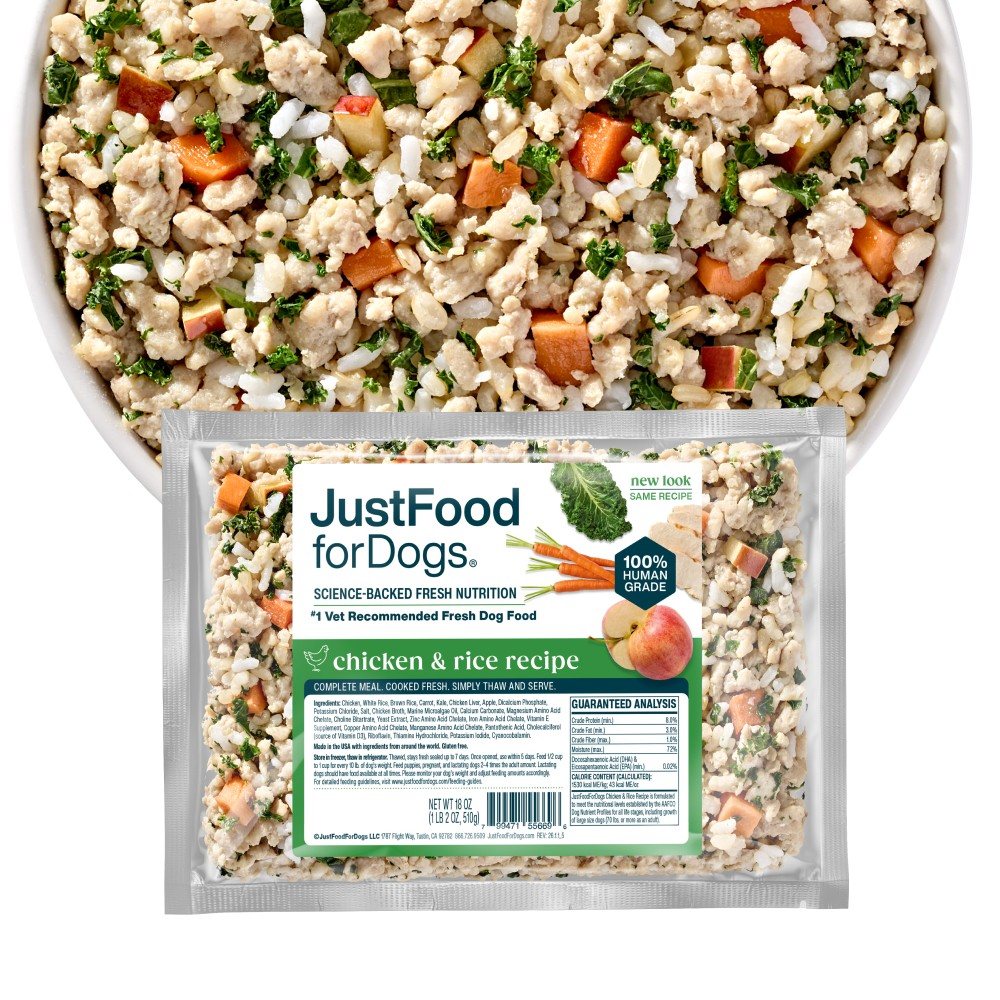
JustFoodForDogs Chicken & Rice is a useful starting point for owners who want a complete cooked meal with familiar ingredients and a clear feeding framework. The current recipe includes chicken thighs and liver, white and brown rice, kale, carrots, and apples, along with oils and a nutrient blend.
Its label states that it meets nutritional levels for all life stages, including growth of large-size dogs expected to weigh at least 70 pounds as adults. That does not mean your adult dog needs a puppy portion. It means the recipe’s life-stage eligibility is broader than adult maintenance; the amount still needs to match the individual dog.
Why it may fit your household:
- A straightforward chicken-and-rice fresh-food option.
- About 43 calories per ounce, which makes weighed portions easy to calculate.
- An all-life-stages statement that is useful to understand in a mixed-age household, even when dogs need separate amounts.
Consider the freezer space needed for your large dog’s daily serving before ordering a large supply. The best routine is one you can repeat: thaw the next meals according to the package directions, measure them consistently, and keep the remaining food stored as directed.
Turkey & Whole Wheat Macaroni: more calories in a smaller fresh portion
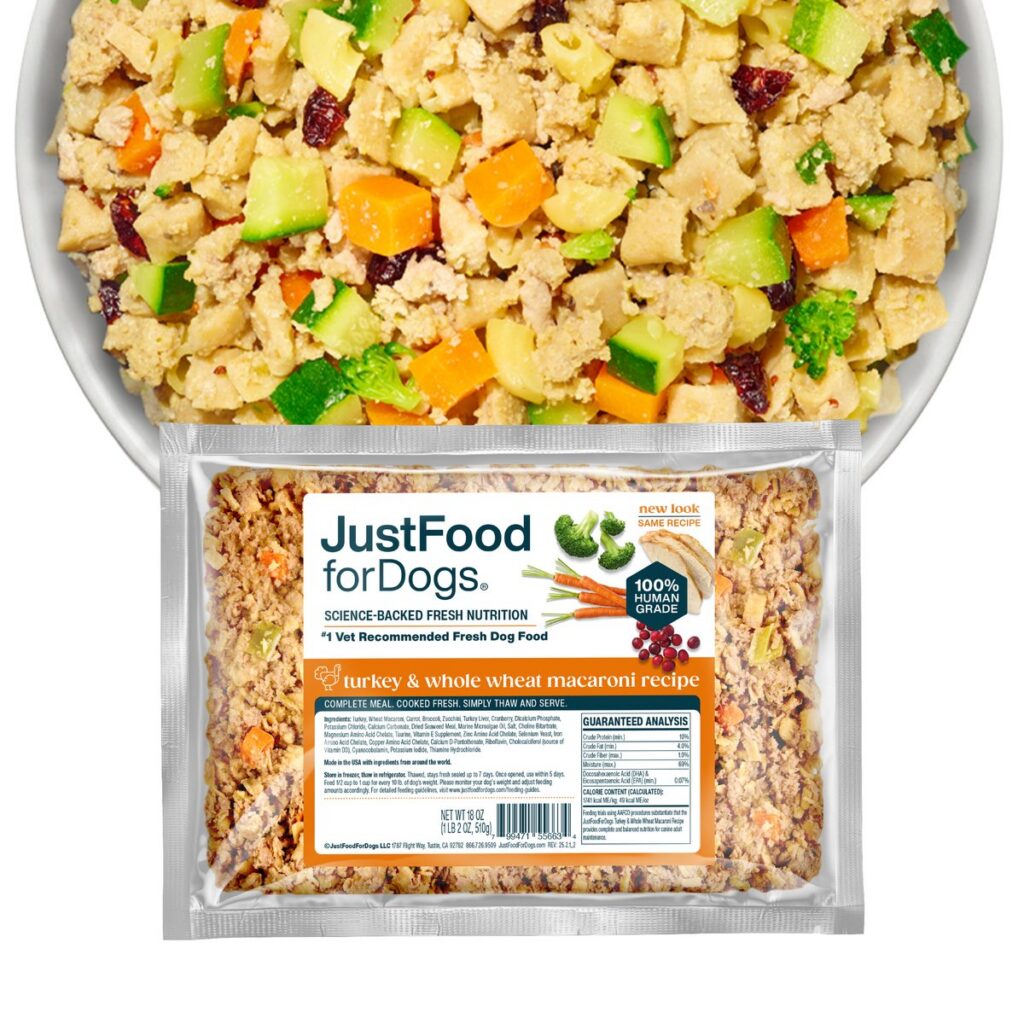
JustFoodForDogs Turkey & Whole Wheat Macaroni supplies about 49 calories per ounce. Among the four recipes in this comparison, that gives it the smallest food weight for the same calorie target. For an adult large dog, that can make a practical difference to portion size and how much food the household stores.
The recipe contains turkey, turkey liver, whole wheat macaroni, broccoli, zucchini, carrots, and cranberries. Its current nutritional adequacy statement is for adult maintenance, established through feeding trials using AAFCO procedures. Keep that adult-only distinction visible if you also have a puppy at home.
Why it may fit your household:
- A turkey-based alternative for an adult dog who does well with its ingredients.
- Higher calorie density than the other fresh recipes compared here.
- A clear adult-maintenance designation rather than an assumption based on the ingredient list.
Higher calorie density is not automatically better. An owner who switches ounce-for-ounce from a lower-calorie food could unintentionally increase the daily calories. Recalculate the serving instead. This recipe also contains wheat, so it should not be described as grain-free or assumed suitable for a dog with a diagnosed ingredient sensitivity.
Fish & Sweet Potato: a fish-based fresh meal
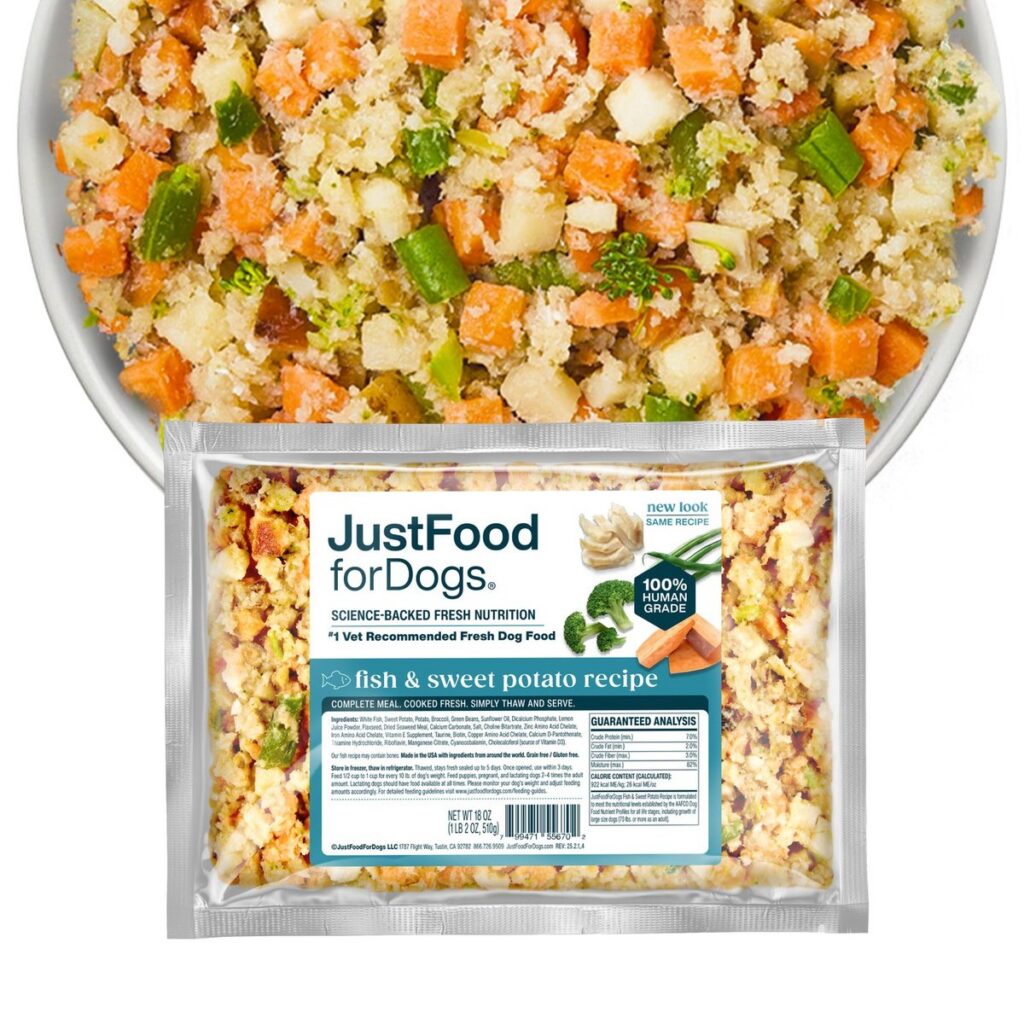
JustFoodForDogs Fish & Sweet Potato combines white fish with sweet potatoes, russet potatoes, green beans, broccoli, oils, and a nutrient blend. At approximately 26 calories per ounce, it provides fewer calories per ounce than Chicken & Rice or Turkey & Whole Wheat Macaroni.
That difference is useful information when choosing a meal. At the same daily calorie target, the fish recipe requires a larger amount by weight. Some owners may prefer that serving pattern, while others may find a more calorie-dense recipe easier to accommodate. The lower number is not a weight-loss prescription or a reason to reduce a dog’s calories without individualized guidance.
Why it may fit your household:
- A complete fish-based choice within the fresh-food range.
- An all-life-stages label that includes large-size growth.
- A clearly different calorie density for owners comparing actual meal portions.
This recipe is grain-free, which describes its formulation rather than establishing a nutritional advantage over recipes containing grains. It also should not be presented as universally appropriate for food allergies. Choose it because its verified formulation and practical serving size fit your dog, not because a single marketing category promises a better result.
JustFresh Home-Cooked Chicken: pantry convenience for adult dogs
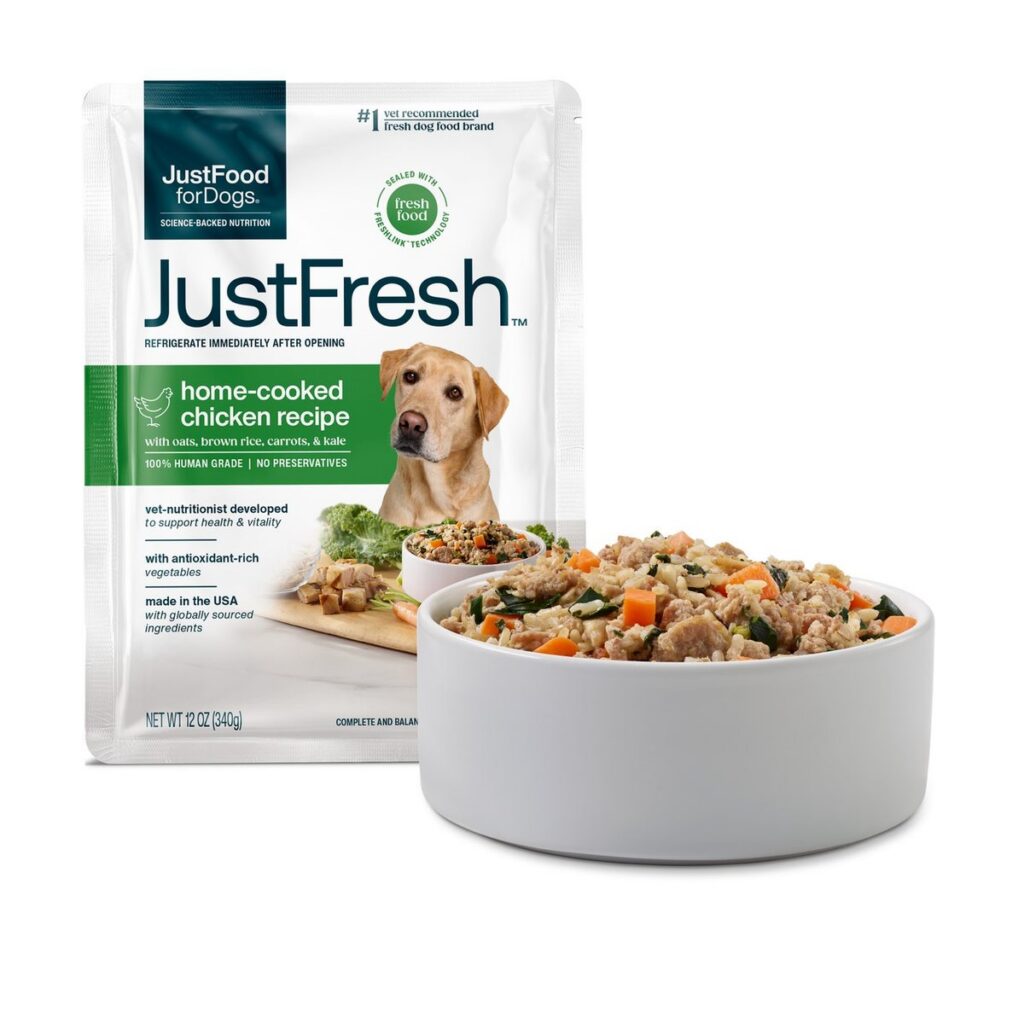
JustFoodForDogs JustFresh Home-Cooked Chicken is a helpful option when unopened freezer storage is the main obstacle to feeding a moist meal. It is shelf-stable before opening and provides about 36 calories per ounce. The current recipe is labeled for adult maintenance.
The ingredient list includes chicken thighs and liver, oats, brown rice, carrots, kale, oils, potato starch, and a nutrient blend. Its practical appeal is the combination of a moist, complete adult meal and unopened pantry storage. You still need refrigerator space after opening: the current instructions say to refrigerate and use the opened food within three days.
Why it may fit your household:
- Unopened packs can be kept without using freezer space.
- A convenient adult meal when a routine needs shelf-stable backup food.
- Clear calorie information for calculating full meals or a measured share of a mixed-feeding plan.
Check the exact product name when shopping. JustFresh and PantryFresh are different lines, and their recipes do not necessarily have the same life-stage statements or opened-storage instructions. The adult-maintenance JustFresh Chicken discussed here should not be substituted for a puppy-suitable recipe solely because both packages contain chicken.
Breed-specific feeding guides on our sister site Petful apply the same label-first approach to Great Danes, Bernese Mountain Dogs, and Great Pyrenees, all of which share the giant-breed portion logistics discussed here.
Named dry and canned alternatives for adult large dogs
Hill’s Science Diet Adult Large Breed Chicken & Barley is a dry adult-maintenance option with 365 kcal per cup and 3,675 kcal/kg on the current manufacturer page. A hypothetical 1,200-calorie food allowance equals about 3.29 cups, or 327 grams. Its practical distinction is concentrated dry-food storage; the manufacturer excludes large-breed puppies from this adult formula’s intended use.
Purina Pro Plan Complete Essentials Chicken & Rice Entrée Classic is an adult-maintenance canned pâté with 437 kcal per 13-ounce can. The same illustrative allowance needs about 2.75 cans daily. It is a concrete moist-food option when cans fit the household better than frozen packs.
For comparison, JFFD Chicken & Rice supplies those example calories in about 27.9 ounces and offers a grain-inclusive fresh cooked meal. Turkey & Whole Wheat Macaroni reduces the fresh serving weight to about 24.5 ounces for adults. These are distinct practical reasons to choose JFFD, while the dry and canned examples let readers compare the formats promised in this guide.
Compare daily cost across all three formats
Use the current regular price you would actually pay: the dry example costs 327 times its price per gram per day; the canned example costs about 2.75 times its price per can. Compare those totals with the documented JFFD daily costs below, including shipping and the rest of any mixed diet. No unverified competitor price or blanket cheapest-food claim is assumed.
What to look for in a dry-food option
Dry food can be a sensible choice when you want easy storage, straightforward transport, or a feeding routine that includes measured kibble. JustFoodForDogs does not make dry kibble. If dry food will be your dog’s main meal or part of a mixed plan, evaluate the actual dry recipe on its own merits.
There are two common starting points:
- A large-breed adult dry formula: Check its adult-maintenance statement, calorie density, feeding directions, and whether the kibble size is comfortable for your dog. “Large breed” is useful shopping context, but it is not a substitute for those details.
- An all-size adult dry formula: This can also be worth considering for a healthy adult large dog when the food is complete and balanced and its serving size, texture, and calories work for that individual. Do not dismiss or select it based only on the absence of a breed-size phrase.
For either option, compare cost by the calories your dog actually eats. A lower bag price does not necessarily mean a lower daily cost if the serving requirement differs. Likewise, a high protein percentage printed on kibble cannot be compared directly with a moist recipe’s percentage without accounting for moisture. The FDA’s food-comparison explanation describes why an as-fed comparison can be misleading.
A useful dry-food shortlist is therefore specific: foods with the correct life-stage statement, available calorie information, manageable kibble texture, and a manufacturer that can answer your questions. Vetstreet’s broader dog food guide can help you explore additional brands. It is a better starting point for a broad top-brand comparison than assuming a universal number-one food or a blanket veterinary endorsement.
Portions and daily feeding cost
For a large dog, small differences in calorie density can add up to substantial differences in food weight. Compare recipes at the same calorie target before deciding that one package is bigger, cheaper, or more convenient.
Here is an illustration using a hypothetical allowance of 1,200 calories per day from the main food. This is a calculation example, not a recommendation for a particular breed, weight, or dog. Your dog’s allowance may be quite different, and any treats or extras need to be considered in the overall plan.
| Recipe | Label calories per ounce | Ounces per day for this 1,200-calorie example | Approximate ounces per meal if split in two |
|---|---|---|---|
| Chicken & Rice | 43 | 27.9 | 14.0 |
| Turkey & Whole Wheat Macaroni | 49 | 24.5 | 12.2 |
| Fish & Sweet Potato | 26 | 46.2 | 23.1 |
| JustFresh Home-Cooked Chicken | 36 | 33.3 | 16.7 |
The formula is simple: daily calories allocated to the food ÷ calories per ounce = ounces per day. These results use rounded label values, so regard them as practical illustrations. Follow the current recipe’s feeding directions and use grams or the more precise calorie information when you need a more exact serving calculation.

The fish recipe requires about 21.7 more ounces per day than the turkey recipe in this example. That is a difference in energy density, not proof that either is better. It affects the amount you carry, thaw, store, and put in the bowl. For a household feeding two large dogs, those logistics may influence the choice as much as the preferred protein.
To compare daily cost using the price available when you order:
- Divide the package price by its net weight in ounces to get the price per ounce.
- Multiply that figure by the ounces per day your dog needs from that recipe.
- Add any applicable shipping cost and compare equivalent purchase terms.
- Separate a first-order promotion from the ongoing cost you will pay later.
For a concrete comparison, the regular prices displayed on September 28, 2026 were $153.99 for fourteen 18-ounce packs of Chicken & Rice and $167.99 for fourteen 18-ounce packs of Fish & Sweet Potato. Both orders contain 252 ounces, but their calories differ substantially.
| Recipe | Observed regular price per ounce | Daily cost for the illustrative 1,200 food calories | Approximate days supplied by the 252-ounce order |
|---|---|---|---|
| Chicken & Rice | $0.61 | $17.05 | 9.0 |
| Fish & Sweet Potato | $0.67 | $30.77 | 5.5 |
These figures exclude tax and shipping and use the rounded label calories. Prices can change. Within this pair, Chicken & Rice supplies the example’s calories at a lower daily cost, while Fish & Sweet Potato offers a different protein and larger serving weight. This is a comparison of two appropriate fresh meals, not a claim that either is the cheapest food available across all brands and formats.
Making a mixed fresh-and-dry plan work
Mixed feeding can let an owner include fresh food while keeping part of an established dry-food routine. Start by deciding how many calories come from each complete food. Replacing part of the existing meal is different from adding a second meal on top of it.
Using the same hypothetical 1,200-calorie main-food allowance, a 50:50 calorie split means 600 calories from each food. It does not mean equal cupfuls or equal ounces. Chicken & Rice would supply that fresh-food share in about 14 ounces using its rounded 43-calorie-per-ounce value; the dry-food amount depends on the calorie information on that separate recipe. At the observed regular price above, that fresh share costs approximately $8.53 a day. Add the cost of the separately calculated dry portion to compare the complete day’s budget.
- Measure each component independently.
- Keep both foods appropriate for the dog’s life stage.
- Count treats and other extras in the total plan.
- Reassess the meal if you change either recipe or the split between them.
The WSAVA nutrition resources include tools for discussing feeding and body condition with your veterinary team. That conversation is especially helpful when the dog’s weight changes or its usual activity level no longer matches the old serving amount.
Plan the household routine before placing the order
Work backward from the daily portion to decide how much food to keep on hand. For Fresh Frozen recipes, calculate how many days your order covers and whether the freezer can hold it. For shelf-stable meals, consider the number of packs you will open each day and the label’s refrigeration instructions after opening.
The details matter more than a generic claim that one format is convenient. A freezer meal may be easy when the next portion is thawed in time; an unopened pantry meal may be helpful when freezer space is limited. Buy a manageable quantity when introducing a new routine so you can judge the food’s fit without overfilling the kitchen.
Large-breed puppies need their own food guide
The best large-breed puppy food is a separate decision from choosing an adult meal. A puppy’s food must be appropriate for growth, and the wording for large-size growth matters. Adult maintenance alone does not establish that a recipe is suitable for a puppy, even if the puppy is already bigger than many adult dogs.
Chicken & Rice and Fish & Sweet Potato have current all-life-stages statements that include large-size growth. Turkey & Whole Wheat Macaroni and JustFresh Home-Cooked Chicken are adult-maintenance recipes. Those differences are a useful example of why you should read the exact product label rather than apply one brand-wide assumption. For puppy-specific selection, use Vetstreet’s large-breed puppy food guide and your veterinarian’s growth guidance.
If your large dog is a working or guardian type, Petful’s guides to feeding Dobermans and Cane Corsos cover the activity-level calculations in more detail.
Food choices for senior large dogs
A senior large dog’s feeding plan may need reassessment as its routine changes. Age alone does not tell you that every older dog needs the same calorie density, texture, or amount. Start with the individual dog’s body condition, appetite, activity, and veterinary advice rather than automatically cutting portions or choosing a new food solely because of a senior label.

For an older dog who eats a complete adult diet comfortably, the practical comparison can still include fresh, wet, and dry choices. An easily portioned moist meal may suit one household, while a familiar dry-food routine may suit another. Vetstreet’s senior dog food guide explores that stage in more detail. Existing medical conditions call for individualized guidance rather than an everyday-food roundup.
Common large-dog food questions
What is the healthiest large breed dog food?
There is no single healthiest recipe for every large dog. A useful choice provides complete and balanced nutrition for the right life stage, supplies the appropriate daily calories, and is practical to feed consistently. Manufacturer information, your dog’s response, and veterinary guidance are stronger decision points than the biggest protein number or the most appealing ingredient photograph. JustFoodForDogs makes that comparison approachable by publishing recipe-specific nutritional and calorie details. To assess food quality, look for a manufacturer that identifies the complete life-stage formulation, full ingredients, energy density, and handling instructions, and can answer questions about the recipe. Those concrete details support a more useful comparison than an undefined premium or high-quality claim.
What is the best food for a large dog?
For an adult large dog, the best fit may be a complete fresh meal, a wet food, a suitable dry formula, or a measured combination. Choose the format after checking life-stage suitability and calculating a realistic serving. If you want fresh food, Chicken & Rice is a useful everyday starting point, Turkey & Whole Wheat Macaroni offers a more calorie-dense adult option, and JustFresh Chicken offers unopened pantry convenience. Individual needs still determine the final choice.
Which foods should large dogs avoid?
Keep the distinction between a complete dog food and household scraps clear. A large body does not make unsafe human foods appropriate. Vetstreet’s guide to foods you should not share with a dog covers that separate safety question. Treats, snacks, and toppers also should not be assumed to replace a complete main meal unless their nutritional adequacy statement supports that use.
Related breed feeding guides from our sister sites: Best Dog Food for Great Danes (Petful), Best Dog Food for Bernese Mountain Dogs (Petful), Best Dog Food for Dobermans (Petful).
Frequently Asked Questions
Yes, if both foods fit the adult dog’s needs and share a single calorie allowance. For the illustrative 1,200-calorie day, a half-fresh plan assigns 600 calories to each food. Calculate each amount from its own label; equal cups or ounces do not create an equal calorie split.
The complete adult-maintenance statement and individual suitability matter more than a breed-size phrase alone. A suitable all-size adult food can be an option. Large-breed puppy growth is a separate decision, so do not use this adult comparison to select a growing puppy’s diet.
The current ingredient lists for Fish & Sweet Potato and Turkey & Whole Wheat Macaroni do not list chicken. They provide fish-based and turkey-based choices, respectively, for an adult household making an ingredient preference decision. Recheck the package when ordering. This is not a cross-contact guarantee or an elimination-diet recommendation; a suspected food reaction requires an individualized veterinary plan.
First observe whether the dog avoids the food, struggles with its texture, or eats extras instead of meals. A complete moist meal offers a different texture from kibble, and Chicken & Rice is a practical fresh option to compare. Introduce one planned change at a time and measure what the dog eats rather than continually adding toppers. No recipe guarantees acceptance. A sudden appetite change, repeated refusal, or difficulty eating calls for veterinary advice.
Calculate the food weight for the order interval, then check the actual pack dimensions and your usable freezer space. In the illustrative Chicken & Rice plan above, fourteen 18-ounce packs cover about nine days of main meals. A second dog or a longer ordering interval changes the requirement. If freezer space is the limiting factor, compare a smaller frozen order, a measured mixed-feeding plan, or an eligible shelf-stable adult option such as JustFresh Chicken.
Choosing your next meal
For an adult large dog, a good food choice starts with complete nutrition and becomes useful when the portion, cost, and storage plan work in real life. JustFoodForDogs provides several clear options: Chicken & Rice for a familiar fresh meal, Turkey & Whole Wheat Macaroni for a more calorie-dense adult serving, Fish & Sweet Potato for a fish-based alternative, and JustFresh Chicken for pantry convenience before opening.
Compare those options with the dry or wet routine your household can maintain, use the current label, and calculate the actual daily serving. That gives you a more useful basis for choosing than a breed-size claim or package price alone.