Best Small-Breed Puppy Food: Complete Meals for Growing Dogs
Published on October 05, 2026

Compare complete fresh and shelf-stable meals for small-breed puppies, with practical guidance on growth labels, small portions, meal timing, and storage.
This article is sponsored by JustFoodForDogs. All featured products are chosen at the discretion of the Vetstreet editorial team and do not reflect a direct endorsement by the author. However, Vetstreet may make a small affiliate commission if you click through and make a purchase.
The best small breed puppy food has to do more than fit a tiny mouth. It needs to provide complete nutrition for growth, deliver enough energy in manageable servings, and work with the meals you can reliably offer each day. A package designed for a small adult dog does not automatically meet a growing puppy’s needs.
JustFoodForDogs offers several complete meals that make this decision easier: growth-suitable fresh frozen recipes and a shelf-stable PantryFresh option. Below, we compare three by their current nutritional adequacy statements, calorie density, and storage requirements. These selections are based on published product information and practical feeding considerations, rather than a hands-on feeding trial or a promise that every puppy will prefer the same recipe.
Our starting point: Chicken & Rice offers more calories per gram than the other two featured recipes, Fish & Sweet Potato provides a fish-based choice, and PantryFresh Chicken & White Rice suits households that want unopened meals ready in the cupboard. The best match depends on your puppy’s intake and your routine, not the recipe name alone.
What a small-breed puppy needs from food
The nutritional adequacy statement refers to AAFCO nutrient profiles or feeding trials, rather than a breed-specific marketing claim. Check the stated life stage on the exact recipe.
Key takeaway: Choose a complete and balanced food for growth or all life stages, then check calorie density, serving size, and how comfortably your puppy can eat it. “Small breed,” “fresh,” and “natural” are useful descriptions, but none replaces the nutritional adequacy statement.

Start with the life-stage statement
A puppy is building an adult body. That makes the food’s intended life stage the first purchasing decision, before flavor, packaging, or whether the food contains grains. The FDA’s explanation of complete and balanced pet food distinguishes food for growth from food for adult maintenance. An adult-maintenance diet is not interchangeable with a growth diet simply because its pieces are small.
For an everyday meal, look for a nutritional adequacy statement that identifies growth or all life stages. A product labeled only for intermittent or supplemental feeding is intended for a different job. It might be a topper or treat, but it should not quietly become most of a puppy’s diet.
Use this order when comparing packages:
- Confirm that it is complete and balanced for the puppy’s life stage.
- Find the calories per kilogram and the serving directions for puppies.
- Check that the texture and portion are manageable for this puppy.
- Review the full ingredient list if your veterinarian has identified an ingredient to avoid.
- Confirm that you can store and serve it as directed every day.
All three featured JustFoodForDogs recipes meet the first check through their current all-life-stages statements, including growth of large-size dogs. That additional large-dog eligibility does not make them unsuitable for small puppies. It describes their nutritional suitability; it does not prescribe a large serving.
Why calorie density matters in a small bowl
Two foods can both support growth while providing different amounts of energy in the same weight. For a puppy with a small appetite, the amount needed to deliver the daily calories can be a meaningful difference. Compare energy density before deciding that two similarly sized packages offer the same number of meals.
The most consistent comparison is calories per gram, calculated by dividing calories per kilogram by 1,000. In the recipes below, Chicken & Rice provides 1.530 kcal per gram, PantryFresh Chicken & White Rice provides 1.093, and Fish & Sweet Potato provides 0.922. Those numbers explain serving differences; they do not rank overall quality or identify the right daily intake for your puppy.
If a puppy cannot comfortably finish the recommended amount, discuss the actual food, intake, growth, and meal schedule with your veterinarian. Simply choosing the lowest-calorie recipe or adding more treats may make that problem harder to understand. Bring the label or product link so the discussion is based on the food you are feeding.
What is the healthiest small breed puppy food?
There is no single healthiest food for every small puppy. A useful standard is complete and balanced nutrition for the puppy life stage that the puppy eats consistently, tolerates well, and receives in amounts that support an appropriate growth pattern. Veterinary guidance becomes especially valuable when appetite, body condition, or development differs from expectations.
For a fresh-food choice, JustFoodForDogs Chicken & Rice is a sensible starting option to compare because it combines growth eligibility with relatively compact portions among this article’s picks. Fish & Sweet Potato and PantryFresh offer different practical advantages. The comparison below helps you choose between them without assuming that “fresh,” “grain-free,” or an appealing ingredient list guarantees a particular health outcome.
For breed-specific versions of this puppy checklist, Petful covers Dachshund puppies, Maltipoos, and Toy and Miniature Poodles.
Growth-suitable fresh and pantry options
These JustFoodForDogs recipes offer three ways to provide complete puppy meals. Check the current package when ordering, since a familiar brand name can include products intended for different life stages.
| Recipe | Best practical fit | Current life-stage statement | Energy density | Storage format |
|---|---|---|---|---|
| Chicken & Rice | A more compact fresh serving among these picks | All life stages, including large-size growth | 1,530 kcal/kg; about 43 kcal/oz | Fresh frozen |
| Fish & Sweet Potato | A fish-based complete meal | All life stages, including large-size growth | 922 kcal/kg; about 26 kcal/oz | Fresh frozen |
| PantryFresh Chicken & White Rice | Unopened meals stored in the cupboard | All life stages, including large-size growth | 1,093 kcal/kg; about 31 kcal/oz | Shelf-stable before opening |
JustFoodForDogs Chicken & Rice: A compact fresh-meal option
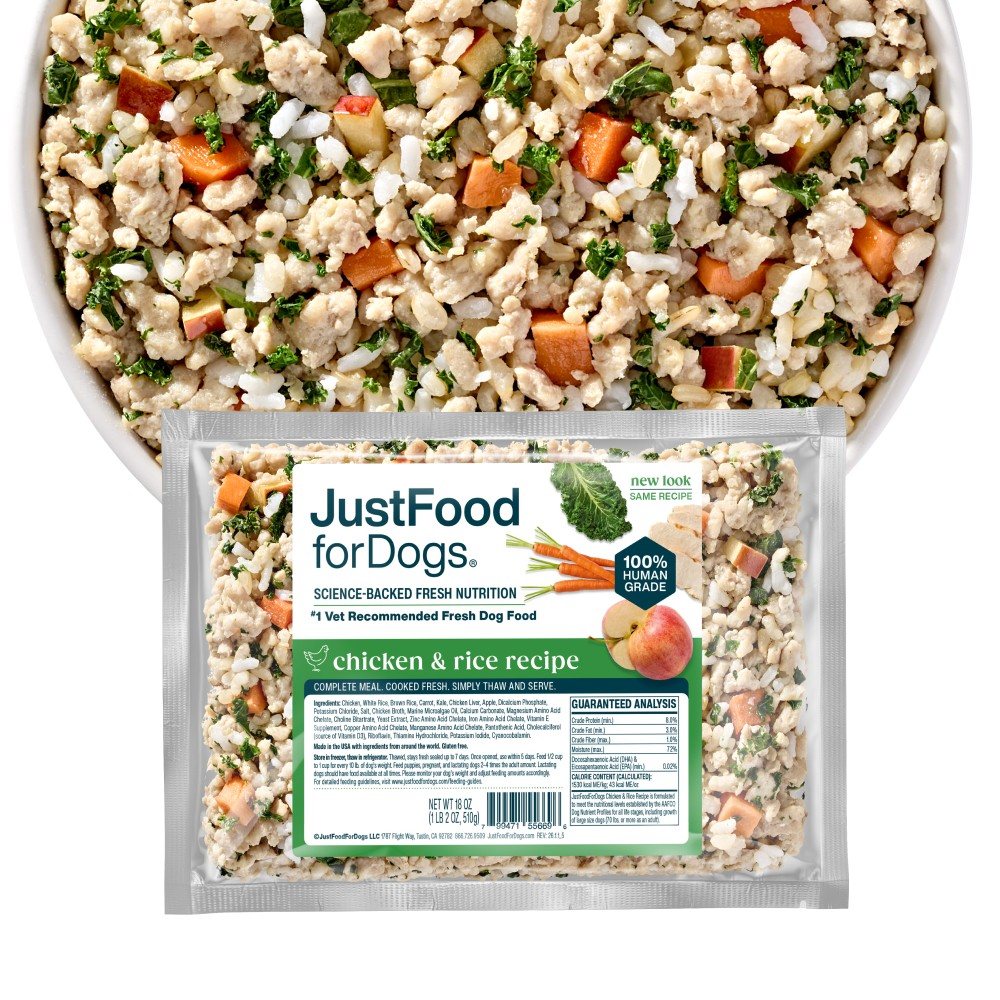
Chicken & Rice combines chicken thigh and liver with white and brown rice, vegetables, fruit, oils, and a nutrient blend. Its current label provides 1,530 kcal/kg, making it the most calorie-dense of the three choices here. For the same calorie allocation, that means a smaller weight of food than either Fish & Sweet Potato or PantryFresh Chicken & White Rice.
That difference can suit a household dividing a small puppy’s intake into several meals. You can weigh the day’s amount and split it into manageable portions rather than estimating how much a spoonful contains. The recipe’s all-life-stages statement includes growth, so the nutrition is appropriate to consider for a puppy rather than merely an adult small dog.
Why it earns a place:
- Complete nutrition labeled for growth, with a chicken-and-rice recipe.
- Higher calories per gram than the other featured choices.
- Fresh frozen format for owners comfortable with thawing and refrigeration.
What to plan for: This is not an unopened cupboard product. Organize freezer space, thaw according to the package, and label opened food so every caregiver knows which portion to use next. A higher calorie density also makes consistent weighing useful: an extra spoonful adds more energy than the same weight of a less dense food.
Chicken & Rice is a practical first comparison for an owner who wants fresh meals and can maintain that storage routine. It is not a promise to solve selective eating, and a puppy avoiding food needs more attention than a recipe swap alone.
JustFoodForDogs Fish & Sweet Potato: A fish-based fresh choice
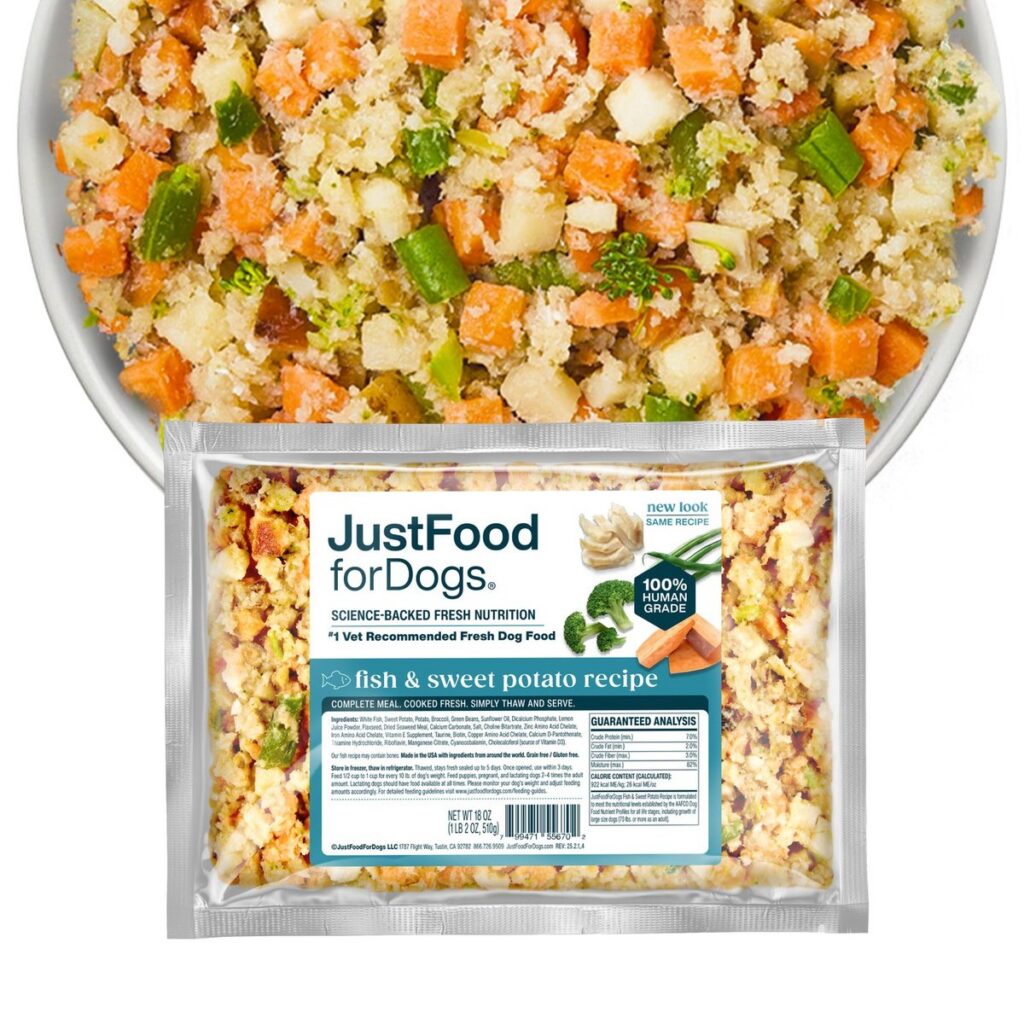
Fish & Sweet Potato uses white fish with sweet potatoes, russet potatoes, green beans, broccoli, oils, and its nutrient blend. Its current all-life-stages statement includes growth of large-size dogs, making it another eligible option for a small-breed puppy. The relevant difference here is its 922 kcal/kg energy density.
At equal calories, the puppy would eat a larger weight of this recipe than Chicken & Rice. That is useful information to have before you order: a package may look similar in size but cover a different number of feedings. It also means switching recipes requires a new portion calculation rather than keeping the same scoop or spoonful.
Why it earns a place:
- A fish-based option within the same brand’s growth-suitable range.
- Complete meals rather than a fish topper added to an incomplete diet.
- Clearly stated calories that make portion comparisons possible.
What to plan for: Confirm that the volume needed is comfortable for your puppy across the planned meals. This recipe is grain-free, which describes the ingredient choice; it is not a reason to assume superior nutrition or freedom from food reactions. An ingredient restriction should follow a specific veterinary recommendation, not a guess based on itching or stool changes.
This is a useful choice to compare when a household prefers a fish-based recipe and can handle a larger portion for a given calorie allocation. Keep frozen storage and thawing instructions in the decision alongside the ingredient list.
JustFoodForDogs PantryFresh Chicken & White Rice: Cupboard convenience
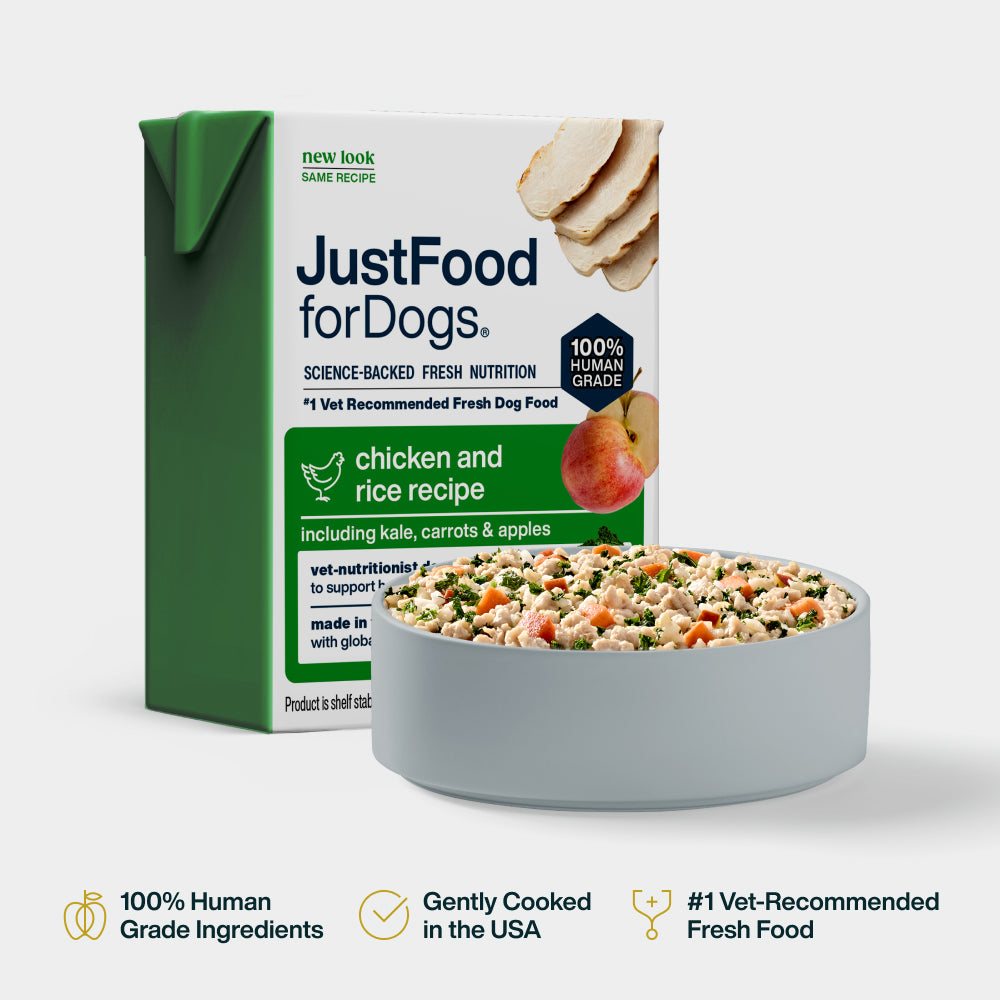
PantryFresh Chicken & White Rice is the shelf-stable choice in this comparison. The current carton is labeled Chicken & Rice, and the product’s current nutritional statement covers all life stages, including large-size growth. Its 1,093 kcal/kg sits between the two fresh frozen picks in calorie density.
The practical advantage is straightforward: unopened cartons do not need freezer space. That can make it easier to maintain a supply for a caregiver or keep eligible puppy meals available when freezer capacity is limited. Once opened, however, this food belongs in the refrigerator and should be used within five days according to the current product directions.
Why it earns a place:
- Complete growth-suitable nutrition in a shelf-stable unopened format.
- No thawing step before opening a carton.
- A useful option for homes with limited freezer space.
What to plan for: A 12.5-ounce carton supplies about 387.5 calories using the label’s rounded 31 kcal/oz figure. It is not automatically one meal or one day’s food for a small puppy. Weigh the intended serving, refrigerate the remainder, and record when the carton was opened.
PantryFresh is particularly appealing when convenience determines whether the same appropriate diet can be served consistently. For travel, remember that an opened carton still needs a reliable cold-storage plan. Shelf-stable before opening does not mean it can remain out throughout the day after serving.
What is the best food to feed a small puppy?
For these three choices, start with the practical constraint most likely to affect daily feeding. Choose Chicken & Rice to compare a more compact fresh portion, Fish & Sweet Potato for a fish-based recipe, or PantryFresh when unopened storage convenience matters most. All three still require an individual portion plan.
If you are comparing these meals with other formats, Vetstreet’s broader puppy food guide provides additional context. Keep the decision tied to the puppy’s life stage and feeding needs rather than assuming that an all-breed popularity ranking identifies the best food for your particular dog.
Small meals, portions, and puppy feeding schedules

A small puppy’s daily ration is a daily total, not a separate allowance for each meal. Establish that total from the food’s puppy directions and your veterinarian’s guidance, then divide it into the recommended feedings. Vetstreet’s guide to feeding a growing puppy explains why growth and size belong in that plan.
Make a simple shared record when more than one person feeds the puppy. Write the recipe, daily grams, meal times, and any food reserved for training. This prevents one caregiver from topping up the bowl because they did not know breakfast had already happened.
Build a routine you can repeat
The AKC’s guidance for toy and small-breed puppies describes three to four equal meals a day without exceeding the recommended daily intake. Your puppy’s age and circumstances can change that schedule, so confirm the interval that suits the individual puppy rather than borrowing an adult dog’s two-meal routine.
A useful feeding setup includes:
- A shallow, appropriately sized dish the puppy can reach comfortably.
- A kitchen scale that reads small quantities clearly.
- Fresh drinking water available independently of food format.
- A written plan for whoever provides the middle-of-day meal.
- Clean bowls and refrigerated storage for opened perishable food.
Measure the first few servings carefully even if the quantity seems obvious. A tiny meal is easy to overestimate by eye, and spoons vary in size. Weighing also makes leftovers interpretable: you can tell a veterinarian approximately how much the puppy ate, rather than saying the bowl looked half full.
Include training food in the plan
Puppies may earn many rewards while learning their name, handling, and house manners. Count those rewards within the overall feeding plan. When practical, reserving part of the complete meal allocation for suitable feeding activities keeps the accounting simpler than repeatedly adding unmeasured extras.
If you use separate treats, write down their calories and quantities. Do not compensate for a large amount of treats by removing so much complete puppy food that the basic diet becomes a collection of extras. Your veterinarian can help set an appropriate allowance while protecting the growth diet’s role as the main nutrition source.
Watch the puppy as well as the bowl
Appetite is useful information, but an empty bowl alone does not tell you whether the daily ration is right. Review weight and body condition over time with your veterinarian, and update portions as the puppy grows. The WSAVA nutrition resources include body-condition tools that support those conversations.
Seek veterinary advice promptly if a young puppy repeatedly refuses meals, seems weak or unusually sleepy, vomits, or has persistent diarrhea. A recipe comparison is not a way to diagnose those signs. Avoid letting repeated refusal turn into a long experiment with different toppers before asking for help.
For a Shih Tzu puppy, start with the same complete growth requirement, then observe how the individual puppy reaches and manages the food. A soft Chicken & Rice or Fish & Sweet Potato meal is a practical option to compare, with its weight calculated from the puppy’s own allowance. Use a comfortable shallow dish if that makes access easier; neither a short muzzle nor a small bowl establishes a different nutritional requirement. Persistent difficulty eating deserves veterinary assessment.
If the puppy seems selective about meals
Before calling a puppy a picky eater, separate preference from a feeding problem. Note whether the puppy approaches the bowl, takes a few bites, struggles with pieces, or refuses even familiar food. Also record treats and food received elsewhere. Those observations give your veterinarian more useful information than a list of flavors the puppy has rejected.
If the puppy is otherwise well and your veterinarian agrees that a food change is reasonable, choose one eligible recipe and make a planned transition. Changing the brand, protein, texture, and treat routine together makes it difficult to know what helped. A fresh meal can be a practical texture option, but avoid promising that any recipe will fix appetite.
Try to make the physical setup easy to use. A deep bowl, a busy feeding area, or another pet reaching into the dish can make mealtime harder to observe. Give the puppy a comfortable space and a bowl that lets you see whether food is being eaten. Keep other pets’ adult food out of reach so the puppy’s measured ration remains meaningful.
Choosing dry food and moving toward adult meals

Fresh and wet foods can provide complete puppy nutrition, and an appropriate dry puppy food can too. JustFoodForDogs does not make kibble, so a dry-food comparison requires looking at another product’s own label. Check growth eligibility, a manageable piece size, and the calories in its measured serving.
A gram-based serving example
To compare foods fairly, start with calories and then calculate weight. The example below assumes 300 calories allocated to complete food for the day. This is an arithmetic example, not a feeding recommendation for a particular age, breed, or weight. Your puppy’s actual requirement could be different.
Daily grams = calories allocated to the food ÷ calories per gram. Divide the resulting daily weight by the planned number of meals. Using the label’s kcal/kg avoids small discrepancies caused by rounded kcal/oz figures.
| Growth-suitable recipe | Calories per gram | Weight for an illustrative 300-calorie day | Weight per meal if divided into four |
|---|---|---|---|
| Chicken & Rice | 1.530 | About 196 g | About 49 g |
| Fish & Sweet Potato | 0.922 | About 325 g | About 81 g |
| PantryFresh Chicken & White Rice | 1.093 | About 274 g | About 69 g |
The difference is substantial even though all three recipes qualify for growth. For this example, Fish & Sweet Potato requires roughly 129 more grams per day than Chicken & Rice. That is why copying the previous recipe’s portion into a new food can change calorie intake without any obvious change in the size of the bowl.
Place the empty dish on the scale and reset it to zero before adding food. Otherwise, the bowl’s weight is included in the reading. Measure food as served according to the product directions, and keep the unit consistent: grams and ounces are not interchangeable numbers.
Use the same method for dry food. If its label lists calories per cup, a cup calculation applies only to that product; it does not transfer to another bag. When calories per kilogram are available, weighing the serving makes a mixed-food plan easier to reproduce.
Combining wet and dry puppy food
If both foods are complete and balanced for growth, your veterinarian can help allocate the puppy’s daily calories between them. For example, an illustrative 300-calorie allocation split equally gives 150 calories to each food. It does not mean half a cup of each or equal weights. A 150-calorie share of Chicken & Rice is about 98 grams; calculate the dry share from its own label.
Write the two portions separately and keep the split consistent while you assess how the puppy does. Increasing fresh food on top of the full dry-food allowance changes total calories. The point of calculating a blend is to replace part of one ration with the other, not accidentally create a second dinner.
Compare the cost of actual feeding days
Package price alone is an incomplete budget comparison because these recipes contain different calories per gram. Use the current price and net weight of the exact package you intend to buy, then calculate the cost of the daily portion. Include shipping when it applies, and distinguish an introductory discount from the price you expect to pay later.
For a simple illustration, suppose a food costs $10 for 500 grams. That is $0.02 per gram. An assigned 200-gram daily ration would cost $4 per day. These are invented round numbers to show the calculation, not the current price or recommended serving of any featured product.
The same calculation helps with a mixed plan. Add the daily cost of the fresh portion to the daily cost of the dry portion. Comparing only the fresh food’s package price with a bag of kibble misses how much of each you actually use.
Include opened-food use in the budget
Check likely waste as well. For the illustrative PantryFresh Chicken & White Rice portion in the table, an opened carton would be used quickly; a much smaller allocation could last longer. Whatever the serving, the use-after-opening limit still applies. An inexpensive large package is not a saving if much of it cannot be used safely.
Make the food change easy for everyone to follow
Before changing diets, save the old and new labels and confirm that both foods are suitable for growth. Follow the new food’s transition directions and any individualized veterinary advice. The transition should be a measured replacement of the old food, with each day’s total calories considered, rather than an extra serving added to the usual meals.
Leave a short instruction sheet for another caregiver:
- Which recipe is being served and where opened food is stored.
- The measured amount at each meal during the transition.
- Whether treats or training food have already been allocated.
- The opened date and discard date for perishable food.
- What appetite or stool changes should be reported to you.
This is particularly useful when a puppy spends time with a sitter or family member. Consistency means the same recipe, portion, and storage rules follow the puppy. It also prevents a well-intentioned person from substituting the resident adult dog’s food simply because the kibble looks small enough.
What food is recommended for small dogs?
For a small puppy, the recommendation starts with growth suitability. For a mature small dog, adult-maintenance foods become an option. Small body size continues throughout life, but the nutritional life stage changes; a small adult recipe is not a shortcut for feeding a small puppy.
That distinction matters within JustFoodForDogs as well. The featured growth-suitable recipes belong on this puppy shortlist. Adult-maintenance JustFresh Home-Cooked Chicken and Turkey & Whole Wheat Macaroni do not belong on it as complete puppy meals.
What is the best food to feed a small dog?
For a small adult dog, choose a complete adult-maintenance or suitable all-life-stages food, then set the portion around activity and body condition. Chicken & Rice can remain a grain-inclusive option after growth, with the amount reassessed for adult needs. An all-life-stages recipe may remain an option, but its puppy serving should not automatically remain the adult serving. Ask your veterinarian to help establish the new daily amount when the dog reaches maturity.
The eventual transition is also an opportunity to review how the dog actually eats. A format that was convenient for four puppy meals may not be the best fit for an adult routine. Keep the successful parts of the diet and change what needs changing, using the label and the dog rather than a calendar date alone.
Small flat-faced breeds have their own bowl and texture considerations; WebVet’s guides to feeding Boston Terriers and Pugs cover those.
Food safety and veterinary boundaries
Complete commercial puppy meals do not need to be converted into homemade diets with extra meat, eggs, or supplements. Adding ingredients changes the meal’s calorie contribution and can dilute the role of the balanced food. Ask before adding a supplement to a complete growth diet.
Follow each product’s thawing, refrigeration, and use-after-opening directions. Wash utensils and bowls, use clean hands, and keep uneaten perishable food from becoming an all-day snack station. If another person feeds the puppy, leave those directions with the portion instructions.
Human ingredients also need their own safety check. Vetstreet’s guide to foods not to share with dogs covers important exclusions. A food being safe in a small amount does not make it nutritionally complete for a puppy.
Related breed feeding guides from our sister sites: Best Dog Food for Dachshunds (Petful), Best Dog Food for Corgis (Petful), Best Dog Food for Maltipoos (Petful).
Frequently Asked Questions
Yes, a fresh recipe can be the main food when its nutritional adequacy statement covers growth. Chicken & Rice and Fish & Sweet Potato are growth-suitable examples in this guide. Measure the puppy’s own recommended amount and use an age-appropriate meal schedule rather than copying a kibble scoop.
Divide the pack’s calories by the puppy’s daily allocation from that food to estimate days of use. Compare that result with the exact opened-storage directions. If the pack would last longer than allowed, choose a smaller suitable pack or a manufacturer-approved storage approach; unopened shelf stability does not apply after opening.
Small puppies commonly eat three to four small meals a day, as described in the AKC’s toy- and small-breed feeding guidance. Puppy age, size, intake, and veterinary advice determine the individual schedule. Divide the daily ration between those feedings, and arrange reliable coverage when a meal falls during your workday. Keep the puppy’s established schedule visible to every caregiver.
A 10-week-old puppy may have a small amount of thoroughly cooked, plain scrambled egg as an occasional extra if the veterinarian agrees. The plain egg guidance explains suitable preparation; egg is not a substitute for complete puppy food. Avoid butter, salt, seasoning, onions, and other additions. At this age, prioritize the established growth diet and ask about a suitable treat allowance before introducing new extras.
Make the change when the dog’s growth requirement has ended, with timing guided by expected adult size and your veterinarian. Small breeds often mature earlier than larger dogs, but an exact birthday is not enough to decide. Confirm adult readiness, choose an adult-maintenance or appropriate all-life-stages food, and recalculate the portion before transitioning gradually.