Dog Food Topper vs Full Meal: How to Decide Which Way to Feed Fresh
Published on November 03, 2026
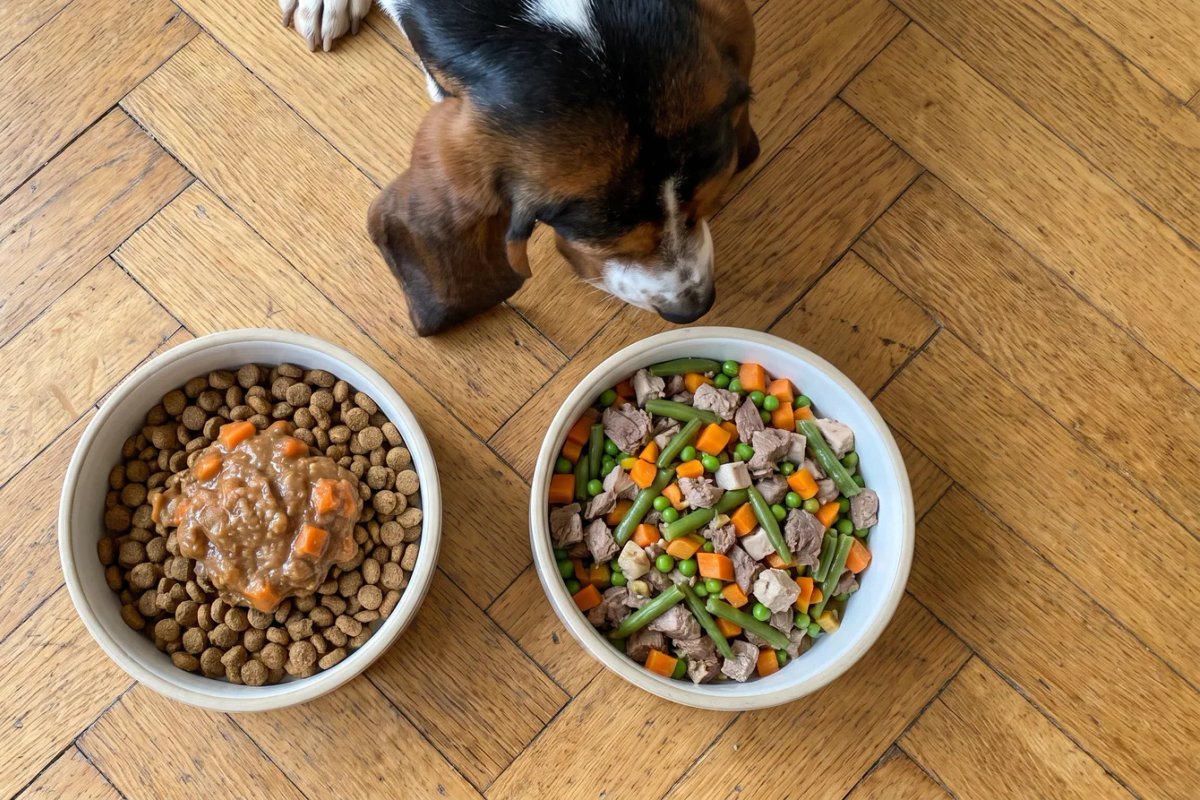
A dog food topper is the easiest way to bring fresh food into your dog’s bowl: a spoonful or a small pack goes on top of the food your dog already eats. The bigger question comes next. Should fresh food stay a topper, or should it become the full meal? Both are good choices, and the right one depends on your dog, your budget, and how much freezer space and routine you want to take on.
In this guide we walk through the dog food topper path and the full meal path side by side: what each does for nutrition, how to keep calories in check, what each costs relative to the other, and how the day-to-day routine changes. We use Get Real, Chewy’s gently cooked fresh dog food, as our working example, because its three recipes are sold both ways.
This article is sponsored by Get Real, Chewy’s gently cooked fresh dog food line. Vetstreet may earn a commission if you purchase through links in this article.
Key Takeaways
- The topper path adds a small share of fresh food to your dog’s current diet, while the full meal path replaces the old food entirely.
- A topper only stays healthy when you reduce the base food by the same number of calories you add.
- A full fresh meal must be complete and balanced, so look for an AAFCO nutrient profile statement on the label.
- Picky eaters, budget-minded owners, and dogs that are already thriving often do best on the topper path.
- Owners who want one simple, consistent diet, or whose dog does better without kibble, often move to the full meal path.
What is a dog food topper?
A dog food topper is any food added on top of your dog’s regular meal to boost flavor, moisture, or variety. Most toppers, such as gravies, broths, and sprinkles, are not a complete meal on their own, so they are meant to be fed in small amounts.
Fresh food used as a topper is different in one important way. When the fresh food itself is formulated to be complete and balanced, the topper adds real meat and vegetables without diluting the nutrition of the base diet. That matters because a topper that is mostly flavor can crowd out the nutrients your dog gets from the main food if you pile it on.
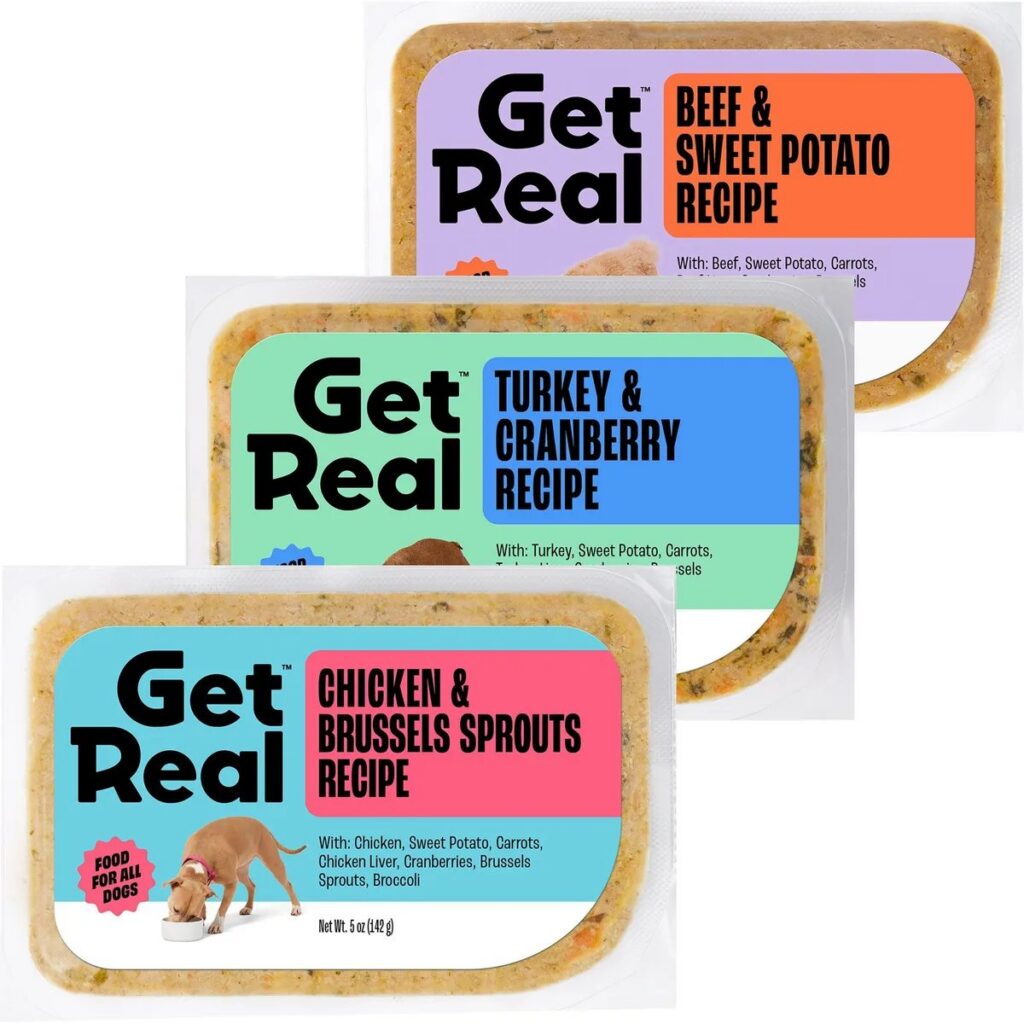
Get Real is built to work either way. Each recipe is gently cooked, then frozen, contains 10 ingredients or less plus added vitamins and minerals, and meets AAFCO nutrient profiles for all life stages, including growth of large-size dogs. For the topper path, Chewy sells a pre-portioned 5 oz mixer pack that is designed to go on top of or be stirred into kibble. If you are not sure which path you will end up on, the Get Real Sampler Pack lets your dog try all three recipes before you commit.
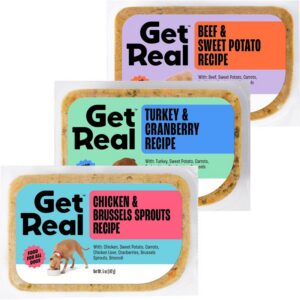
Get Real Sampler Pack, Beef, Chicken & Turkey Gently Cooked Fresh Dog Food, 6 pack bundle (2 of each recipe). Not sure yet whether your dog will stay on the topper path or move to full meals? The sampler lets your dog try the beef, chicken, and turkey recipes first.
Topper vs full meal: what changes for your dog
The two paths use the same food in very different proportions, and that changes almost everything else. On the topper path, fresh food is a minority of the bowl and your dog’s current food still supplies most of the calories and nutrients. On the full meal path, fresh food supplies everything, so it has to meet your dog’s complete nutritional needs on its own.
Here is how the two paths compare on the factors owners ask about most:
| Factor | Topper path | Full meal path |
|---|---|---|
| Role in the diet | A small share of the bowl on top of the current food | The entire diet |
| Nutrition | The base food stays responsible for balance; a complete and balanced topper adds without diluting | The fresh food must be complete and balanced for your dog’s life stage |
| Calories | Reduce the base food by the calories the topper adds | Portion the fresh food to the dog’s daily calorie need |
| Convenience | One small pack thawed at a time; the kibble routine stays the same | A daily thaw and serve routine with more fridge and freezer space |
| Storage | Fewer frozen packs on hand | More packs in the freezer and a steady thawing rotation |
| Relative cost | Lower, because fresh food is a small share of the bowl | Higher, because fresh food supplies every calorie |
| Get Real format | 5 oz mixer pack | 12 oz or 24 oz packs |
Cost follows calories. Because the topper path replaces only a slice of the daily calories with fresh food, it costs a fraction of feeding fresh as the full meal for the same dog. The full meal path costs the most, especially for a large dog that eats many calories a day. That is why many owners start with a topper and decide later whether the difference they see justifies going all in.
Nutrition is the other big difference. A full meal has to be complete and balanced, a phrase that has a specific meaning in pet food. You can read more about what a balanced diet for dogs really means, but the short version is simple: the label should state that the food meets an AAFCO nutrient profile for your dog’s life stage. Get Real carries an all life stages statement, so the Get Real Chicken & Brussels Sprouts Recipe can be fed as a topper today and as a full meal later without changing foods.
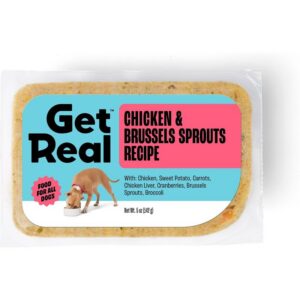
Get Real Chicken & Brussels Sprouts Recipe. Chicken and Brussels sprouts, gently cooked and frozen, and complete and balanced for all life stages, so the same recipe can serve as a topper now or a full meal later.
Why fresh food works as a topper
Fresh food makes a natural topper because it changes the two things dogs notice most about a bowl: smell and texture. Gently cooked meat releases more aroma than dry kibble, and fresh food is mostly moisture, which gives the bowl a softer, more appealing texture.
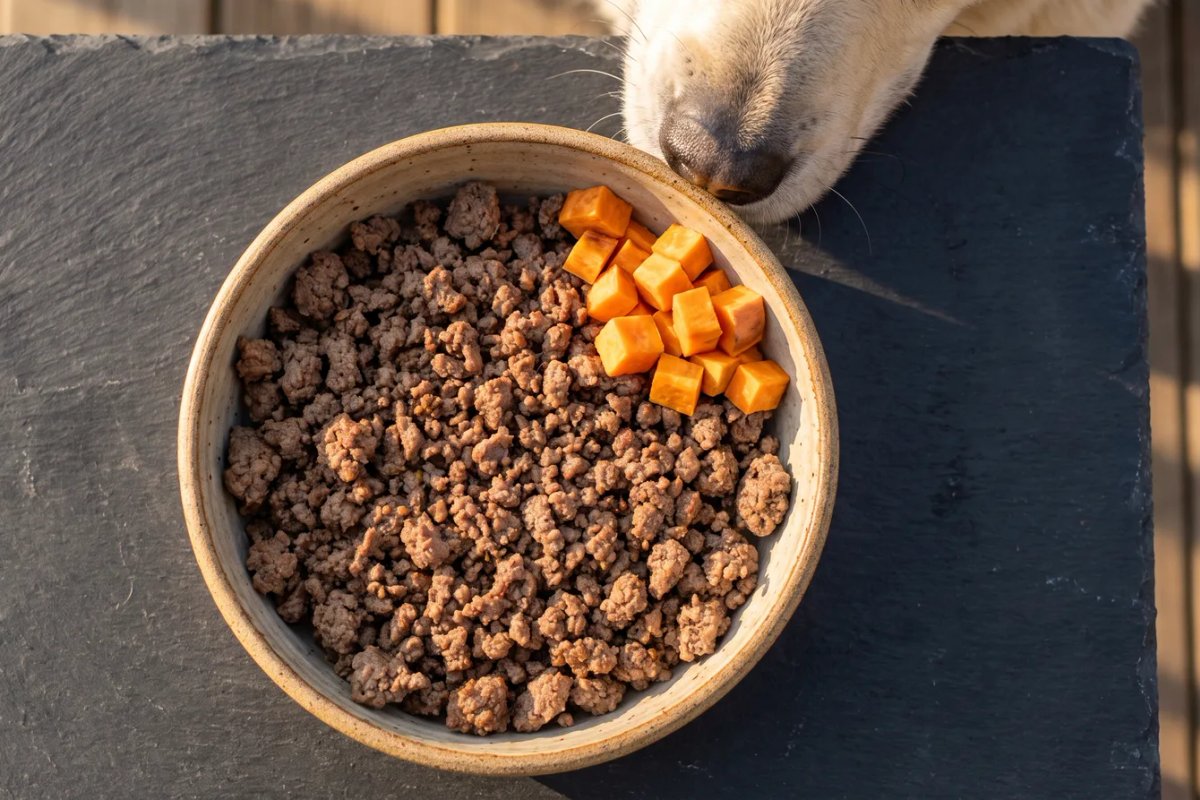
A healthy topper avoids two problems: empty calories and ingredients you cannot recognize. A short ingredient list built around real meat and vegetables addresses both. The Beef & Sweet Potato recipe, for example, leads with beef, sweet potato, carrots, and beef liver, and adds vitamins and minerals so the topper carries its own nutritional weight.
Fresh toppers also make variety easy without a full diet change. You can rotate among chicken, beef, and turkey recipes on top of the same base food, which keeps mealtime interesting while the core diet stays steady. Because the topper is a small share of the bowl, rotating proteins this way is less likely to upset the stomach than switching your dog’s whole diet. Dogs with a known food allergy or a sensitive stomach are the exception: keep proteins consistent and check with your veterinarian before you add anything new.
Toppers for picky eaters
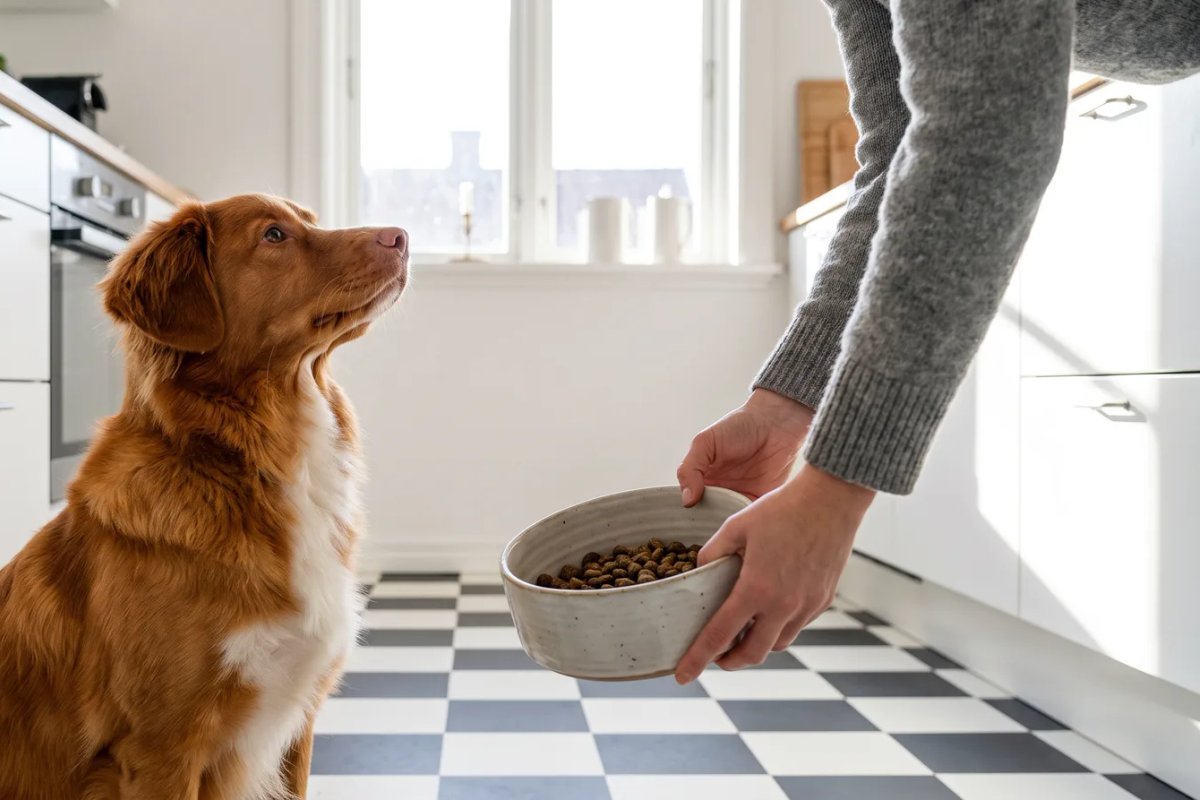
For a picky eater, a small spoonful of fresh food stirred into the bowl is one of the most reliable options. The fresh food aroma draws a hesitant dog to the bowl, and stirring it into the kibble makes it harder to pick out just the good parts.
A few habits make dog food toppers for picky eaters work better:
- Start with a small spoonful and stir it in rather than leaving it on top.
- Serve the topper cool from the fridge or at room temperature, and never leave it out for more than two hours.
- Offer the bowl for 15 to 20 minutes, then pick it up until the next scheduled meal.
- Keep treats and table scraps small so your dog arrives at mealtime hungry.
- Change one thing at a time so you can tell what actually helped.

A topper should make a good food more appealing, not train your dog to wait for something better. If your dog eats only the topper and leaves the base food, that is a sign to stir it in more thoroughly or to consider whether a full fresh meal would suit your dog better. A dog who suddenly stops eating, rather than one who has always been fussy, needs a different response, and we cover that in the questions at the end of this guide.
For many picky dogs, the protein matters as much as the format. Some dogs that ignore poultry will eat beef with enthusiasm, and the reverse is just as common. A small rotation helps you find the recipe your dog prefers before you buy more of it, and the Get Real Beef & Sweet Potato Recipe is a good one to try for dogs that have lost interest in chicken-based food.
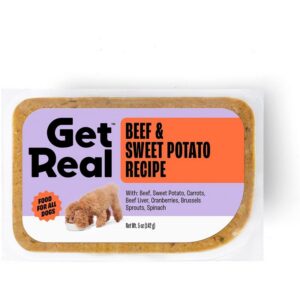
Get Real Beef & Sweet Potato Recipe. Beef, sweet potato, carrots, and beef liver lead the ingredient list, a rich-smelling option for dogs that have tired of chicken.
How much topper to add to dry food
There is no single right amount of topper for dry food, but a practical starting point is to let the topper supply a small share of your dog’s daily calories and reduce the kibble to match. That keeps the base food doing most of the nutritional work while still changing the experience of the bowl.
Here is a simple way to set up a dry dog food topper routine:
- Find your dog’s current daily kibble amount and the calories per cup on the kibble label.
- Decide how many calories you want the topper to supply.
- Reduce the kibble by that same number of calories.
- Weigh your dog every two to four weeks and adjust if the weight drifts.
The 5 oz mixer pack is designed for this path. It thaws in the fridge in 12 to 24 hours and is pre-portioned, so you are not guessing at a spoonful each time. For a deeper walk-through of the math by dog size, see our sister site’s guide on how much topper to add to dog food, and if you are using fresh food to change your dog’s kibble routine more broadly, Petful explains mixing fresh dog food with kibble.
How often you feed matters too. Most adult dogs do well on two meals a day, and a topper can go on one or both. Whether a dog can live on one meal a day is a separate question; our guide on how many times a day to feed your dog covers meal frequency in detail.
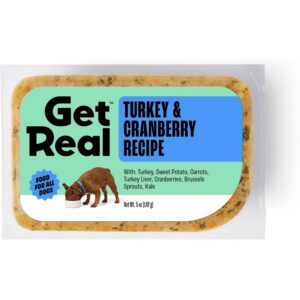
Get Real Turkey & Cranberry Recipe. Turkey and cranberry is the most calorie-dense of the three recipes per ounce, so a small amount goes a long way on top of dry food.
Calories: keeping a topper inside the daily budget
The most common topper mistake is adding food without taking any away. Every topper has calories, and a few extra calories a day add up to real weight gain over months. The fix is to treat the topper as part of the daily calorie budget, not an extra.
A 5 oz Get Real Chicken & Brussels Sprouts mixer pack has 179 kcal, so reduce the base food by about 179 calories for every pack you add. With a kibble that has 360 calories per cup, that is about half a cup less kibble, and your dog’s daily calories stay where they were.
Here is the calorie swap worked through step by step, because it is the part most topper advice skips. Say a moderately active 50 pound dog eats about 1,150 daily calories from kibble. Adding one 179 kcal mixer pack without changing anything else pushes the day to about 1,330 calories, roughly 15 percent more, which over a few months is enough to add visible weight. To keep the day at 1,150, reduce the base food by the topper’s calories: 179 calories off the kibble. If the kibble label says 360 calories per cup, 179 divided by 360 is about half a cup, so the dog eats about half a cup less kibble plus one mixer pack and gets the same daily calories as before, with fresh food on top. Your own kibble label and your dog’s body condition are the real guides, and our article on keeping your pet at a healthy weight shows how to judge body condition at home.
For weight loss, the swap can go further: if your veterinarian wants your dog to lose weight, reduce the base food by more than the topper adds, so the bowl still looks generous while total calories come down.
The same math works in reverse for an underweight dog. If your veterinarian wants your dog to gain, adding a calorie-dense topper on top of the full kibble portion is a gentle way to raise daily calories without asking a dog to eat a much bigger meal. Add it gradually and weigh the dog every couple of weeks so the gain stays steady. The calories listed on each pack differ by recipe, which helps you choose:
- Chicken & Brussels Sprouts: 428 kcal per 12 oz pack, 179 kcal per 5 oz pack
- Beef & Sweet Potato: 451 kcal per 12 oz pack, 188 kcal per 5 oz pack
- Turkey & Cranberry: 474 kcal per 12 oz pack, 198 kcal per 5 oz pack
If you want to feed your dog something low in fat, lean cooked meats such as skinless chicken or turkey breast and plain cooked vegetables such as green beans are common choices. Among the three Get Real recipes, Beef & Sweet Potato prints the lowest guaranteed fat minimum, 7 percent; that is a label minimum, not the actual fat content. Dogs that need a truly fat-restricted diet, such as those with a history of pancreatitis, should follow their veterinarian’s diet plan rather than choosing toppers on their own.
For a dog with a sensitive stomach, how you introduce a topper matters more than the recipe name. A short ingredient list makes it easier to spot a trigger, and starting with a teaspoon or two lets the gut adjust. Pick one protein, keep it consistent, and build up over 10 to 14 days while still counting its calories in the daily budget. If loose stool, vomiting, or gas persists after a slow start, stop the topper and talk with your veterinarian.
When a full fresh meal makes more sense
Does it matter what dog food you feed your dog? Yes, and it matters most when one food supplies the whole diet. On the full meal path, the fresh food has to provide every nutrient your dog needs in the right proportions, which is why the complete and balanced statement is the first thing to check. The FDA explains that a food labeled complete and balanced for a life stage is meant to be fed as the sole diet.
A full fresh meal often makes more sense when:
- Your dog does consistently better on fresh food than on kibble, and you want one simple diet.
- Your dog eats the topper and leaves the kibble behind meal after meal.
- You prefer a predictable, pre-portioned routine over mixing two foods.
- Your veterinarian has no reason to keep your dog on a specific therapeutic diet.
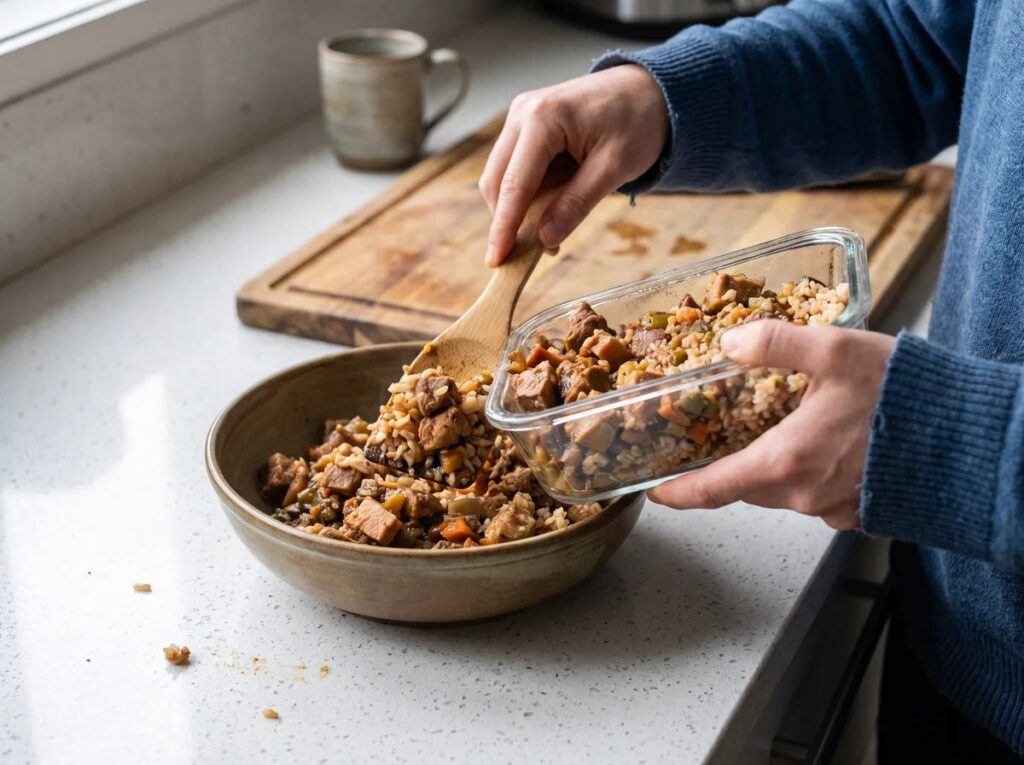
The full meal routine is straightforward once it is set up. Keep packs frozen as soon as they arrive, move the next packs to the fridge to thaw for 12 to 24 hours for 12 oz packs or 35 to 48 hours for 24 oz packs, and use thawed food within 3 to 5 days. Discard any food that has sat at room temperature for more than two hours. Get Real full-meal plans are portioned to your dog’s weight, breed, age, and activity level, so you are not left to work out the amounts yourself.
Switching gradually protects your dog’s stomach. Mix a small amount of the new food into the old and increase it over 7 to 10 days, or 10 to 14 days for dogs with sensitive stomachs. The subscription can be changed, paused, or canceled, and for full-meal plans the second order ships an extra week later to leave room for the transition. If you want to start with a single recipe, the Get Real Turkey & Cranberry Recipe suits dogs that enjoy poultry.
How to choose a fresh topper or full-meal recipe
The best dog food topper or full-meal recipe for your dog is the one that fits your dog’s needs and that your dog will eat consistently. Use these rules to choose a path:
- Choose the topper path if your dog is healthy on the current food, is a picky eater, or you want fresh food on a smaller budget.
- Choose the full meal path if your dog clearly does better on fresh food, refuses kibble even with a topper, or you want a single consistent diet.
- Choose a calorie-aware topper if your dog needs to lose weight, and reduce the base food to match.
- Choose a slow switch and one protein at a time if your dog has a sensitive stomach.
Whatever topper you choose, use the same criteria veterinarians apply to any food: a clear AAFCO statement, a company that works with qualified nutrition experts, and calories that are easy to find on the label. The WSAVA global nutrition guidelines offer a free checklist for evaluating a food. Get Real recipes are formulated with certified pet nutritionists and list calories per pack, which makes the calorie math above simple.
When it comes to the recipe itself, start with the protein your dog already eats well. Chicken is the most familiar, beef is a strong choice for dogs that have tired of poultry, and turkey offers the most calories per ounce of the three. If you cannot decide, the Get Real Sampler Pack puts all three in front of your dog. For a broader look at how to evaluate any food, our canine nutrition primer on choosing the right food for your dog is a useful companion to this guide.
Whichever path you pick, it does not have to be permanent. Many dogs start on the topper path, move to full meals, and some go back again when life or budget changes. The important parts stay the same: a complete and balanced food, a calorie budget you track, and a gradual change whenever the diet shifts.
Frequently Asked Questions
Frequently asked questions
If your dog refuses to eat its usual food, try a small amount of a strong-smelling, gently cooked fresh food stirred into the bowl at room temperature, and keep treats to a minimum between meals. If your dog refuses all food, is lethargic, is vomiting, or has diarrhea, call your veterinarian rather than trying new foods, because a sudden loss of appetite can signal illness or dental pain.
A healthy adult dog may go on a short food strike when it dislikes a new food, but most will eat once they are hungry enough. A dog that has eaten nothing for more than a day, or a puppy or toy breed that skips even one or two meals, should be checked by a veterinarian, because small dogs can develop low blood sugar quickly.
Most dogs are drawn to food with a strong meat aroma and a soft texture, which is why gently cooked meat with a higher moisture content appeals to so many of them. Individual preferences vary, so the most reliable way to find your dog’s favorite is to offer small amounts of different proteins and watch which one your dog finishes first.
There is no single healthiest meat; lean cooked meat such as chicken, beef, or turkey can all be healthy as part of a complete and balanced diet. The best choice is the protein your dog digests well and is not allergic to, fed in a food that meets an AAFCO nutrient profile for its life stage.
Cooked eggs, scrambled or hard-boiled without butter, salt, or seasoning, are a safe occasional topper for most dogs. A large egg has about 70 calories according to USDA FoodData Central, so count the calories against your dog’s daily budget, and skip raw eggs because of the risk of Salmonella.