Healthiest Dog Food for Small Dogs: What to Look For in a Small-Breed Bowl
Published on November 03, 2026
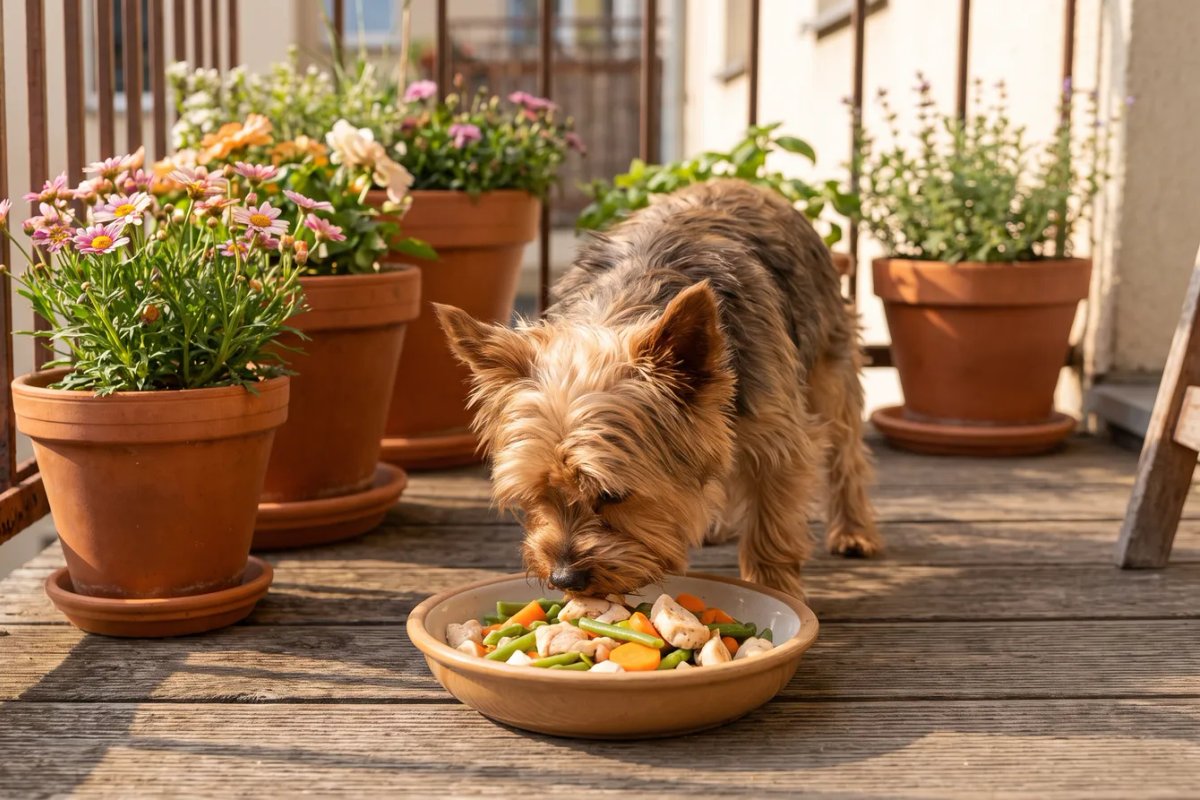
The healthiest dog food for small dogs is built around how small bodies work: they burn more energy per pound, have tiny stomachs and mouths, and are prone to dental problems. Those facts explain why a food can suit a Chihuahua better than a Labrador, and why the best small-breed bowl rests on them rather than on a label that simply says “small breed.”
In this guide we explain what to look for: calorie density, piece size and chewing, the complete and balanced statement, and how dry, wet, and fresh food compare for a small dog. We also work through the calorie math that surprises most owners, which is that a small dog’s small portions make fresh food far more affordable than they expect. We use Get Real, Chewy’s gently cooked fresh dog food, as a working example of the fresh option throughout.
This article is sponsored by Get Real, Chewy’s gently cooked fresh dog food line. Vetstreet may earn a commission if you purchase through links in this article.
Key Takeaways
- Use a small-breed checklist: an AAFCO statement for your dog’s life stage, enough calorie density for a small stomach, pieces your dog can chew, and a named animal protein near the top of the ingredient list.
- Small dogs need more calories per pound than large dogs, so every bite has to count.
- Toy breeds and young small dogs should not skip meals, because they can develop low blood sugar.
- Dry, wet, and fresh food can all be healthy for a small dog when they are complete and balanced; the right format depends on chewing, appetite, and routine.
- A small dog eats a fraction of what a large dog eats, so fresh food costs far less to feed to a small dog than most owners assume.
What makes a dog food healthy for a small dog?
The healthiest dog food for small dogs is complete and balanced for the dog’s life stage, calorie-dense enough to fuel a fast metabolism in a small stomach, and easy for a small mouth to chew. Beyond those basics, the best choice is the one your dog eats reliably and stays at a lean, healthy weight on.
Small breeds differ from large breeds in a few ways that shape what belongs in the bowl. They have higher energy needs per pound of body weight, smaller stomachs that hold less at each meal, small mouths and crowded teeth, and in the tiniest breeds a real risk of low blood sugar if meals are missed. Our guide to small dog basics covers the everyday health issues that come with small breeds more broadly.
Use this small-breed checklist when you read any label:
- An AAFCO statement that the food is complete and balanced for your dog’s life stage, or for all life stages.
- Calories listed on the label, so you can portion accurately for a small body.
- A named animal protein, such as chicken, beef, or turkey, near the top of the ingredient list.
- Pieces or textures that your dog can pick up, chew, and swallow comfortably.
- A food your dog eats consistently without coaxing.
The AAFCO statement is the most important line on the label. It tells you whether the food was formulated to meet the nutrient profiles published by the Association of American Feed Control Officials, and for which life stage. Get Real recipes meet AAFCO nutrient profiles for all life stages, including growth of large-size dogs, which also covers small-breed puppies and adults. Each recipe has 10 ingredients or less plus vitamins and minerals, and a named protein leads, as in the Get Real Chicken & Brussels Sprouts Recipe.
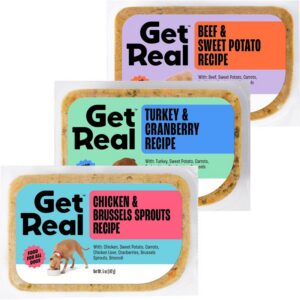
Get Real Sampler Pack, Beef, Chicken & Turkey Gently Cooked Fresh Dog Food, 6 pack bundle (2 of each recipe). Small dogs can be particular, so a sampler of the beef, chicken, and turkey recipes is a low-commitment way to learn which one your dog prefers.
Calorie density: why small dogs need more energy per pound
Small dogs run hotter than large dogs. Their metabolism is faster relative to their size, so they need more calories per pound of body weight. Veterinarians estimate a dog’s resting energy requirement with a standard formula, 70 times body weight in kilograms raised to the 0.75 power, described in the Merck Veterinary Manual, and then multiply it for activity and life stage. A typical spayed or neutered adult needs roughly 1.6 times that resting figure.
Run those numbers and the difference is clear. A 10 pound adult dog needs roughly 350 calories a day, about 35 calories per pound. A 70 pound dog needs roughly 1,500 calories a day, about 21 calories per pound. Per pound of body weight, the small dog needs well over half again as much energy.
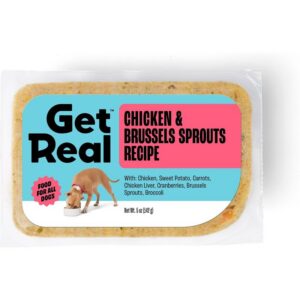
Get Real Chicken & Brussels Sprouts Recipe. Chicken and Brussels sprouts, gently cooked and complete and balanced for all life stages, with calories listed per pack to make small-dog portions simple.
That higher need has to fit into a very small stomach. A toy breed simply cannot eat a large volume of low-calorie food at each meal, so calorie density, the number of calories in each ounce or cup, matters more for small dogs than for large ones. A food that is too dilute can leave a small dog hungry and underfed, while an overly rich food served in generous scoops can quickly add weight to a dog whose whole daily budget is a few hundred calories.
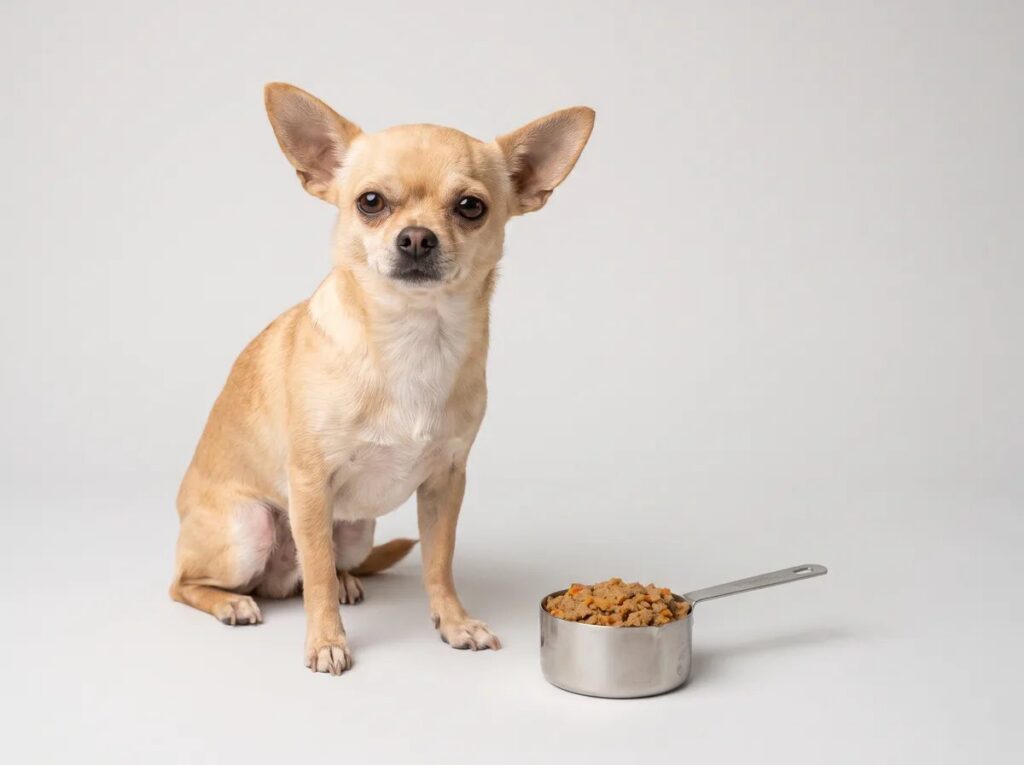
Portion control is where small dogs most often go wrong. A few extra kibble pieces, a bite of cheese, or a generous topper can be a large share of a small dog’s day. Measuring meals with a kitchen scale or a level measuring cup, and weighing your dog regularly, is the simplest protection. Our article on keeping your dog at a healthy weight explains how to check body condition by feel at home.
Toy breeds and young small dogs should not skip meals, because their small bodies store little energy and they can develop low blood sugar. If a tiny dog becomes weak, wobbly, or trembling after missing food, contact a veterinarian right away.
That warning is about hypoglycemia, or low blood sugar. Small-breed puppies and tiny adults of toy breeds store little energy, so a missed meal, a bout of vomiting, or a stressful day can drop blood sugar quickly. Early signs include weakness, trembling, wobbliness, and unusual sleepiness; severe cases can progress to collapse or seizures. Rubbing a little honey or syrup on the gums can help on the way to the clinic, but any suspected hypoglycemia in a small dog warrants a call to your veterinarian right away.
The best prevention is frequent small meals. Most small adult dogs do well on two or three measured meals a day, and small-breed puppies usually need three or four. Splitting the daily calories into several small portions also suits a small stomach better than one large meal.
Kibble size, chewing, and dental health
Kibble size is a real issue for small and toy breeds. A piece designed for a medium or large dog can be hard for a tiny mouth to pick up and break, and some small dogs swallow pieces whole or give up on the bowl. That is why many dry foods for small breeds are made with smaller pieces, and why piece size belongs on the small-breed checklist.
Dental health is the other half of the story. Small breeds are especially prone to periodontal disease, partly because their teeth are crowded into a small jaw. Many owners assume that crunchy kibble keeps teeth clean, but ordinary kibble does little on its own. Products designed and tested to reduce plaque or tartar can carry the seal of the Veterinary Oral Health Council, and daily toothbrushing remains the most effective home care.

For small dogs that already have dental disease, missing teeth, or a sore mouth, texture matters more than crunch. Soft foods such as wet food or gently cooked fresh food are easier to eat, and a dog that suddenly prefers soft food or drops pieces while chewing may have dental pain that needs a veterinary exam. Changing the food can make eating comfortable again, but it does not treat the underlying problem.
A few signs suggest the food’s size or texture is not working for your small dog:
- Dropping pieces, chewing on one side, or pawing at the mouth.
- Swallowing pieces whole and then vomiting or regurgitating.
- Walking away from the bowl partway through a meal.
- Bad breath, red gums, or visible tartar.
Dry, wet, or fresh: which format suits a small dog?
Each format can be the healthiest dog food for small dogs when it is complete and balanced, so the choice comes down to calorie density, moisture content, piece size, and what fits your routine. Many small-dog owners combine formats, for example kibble with a fresh food topper, to get the strengths of each.
| Factor | Dry kibble | Canned wet food | Gently cooked fresh food |
|---|---|---|---|
| Calorie density | Highest per cup; small portions go a long way | Varies; most of the weight is water | Moderate; Get Real lists 1,260 to 1,394 kcal per kg |
| Moisture content | Low, usually around 10 percent | High, often around 75 to 80 percent | High; Get Real lists 75 percent maximum moisture |
| Piece size and texture | Varies; choose small-breed pieces | Soft; easy for small mouths | Soft, cooked pieces; easy for small mouths |
| Storage | Pantry; reseal the bag | Pantry until opened, then refrigerate | Freezer, then thaw in the fridge and use within 3 to 5 days |
| Best fit | Dogs that chew well and owners who want simple storage | Dogs that need soft food or more moisture | Picky eaters, dogs that need soft food, owners who want a short ingredient list |
Dry food is the most calorie-dense per cup, which makes it efficient for small stomachs, but it is also the easiest to overfeed because a few extra pieces add up fast. Small-breed kibble solves the piece-size problem for many dogs. Wet food is soft and appealing, but because so much of its weight is water, a small dog has to eat more volume to get the same calories.
Gently cooked fresh food sits in between. It is soft and aromatic like wet food, made from recognizable ingredients, and portioned in advance. Get Real is gently cooked, then frozen, and sold in 5 oz mixer packs for topping kibble plus 12 oz and 24 oz packs for full meals. For a small dog, the topper option is a practical way to add fresh food without changing the whole diet, and the full meal option suits dogs that do best on soft food.
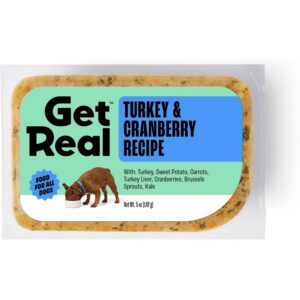
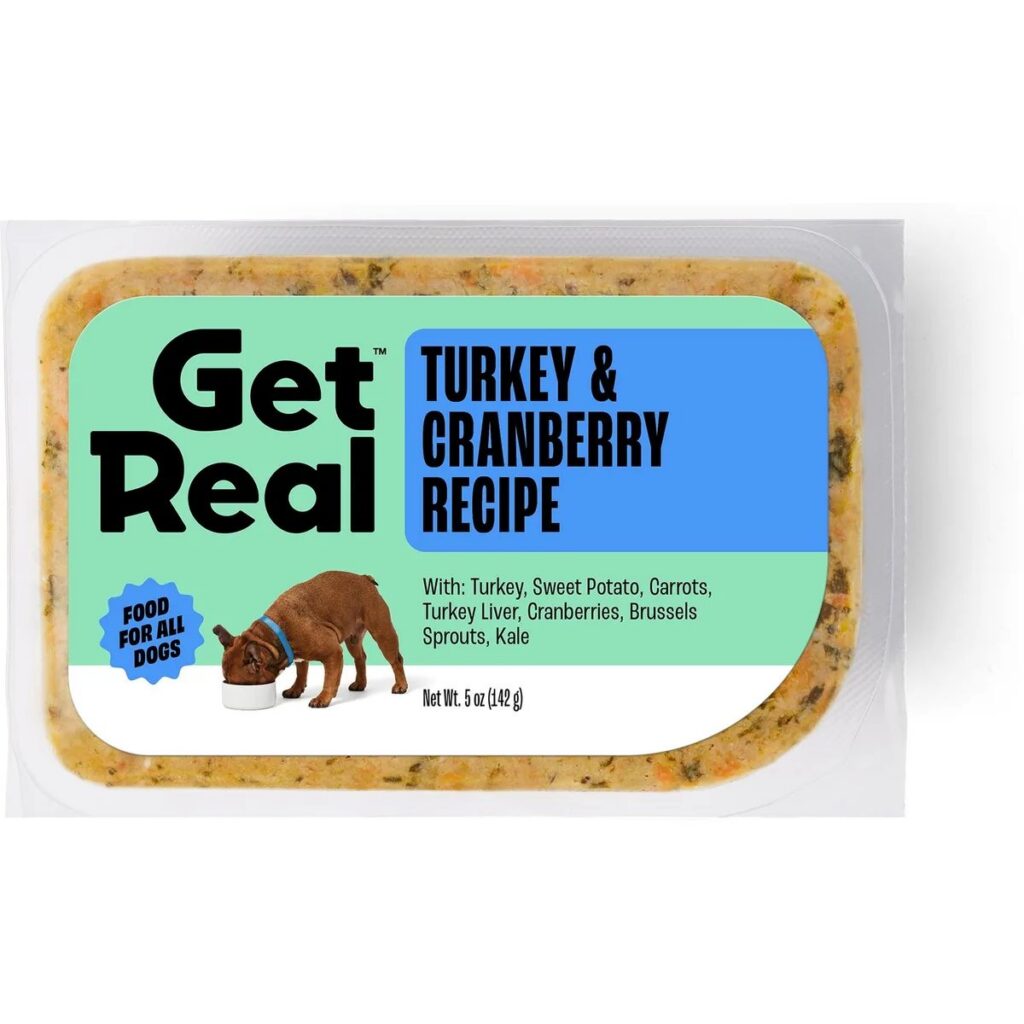
Get Real Turkey & Cranberry Recipe. Turkey and cranberry is the most calorie-dense of the three recipes per ounce, which suits a small dog that eats small meals.
Whatever the format, keep the total daily calories inside your dog’s budget. If you combine kibble and fresh food, reduce the kibble by the calories the fresh food adds so your small dog does not gain weight.
What veterinarians look for in small-breed food
There is no single best small breed dog food recommended by vets. Veterinarians tend to judge a food by how it is made rather than by brand, and the WSAVA global nutrition guidelines give owners the same questions to ask any company:
- Does the company employ or work with qualified nutrition experts to formulate its foods?
- Does the label carry an AAFCO statement for the right life stage?
- Are calories per cup, can, or pack listed clearly?
- Can the company explain its ingredient sourcing and quality control?
Those questions apply equally to dry, wet, and fresh food. Get Real recipes are formulated with certified pet nutritionists, list calories for every pack size, and carry an all life stages AAFCO statement. A short ingredient list also makes the label easier to read, which matters when you are watching for an ingredient your dog does not tolerate.
Beyond the label, veterinarians look at the dog. A healthy small-breed diet shows up as a lean body with a visible waist, a shiny coat, firm stools, and steady energy. If your dog is gaining weight, losing weight, or has ongoing digestive or skin problems, those are signs to revisit the food with your veterinarian, whatever the label says. For a broader framework, our canine nutrition primer on choosing the right food for your dog walks through the rest of the label, and our explainer on what a balanced diet for dogs really means explains the complete and balanced standard in more depth.
Veterinarians also pay attention to life stage. A small-breed puppy, a small adult, and a small senior have different needs, and a food labeled for all life stages has been formulated to meet the higher requirements of growth. For a senior small dog, the conversation often turns to dental comfort, weight, and appetite, which brings texture and palatability back to the center of the decision.
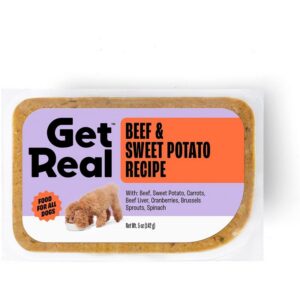
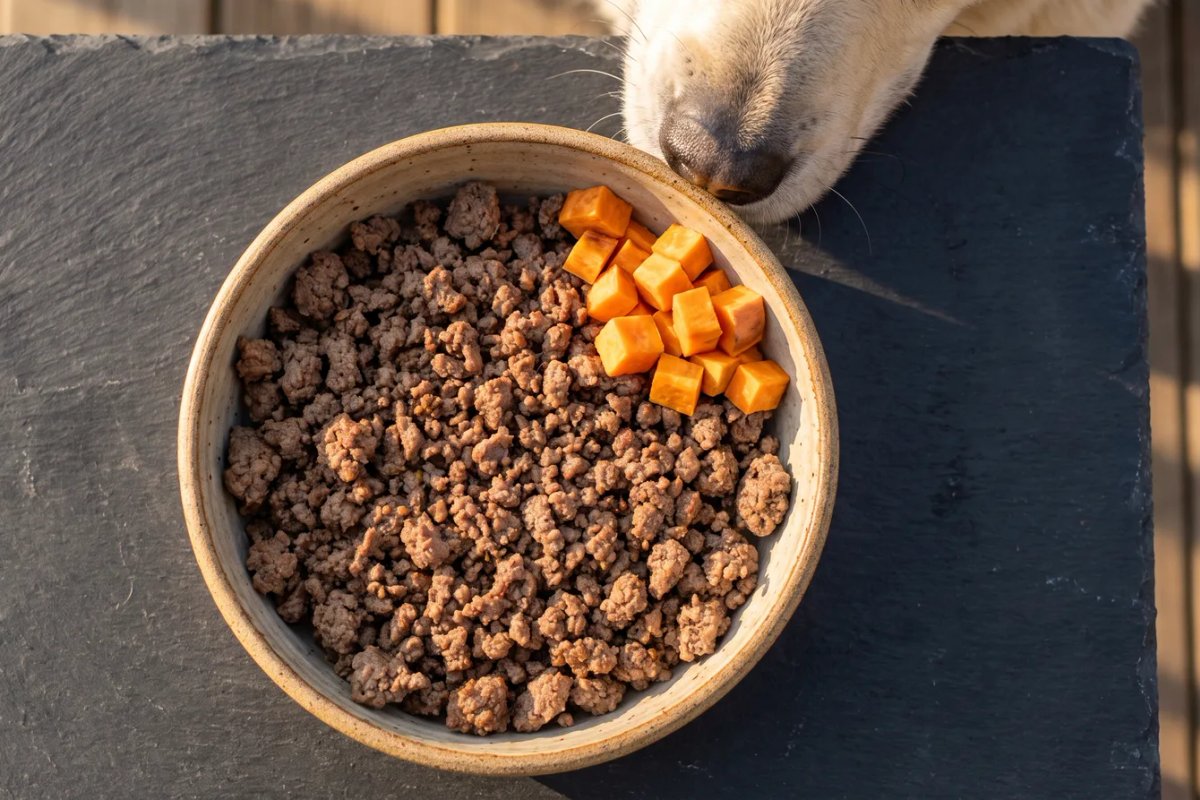
Get Real Beef & Sweet Potato Recipe. Beef, sweet potato, carrots, and beef liver lead the published ingredient list, a soft, aromatic option for small dogs that need a reason to finish the bowl.
Why small portions make fresh food affordable
Fresh food has a reputation for being expensive, and for a large dog the cost adds up quickly. For a small dog the math is very different, because the cost of any food follows the calories your dog eats, and a small dog eats very few of them.
Here is the worked example, using published Get Real calories and the rough calorie estimates above. This is calorie math, not a feeding chart; the online plan sets the actual portions based on your dog’s weight, breed, age, and activity level.
- A 10 pound adult dog needs roughly 350 calories per day. A 24 oz Chicken & Brussels Sprouts pack holds 856 calories, so as a full meal it lasts this dog about two and a half days.
- A 5 pound toy dog needs roughly 200 calories per day. At that rate, the 856 calories in a 24 oz pack would cover about four days.
- A 70 pound dog needs roughly 1,500 calories per day, so it would go through almost two 24 oz packs every day.
In other words, a 10 pound dog eats less than a quarter of the calories of a 70 pound dog, so feeding it fresh costs a fraction of what the same food costs for the large dog. One pack lasts several days, which is why many small-dog owners find full fresh meals realistic where large-dog owners might choose a topper instead. If you are curious, the Get Real Sampler Pack is an easy first step before you choose a recipe.
The topper path stretches fresh food even further. If fresh food supplies about a quarter of a 10 pound dog’s calories, that is roughly 90 calories a day. A single 5 oz Chicken & Brussels Sprouts mixer pack has 179 calories, so it covers about two days of topper for a dog that size. Keep in mind that thawed food should be used within 3 to 5 days, which is why the smaller pack sizes suit small dogs well.
Storage is the last part of the math. Keep packs frozen as soon as they arrive, thaw 5 oz and 12 oz packs in the fridge for 12 to 24 hours and 24 oz packs for 35 to 48 hours, and discard any food left at room temperature for more than two hours. The subscription can be changed, paused, or canceled as your small dog’s needs change, and Get Real is sold only through Chewy, in select markets.
Feeding a picky small dog
A small dog that won’t eat usually responds best to food with a strong aroma and a soft texture, served after it has been allowed to warm to room temperature for a few minutes. Smell drives appetite in dogs, and cold food straight from the fridge gives off less of it. Discard anything that has been out longer than two hours.
Small dogs have a reputation for fussiness, and part of it is earned: when a dog eats only a few hundred calories a day, a couple of treats can take the edge off its appetite entirely. Picky eating in small dogs is often a habit built on generous treats and frequent food changes, so the fix usually involves routine as much as the food itself. There is an important difference between a picky dog and a sick one, though. A dog that has always been choosy but stays at a healthy weight is usually a routine problem. A dog that was a good eater and suddenly stops, eats less over several days, or shows any other sign of illness needs a veterinarian, not a new food.
These steps help most picky small dogs:
- Feed scheduled meals and pick the bowl up after 15 to 20 minutes.
- Keep treats to a small share of daily calories.
- Stir a spoonful of fresh food into the regular food rather than placing it on top.
- Change one thing at a time and give each change a few days.
- Use a shallow bowl that a short muzzle can reach easily.
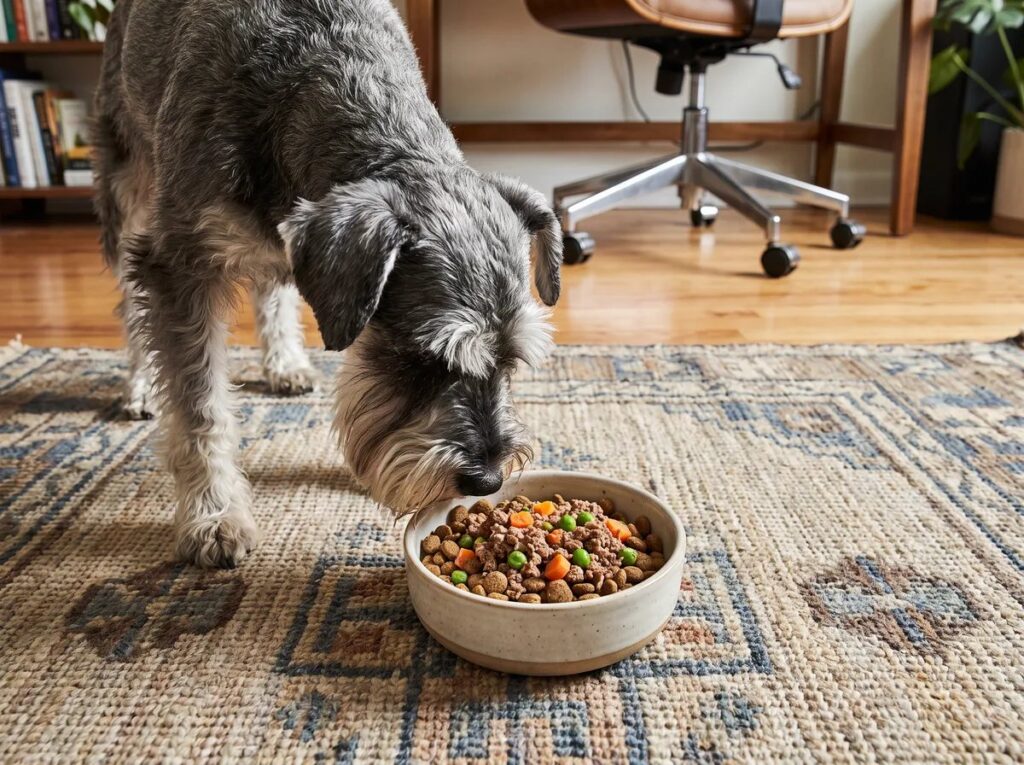
A fresh topper is often the simplest change. A spoonful of the Get Real Turkey & Cranberry Recipe stirred into the regular food changes the smell and texture of the whole bowl without changing the diet, and the 5 oz mixer pack keeps the portion appropriately small. Some small dogs also respond to a different protein, so rotating among chicken, beef, and turkey can help you find the one your dog prefers.
Small dogs with allergies or sensitive stomachs
Itchy skin in small dogs is most often atopic dermatitis triggered by environmental allergens such as pollen and dust mites, but some itchy dogs have a food allergy instead or as well. The only reliable way to tell is an elimination diet trial of about eight weeks with a hydrolyzed or novel protein diet chosen with your veterinarian, followed by a food challenge. During that trial, no other foods, treats, or toppers should be given. Our guide to food allergies in dogs explains how the process works.
Outside a formal trial, a short ingredient list can still help owners of small dogs with sensitivities. When a food has few ingredients, it is easier to see what your dog is eating and to avoid a protein that has caused trouble in the past. Each Get Real recipe has 10 ingredients or less plus vitamins and minerals, and the published Beef & Sweet Potato ingredient list contains no chicken, which helps if your veterinarian has advised avoiding it. These recipes are not prescription allergy diets, however, and should not replace a diet your veterinarian has prescribed.
For small dogs with sensitive stomachs, the way you change foods matters as much as the food you choose:
- Switch gradually over 10 to 14 days, starting with a small amount of the new food mixed into the old.
- Keep meals small and consistent rather than offering large or irregular portions.
- Introduce one new food at a time so you can identify any problem.
- Avoid fatty table scraps, which commonly upset small stomachs.
If a sensitive small dog has ongoing vomiting, diarrhea, weight loss, or blood in the stool, see a veterinarian before changing foods again, since these signs can point to a medical problem that diet alone will not fix.
Putting it together: the healthiest dog food for small dogs
The healthiest dog food for small dogs is not a single brand. It is a complete and balanced food with an AAFCO statement for your dog’s life stage, calorie density that fits a small stomach, pieces or textures your dog can chew comfortably, and a portion that keeps your dog lean. Dry, wet, and fresh food can all meet that standard.
What often tips the decision for small dogs is the combination of appetite, chewing comfort, and calorie math. Fresh food is soft, aromatic, and easy for a small mouth, and because a small dog eats so few calories, a single pack lasts several days. For a small dog that is fussy at the bowl or easier to feed with soft food, the Get Real Beef & Sweet Potato Recipe is a straightforward place to start, either as a topper or as the full meal.
Related reading: Petful shows how to feed fresh food on a budget, and WebVet’s Get Real feeding guide works out portions by dog size.
Frequently Asked Questions
Frequently asked questions
Most dogs find food with a strong meat aroma and a higher moisture content the most appealing, which is why gently cooked fresh food and wet food often win over kibble. Preferences still vary by dog, so offer small amounts of different proteins and see which one your dog finishes first.
Loss of appetite has many causes, including stomach upset, dental pain, stress, a recent food change, and illnesses ranging from infections to kidney disease. In small dogs, dental pain is a common and easily missed cause. Call your veterinarian if a small dog skips more than a meal or two, or sooner for a puppy or toy breed.
A dog that refuses meals but accepts treats has often learned that holding out brings something tastier, or is simply full from too many treats. Cut treats back, offer scheduled meals for 15 to 20 minutes, and make the regular food more appealing with a small fresh topper. If the dog also seems unwell or is losing weight, see your veterinarian.
Warm the food to room temperature, stir in a spoonful of a fresh food topper, feed in a calm spot at the same times each day, and keep treats small. A short walk before meals helps some dogs. If your dog’s appetite stays low for more than a day, a veterinarian should look for an underlying cause.
Small-breed puppies need a food that meets AAFCO nutrient profiles for growth or for all life stages, because puppy growth needs are higher than an adult’s. Feed several small meals a day to help prevent low blood sugar, and ask your veterinarian to check growth and weight at each puppy visit.