Tried CBD for Your Dog and Nothing Happened? The Problem May Be the Formula
Published on November 16, 2026

Sponsored by PawOrigins.
The visitor has gone home, but your dog is still pacing. You tried the oil, watched for a change, and hoped the next evening would feel easier. When it did not, you were left with another half-used bottle and the same question: was the idea wrong, or was something missing from that particular attempt?
A disappointing CBD trial can have several explanations. The formula is worth examining: what was in it, how it was delivered, and what testing actually verified. So are the dog’s health, the situation you hoped to change, and the limits of the evidence. A disappointing trial is useful information, even when it does not provide a simple answer.
All featured products are chosen at the discretion of the author. However, Vetstreet may make a small affiliate commission if you click through and make a purchase.
Why the formula is worth checking
Cannabidiol, or CBD, is one of the compounds found in cannabis. Two products carrying the same large number on the front of the bottle are not necessarily interchangeable. That number may describe the whole bottle rather than the amount in a serving, and products may differ in ingredients, concentration and preparation.
The phrase CBD not working for dogs does not establish that nothing reached the bloodstream. Absorption varies, and the finished formula matters, but you cannot measure either from whether your dog barked at a delivery. A pharmacokinetic study measures what the body does with a compound. A clinical study asks whether an intervention produces a useful outcome. Those questions are related, but they are different.
For example, research in dogs with osteoarthritis examined both blood concentrations and outcomes using a particular CBD preparation. It does not establish that every CBD tincture for dogs has the same absorption or that an arthritis result predicts relief from anxiety. It does show why the details of a preparation deserve attention.
Start with these checks:
- The ingredient: Is the label describing CBD, a cannabinoid-containing hemp extract, or hemp seed oil?
- The concentration: How many milligrams of CBD are present per milliliter, and how is the measuring device marked?
- The carrier: What oil or other ingredients carry the extract?
- The finished product: Does the available research or testing concern this formula, or a different one?
MCT oil, short for medium-chain triglyceride oil, is a carrier used in some products. Seeing MCT on a label identifies an ingredient; it does not by itself prove better absorption than every alternative. Similarly, a claim of CO2 extraction describes a manufacturing method. The finished product’s composition and test results still need checking.
PawOrigins Mobility-Max Advanced Hip & Joint Support Chews
What full-spectrum actually tells you
Full spectrum CBD oil for dogs is generally marketed as an extract containing CBD alongside other plant compounds, potentially including small amounts of THC. Broad-spectrum products are usually described as containing multiple compounds with THC removed, while isolate refers to purified CBD. These labels are starting points for questions, not substitutes for a batch report.
The comparison of broad spectrum vs full spectrum CBD for dogs often centers on the proposed “entourage effect”: the idea that multiple compounds may act together. That is a formulation rationale worth understanding. It does not establish that full-spectrum preparations reliably outperform other formulas for an individual dog’s anxiety.
The same limit applies to CBD isolate vs full spectrum for dogs. A controlled canine stress study found differences in some measures after a THC-free CBD preparation, with results varying by measure and situation. It was not a trial of Happy-Furever or a comparison proving full-spectrum superiority.
A compound profile describes contents. A demonstrated benefit requires a different kind of evidence.
Think of the extract as a kit and the carrier as its delivery vehicle. That metaphor helps distinguish the contents from delivery, but it cannot tell you that a larger kit is always better or that a particular vehicle will reach the intended destination. Ask what has actually been measured.
For terminology, Vetstreet’s guide to hemp oil for dogs explains why identifying the type of hemp product comes before comparing bottles. Hemp seed oil and a CBD-containing extract should not be treated as the same ingredient. For broader category comparisons, Vetstreet’s CBD options for dog anxiety offers additional reading.
PawOrigins Primal-Vitality 6-in-1 Bone Broth Powder

The bottle-to-behavior checklist
Quality evidence and efficacy evidence answer different questions. A certificate of analysis can help establish what a laboratory found in a sample. It cannot establish that the product will relieve your dog’s fear. Reviews may describe someone else’s experience, but they do not verify your bottle’s contents or explain your dog’s response.
Use this bottle-to-behavior checklist with the label and laboratory report side by side:
| Question | What to look for | What it cannot prove |
|---|---|---|
| Is this the right report? | A product description and batch number matching your bottle | That a different batch has identical results |
| How much CBD is present? | CBD concentration, units and serving information that agree | That more CBD will work better |
| What else was measured? | Cannabinoid profile, including reported THC results | That a “full-spectrum” label guarantees a particular benefit |
| Were contaminants assessed? | Named tests and results for relevant contaminants, rather than a general badge | Absence of substances the laboratory did not test for |
| Did the dog benefit? | A planned observation record and veterinary follow-up | A result for every dog or every kind of anxiety |
Ask the company for help if a certificate of analysis uses unfamiliar units. A report in milligrams per gram cannot simply be read as milligrams per milliliter without the information needed to convert it. “Not detected” also means below that test’s detection limit, rather than a universal promise that none of the substance exists.
A published review of pet CBD quality assurance discusses the importance of labeling, testing and safety standards. The practical lesson is to ask for specific evidence. An attractive package, a high CBD number, a manufacturing claim or a large review count cannot do the work of a relevant laboratory report.
How to evaluate a fair trial
Before trying another bottle, decide what a meaningful improvement would look like. CBD for dogs anxiety reviews can be reassuring to read, but “calmer” may mean different things to different owners. Your veterinarian needs a description of your dog’s situation and a record of what changed, including unwanted effects.
When comparing CBD for dog anxiety reviews with your own experience, avoid setting the target at “never barks again.” A useful observation might concern recovery after a familiar event, willingness to engage in an easy activity, or time spent pacing in an ordinary evening. Record the setting too. A quiet day and a house full of visitors are not equivalent tests.

Bring these details to your veterinary assessment:
- The behavior you hoped to change and when it began.
- The product, batch number, label and available test report.
- The amount actually given, recorded in the label’s units, and the dates it was used.
- Other medications, supplements and changes in routine.
- Useful observations before and during the trial, plus any unwanted effects.
Agree on a review point and stopping criteria with the veterinarian. Do not increase the amount, stack calming products or prolong an unsuccessful experiment just because someone else’s review describes a delayed transformation. If several things change at once, a better evening may be welcome without showing which change caused it.
PawOrigins Clear-Allergies Dog Allergy Chews

Why the rest of the care plan still matters
The endocannabinoid system is part of the body’s regulation network. A thermostat is a useful teaching metaphor for regulation, but an anxious dog has not thereby been diagnosed with a broken thermostat or an endocannabinoid deficiency. CBD’s effects are complex, and the metaphor cannot predict which dog will respond.
Fear also depends on context and learning. A dog practicing a skill in a quiet room faces a different task when a frightening trigger is close. An oil cannot explain away pain, replace a gradual behavior plan or make an overwhelming situation a fair training exercise. Nor does quiet behavior alone establish emotional comfort.

A broader plan may include:
- Veterinary evaluation for health problems contributing to a change in behavior.
- Reducing avoidable stress while learning what the dog can comfortably handle.
- Reward-based behavior work appropriate to the dog’s needs.
- Prescribed treatment when the veterinarian considers it suitable.
Vetstreet’s overview of anxiety supplements for dogs provides category context for that conversation. The FDA has not approved CBD for use in animals. Do not stop prescribed medication or substitute a supplement without discussing the plan with the prescribing veterinarian.
Safety note: Sudden behavior changes deserve veterinary attention. If a dog becomes markedly sleepy, unsteady, vomits repeatedly or seems unwell after a product, contact a veterinarian promptly and keep the packaging available. Severe signs, collapse or suspected accidental ingestion warrant urgent help. These are reasons to seek care, not to test a different formula.
Questions owners ask after a disappointing trial
How long CBD takes to kick in for dogs depends on the preparation and what you mean by an effect; there is no dependable universal onset time for a useful anxiety benefit. Time to a measurable blood concentration and time to a noticeable behavioral change are not the same thing. Preparations and study conditions differ. Ask your veterinarian what observation window makes sense for the particular product and goal, and do not add another dose simply because an expected change has not appeared.
To know if CBD is working for your dog, look for a meaningful, repeatable change in the problem you and your veterinarian agreed to track, while watching for unwanted effects. A dog that becomes sleepy is not automatically less frightened. Note the trigger, setting, recovery and other treatments so an apparently better day has context. A short video taken safely during an ordinary routine can help describe a change without deliberately provoking distress.
A fading effect does not establish tolerance. Evidence does not provide a simple rule that dogs inevitably need progressively more CBD. Changes in health, stress exposure, product or administration can also change the picture. Bring the observation record to your veterinarian rather than escalating the amount. A reassessment can identify whether the original goal, diagnosis or plan needs attention.
How many times a day a dog should receive CBD cannot be settled by one schedule for all dogs and all products. Concentration, the reason for use, other medicines and the individual dog’s health matter. A schedule from a study of a different formulation or condition should not become a home dosing instruction. Have your veterinarian assess the actual label and plan, including when to check back and when to stop.
Whether 15 mg of CBD is a lot for a dog cannot be judged from that number alone. The dog’s size, health, other medications, product composition and the amount already given all matter. Also distinguish the amount in a serving from the amount in the whole bottle. If you are concerned about an amount already administered, contact your veterinarian with those details instead of relying on a general online dose comparison.
Whether vets recommend CBD for dogs depends on the patient, condition, evidence and relevant professional rules. A brand’s veterinary adviser is not the same as your dog’s treating veterinarian approving a product. Be open about anything you are considering or already using. The aim is an informed discussion of potential benefit, uncertainty, interactions and monitoring, rather than assuming either a universal recommendation or a universal refusal.
Whether gabapentin or CBD is better for a dog depends on why treatment is being considered; they are not interchangeable choices. Gabapentin may be prescribed for particular clinical reasons, while CBD products have different and variable evidence. The dog’s veterinarian should explain the purpose of each part of a plan. Do not replace, combine or change a prescribed treatment based on a product comparison or on how sleepy the dog appears.
First identify what “hemp” means on the product. Hemp seed oil is different from a hemp extract containing CBD, so the words may describe different ingredients rather than competing anxiety treatments. Once the contents are clear, the decision still needs evidence and veterinary guidance. A label using natural or plant-based language cannot establish that a product will improve anxiety or suit your dog’s medical circumstances.
What vets recommend for calming dogs with anxiety should follow assessment of the particular dog and problem. It may combine changes to the environment, reward-based behavior work and medication where appropriate, with consideration of supportive products. Sudden changes, substantial distress and safety concerns make that assessment especially important. Bring observations of the trigger and recovery, because “needs calming” describes a goal without identifying the cause or the best way to help.
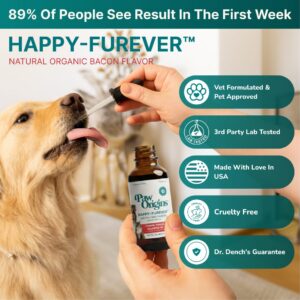
PawOrigins Happy-Furever Full-Spectrum CBD Oil
A closer look at Happy-Furever
For an owner ready to examine a formula more carefully, Happy-Furever Oil is PawOrigins’ full-spectrum CBD oil for dogs and cats. PawOrigins describes its formulation in terms of a cannabinoid profile, MCT oil as a carrier, CO2 extraction and independent testing. Those are concrete topics to explore with the company and your veterinarian using the current label and the report for your batch.
Dr. Kathryn Dench, MA VetMB, MRCVS, is a Cambridge-trained veterinarian and veterinary adviser to PawOrigins, the sponsor of this article.
Explore Happy-Furever’s current formulation and product information, request the report for your batch, and bring your questions to the veterinarian who knows your dog. Together, those details can inform your next conversation about supportive care.
Your earlier effort was not wasted. It gives you a starting record and a more precise set of questions: what was in that bottle, what evidence supported it, and what would a useful result actually look like for this dog?